Wednesday Witness: Let Yourself Be Loved

We are blessed to be hosting two young women from the NET team leading retreats for our St. Michael Catholic School middle-level students this week. It’s a wonderful opportunity to practice hospitality in our own home, underscoring the wisdom of the old saying, “It’s better to give than to receive.” We feel very blessed to open our home, to share our food, to visit and pray with people who are making themselves available to our daughter Lily and her classmates in such a beautiful, faith-filled way.

But the gift of giving is not what this column is about. Instead, I want to focus on the gift of receiving.

These two young women came into our home not knowing at all what to expect. We have a large and overfriendly dog and a house that comprises a wide array of half-finished renovations. We had a supper plan made independently of them. We knew nothing about them and wanted them to be comfortable, so we asked questions, provided options, and generally talked their ears off.

Continue reading

Wednesday Witness: ‘You Can’t Save the World’

This column is part of a new, weekly series on what the Lord is doing in my heart, specifically encouraging me to simplify my own life in order practice the virtue of charity and the Corporal and Spiritual Works of Mercy. Come back each Wednesday to read the latest!

I’ve always been a big-hearted and emotional fellow. As a grade-schooler, I tried to intervene when those who were littler than me (not many) were being bullied. Invariably, I took a thumping myself. But I couldn’t help it: I hurt to see others hurt.

Whenever I got wound up about some injustice or suffering, real or imaginary, Dad would say, “You can’t save the world.”

What he taught me, instead, was how to stand up for myself, to treat others with respect, and to look out for my own—my family and close friends, those whom I could count on to help take care of me.

Dad was right: I can’t save the world. I can’t even save myself. Jesus is the sole Savior of the world, and—thanks be to God—it is accomplished (John 19:30).

But I don’t think our eternal salvation is what Dad meant.

Continue reading

Wednesday Witness: At My Door

This column is part of a new, weekly series on what the Lord is doing in my heart, specifically encouraging me to simplify my own life in order practice the virtue of charity and the Corporal and Spiritual Works of Mercy. Come back each Wednesday to read the latest!

In last week’s column, I referenced a letter from St. Vincent de Paul, in which he describes our obligation to the poor person at the door. While I was on retreat, the phrase “at the door” stuck with me. We live in a mid-1980s neighborhood in Albertville—a curving, suburban street with split-level homes, mature trees, the barking of dogs, and the laughter of children. We have no beggars, no one camping in the park, no one asking for handouts.

We do, however, have two men with developmental disabilities. Both are about my age (one, a little older; one, a little younger). Both grew up in this neighborhood, and their natural sociability means they know everyone. Both have been friends with us as our family has grown up, until, one by one, my children have aged past them, despite being a generation younger.

Continue reading

Given Name

To the victor I shall give some of the hidden manna; I shall also give a white amulet upon which is inscribed a new name, which no one knows except the one who receives it.

Revelation 2:17

On Monday evening, something unusual happened—something unique in my experience, though the tradition extends back to the Book of Genesis: My son received a new name.

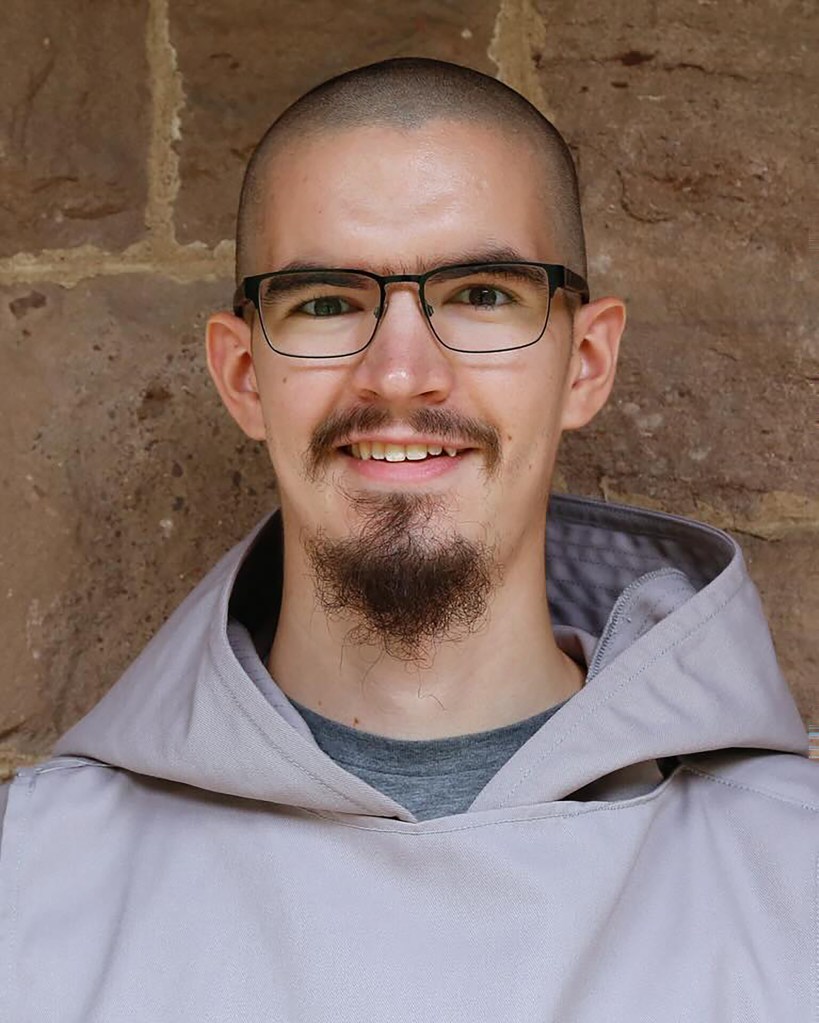
Our second son, whom we named Gabriel Venjohn Thorp, is discerning religious life with the Community of Franciscan Friars of the Renewal (CFRs). After spending the past year as postulants at St. Joseph’s Friary in Harlem, he and five other young men entered the novitiate Monday at Most Blessed Sacrament Friary in Newark, New Jersey. As novices, they received their habits—the gray hooded robe and cincture of the friars—and their new names. Our son is now Brother Jude Apostoli, of St. Michael.

In my line of work, you might call this a brand refresh: new name, new packaging, same great mission—serving as a living witness and example of the love of Christ.

Continue reading

Transformed or Transmitted?

This post appeared in the Sunday, July 21, 2024, edition of the St. Michael Catholic Church bulletin.

A couple weeks ago, I shared a short reflection on the Healing the Whole Person study I was blessed to be a part of in June. (Another one is starting up next week; see the bulletin or Father’s weekly email for details.) The gist of that column was the freedom I received to look squarely at my past and admit that everything wasn’t sunshine and daisies, then to seek the Lord’s healing for even the little ways in which I have been wounded.

Healing is not only important for our own sake. The Lord desires joy, not just for us, but for all those we encounter—and as the old saying goes, “Hurt people hurt people.”

Throughout the study, Dr. Bob Schuchts and Sister Miriam James Heidland, SOLT, reiterate that suffering that is not transformed is transmitted. The desire to avoid suffering ourselves is so strong that, when we encounter past or present pain, we instinctively pass it on—through blame and bitterness, anger and control, habitual sin, you name it.

But, if we are thoughtful and intentional, we can learn to confront pain and choose to bring it to the Lord instead of dumping it on our spouses or kids, family or friends. This is redemptive suffering—suffering in the right way, self-sacrificially, like Jesus.

I have long understood redemptive suffering in concept, but, to be honest, that understanding didn’t seem to help much:

  • St. Paul tells us, “Now I rejoice in my sufferings for your sake, and in my flesh I am filling up what is lacking in the afflictions of Christ on behalf of his body, which is the church” (Colossians 1:24).
  • What is lacking in the suffering of Jesus? Nothing, of course—His sacrifice was complete and perfect, once for all.
  • Jesus does not need our help, but He desires our cooperation. As St. John Paul II wrote, “Those who share in the sufferings of Christ preserve in their own sufferings a very special particle of the infinite treasure of the world’s Redemption, and can share this treasure with others” (Salvifici Doloris, 27).
  • This is a beautiful idea, but suffering well is hard work, and, really, I’d rather not.

But the idea of not passing my suffering on to those I love really struck me. Hard work is easier to do when you understand the why of it. Here’s how I break it down:

  • Suffering is a result of sin and the Fall. Jesus redeems us by taking the sins and suffering of the world, past, present, and future. His sacrifice lacks nothing, and through it, God’s perfect love and perfect justice are both sustained.
  • If Jesus takes on all the sin and suffering, then he takes on my sin and suffering, as well as that of my bride. Nothing I can do can add to or subtract from His saving act. And yet…
  • If I choose to avoid suffering and pass it on to Jodi, she suffers. In a sense, I haven’t increased the suffering in the world—I’ve just passed it on. But in another sense, I have increased the suffering, at least, for Jodi.
  • Jesus has already handled all of it—praise God! But I can also choose to say, “My suffering ends with me.” I can resist the urge to avoid the pain and pass it on. I can, like Jesus, carry my own cross and love sacrificially so Jodi (or my kids, neighbors, or enemies) don’t suffer in my stead. Now redemptive suffering makes sense!

I shared this line of thinking with my confessor, and he added an important caveat: Jesus didn’t bear His burden alone. He offered His sacrifice to His heavenly Father, leaning on the Father for strength and guidance. If we say, “My suffering stops with me,” but then hold on to it and let it accumulate, sooner or later it will become too much to bear.

Redemptive suffering, it seems to me, is suffering transformed by love—the loving act each of us performs by not passing our pain on to others and the healing love of God who turns every sacrifice to grace, joy, and peace. Let us pray, today and always, to carry our own crosses with God’s help, so that those we love may know His sacrificial love through us. Amen.