


Our annual Christmas letter is online now for your enjoyment! A Christmas card and poem are pending for friends and family, but to save ink and paper, our letter will appear here. Please feel free to print and pass it on. Merry Christmas!
Our annual Christmas letter is online now for your enjoyment! A Christmas card and poem are pending for friends and family, but to save ink and paper, our letter will appear here. Please feel free to print and pass it on. Merry Christmas!

This morning’s thought comes courtesy of St. John of the Cross via Deacon Ralph Poyo, whom our parish staff had the pleasure of following on retreat yesterday, and who never actually mentioned St. John of the Cross by name.
Jesus tells us throughout the Scriptures that we must leave everything behind to follow him. Certain of these passages seem particularly harsh: “Let the dead bury the dead;” “No one who sets his hand to the plow and looks to what is left behind is worthy of the kingdom of God.” I have struggled with these passages over the years, but in the wee hours this morning, lying in the dark, I had a brief moment of clarity.
Dcn. Ralph reminded us that choosing to be a disciple of Christ (in particular, Christ crucified, since Jesus himself tells us that in order to be a disciple we must pick up our cross and follow) is a black-or-white, all-or-nothing choice. He asked us to imagine, on one hand, Jesus suffering on the cross, and on the other hand, a table filled with all these little icons of the people, places, and things of this passing world that matter to us: our spouse, children, family, and friends; our pets, possessions, and pastimes; our worries, anxieties, and sins.
Of the two, we are called to choose Christ—you shall love the Lord your God with all your heart, soul, mind, and strength—but it’s hard to embrace the cross and even harder to carry it any distance. So we are tempted to walk to the foot of the cross and break a chunk off from it, to shape that piece of the cross into another little icon representing our Christianity, and to place it on the table with the rest, our tiny God, lost in a sea of idols.
St. John of the Cross writes of the tremendous longing God has for union with us (and vice versa). He wants to live within us, but before He can enter fully, He needs a God-size space. And since our God is infinite and eternal—the source of being for everything—the only space big enough is complete emptiness. Nothing else fits where God fills.
I have thought about this before in terms of the little pieces of the world we cling to or the tiny sins we allow to continue because “they aren’t so bad.” But early this morning, it occurred to me that even clinging to the good things of this world—my wife and children, my vocation as a husband and father, my job, and the parish that I love—can push God out.
This does not mean I must give these things up, only that I let them go to make space for God. If I can empty myself completely and seek Him alone, He who is the source of all good things will fill me, and like Job, I will regain what seemed lost, and more!
God is indivisible, the ultimate All, and we cannot claim just a piece of Him—“But seek first the kingdom of God and his righteousness, and all these things will be given you besides” (Matthew 6:33).
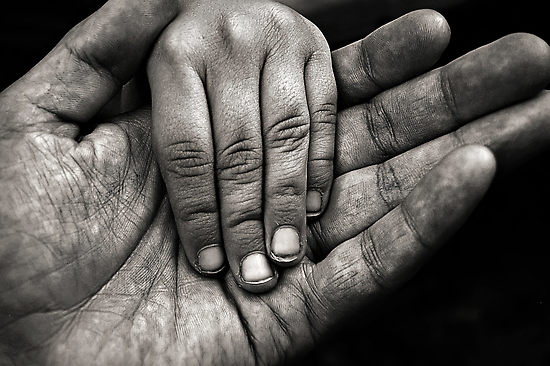
Last month I wrote about the power of family— in particular, parents—in keeping their children Catholic. It’s sobering, then, to learn that the Catholic Church in the U.S. is losing members faster than it is gaining them, and that, for today’s teens, religious identity is no longer reliably inherited. In other words, Millenials aren’t likely to stay Catholic simply because their parents and grandparents were Catholic.
What does it take to keep our young people in the faith? According to a 2012 Canadian study, young adults who choose to remain Christian have four main characteristics:
Numbers 1 and 4 have to do with experiencing God, both personally and in community. Numbers 2 and 3 involve grappling with spiritual truth. Young people who have the opportunity to know and personally experience God and are encouraged to explore that knowledge and experience are more likely to choose for themselves to remain faithful to Christ and His Church.
Is that the environment we are fostering at St. Michael Catholic Church? In our homes and our schools?
Unfortunately, Catholics have a reputation—earned in many cases—for not spending much time delving into sacred Scripture and for not sharing firsthand experiences of the very real and personal God we hear about in the Bible and the Catechism. And while our Masses may be well attended, a faith that is manifested for an hour on Sunday is not the same faith that made evangelists, world travelers, and martyrs out of a dozen unknown Galileans. Their faith changed lives—their own, first and foremost. If church doesn’t change us, we’re not doing it right!
Eventually everyone makes a choice for or against Christ. So maybe it’s a good thing that we can no longer rely on birth and blood to pass our Catholicism on to the next generation. If we acknowledge that even cradle Catholics need conversion; if we share our faith not just with those outside the Church, but with each other; if we pray for, and come to expect, God to act in our lives in personal and tangible ways, through answered prayers, spiritual gifts, vocations, and more—we will “become a people living for Christ” in every generation.
Blogger’s Note: This article appears in the Sunday, Nov. 15, parish bulletin.
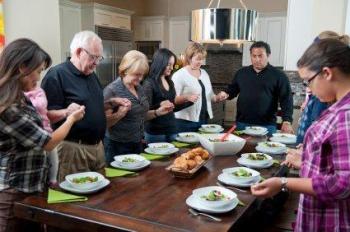
The family is the community in which, from childhood, one can learn moral values, begin to honor God, and make good use of freedom. Family life is an initiation into life in society.
As I type, bishops from around the world are gathered in Rome discussing how best to preserve, strengthen, and encourage Christian families. With so many families suffering or broken, such confusion over the nature and purpose of marriage, and the constant cultural tension between anti-child forces (for reasons of overpopulation, so-called social responsibility, or personal choice and comfort) and “child worship” (treating each child as the center of the world, deserving of the very best of everything), it’s easy to feel underappreciated and overwhelmed. It’s also easy to get caught up in the everyday hustle of school, work, sports, and recreation and lose sight of the true power of the family as a domestic church: an apprenticeship in love of God and neighbor.
The Catholic Church, in her wisdom, teaches that the family is the fundamental unit of society, with certain rights and responsibilities that no higher level social organization can ever claim. Humans are social creatures, made in the image of God, who is Himself a loving, life-giving communion of Persons—the Holy Trinity. The Catechism insists that government has a duty to protect and foster marriage and family and to help families (and not interfere) with raising and educating their children as they see fit, both in the world and in faith.
The Church, in fact, regards the education of children in the faith as a duty of parents—a point that cannot be overstated. I sometimes hear parents say, “I want my son to make his own choice about his faith,” or “I don’t want to force it—it will mean more my daughter if she comes to God on her own path.” While it is true that, ultimately, we each make our own choice for or against Jesus Christ and His Church, we cannot entrust that choice to the sole discretion of our children—any more than we would allow them to decide whether to drink something we know to be poison. If we truly believe what the Catholic faith teaches, the choice our children face is much more stark than how they will spend their Sunday mornings—it’s about how they will spend eternity.
Next Wednesday we begin a new year of First Confession/First Communion and Confirmation classes—and as always, it is essential that parents take the lead in sharing the good news of Jesus Christ and the eternal truths of the Catholic Church. Your personal example is the most powerful witness to your children—and male role models, in particular, have extraordinary power in keeping kids Catholic. Even simple things, like reading a Bible story, putting on a tie or a dress for Mass, or taking time to pray with and bless your child before bed, make deep and lasting impressions.
Scripture reminds us, “Train the young in the way they should go; even when old, they will not swerve from it” (Proverbs 22:6 ). We are all practicing Catholics, all sinners who are in training to love as God loves. But as parents we are also powerful, and we must not neglect to use that power to bring our kids to Christ, who said, “Whoever receives one child such as this in my name receives me” (Matthew 18:5).
Blogger’s Note: This article appears in the Sunday, Oct. 18, parish bulletin.
 Archangel Stomp