Brandings

Blogger’s Note: Another past writing, from 2001. This is one of my favorite pieces of non-fiction I ever wrote, and came back to my mind following this recent post from Prairie Father. In case you are wondering, Fr. Tyler is, in fact, the Tyler mentioned below. Finally, I’m no cowboy. If my terminology is imprecise or inaccurate, forgive me. If it is offensive to cowboys, correct me in the comments!
I

The city girl behind the counter called it a marking. She wore Doc Marten sandals and just last week mistook a bird’s call for approaching cattle. Drugstore cowgirl, with her chopped blonde hair tucked beneath a curled straw hat, more Junior Brown than Tom Mix. She wants a stampede string to keep it in place should she need to chase cattle at the “marking,” and I’m smiling at the thought of her sprinting in her sandals through knee-high grass behind some rangy Angus cow, her hat tied tight beneath her chin.

II

We rose to cinnamon rolls and coffee—six a.m., and Bob’s pulling his tall, red-topped boots over his jeans; a bright silk scarf about his neck; white shirtsleeves shining softly in the morning sunlight. Bob drinks tea, not coffee; sweeps the crumbs from his long moustache, takes from the wall a straw hat with the same crease, crown and brim as his felts, and heads out, spurs jingling, to catch his pony.

The hands arrive in twos and threes, and their rigs line both sides of the driveway—crew-cab pick-ups and long stock trailers with cow-horses saddled and tied short alongside. The men gather around the plank table in the kitchen, exchanging greetings and jabs, sipping coffee and complimenting Cindy on the rolls. All wear boots and hats; many have chinks, and most wear spurs. They range in age from 15 to about 60. Chance, Bob’s youngest, wears his boots outside his pants, same as his dad; a rosy plaid western shirt, battered chinks and a black felt hat set back on his head. He’s rough and ready, a chaw in his cheek and blue eyes sparking, happily cussing the dogs.

Chance has two friends with him today—John’s dark haired and dark skinned, with baggy carpenter’s jeans and Docs on his feet. He’s clearly not cowboy, and his T-shirt reads the same as yesterday: “I’m just one big f—ing ray of sunshine, aren’t I?” (Hyphens mine, not his.) His sister, Rachel, watches Chance with dark eyes and prepares to ride—purple chinks with heart-shaped conchos; a long denim shirt opening on a white tanktop.

Straws are the hats of choice in summer; still, a few felts make an appearance. “Real cowboy hats can be any color, so long as it’s black or silverbelly,” Bob says. Rick Smiley wears a dark gray hat, for what that’s worth, and sky-blue plaid. Frank Timmons wears battered silverbelly, with a sweaty ring at the base of the crown. It sits low on his brow, so that the curled ends of his moustache are often all that escapes its shadow.

Where I come from is not far from the girl at the drugstore. I shake hands with the men around me, conspicuous in a green Filson cap that suggests I’d rather be fishing. I remember selling western boots in that same drugstore, when my own boots and the pearl-white snaps of my uniform shirt branded me a cowboy in the eyes of little boys from New Jersey—this day even my father, in his broad black hat and leather vest with antler buttons, may have dressed too plainly to be called “cowboy.”

III

A couple days later we’re eating chili around that same plank table. Bob took a call a few moments earlier from a Manhattan-based research firm conducting a survey on environmental policy and public opinion. He spends a good ten minutes on the phone with the caller, and by the time he hangs up, he has identified himself as a heterosexual white male, a conservative, a Catholic, and a staunch Republican.

“You realize,” I tell him, “that you are the enemy.”

He’s cutting cheddar with the same pocket knife he cut calves with two days ago. He’s got a saddle shop in his kitchen. He doesn’t care.

IV

The riders mount and spread across a broad expanse of grass to round up the cows and calves. We’re watching from a windy hilltop overlooking the pasture, the pond, an old windmill and a few crooked trees, with the house, pens and buildings beyond.

Bob’s oldest boy, Tyler, is leaning against Sorley, a stripped down Suzuki Samurai with a homemade plywood roof and four-wheel drive—the name comes from the little rig’s sorrel color. He’s only recently back from Winona, where he’s studying for the priesthood; he’s dressed in a plain t-shirt and sweats, untied duck boots and an old fedora. His little brother’s riding with the men below.

Tyler stands in front of the little 4×4, watching the cowboys work. He’s not like these others—he’s a big kid and prone to discussing philosophy, praying aloud in Latin or singing in Spanish—but he looks at home here and I snap a picture of him, God’s country in his eyes.

V

The cows are vaccinated, and the fire’s lit. Bob moves between groups of cowboys enjoying cookies and iced tea and assigns them to work as ropers, wrestlers, branders and cutters. Dad and John man the gate, shooing the bravest calves back into the pen. An odd pairing, to be sure—my father will lock up the brakes on the pickup at the sight of a middle finger, and this kid’s wearing as bad as that across his chest.

The ropers ride into a sea of bawling black and throw their loops. They drag the calves out by their hind feet, and the wrestlers topple them to their right sides and pounce on them, one on the head and topside foreleg, the other on the hind feet. The horses keep the rope tight, looking only slightly interested, and the riders watch. Two needles to the neck; blue smoke, the stink of burning hair and the sizzle of flesh. If it’s a bull calf, a few deft strokes with a pocket knife and a squirt of disinfectant. It’s brutal, quick and effective—strangely, the calves bawl loudest when first roped and dragged, and scarcely limp upon release.

Bob is cutting calves, and in just half an hour, his white sleeves are punctuated in red. He keeps his pocket knife in hand, wiping the blade occasionally on his chinks. It’s coarse surgery, without anesthesia or stitches, and I tell him so.

“You’re right,” he says, looking to the next calf. “It’s pretty rough, what we do to these critters.”

The smoke rolls.

VI

The latest issue of The Atlantic ran an ad for the American Indian College Fund, with the tagline, “Have you ever seen a real Indian?” The picture is of a young woman of no obvious ethnicity, with long dark hair, standing near a wooden cabinet full of microscopes. “Carly Kipp, Blackfeet,” the ad reads. “Biology major, tutor, mom, pursuing a doctorate in veterinary medicine, specializing in large-animal surgery.”

VII

The work’s nearly done, and Chance and Rachel are leaning against a gate, saying little. He dates her cousin, and he, Rachel and John spent last night beneath the stars on a hide-a-bed couch in the back of a pickup.

When the branding’s finished, it’s dinner—roast beef and beans; mashed potatoes and gravy; bread and salad and beer. Some of the men head home—the rest take up spots on the porch or the lawn. After a bit, two guitars come out, and Bob and Paul (a rancher out of Montana who owns the cattle we branded today) take turns picking—old country songs, rock older still—and discussing how music and cowboying has changed over the years.

“My wife tells me,” says Paul, “that if I want to get back to cowboying, the first thing I gotta do is get rid of about 1,500 head.”

I’m riding a sawhorse next to Chance. He takes his dad’s guitar and begins to play—bits and pieces of more recent rock songs. He finally settles into “Mary Jane’s Last Dance”—bending strings to coax all the heartbreak he can out of them, the lyrics audible only in fits and starts above his playing.

Three-year-old Brendan’s on the porch with Rachel—they’ve been splashing each other with water from a five-gallon pail, and Brendan is soaked. Rachel’s hair is dripping, and Brendan’s new “pet” clothespin is clipped to the back of his shirt—he’s been looking for it for the past twenty minutes. She’s swiped a beer from the ice-filled tub in the grass, and Brendan wants what she’s having. They play together for an hour or more, when nobody asked her to—she’ll make a mother someday. Or someone’s favorite aunt, at least.

Bob says her older sister’s a beautiful girl—could’ve been a model.

“She’s got just enough Indian—they’d take her to Elko, to the Artists’ Ride, and dress her in skins …”

Rachel’s a beauty in her own right—her mixed ancestry shows in her complexion, her dark curls and brown eyes. She’s been arguing with Bob about whether her Adidas visor qualifies as a hat.

It takes a special girl, I think, to make a visor and chinks look good.

VIII

I’m driving to work and NPR is talking to songwriter who’s latest recording is called Scar. The title cut, he said, is based loosely on his relationship with his wife—it’s about how our relationships and experiences, for better and worse, mark us for life.

Brutal, quick and effective.

J. Thorp
May 2001

The Flitter-Flutter of Tiny Wings

“Geronimo!”

For the past several days, we’ve had just two kids at home, Trevor and Lily. The elder three were at Extreme Faith Camp, Brendan as a leader, Gabe as a member of the prayer team, and Rose as a camper. Their return, I think, was bittersweet for the younger ones — although bored and (allegedly) overworked at points, they enjoyed having Mom’s and Dad’s full attention. Lily got in trouble for interrupting far less, because there was far less to interrupt. And Trev got to go to Culver’s and Jurassic World with just Jodi and me.

We parents, on the other hand, missed our teens. It took only a day or so for me to stop and calculate that we are just six years from potentially being a permanent four-person household, and eight years from Lily being alone with us, At some point unmarked in the past, the pitter-patter of tiny feet was drowned out by the flitter-flutter of tiny wings as the fledglings prepare to leave the nest.

This, I’m discovering, is going to be harder for me than the fact that I, too, am aging and yet still feel like I have much to learn — in fact, my own feelings of inexperience in this world only magnify my anxiety for my offspring. Have a taught them what they need to know to survive? Will they thrive? Will they avoid the pitfalls and snares in which Jodi and I have become entangled over the years? Have the courage to be faithful in public? To remain Catholic, with all that entails?

We see encouraging signs from each of them. Bren, now 17 and approaching his senior year, has changed his views on a military career, primarily due to moral concerns. He takes his faith very seriously: donates to Catholic causes, joins his friends for weekday Mass on Wednesdays, joins his girlfriend Olivia in the Adoration Chapel in our church. Gabe, nearly 15 and a coming sophomore, still has his eyes on the priesthood, joins his brother and friends at Wednesday Mass, and just last night asked where he could find the Divine Office that priests commit to praying daily — hinting that he’d like to take it up, but that he’d rather not do it alone. Thirteen-year-old Emma came home from having been deeply impacted by Eucharistic Adoration at camp, trembling with emotion before the Blessed Sacrament and alternating between sorrow and joy (ending on joy) as she prayed.

Yesterday I came home from the church for lunch, and popped in a DVD that would not play in my work computer. The video came up immediately, and featured Fr. Robert Barron tackling common Catholic apologetics questions in short video clips. I began cherry-picking a few that might be interesting, and Trev, who will be 11 in few days, sat down to watch. For more than an hour, we watched and discussed the rational foundations for our Catholic faith. It’s amazing to see what he absorbs in such a short time, and I pray the same has been true for the others.

Lily, of course, is only three. She knows Jesus by sight, likes to pray (the Angelus and petitions, in particular, and especially for her friends and for babies) most evenings, and is at home in our church, if not fully engaged by the Mass yet. As I continue in my job as faith formation director, planning the coming year’s program, I realize how much more we could be doing with our parish youth, and by extension, how much more I could have done with my own children. Lily will benefit from that realization — and yet when I look at her four older siblings, I wonder how much I should do differently. But how can I give anything less than my all for my family when the stakes are so high and the implications, eternal?

Are We There Yet?

Gabe, napping in the minivan…

Back in my newspaper days, I wrote a column each Tuesday called “Almost There.” My bride and I were young parents of two preschool boys at that time, so “Almost there!” was a constant refrain wherever we went. But the name also captured the sense that we were on the verge of putting it all together—of making sense of marriage and family life, and of my newfound faith and fledgling career as a writer.

That was more than 15 years ago, and that sense has never left. The novelty of feeling so close to understanding wore off years ago, however—as a result, I am prone to asking our Lord like the spiritual child that I am: “Are we there yet?”

The answer, invariably, is no.

This world so loves achievement that we have turned even baseline accomplishments like participation and attendance into certificates and celebrations. In what other facet of life besides our faith do we commit ourselves to weekly participation, devotion, and study, year after year, and discover that we have done only what is expected of us?

We long for recognition of our efforts, and this longing even skews our perception of the sacraments. As children and as parents, we are pleased with having made it to Mass or Confession, but sometimes forget that these are not ends in themselves, but means by which we conform ourselves to Christ and reorient ourselves toward Heaven. We treat both Confirmation and Marriage as the culmination of work already done rather than the beginning of something new. The certificates we receive look for all the world like diplomas, when in fact they are birth certificates!

The path to Heaven leads out of this world, and among those born into humanity, only Jesus knows the path in its entirety—so we have no choice but to follow Him and go where He leads. Since we cannot know the path ourselves, the only way we can help others get to Heaven is to teach them to follow Christ who said, “I am the Way.”

Road trip!

How does one follow Christ? St. John of the Cross writes, “God carries each person along a different road, so that you will scarcely find two people following the same route in even half of their journey to God.” As a result, we need to teach others where to find God and how to engage Him—in the Church; through scripture, prayer, and the sacraments. And we need to do this as a community. Why? Since there are as many paths to sanctity as there are unique persons, each of us will resonate with others in ways that no one else can. Somewhere in this parish, someone needs your example!

Fr. Robert Barron shares a story of Jewish academic and Catholic convert Edith Stein, now St. Teresa Benedicta of the Cross, who before her conversion went into a cathedral to admire the architecture and saw a woman still laden from her day’s shopping, kneeling and rapt in silent prayer. This simple act of devotion struck the future saint profoundly, advancing her on the path toward holiness and heaven. Who knows what saints we will help to create simply by showing up each week to bend our knees in prayer and worship?

Blogger’s Note: This article appears in the Sunday, June 14, church bulletin.

LIFT Links: Summer Break Edition

Today was the final parish school Mass of the year, in which Fr. Richards and Fr. Nathan collaborated on the homily/skit to underscore to the students that we do not take a vacation from God. With that in mind, I thought I’d share a few ideas to keep growing in faith during these months of summer leisure.

The Basics

  • Make Sunday Mass a priority all summer long. Especially for those of us who like to escape to the cabin or lake, or who plan trips during the summer months, it can be tempting to skip out on Mass, or to plan to attend the last possible weekend Mass and miss accidentally or arrive late, hungry, harried, and distracted. But Mass and the Eucharist are central to our Catholic faith — the closest encounter with Christ and the most powerful prayer we can offer! Wherever you are headed, take time to find a Catholic Church along the way and make sure you make it to Saturday evening or Sunday Mass. (We once stopped at the Catholic Church in St. Ignace on the way back from Michigan, and the kids were invited by the priest to help with the May Crowning of Mary!) If you have kids, let them look online and help you pick which church you attend, then check out the stained glass, statues, Stations of the Cross, and such — and see what you can learn about that parish’s patron saint.
  • Make Confession a priority. Most of us don’t sin less during the summer, so Confession is no less important during vacation. Get it on the calendar now, so you don’t forget — and if you do happen to miss weekend Mass, make it a priority to do penance and receive absolution before the next weekend, to ensure you receive all the graces of the Eucharist when you receive Jesus again!
  • Don’t forget prayer and spiritual reading. Some of us relish our down time, and look forward to those quiet moments on the deck, in the the sun, on the water, or in the garden. Before you turn on the Twins game or grab the latest paperback thriller, take a little time for quiet prayer or spiritual reading. Give to God from the top of your time, and He will give you so much in return! Also, don’t overlook the blessings of the Road-Trip Rosary: kick off any long drive with a family rosary and see if the trip doesn’t go more smoothly!
  • Check out daily Mass or Adoration. It’s easy during the summer to run ourselves ragged and need a spiritual recharge. Daily or weekday Mass offers a great opportunity for quiet time to pray and to receive a daily dose of scripture and the Holy Eucharist. Often weekday Mass is early or late in the day, providing a nice bookend to whatever else you have planned, and most weekday Masses are only about 30 minutes long. Or for more flexibility, check out the nearest Adoration Chapel, and spend one-on-one time praying before the Blessed Sacrament. Bring your Bible or current spiritual book and see what Jesus has to say as you dig deeper into the words on the page!
Spiritual Vacations
We are blessed in our parish and area to have many opportunities for deeper spiritual recharging for Catholics of all ages — here are just a few options:
  • Sign the kids up for Vacation Bible School (VBS). This year’s VBS offering is Cathletics: Training to Be Champions for Christ! VBS is open to children from four years old through those who have just completed 5th grade. Registration forms and more information are available on the parish website, at the parish office, or in Gathering Space.
  • Take the family to Camp Lebanon for faith-filled fun on the water! Enjoy lakeside cabin and lodge style camping near Upsala for families from St. Albert and St. Michael parishes, coming up  August 14-16 – swimming, fishing, zipline, paintball, fireside rosary, Mass, and more. Information is available on the easel in the Gathering Space.
  • Register for our free series on meditative prayer. Local Catholic teacher Angie Lambert and local Catholic speaker Michelle Steele will be offering two evening sessions on meditative prayer: what it is and how to grow in it–including a little time to practice. They will also be discussing contemplative prayer, a higher form of prayer beyond meditative prayer, toward which meditation leads, as well as the virtues that lead us to a deeper life of prayer.  We all know the key to happiness and peace is a life of prayer. These sessions are free and open to all ages; they will be held at St. Michael’s Catholic Church, on Monday, June 22, and Monday, June 29, from 6 to 7:30 p.m. Please RSVP by June 17 at taketimeforHim@tds.net or call Monica at the parish office at (763) 497-2745 to sign up.
  • Go on an actual retreat! We have great opportunities for Catholic retreats in this area, including King’s House in Buffalo, Pacem In Terris in Isanti, and the Jesuit Retreat House (Demontreville) in Lake Elmo. For a more complete listing of Catholic retreat centers around Minnesota, visit CatholicRetreats.net.
Recommended Reading
Over the past few weeks, I’ve had a few conversations about books that might help rekindle our love for the Catholic faith in our families. I’ve done some reading myself and have asked around a bit — here are a few recommendations that don’t require a theology degree to read and enjoy:
  • Consider getting one of the publications for kids that explore the weekend Mass readings and discussing them before Mass. Not only will this provide a great and simple opportunity to share scripture and your faith, but it will also deepen their Mass experience, since they will be hearing the readings for the second time! Either Magnifikid! or Celebrating Sunday for Catholic Families are good options.
  • My bride and I are part of a couples group that is just finishing Jason Free’s Parenting on Purpose, an easy-to-read refresher on why Christian (specifically Catholic) parenting matters, with simple, practical ideas on how parents can raise children who catch and keep the faith.
  • For parents of teens, our youth minister, John O’Sullivan recently recommended Blessed are the Bored in Spirit: A Young Catholic’s Search for Meaning by Mark Hart. I’m just reviewing this now, but it appears to be geared toward teens who may just be going through the motions and those who care about them
  • I also know several families who swear by reading about the lives of the saints as a great way to inspire children and teens to lead holy lives. There are lots of books on the lives of the saints, saints of the day, etc. — or you can pick biographies of particular saints that might appeal to specific children. The book we gave away at the parish this past Christmas, Jason Evert’s Saint John Paul the Great: His Five Loves, is a wonderful and inspiring read for young Catholics and older alike — and I’m sure I have an extra copy of it if you missed out.
Many blessings on your summer — and for those of you traveling, Our Lady of the Highway, pray for us!

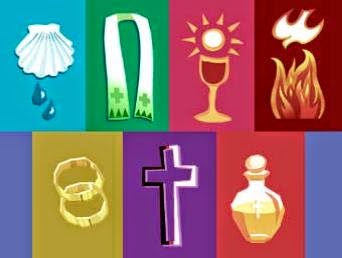
The Sacraments Keep Us Catholic

“At last the most wonderful day of my life arrived, and I can remember every tiny detail of those heavenly hours … How lovely it was, that first kiss of Jesus in my heart—it was truly a kiss of love.” – St. Therese of Lisieux, describing her first Holy Communion

Last month I was blessed to witness nearly 140 young people from our parish and school receiving their first Holy Communion. They were, by and large, reverent and excited—and those I spoke with personally understood at least in concept that they were receiving Jesus’s Body and Blood under the appearance of bread and wine. I hope at least a few of them remember the day with the same deep joy and devotion as St. Therese expresses above.  I’m almost certain, unfortunately, that a few have not been back.

Our approach to preparing children for First Confession and First Communion in recent years has increasingly fallen on their parents. In one sense, this is as it should be: the Catechism of the Catholic Church affirms that, through marriage, “parents receive the responsibility and privilege of evangelizing their children” and “should initiate their children at an early age into the mysteries of the faith.”

On the other hand, many parents do not feel equipped to share those mysteries, being uncertain themselves about the Church’s teachings on Reconciliation and the Eucharist. And while we provide families with workbooks to help them teach their children, these are poor substitutes for the level of love and support young Therese had in the months leading up to the sacraments. Her desire to make a good confession and to receive the gift of the Eucharist consumed her completely, and everyone in her family and community fueled her understanding and love for the Lord in whatever way they could.

As a parish, we can certainly do more. Beginning this fall, First Reconciliation and First Communion students will have an extra class or activity (in addition to LIFT) each month dedicated to sacramental preparation and a deeper understanding of the great gifts of Christ’s love and mercy we find on the altar and in the confessional. But this is no substitute for the evangelizing witness of parents leading a sacramental life in which their Catholic faith is a top family priority.

This is true for two reasons. The first is this: because children naturally observe and imitate their parents’ actions and interests, parents don’t have to have all the right answers, but it helps if you do the right things. Secondly, the sacraments are defined as outward signs instituted by Christ to give us grace—in particular, sacramental grace, which strengthens us to live according to our faith and state in life. The sacrament of Matrimony, for example, confers upon the spouses the graces needed to live in union as husband and wife, come what may.

The same applies to the sacraments of Confession and Communion. They strengthen us to resist temptation and seek communion with God, to forgive and seek forgiveness, to love sacrificially—in short, to be holy men and women of God. Each time we receive them, we are changed for the better. And when our children imitate us, so are they. What better way to ensure our kids remain Catholic?

Blogger’s Note: This article appears in the Sunday, May 24, church bulletin.