Wish Flowers

We were walking the sidewalk along Selby Avenue toward Dark Raven Studios, where the older kids practice tai chi. Here and there, a tree grew along the walk, skirted in weeds and dust. In the center of the street a crow pecked crumbs from discarded cellophane, hopping first to one side, then to the other, as the occasional car passed.

I snuffed a breath through my stuffy nose and grumbled inarticulately. Only the crow seemed to hear, and flapped to a nearby lamppost.

Then Trevor said, “I know why there are so many wish flowers today.”

Wish flowers? I thought. I looked at our youngest. He was gazing at a clump of ragged dandelions, which had shed their jaunty yellow caps to bare their graying heads to the breeze

“There are lots of wish flower because last week there were lots of dandelions!” he said, pointing to the balding stems.

Today a weed; tomorrow a wish. So much I’ve forgotten about wonder. So much to learn.

Trevor’s Ambitions

We spoke to Trevor last night about his ambitions — we had friends over, and they were asking the kids what they aspire to be when they grow up. Trevor said he wants to be an “army man, a police officer, a cowboy,” or (and here he smiled a little, shy smile, like he was showing us a glimpse of his soul) a “hobo swordsman.”

We questioned him further. Most questions were met with a small, inscrutable smile. He was infinitely patient with us. Apparently, if you grasp “hobo” and grasp “swordsman,” you’ve pretty much grokked his life plan. He likes trains, likes blades, and true to the hobo spirit, appears little concerned with a roof, or food, or money.

The world doesn’t have enough — or perhaps any! — hobo swordsmen, don’t you think? A story is emerging: Zatoichi-meets-Kwai Chang Caine-meets-The Twilight Samurai: a vagabond dressed in threadbare clothes, with only a sword to his name, riding the rails, righting the wrongs …

I already have the cover of the graphic novel sketched in my mind. I can write; who can draw?

If you haven’t seen The Twilight Samurai, check it out. One of my favorites. More heart and fewer arteries than typical samurai movies.

Trevvy Figures It Out

Our youngest, Trevor, spent most of his Friday at the home of a friend who is pregnant. Exactly how he knew she was pregnant, I’m not sure, but apparently partway through the day he approached her, sized up her belly, and said, “You got a baby in there.”

“Yes, I do,” she said.

He looked at her belly again. “Sometimes if people eat a lot they look like that, too,” he said.

She laughed. “Yes, I guess they do.”

He hesitated a moment, then said, “Maybe that’s how you get a baby in there!”

Callings, Revisited

Blogger’s Note: That last post garnered some interesting comments, both on- and off-line. Hope this one does, too.

It occurred to me on my commute this morning that there is one aspect of the priestly vocation versus the married vocation that I failed to explore: The possibility of answering one calling, only to hear another years or even decades later.

I know of at least two former Catholic priests who have chosen to leave the priesthood and get married. To the best of my knowledge, one left the Catholic Church and may now be a Protestant minister; the other is the head of one of the most Catholic families I know back home in Michigan.

I know of precisely zero married men who have chosen to leave their marriage to become priests. In neither case do I know what the “rules” are — how one “undoes” one sacramental vow and undertakes a new one, or even if it’s possible, within the Catholic Church. I suppose one might do it regardless and seek forgiveness in some way, perhaps.

What is of more interest to me is that it is easier for people to imagine a celibate priest discerning a call to marriage later in life than to imagine a married man discerning a call to the celibate life of a priest. The romantic-triangle buddy comedy Keeping the Faith includes a great scene between a young priest, played by Edward Norton, who is contemplating turning his back on his vows over a girl, and an old priest who declares that falling in love every so often is part of the gig — and just like in marriage, you make a choice to stay faithful to your vows. The scene seems funny, wise, and true.

But why not the other way? I can imagine the possibility of years or even decades of celibacy were I to outlive my wife. (Perhaps even celibacy by my own choice …) But another calling now? While I’m here, with this other half of me? It’s unfathomable.

The question becomes, why is it unfathomable for me to imagine falling so in love with the Church that I would want to leave my married vocation, but it’s not unfathomable for me to imagine a priest falling so in love with a woman that he would want to leave the Church? If you knew a man in former situation, would you not think it strange, or even outrageous? But in the latter situation? I suspect most people might be sympathetic.

I wonder if it’s not the case that have we been so immersed in popular understandings of sexuality — especially male sexuality — that continence seems unnatural and celibacy, next to impossible. In such a world, it’s difficult to imagine anyone who had experienced marital intimacy ever choosing celibacy.

But the discussion returns to a question posed in the last post: Would you leave your spouse if a tragic accident made it necessary for you to spend the rest of your days celibate? Would you stay married and cheat?

If you can imagine one, you can imagine the other. And if you can’t imagine a love for God deep enough to forsake all others, perhaps you simply aren’t called.

Callings

Lots of folks — Catholic and non-Catholic alike — have a hard time imagining the choice a priest makes to remain celibate his entire life. Some are amazed; some view it as impossible; some are simply grateful they weren’t called to such a life. Boy, I couldn’t do it, they say. Better them than me.

A few months back, our associate pastor, Father G, joined a group of us at an event for married couples. He spoke about what a beautiful vocation marriage is, then said, “I’m glad I wasn’t called to it.”

As you might expect, that got quite a laugh from the couples in attendance — like, if it’s so great a calling, why are you so happy not to be married?

I laughed, too. Later, as I talked to a friend, he pointed out that no one thinks twice about a married man saying, “I’m glad I wasn’t called to the priesthood.” The Catholic Church views both vocations as lifelong, life-giving commitments, in one case, to your spouse; in the other case, to the Church. So just as I feel I am meant to be a husband and father, so Father G feels he is meant to be a priest.

You might argue that the reason one’s easier to swallow for most people than the other is that taking a mate and giving birth to children seems somehow more natural. And in a way, that makes sense — in a “taking a mate and giving birth” sort of way. But in terms of a lifelong commitment to marriage and raising a family, come what may, the differences are less apparent. Would I leave Jodi if a tragic accident made it necessary for us to spend the rest of our days celibate? No. Would I stay married and cheat? Of course not. My “I do” a dozen years ago was more than a mere one-time choice — it’s a daily commitment and lifelong vocation. It’s a calling.

I bring this up because for the past couple of years, our middle son, Gabriel, has been talking about becoming a priest. When he first told our priest, Father M began to call Gabe “Father Gabriel” — and it bugged him at first, because he was worried that we might hold him to a lifelong decision made at age seven. “What if I don’t become a priest?” he asked.

But his comfort with the idea seems to be deepening, and he talks to Father M and Father G whenever he gets the chance. When we start poking fun at the kids about girls and boys and who they might marry, Gabe says matter-of-factly, “I’m marrying the church.”

Puberty may tweak his thinking, but for now, he seems to be serious.

When my mom first heard this, she was saddened, despite herself. She’s Catholic, too, and knows we need priests, but she also dreams of seeing countless great-grandchildren from each of her grandkids. Our oldest, Brendan, wants to go the Naval Academy, then become an officer in the Marine Corps. I mentioned this to another friend of mine, who said, “Well, at least you’ve got time to talk him out of that!”

I understand these feelings, but I wouldn’t dream of it — first, because a kid deserves his or her dreams, and second, because I am so deeply proud to have two boys who are willing to entertain lives of service and sacrifice at their young age. Even if they don’t become what they aspire to today, that willingness to serve will be a great asset to our future.

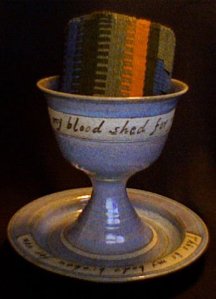
Some of you read about the special gift given to Gabe by Father M a few weeks back — a stole, chalice and paten (pictured above) with which to practice the Mass. Gabe made him a thank-you card and has been looking for an opportunity to give it to him. In the meantime, last Saturday we visited our friend Deacon Tyler (from the Future Priests of the Third Millennium blog) at the St. Paul Seminary. (He will be ordained a priest in Rapid City this June, and yeah, we’ll be there.) He showed us all around: the chapel, the dorms, the lounge, the grounds. He explained that the higher floors of the residence hall have the best view of the Mississippi River below, and that the priests who teach at the seminary get those rooms.

While we were in St. Paul, we stopped by one of my favorite used bookstores, Sixth Chamber, to pick up a copy of Steinbeck’s East of Eden, which Deacon Tyler, Jacqui of Jacqui’s Room, and Matt “HubbaTrask of Hubba’s House turned me onto. I had discussed it briefly with Father M and discovered that he hadn’t read it, so we thought we would get a copy to thank him for his thoughtfulness toward Gabe.

He was not the presiding priest at the Mass we attending on Sunday, but appeared just before the end to make a bombshell announcement: he will leaving our parish this summer — the archbishop has asked him to teach at the seminary.

Through my own tears, I looked at Brendan. He was crying softly; he and Father M had bonded over military history during numerous conversations. Gabe was quiet, unflinching.

After Mass, we made a beeline across the church with Gabe’s card and the book. We hugged Father M and told him it was coincidental, but we had something for him. It was a bittersweet moment — then Gabe piped up that he had been to the seminary the day before, and that Father would live on the upper floors, overlooking the river …

Later, I asked Gabe how he felt to hear that Father was leaving for the seminary. His eyes grew wide and glassy, but he didn’t speak.

I told him that I noticed he didn’t cry like Bren and I did. He told me he was sad, too — but a little excited that he might have Father M for a teacher one day.

He is eight, but this appears to be no distant calling.