Your Eternity Begins Now


For the past few years, our family has joined numerous others from our parish and surrounding churches for Life Chain, an hour of silent public prayer for an end to the evil of abortion in our country. We spread out along Highway 19 between the parish school and Middle School West and stand facing the road, holding signs and praying.

On the back of the signs are suggested hymns, prayers, and petitions to guide our personal reflection during that hour. Every year, I am taken aback by the petition that asks me to pray for God’s mercy for all I have failed to do to protect life and work for an end to abortion—because every year, I am convinced I could have done more.

Now we are two weeks out from electing a new president. Most of us have likely made up our minds how we will vote—guided, I hope, by reason and a well-formed conscience.  God willing, no Catholic will cast a vote in support of abortion or its proponents. Beyond that, faithful Catholics can and do disagree on how best to combat the evils in our society by our actions at the ballot box. With that in mind, I would like to share three thoughts about the aftermath of Election Day.

First, remember the words of St. Therese of Lisieux: “The world is thy ship and not thy home.” We are a pilgrim people, and although our country is great and worth fighting for, the kingdom to which we truly belong is not here. We are called to evangelize and make disciples; to deny ourselves, take up our cross, and follow Jesus. The outcome of this election will not change our mission.

Second, we are all called by God—and not one of us is worth less in His eyes because of the votes we’ve cast, the mistakes we’ve made, or the sins we’ve committed. Whatever happens on November 8th, we will continue to suffer for our faith, as Christ foretold, and our nation and world will continue to need our light, our service, our faithful example. Cast your vote on Tuesday and move on, because we must pull together as one body, one spirit, in Christ.

Finally, we have no time to waste. Too often our efforts on behalf of the unborn, marriage, freedom of conscience, or religious liberty hinge on the headlines and reach a fever pitch every four years with the election of a new president. We support particular candidates or policies; we act as though everything is riding on the results of the next election, then shake our heads when nothing changes and go back to minding our own business.

What about the roughly 1,460 days between presidential elections?

As Catholics, our opposition to abortion and the other great evils of our time is not primarily about saving lives, but about saving souls—including our own. Obedience to Christ and His Church is a daily choice. Disobedience is also a choice. So is complacency and non-action.

Every moment, God calls; every moment we respond. Our eternity begins now.
Lord, have mercy on me for all have failed to do here in my own community to draw people to you and build your kingdom. Amen.
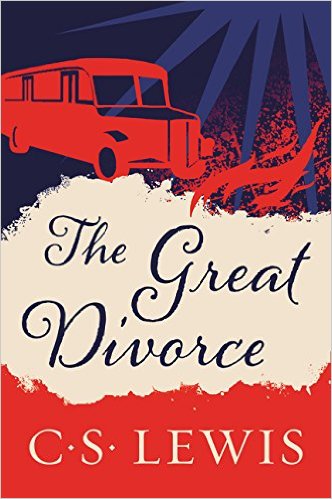
Book Break: The Great Divorce

I mentioned in an earlier post that I had a profound Good Friday, but that was only half the story. The other half of the story is that, early that Friday morning, I sought out some spiritual reading for the day, and wound up with a new top-five favorite book: C.S. Lewis’s The Great Divorce.

Of course, when reading spiritually, the Bible is always a good place to start, and I’m also making slow but steady progress through Dante’s Divine Comedy a canto or two a day. But I wanted something fresh, something I could possibly read in a day, and something related to the penitential character of Good Friday and the great saving act of our Lord.

On a hunch, I took C.S, Lewis’s The Great Divorce from the bookshelf. I have great regard for Lewis as a writer and had heard good things about the book, particularly from my good friend Angie at Take Time for Him.

Lewis had me hooked from the preface, which begins by explaining the title of his fantasy:

BLAKE WROTE the Marriage of Heaven and Hell. If I have written of their Divorce, this is not because I think myself a fit antagonist for so great a genius, nor even because I feel at all sure that I know what he meant. But in some sense or other the attempt to make that marriage is perennial. The attempt is based on the belief that reality never presents us with an absolutely unavoidable “either-or”; that, granted skill and patience and (above all) time enough, some way of embracing both alternatives can always be found; that mere development or adjustment or refinement will somehow turn evil into good without our being called on for a final and total rejection of anything we should like to retain.

The book begins with our narrator in line at a bus stop in a grey and gloomy town, surrounded by people he doesn’t know and wouldn’t want to — unsure of where he is or where he’s going. It unfolds like Dante’s Divine Comedy in modern miniature: a pilgrim’s journey from hell to the edge of heaven in just 128 pages. I’m reading Dante now, too, canto by canto, and it is powerful in its way, but this held my attention from the preface to the end, with every word relevant to this sinner and this sinful time. Lewis articulates with poetic beauty and unflinching honesty the glory of God and his angels and saints, the pain of detaching from this world, and the stubbornness, the grasping, the pride and distrust that keep even “good” people from choosing God and reaching Heaven.

The book challenges the reader particularly on the Greatest Commandment: “You must love the Lord your God with all your heart, with all your soul, and with all your mind” (Matthew 22:37). On this point, Dante provides an unintended summary (being some seven centuries older) which, as providence would have it, I read over lunch on Easter Monday. In Purgatorio, Canto IX, Lines 127-132, he writes the words of the angel guarding the gates of Purgatory proper:

“I hold these keys from Peter, who advised
‘Admit to many, rather than too few,
if they but cast themselves before your feet.'” 
Then pushing back the portal’s holy door,
“Enter,” he said to us, “but first be warned;
to look back means to go back out again.”

We sin when we put anything — even the blessings of life on this good Earth — ahead of loving and seeking God. Pilgrim after pilgrim turns his or her back on Heaven because the cost of entry is too high: the cost of admitting that they are mere creatures and of letting go of their earthly pleasures, passions, and prejudices. They want Heaven on their own terms and choose Hell to feel like they have some say in the matter. They cannot stand the humiliation of grace as an unmerited gift.

It is a powerful book: perhaps tied at this moment with Steinbeck’s East of Eden as my favorite of all time (although Tolkein’s The Lord of the Rings (which I still need to review as an adult) and Sigrid Unset’s Kristin Lavransdatter trilogy are right up there, too!) It paints a stark and revealing picture of how far so many of us have to go to be purged of all sin. So I will end this post with Lewis’s words from the Preface, on a hopeful note:

I do not think that all who choose wrong roads perish; but their rescue consists in being put back on the right road. A wrong sum can be put right: but only by going back till you find the error and working it afresh from that point, never by simply going on. Evil can be undone, but it cannot “develop” into good. Time does not heal it. The spell must be unwound, bit by bit, “with backward mutters of dissevering power”– or else not. It is still “either-or.” If we insist on keeping Hell (or even earth) we shall not see Heaven: if we accept Heaven we shall not be able to retain even the smallest and most intimate souvenirs of Hell. I believe, to be sure, that any man who reaches Heaven will find that what he abandoned (even in plucking out his right eye) was precisely nothing: that the kernel of what he was really seeking even in his most depraved wishes will be there, beyond expectation, waiting for him in “the High Countries.”

The Great Divorce. Find it. Read it.

A Baby Catholic’s First Steps

be26f-cover_october_2014_web

Fr. Bill, from an article on Confession
in the Diocese of Grand Rapids magazine Faith.

I have mercy on the brain this month. At LIFT we talked about the sacrament of Confession, and several parishioners shared powerful stories of how God’s mercy had strengthened their faith. Then, in recognition of the Pope’s Year of Mercy, our parish retreat focused on God’s message of Divine Mercy. Fr. Alar’s presentations were both consoling and challenging—showing me clearly the great ocean of mercy that stretches before us and how slow we are to tap into it for ourselves, much less for others.

I made my first Communion around age 10, during a brief period in which my mom returned to the church with my sister and me. As a young husband, I attended Mass with Jodi, out of respect for tradition and curiosity more than anything else. When I became a father, I began to open up to the possibility of becoming a practicing Catholic, but I had many questions and was deeply enmeshed in many of the typical sins of young men. I hid those sins under a thick blanket of pride, convinced that I knew better about right and wrong—but Jodi’s solid, peaceful faith played on my curiosity. So one evening, I sat down in the rectory to talk with our priest.

I told Fr. Bill I wasn’t sure it was possible to know if God exists. I told him I disagreed with the Church’s teaching on birth control. I told him I didn’t understand the Church’s teachings on the real presence of Jesus in the consecrated bread and wine at Mass. I told him I couldn’t believe that a merciful God could condemn good men to Hell for not believing in Him.

Fr. Bill addressed my issues calmly and thoughtfully. He told me I had a good head on my shoulders, and God gave it to me to use. He told me not to be afraid of my doubts or questions—that even priests struggle with the same and need faith to follow God.

“But you’re not going to find the answers to these questions by holding your faith at arm’s length,” he said. “My advice is to go to Confession and begin receiving Communion again, and ask your questions from inside the Church.”

I thanked him, and he said, “I could hear your confession now, if you want.” I protested that it had been many years and I didn’t remember how, and he said, “Don’t worry—I will help you.”

So right there, in the living room of the rectory, I made the first Confession of the rest of my life—my first face-to-face Confession—with the priest who first showed me the depths of God’s mercy. I began receiving Holy Communion again the following Sunday, was Confirmed in the Church a few years later, and began a lifelong march to Calvary and Christ, because Fr. Bill saw my dignity as a son of God under layers of pride and years of sin.

Here’s the kicker: I know now that my Confession that evening wasn’t technically valid. The sins I was struggling with come in buckets; I confessed most of them that night, but not all, because some I didn’t agree were sins and had no intention of changing. But I made the best Confession I could in my ignorance and was sincerely contrite—as sorry as I could be in that moment of faltering pride and budding faith. Fr. Bill started me on a road I may not have taken otherwise. Had I waited a week, that spark may have gone out, and had he said, “Good effort…but come back when you’re ready to confess everything else I suspect you’re doing,” I may never have come back.

I need to remember that my first steps on the path to an adult faith were baby steps, small and unsteady, and that Fr. Bill saw enough in me to invite me back to communion with God. We need to see each other as he saw me—as Jesus sees every sinner—and encourage those first faltering steps.

Unbroken

Blogger’s Note: There are both book and movie spoilers below. You have been warned.

We finally saw Unbroken last week. The book version of the story — Laura Hillenbrand’s 2010 biography of Olympic athlete and WWII veteran Louis Zamperini — is a spell-binding, white-knuckled page-turner. It’s well researched, lovingly crafted, and unflinching in its portrayal of the danger and brutality endured by Zamperini and his comrades during 47 days adrift in a life raft after their plane crashes into the Pacific and two and a half years in Japanese prison camps.

I know many people now, men and women alike, who have read this book, and every single one has loved it. When I finished it, I told Jodi this man had four or five movies worth of material happen to him in his lifetime, and I blogged that “the fact that all of them really happened to one man is almost too much to be believed.

Zamperini died just this past summer at age 97. When I heard the news on the radio, I choked up. What an amazing man.


Perhaps it was too much to expect a single film could carry the weight of Zamperini’s story alone. I liked it well enough, I suppose, primarily because it reminded me of the book — but unlike the book, it had no lasting impact for me. I’ve heard both critics and friends offer two reasons for this (Note: Spoiler alert!):

  • Some have said that it’s overly sanitized — that a PG-13 version of an R-rated book simply can’t convey the horrors experienced by Japan’s POWs. Some have suggested that it’s a “Golden Age of Hollywood” sort of movie, well done but too beautiful, without the real grit we’ve come to expect in newer war movies.
  • Others blame director Angelina Jolie for leaving out the book’s final act, which showed both the dreadful toll Zamperini’s years in captivity took on his mental and emotional health, and the path to forgiveness and healing he found in Jesus Christ.
Although I remain disappointed with the pat ending, which relegates Zamperini’s conversion story and personal forgiveness of his captors to an end note, I’m closer in opinion to the “overly sanitized” argument. Don’t get me wrong: I’m glad that teens may get the chance to see this movie and learn about the man — and the violence is plenty real. What’s missing, from my perspective, is the moment-to-moment tension and suspense of the book: the arbitrary, madness-inducing, constant fear of violence and death that make Zamperini’s survival and redemption so incredible and uplifting. 

For example, in the film, when Louie and his two companions are adrift on the Pacific, they are hungry, thirsty, sunburnt, circled and attacked by sharks, and strafed by Japanese warplanes, just like in the book…except that in the book, these dangers weighed on the men constantly. While the movie plays up a single shark attack for a scare moment, the book portrays the sharks as an ever-present fear, constantly testing the integrity of the raft and the resolve of the men. In the book, the rubber life raft is shot full of holes more than once, and pumping and patching to stay afloat and alive is steady work. In the book, faced with malnutrition, disease, parasites, and torture, the POWs are constantly struggling to stay healthy enough to endure daily hard labor — and the “victories” that Louie wins over his antagonizer, the Bird, are moral victories only, and fleeting. He wakes the next morning with new injuries and new challenges, still malnourished and still under the Bird’s oppressive thumb.
Of course, great books are rarely matched by the films based on them — but if a magical, whimsical book like The Hobbit can be expanded into three dark and swarming action movies of three hours a piece, perhaps we could have given a little more time to Zamperini. The TV miniseries (think Roots or Lonesome Dove) seems to be a fading form — perhaps that would have been a better choice for Unbroken?