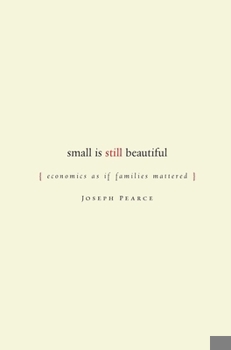
Book Break: Small Is Still Beautiful: Economics as if Families Mattered

Providentially, my reading lately has all been cut from similar cloth: our relentless pursuit of better, newer everything and the dangers it poses to our humanity and health (physical, mental, and spiritual). This latest volume, Small Is Still Beautiful: Economics as if Families Mattered by Catholic scholar, biographer, and author Joseph Pearce was a gift from our Bismarck family, and is a reiteration and expansion on E.F. Schumacher’s 1973 classic Small Is Beautiful: Economics as if People Mattered, with a particular focuses on the environment, food supply, and land use.

In my 2017 review of Schumacher’s book, I described a couple non-academic objections and numerous things I loved about the book. I also said it seemed like the sort of book that had been read, admired, and forgotten in the powerful current of worldly progress.

Continue reading

Book Break: Two Volumes by Matthew B. Crawford

One of the great pleasures of these latter years as a father is receiving books and book recommendations from my grown children. The University of Mary in Bismarck, Saint John Vianney Seminary in Saint Paul, and the Franciscan Friars of the Renewal have led each of them on tremendous intellectual and spiritual journeys. Occasionally, I tag along.

This past Christmas, Brendan and Becky presented me two books I may have never encountered had Brendan not taken a surveying (as in, land measurement) course as an undergrad…a surveying course taught by a history professor with a love for useful arts and practical skills.

Both books are by Matthew B. Crawford, who holds a PhD in political philosophy and a prestigious research fellowship at the Institute for Advanced Studies at the University of Virginia. He also runs a motorcycle repair shop. In these two books, he makes a convincing case that we are ceding more and more of our will, abilities, and control to technologies and systems that make life easier by making it less lively, less human, less worth living.

Continue reading

Wednesday Witness: The Father’s Heart … In Us

Last Saturday I was blessed to go to the Men’s Lenten Event at St. Michael Catholic Church, with our former associate Father Nathan LaLiberte presenting. Father Nathan celebrated Mass before the event, and his homily left a mark on my heart for ministering to those in need.

The gospel was the familiar Parable of the Prodigal Son (or the Forgiving Father). He opened by noting that this powerful and thought-provoking story only appears in St. Luke’s gospel. Why did a Gentile include this story when the Jewish evangelists did not? Father suggested a Jewish audience, like many rules-based Christians today, would struggle to accept the superabundant mercy of the father in the story.

Continue reading

Wednesday Witness: Wanting What You Have

There’s a saying I ran across somewhere:

Contentment isn’t having what you want but wanting what you have.

At the time it seemed like wisdom, and there is a grain of truth in it: The more stuff we accumulate, the more we tend to want, so getting everything you want not only doesn’t lead to contentment, but creates a self-defeating cycle of desire for bigger, better, and just MORE things.

Mostly I have made peace with not having the best of everything, and I’ve reached a point in my life at which I am trying to detach and downsize. However, as I attempt to rid myself of so much stuff, I find that I do want what I have. I want it a great deal.

For example, I have accumulated a lot of books over the years. The ones I’ve read and kept are wonderful, and although I could get them at the library if I wanted to read them again, I love my collection and struggle to decide which volumes to part with. The books I haven’t read, I keep in the earnest if foolish hope that I will find time to read them one day soon. Then, I tell myself, if I am unlikely to reread them, I can get rid of them. Why should I get rid of them now?

Continue reading

Handled or Healed?

This spring I shared about a homily we heard from Father Columba Jordan, CFR, while visiting Gabe and his fellow postulants in Harlem. Father Columba asked if we were handing our problems over to the Lord or squeezing Him like a stress ball while we tried to handle them ourselves. Surrender is more than admitting we need help or even asking for help—it means relinquishing control and receiving His help, in whatever form it comes.

Fast-forward to this month: After years of talking about it, Jodi and I decided to work on our marriage together by participating in the Healing the Whole Person study at the church this summer. By most measures, our marriage is healthy and strong, but anyone who has spent decades living with the same person can point to areas in need of healing: issues that consistently cause anxiety or anger, conversations that invariably go sideways, little things that drive us crazy in disproportionately big ways. And we don’t want to settle for that.

Continue reading