Easter Greetings from the Thorp Gang

Holy Saturday

“Have you come to believe because you have seen me? Blessed are those who have not seen and have believed.” – John 20:29

How dark a Sabbath dawned the day after Jesus’s crucifixion: the so-called savior dead and in the ground; his disciples scattered, and the Passover at hand—a remembrance of freedom for God’s chosen people, once again marked under Roman rule.

Our Holy Saturday is not so dark, for although we did not walk with the living Lord or see His risen self, we know the story and believe what we have heard—that fear-filled seventh day was followed by an eighth, a day of resurrection and re-creation. A day of joy and wonder.

So we rise this Holy Saturday, not with trepidation, but anticipation. We rise to the same hell-bent, broken world the apostles did, still filled with pride and pain and broken people; we look with wonder this morning at four inches of fresh snow fallen silently over night and rejoice that God has seen fit to grace us with another day, another hour, another breath. Continue reading

What I Couldn’t Say

Yesterday was Bethany’s wake; today will be her funeral. For me, the wake was a flurry of hugs and tears; I had an evening meeting to attend and wanted to see as many of my Poland daughters as possible, along with Bethany’s family, before I left.

It was hard to feel the heartache of people you care for in your arms and chest as you hold each other in sorrow. I wished aloud more than once that I could say something to ease the pain of her passing (I believe that, in the moment, the words were actually “to make this suck less”)—but I don’t know why this happened, and I miss her, too.

* * * * *

Imagine the thing that matters most to you in all the world—beautiful, precious, perfect in your eyes. Imagine that you crafted this thing yourself, putting all of your attention, skill, and loving care into every detail. Imagine holding it in your hands, gazing at it in joy and wonder, and seeing how good it is. Continue reading

Peace in God’s Hands

A week ago Friday, Emma and I went for a drive. The purpose was to get her on the freeway for the first time—on Saturday, we were heading to Bismarck to visit friends, and that long drive straight west is a great opportunity to get practice hours behind the wheel. We had planned to take the Suburban, but Emma had less experience and comfort with the Blue Beast, so we opted to take the minivan. It is getting older, but it’s my daily driver and a little easier for a new driver to manage.

Emma has been doing well in her driving thus far. She is focused and attentive and rarely gets rattled. She has driven 55 to 60 miles per hour on regular roads and has experience in town traffic, but this was to be her first time on the freeway. I drove us westward on I-94, away from the Cities and end-of-the-workday traffic, reminding her as we went of what she had learned in class: merging, moving over for entering traffic, blind spots, etc. She admitted she was nervous, but no more so than trying any other new thing behind the wheel. I offered that we should get off at the Hasty exit, and that she could drive toward Maple Lake on regular roads a bit before we looped back and got on the freeway. And so we did.

The sun was setting as we approached the freeway and turned right onto the eastbound ramp. Westbound traffic was still heavy; eastbound, not so much. So far so good. I talked her through the merge as we headed down the ramp, and she responded: Get up to speed. Signal. Check your blind spot…

A vehicle was in the near lane, closing on us. We both saw it; it was difficult to tell if they were letting us in, and Emma said so.  We looked forward at roughly the same time and saw we were coming off the ramp and onto the shoulder, which was covered with a thin layer of slushy snow. The van began to fishtail.

Continue reading

He Thinks, Therefore I Am

Do you not know that you are the temple of God, and that the Spirit of God dwells in you? — 1 Corinthians 3:16

Yesterday morning I read St. Matthew’s account of the baptism of the Lord. Two things struck me. The first was that, in the Ignatius (Revised Standard Version) Bible I was reading, the translation is somewhat different from the New American version we hear at Mass (linked to above). The New American translation says, “[H]e saw the Spirit of God descending like a dove [and] coming upon him.” The Revised Standard translation says, “[H]e saw the Spirit of God descending like a dove, and alighting on him.”

The difference is small, but struck me as important, because alighting suggests the Holy Spirit came to rest on Jesus and remained with Him. This is reinforced by the first line of the next chapter, which begins just one verse later: “Then Jesus was led up by the Spirit into the wilderness to be tempted by the devil.”

See that? The Spirit is still with Him, leading Him.

The Holy Spirit doesn’t leave us, either. We talk sometimes about the indelible mark left on our souls by certain of the sacraments, which might leave us with the mistaken notion that God makes an impression on us but doesn’t stick around. But clearly the Spirit did not leave Jesus—in fact, in paragraph 695 of the Catechism, we learn that the Holy Spirit represents the very anointing that signifies Jesus as the Christ, or messiah: the anointed one of God. And He is covered completely by this anointing, as close as oil on skin: “The humanity the Son assumed was entirely anointed by the Holy Spirit” (CCC 695). Continue reading

Chains of Memory

The past couple of days I’ve been plagued by memories: guilty recollections of past sins, glimpses of images I never should have seen, bits of off-color or debauched “humor,” lyrics to songs that should not be sung.

Beginning in college, this was my rebellion. I looked at, listened to, and watched whatever I wanted. And in short order, I proved the adage, “Garbage in, garbage out.” During much of my college years, I swore like a sailor; I told dirty jokes to old friends and new acquaintances, and I made excuses for my behavior—to others and to myself.

“It could be worse,” I said, and I knew I was right. I had a vivid imagination, and worse played out in my mind if I lingered too long on any impure thing.

Thanks be to God, over the first ten year of my marriage to Jodi, I weeded these things out of my life. Little by little I dropped the jokes, kicked my swearing habit, left porn behind, stopped watching racy movies, and cleaned up my taste in music. And beginning with one no-nonsense confession with Fr. Siebenaler, in which he politely but firmly questioned my resolve to actually amend my life and advised me to open myself to Jodi and ask for her help, I left off making excuses, and began instead to apologize.

So here we are, more than a decade later, and the Enemy is at work again: I find myself mindlessly mouthing the music in my head, only to realize it’s some obscene gangster rap fantasy or metal mayhem I laughed at as a younger man. In my mind’s eye I see images I haven’t looked upon in years, like a sin scrapbook I can’t help but leaf through, gazing at memories best forgotten.

That’s the first point of this ramble: you can’t forget. What your brain takes in is filed away for later reference. Every image, every word, is there, tying you to past experience. And those things you subject yourself to again and again, out of desire or habit? Your mind naturally assumes they are important, forging shorter, stronger connections so they can be easily accessed.

I can’t recall yesterday’s discussion with my bride, but I remember every detail of my past sins, with a clarity that repels the spirit and tempts the flesh anew. The Accuser seeks to set me against myself—but I know now I must seek every day, every moment, to purify both body and soul.

That’s the second point: The struggle against sin is noble and never-ending, to be sure, but all struggles are not created equal. The struggle of the rabbit in the snare speeds its demise; it kicks and thrashes against the noose, which only tightens against its efforts.

That was me, in the confessional all those years ago—declaring sorrow for my sins but unwilling to even attempt to remove my head from the strangling wire. The death brought about by sin cannot be escaped by panic, emotionalism, or bodily struggle. It is a spiritual struggle, requiring prayer, persistence, and genuine love of neighbor and of self. At some point, all the plans, safeguards, and accountability measures boil down to a decision: Am I going to stop doing these things or not?

How does one become a saint? Will it.

Finally, the third point: We don’t have to remain bound in these chains of memory, because God’s love is mercy.

This is not the first time I’ve struggled with recalling past sins and feeling old remorse and new temptation. The last time I remember it as strongly as this, our pastor, Fr. Richards, advised that I repeat the prayer, “Jesus, I trust in you.”
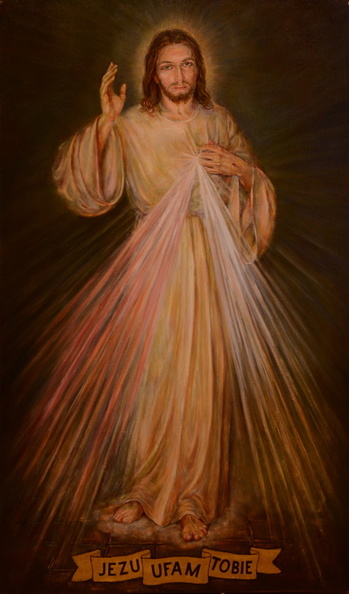
84764-divinemercy

At the time he told me this, it didn’t click with me that these are the words of the inscription at the bottom of St. Faustina’s image of Divine Mercy. (“Jezu ufam tobie” in the original Polish, above.)

Jesus, I trust in you. I trust in your mercy. I trust that you have forgiven these past, confessed sins. I trust that you continue to forgive me. I trust that you love me.

We are washed clean in the blood and water that flow from His Sacred Heart. We need not linger in darkness or doubt. He loves us. He forgives us. He saves.