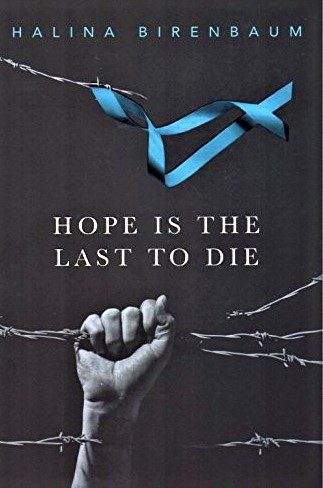
Book Break: Hope Is the Last to Die

In 2016, I was blessed to travel with my son Gabe and STMA Catholic Youth Ministry to World Youth Day in Kraków, Poland. Southern Poland is a wonderful place for a Catholic pilgrimage; so many ancient and modern saints lived and died in so small a region that every day it seemed we visited another sacred site in another blessed city. The big three, of course, were 20th century saints: St. John Paul II, St. Faustina Kowalska, and St. Maximilian Kolbe.

In the case of St. Maximilian Kolbe, we were blessed to visit his religious community at Niepokalanów as well as the concentration camp where he gave his life at Oswiecim (Auschwitz). I say blessed truly, but not in the typical sense of the word. On a sunny summer day, Auschwitz is still and green and peaceful as an cemetery, but still more somber and hushed; the fences, ruins, and the dreadful sign above the gate, “Arbeit Macht Frei” (Work Will Free You), bear silent witness to the cruelty of which humanity is capable.

As we left the camp, we passed a small booth selling items commemorating the place—most prominently, a book entitled Hope Is the Last to Die by Halina Birenbaum. Born Halina Grynsztajn to a Jewish family in Warsaw, she survived the horrors of the Warsaw Ghetto during Nazi occupation, followed by four prison camps in succession:  Majdanek and Auschwitz in Poland, and Ravensbrück, and Neustadt-Glewe in Germany.

I bought the book, as the most appropriate way to recall the place and what happened there. I finally found the courage to read it this Lent.

Continue reading
A Wee Bit Irish: Peace and Understanding Addendum

Over many St. Patrick’s Days I’ve shared and reshared a short post on how Irish I actually am. The answer? Not very, in flesh-and-blood sense; in fact, some of my ancestry was Scots-Irish, Protestant, and apparently anti-Catholic, even in my parents’ younger days. But though our Thorp name persists, we’ve since converted to the Catholic faith of my mother’s Polish family, so spiritually I feel more akin to the the Poles and the Irish these days.

My father tells, however, of a period in which peace was achieved between the Scots-Irish Protestant Thorps and Polish Catholic Galubenski clans. The story goes that during Prohibition, my great-grandfather Bronislaw Galubenski was brewing or distilling on the family farm. One of Dad’s uncles or cousins was a deputy sheriff at the time. He knew what was cooking on the farm and could’ve shut it down, but instead, reached an agreement: As long as Broni left a bottle in the culvert on the corner, the deputy left well enough alone.

Peace and understanding acheived thanks to a shared love of spirits. Would that all conflicts could be resolved over a drink.

Laughs and Life Lessons at Moonshine Abbey

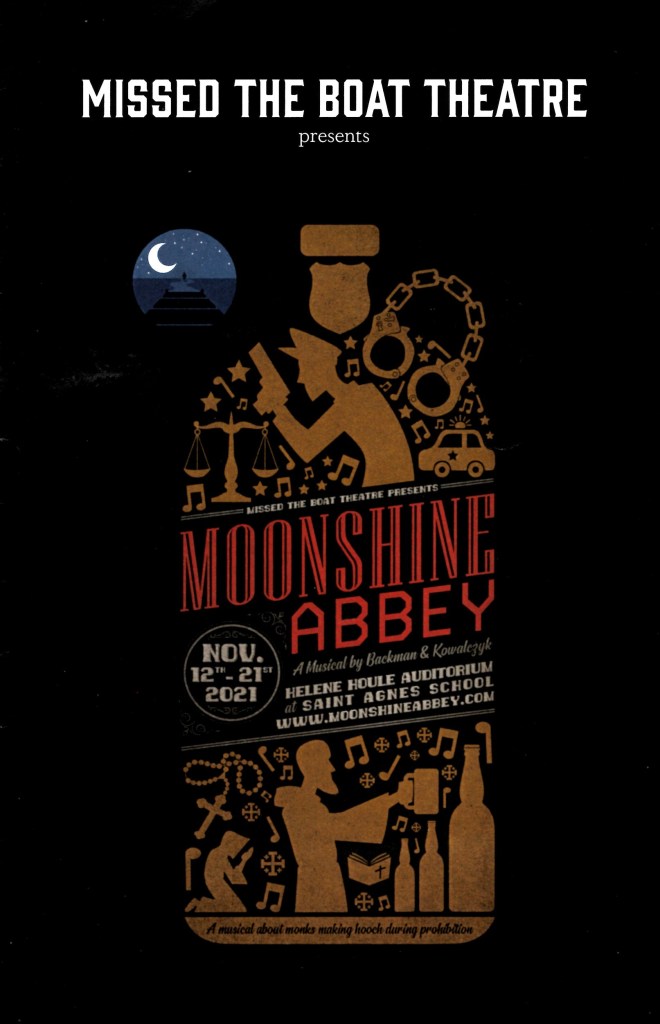
In case you missed the news, we’ve a playwright in the priesthood: Fr. Kyle Kowalczyk, pastor of the Church of St. Maximilian Kolbe in Delano, has also written, directed, produced, and acted in theatrical productions since high school. This week and next, his Catholic community theater company, Missed the Boat Theatre, is performing Moonshine Abbey, an original musical by Fr. Kyle and composer Sam Backman. It tells the story of a community of monks trying to preserve its rule, identity, and livelihood of brewing beer and distilling spirits during Prohibition.

Continue reading

Book Break: Technopoly

Now for something completely different: I haven’t been writing nearly enough and am way behind on books I’ve read and would like to share. Most of the books I share are fiction, spiritual, or both. Technopoly by Neil Postman is neither.

This book came to me as an unexpected Christmas gift from our son Brendan’s friend Nick, who was his roommate at University of Mary and is now a seminarian for the Diocese of Milwaukee. Brendan has always been a curmudgeon and skeptic regarding technology; Nick, not so much, until he started reading more deeply on the subject. Then, he started spreading the word, including by giving our family a lightly used paperback copy of Technopoly.

One of the concepts that intrigued me as a young anthropology major was the idea that, at a certain point, our ancestors began to compete technologically rather than biologically, meaning that, at a certain point, our ancestors crossed a threshhold and were no longer strictly beholden to their biology to survive—the fittest was not necessarily the fastest or strongest hominid, but may be the cleverest one, with the best tools.

I’m certain that, soon afterward, our ancestors saw another defining characteristic of our species: Our solutions to problems often cause other, unforeseen problems. Indeed we can see this in the anthropological record, with evidence of hominids using “tools” to club each other to death beginning nearly half a million years ago.

Continue reading

Blessed to Live in ‘God’s Country’

This post appeared in the September 12, 2021, issue of the St. Michael Catholic Church bulletin.

One of the smaller blessings of the pandemic was that it forced me to find topics to write about for our parish newsletter beyond our typically active ministries. As a result, the May 2020 issue of DISCIPLE (online at stmcatholicchurch.org/disciple) provides an overview of our parish history. From the beginning, the faithfulness and self-reliance of this community was evident: German Catholic families literally carved their farms out of the wilderness along the Crow River; in the early days, the paths to get here were so poor that visiting priests came on foot rather than risking a ride on horseback.

Jodi and I moved here from Michigan in 2003. I took a job in Minneapolis and came out a month earlier than the rest of our family, shopping for a house and a parish on the weekends. The home we ultimately purchased was the first one I looked at, a mid-‘80s split-level near Four Seasons Park in Albertville. The church we chose was the first I visited too: the historic Catholic church in downtown St. Michael.

I think what drew me there first was the Old-World charm—I’m a sucker for old buildings, and old churches in particular. I arrived early that first Sunday and watched the narrow wooden pews fill and fill and fill. Old folks and young families, with toddlers tumbling into the aisles. Singing mixed with the squeals of infants. The church was overflowing with life. I checked out a couple other parishes in the area, then called Jodi and said, “We don’t have a house yet, but I think I found a church.”

Continue reading