Wednesday Witness: Step Outside Yourself

But God said to him, “You fool, this night your life will be demanded of you; and the things you have prepared, to whom will they belong?” – Luke 12:20

Not long ago I met a woman going through serious medical and financial difficulties. For many weeks, she had been off work and in severe pain due to a spinal injury. She was behind on her bills, immobile most of the time, barely able to care for herself and her child. Friends and family offered what support they could, but even the very best prognosis put her a month away from working again, provided she still had a job.

At the end of a tearful conversation, I offered to pray with her and for her. She gratefully accepted, and I asked the Lord to heal her, to address her challenges, to protect her family, and to guide those around her to know how best to help.

When I stopped to ask if she would like to add anything, she said yes—and then proceeded to pray for a friend who was going through hard times and needed a spiritual boost. She prayed earnestly, by name, for this other person, then thanked God for all the help He has provided to her so far. She never once mentioned her own situation.

Continue reading
Wednesday Witness: ‘You Can’t Save the World’

This column is part of a new, weekly series on what the Lord is doing in my heart, specifically encouraging me to simplify my own life in order practice the virtue of charity and the Corporal and Spiritual Works of Mercy. Come back each Wednesday to read the latest!

I’ve always been a big-hearted and emotional fellow. As a grade-schooler, I tried to intervene when those who were littler than me (not many) were being bullied. Invariably, I took a thumping myself. But I couldn’t help it: I hurt to see others hurt.

Whenever I got wound up about some injustice or suffering, real or imaginary, Dad would say, “You can’t save the world.”

What he taught me, instead, was how to stand up for myself, to treat others with respect, and to look out for my own—my family and close friends, those whom I could count on to help take care of me.

Dad was right: I can’t save the world. I can’t even save myself. Jesus is the sole Savior of the world, and—thanks be to God—it is accomplished (John 19:30).

But I don’t think our eternal salvation is what Dad meant.

Continue reading

In Big and Small Ways, Hope Prevails

In recent months it has become apparent that I am a Worrier. Everyone has concerns, and sometimes those concerns get the better of us—but I actively pursue potential problems no matter how unlikely they may be, then chew and chew and chew on them.

I try to pass it off as a strength—foresight leads to preparation, which benefits my whole family. But the truth is less noble: Mostly, I just don’t want to appear late, ill-equipped, or foolish. Despite my best efforts, I am still trying to measure up. But to whose standard?

Jesus warns us against worry:

“So do not worry and say, ‘What are we to eat?’ or ‘What are we to drink?’ or ‘What are we to wear?’ All these things the pagans seek. Your heavenly Father knows that you need them all. But seek first the kingdom [of God] and his righteousness, and all these things will be given you besides.Do not worry about tomorrow; tomorrow will take care of itself. Sufficient for a day is its own evil.”

Matthew 6:31-34

The saints also warn us:

“Anxiety is the greatest evil that can befall a soul, except sin. God commands you to pray, but He forbids you to worry.”

St. Francis de Sales

“Let nothing perturb you, nothing frighten you. All things pass. God does not change. Patience achieves everything.”

St. Teresa of Avila

“Pray, hope, and do not worry.”

St. Padre Pio

I know this, and yet I persist in losing time and sleep, humor and hair, while fretting about the future and all its possibilities and challenges.

In the past several weeks, God has been working on this aspect of my conversion, especially in two areas of our marriage in which I am not only likely to worry but also to drive my bride nuts: travel and money.

Continue reading

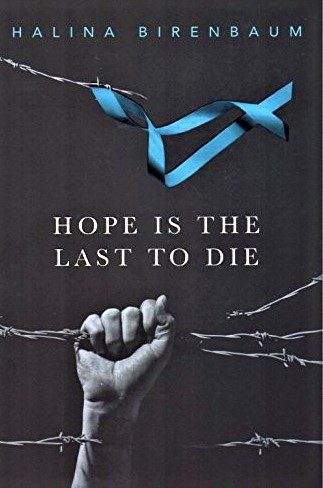
Book Break: Hope Is the Last to Die

In 2016, I was blessed to travel with my son Gabe and STMA Catholic Youth Ministry to World Youth Day in Kraków, Poland. Southern Poland is a wonderful place for a Catholic pilgrimage; so many ancient and modern saints lived and died in so small a region that every day it seemed we visited another sacred site in another blessed city. The big three, of course, were 20th century saints: St. John Paul II, St. Faustina Kowalska, and St. Maximilian Kolbe.

In the case of St. Maximilian Kolbe, we were blessed to visit his religious community at Niepokalanów as well as the concentration camp where he gave his life at Oswiecim (Auschwitz). I say blessed truly, but not in the typical sense of the word. On a sunny summer day, Auschwitz is still and green and peaceful as an cemetery, but still more somber and hushed; the fences, ruins, and the dreadful sign above the gate, “Arbeit Macht Frei” (Work Will Free You), bear silent witness to the cruelty of which humanity is capable.

As we left the camp, we passed a small booth selling items commemorating the place—most prominently, a book entitled Hope Is the Last to Die by Halina Birenbaum. Born Halina Grynsztajn to a Jewish family in Warsaw, she survived the horrors of the Warsaw Ghetto during Nazi occupation, followed by four prison camps in succession:  Majdanek and Auschwitz in Poland, and Ravensbrück, and Neustadt-Glewe in Germany.

I bought the book, as the most appropriate way to recall the place and what happened there. I finally found the courage to read it this Lent.

Continue reading

Perfection Reconsidered

This post appeared as a column in the Sunday, March 20, 2022, issue of the St. Michael Catholic Church bulletin.

Last Saturday, my bride and I went to morning Mass together. In the gospel, Jesus admonishes His disciples, “So be perfect, just as your heavenly Father is perfect” (Matthew 5:48).

I’ve always taken this to be a tall order—impossible, in fact, for anyone but God alone. It almost always makes me feel small, weak, and inadequate to the task. These feelings may be true, but do not seem particularly helpful when it comes to striving for sainthood.

But Father Joe tweaked my thinking with his homily Saturday morning.

“Notice,” he said, “that the Lord doesn’t say, ‘Do everything perfectly,’ but ‘Be perfect.’”

He went on to explain that, with our fallen nature, we cannot expect never to make mistakes—but that we should do the best we can in every circumstance, striving to love as God loves.

Continue reading