Wednesday Witness: All the Time in the World

This column is the first in a new, weekly series on what the Lord is doing in my heart, specifically encouraging me to simplify my own life in order practice the virtue of charity and the Corporal and Spiritual Works of Mercy more and more. Come back each Wednesday to read the latest!

In last Sunday’s gospel, blind Bartimaeus cries out to Jesus, who is passing by with His disciples and a large crowd. The detail that stuck out to me is that, when this beggar calls to the Lord, “Son of David, have pity on me!” many in the crowd rebuke him. These are people like you and me, who have found in Jesus someone we want to follow, maybe even dedicate our lives to. They have heard the Lord preach, seen Him work miracles, and shared in His ministry…and instead of lifting this poor man up and inviting him in, they tell him to pipe down, intending to pass him by.

But not Jesus. He has all the time in the world. He tells His followers to bring the man they have just rejected to Him. Bartimaeus doesn’t need their help, but springs to his feet—a bold move for a blind man—and rushes to the Lord. Jesus asks him what he wants, and he doesn’t ask for food or spare change. He asks BIG: “Master, I want to see.” 

And the Lord delivers even bigger: Not only does Bartimaeus see, but Jesus tells him, “Your faith has saved you.” God’s plan for Bartimaeus is bigger and more generous than even he can dream.

Continue reading

Given Name

To the victor I shall give some of the hidden manna; I shall also give a white amulet upon which is inscribed a new name, which no one knows except the one who receives it.

Revelation 2:17

On Monday evening, something unusual happened—something unique in my experience, though the tradition extends back to the Book of Genesis: My son received a new name.

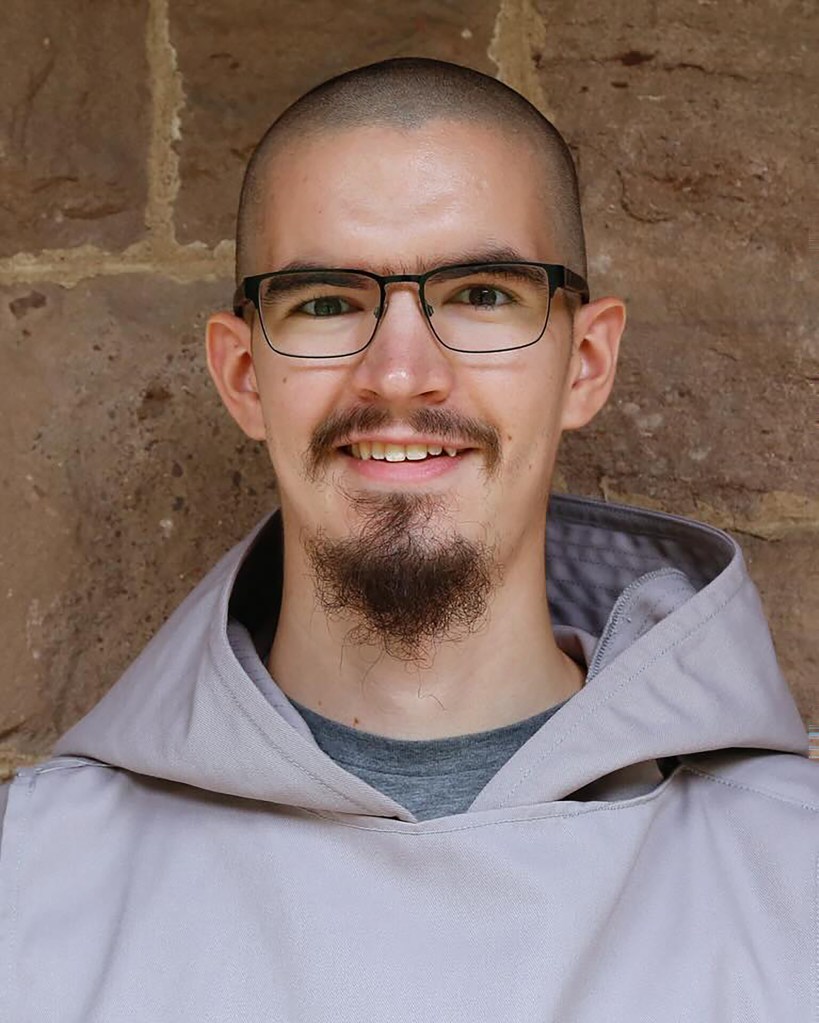
Our second son, whom we named Gabriel Venjohn Thorp, is discerning religious life with the Community of Franciscan Friars of the Renewal (CFRs). After spending the past year as postulants at St. Joseph’s Friary in Harlem, he and five other young men entered the novitiate Monday at Most Blessed Sacrament Friary in Newark, New Jersey. As novices, they received their habits—the gray hooded robe and cincture of the friars—and their new names. Our son is now Brother Jude Apostoli, of St. Michael.

In my line of work, you might call this a brand refresh: new name, new packaging, same great mission—serving as a living witness and example of the love of Christ.

Continue reading

Transformed or Transmitted?

This post appeared in the Sunday, July 21, 2024, edition of the St. Michael Catholic Church bulletin.

A couple weeks ago, I shared a short reflection on the Healing the Whole Person study I was blessed to be a part of in June. (Another one is starting up next week; see the bulletin or Father’s weekly email for details.) The gist of that column was the freedom I received to look squarely at my past and admit that everything wasn’t sunshine and daisies, then to seek the Lord’s healing for even the little ways in which I have been wounded.

Healing is not only important for our own sake. The Lord desires joy, not just for us, but for all those we encounter—and as the old saying goes, “Hurt people hurt people.”

Throughout the study, Dr. Bob Schuchts and Sister Miriam James Heidland, SOLT, reiterate that suffering that is not transformed is transmitted. The desire to avoid suffering ourselves is so strong that, when we encounter past or present pain, we instinctively pass it on—through blame and bitterness, anger and control, habitual sin, you name it.

But, if we are thoughtful and intentional, we can learn to confront pain and choose to bring it to the Lord instead of dumping it on our spouses or kids, family or friends. This is redemptive suffering—suffering in the right way, self-sacrificially, like Jesus.

I have long understood redemptive suffering in concept, but, to be honest, that understanding didn’t seem to help much:

  • St. Paul tells us, “Now I rejoice in my sufferings for your sake, and in my flesh I am filling up what is lacking in the afflictions of Christ on behalf of his body, which is the church” (Colossians 1:24).
  • What is lacking in the suffering of Jesus? Nothing, of course—His sacrifice was complete and perfect, once for all.
  • Jesus does not need our help, but He desires our cooperation. As St. John Paul II wrote, “Those who share in the sufferings of Christ preserve in their own sufferings a very special particle of the infinite treasure of the world’s Redemption, and can share this treasure with others” (Salvifici Doloris, 27).
  • This is a beautiful idea, but suffering well is hard work, and, really, I’d rather not.

But the idea of not passing my suffering on to those I love really struck me. Hard work is easier to do when you understand the why of it. Here’s how I break it down:

  • Suffering is a result of sin and the Fall. Jesus redeems us by taking the sins and suffering of the world, past, present, and future. His sacrifice lacks nothing, and through it, God’s perfect love and perfect justice are both sustained.
  • If Jesus takes on all the sin and suffering, then he takes on my sin and suffering, as well as that of my bride. Nothing I can do can add to or subtract from His saving act. And yet…
  • If I choose to avoid suffering and pass it on to Jodi, she suffers. In a sense, I haven’t increased the suffering in the world—I’ve just passed it on. But in another sense, I have increased the suffering, at least, for Jodi.
  • Jesus has already handled all of it—praise God! But I can also choose to say, “My suffering ends with me.” I can resist the urge to avoid the pain and pass it on. I can, like Jesus, carry my own cross and love sacrificially so Jodi (or my kids, neighbors, or enemies) don’t suffer in my stead. Now redemptive suffering makes sense!

I shared this line of thinking with my confessor, and he added an important caveat: Jesus didn’t bear His burden alone. He offered His sacrifice to His heavenly Father, leaning on the Father for strength and guidance. If we say, “My suffering stops with me,” but then hold on to it and let it accumulate, sooner or later it will become too much to bear.

Redemptive suffering, it seems to me, is suffering transformed by love—the loving act each of us performs by not passing our pain on to others and the healing love of God who turns every sacrifice to grace, joy, and peace. Let us pray, today and always, to carry our own crosses with God’s help, so that those we love may know His sacrificial love through us. Amen.
Strong and Wrong or Weak and Wise?


This post appeared as a column in the Sunday, November 19, edition of the St. Michael Catholic Church bulletin.

Last Wednesday’s gospel challenged me. Jesus starts and ends with strong, provocative language—”If anyone comes to me without hating his father and mother, wife and children, brothers and sisters, and even his own life, he cannot be my disciple” (Luke 14:26) and “In the same way, every one of you who does not renounce all his possessions cannot be my disciple” (Luke 14:33).

In between, he offers two examples for our reflection. In the first, He asks who would undertake to build a tower without first calculating whether or not he could finish it; in the second, he calls to mind a king assessing the strength of an advancing army to determine whether he could successfully oppose them.

In both examples, the concern is clear: Will I be able to persevere and succeed with the resources I have at hand? But the actions and outcomes are subtly different. In the first, the builder does not take the time to calculate, and his inability to complete his tower leads to failure and ridicule. In the second, however, the king does take the time, and upon realizing he cannot win, seeks peace before the battle ever begins.

Continue reading

Seeing Jesus in the Poor

Religion that is pure and undefiled before God and the Father is this: to care for orphans and widows in their affliction and to keep oneself unstained by the world.

James 1:27

A year or two ago, I took my dad to visit an old friend. I heard many stories from their younger days, from middle school through their time in the Army.

I knew my father grew up with a little bit of nothing: He was the youngest of his siblings; his mom died when he was little, and his dad and stepmom had new babies to provide for and little means to do it. That morning I learned that Dad and his friend lived out of Dad’s car for awhile when they were in high school, scraping together what money they could for food or a cheap hotel room by doing odd jobs for their teachers and neighbors.

I learned something else as well: As tough as Dad’s life was at that point, his friend’s was tougher. From his outside perspective, Dad had a wonderful family—a place to get a half loaf of bread if things got really bad. Dad was his friend’s safety net.

Continue reading