Fool for Christ: An Easter Reflection

Such fools, these followers of Jesus. Witless tradesmen, traitors, cowards, and louts, smelling of dust and sweat and fish—with a carpenter to lead them! The honest one, Nathanael, spoke well when he asked, Can anything good come from Nazareth? Yet even he was smitten—by a wandering woodworker!

And then what? This Jesus rides into Jerusalem like God’s gift to humanity, picks a fight with the scribes and scholars, and blasphemes before the high priest. Who could stand for it? They had him flogged and humiliated, beaten within an inch of his life—they gave him every opportunity—and still he would not repent. So they had him crucified.

Great wickedness demands great atonement.

Such disciples! Most of them fled when God’s arm was revealed. Only the young one, John, stuck it out to the end. His mother was there, too, I hear. Poor woman. She raised him right, by all accounts, and this is her thanks: a criminal in an early grave. She must be proud.

They’ve been in hiding since. What would you do, if you left your home and livelihood to follow your heart’s desire, only to see it crushed completely and come to nothing? They say he worked wonders: fed the masses, healed the sick, even raised the dead! But how could that be, unless he came from God Himself? And why would God would allow his servant to be profaned so publicly, so completely—on the Passover, no less! Why could he not save himself?

Unless…

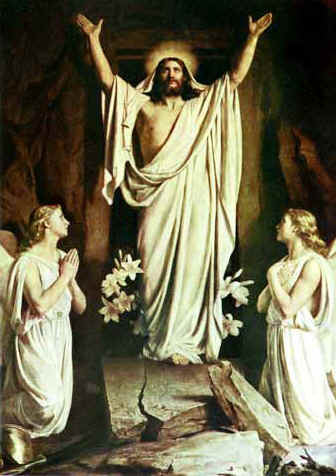
But no. Nothing short of bodily resurrection could make up for so great a loss. For the man Jesus to redeem Himself and his followers, He would have to burst from that tomb of his own accord, bathed in light and breathing God’s own spirit, baptizing in fire as the beheaded Baptist foretold, with angels as His heralds and judgment on His lips. He would have to show Himself victorious over not only worldly powers, but over sin and death itself.

Some say he will. Just imagine: the stone rolled back, an empty tomb, the astonished guards. Imagine the embarrassment of the Romans, the recriminations among the Jewish leaders, the joy and wonder among His followers.

Mercy! Who could stand before so great a Redeemer as that?

On that day, may every knee bend at His holy name. May He find a people worthy to be called His disciples.

And may I be one of them.
Poured Out In Love

 Each year during Lent, the Church focuses more intentionally on the Passion and Death of Jesus. How strange it seems that, during the very season we are trying to examine our lives and conform ourselves to Christ, we are also focused on Jesus at His lowest: beaten, humiliated, tortured. Jesus tells us in no uncertain terms that, to be His disciples, we must deny ourselves, pick up our cross, and follow Him—but surely we can stop short of whips and spears, thorns and nails, can’t we?

We are each a unique image of God, and each called to follow Christ in a unique way: to pour ourselves out in love for those around us. Most of us won’t be called to martyrdom in the bold and bloody sense—though some of us may. Most of us won’t be called to leave behind family and friends for foreign missions or cloistered religion life— but, God willing, some of us will.

Instead, most of us will be called to holiness in the context of ordinary, everyday lives: working, raising a family, pitching in where we can. This may seem easier than facing blades or beasts in the Coliseum, but I’m convinced it’s not. St. Josemaria Escriva warns us, “Many who would willingly let themselves be nailed to a Cross before the astonished gaze of a thousand onlookers cannot bear with a Christian spirit the pinpricks of each day! Think, then, which is the more heroic.”

To make a once-for-all choice for Christ, in the heat of the moment, facing certain death and eternal glory, seems downright doable compared to 70, 80, 90 years of making a million moment-by-moment choices to love the person in front of us, in every circumstance. Daily discipleship is difficult—and it’s made more difficult when we attempt to carry crosses we were never meant to bear.

Think about it: Each of us is called to be a disciple, and each disciple is called to pick up his or her cross and follow Christ. But since many people choose not to be disciples, we have a lot of crosses lying around, waiting for someone to drag them away. All these crosses can make it difficult to discern which is ours. They can cause us to stumble and fall. They can cause us to neglect our own cross in a misguided effort to clear the path.  But if we take the time to identify our own cross—the one God made precisely for our particular strengths and weaknesses—and if we shoulder it and keep our eyes fixed on Jesus, who walks the path ahead of us, He will show us the way.

This, at last, is discipleship: Not to drive ourselves into the ground trying to do everything for everyone, but to ask God what He wants from us, to listen for the answer, and to resolve to do exactly that—to embrace the cross the Carpenter has crafted with each of us in mind, and leave the others.

Imagine a parish of such disciples, all doing exactly what God has asked of them—no more, no less—and all moving the same direction, pouring themselves out in love on a world that desperately needs it.

Such a parish would change the world, because unlike time and energy, love never runs out.

The Stray: A Christmas Poem


The Stray
Well-groomed for a shepherd, fragrant for a sheep, the sleepless lad lurches, shuffle-stomp, shuffle-stomp, out of town toward the hills. Dawn spills like too much wine, red above the ridges where flock and friends, abandoned, spent the night. Alright, he mutters thickly, steadying himself as for a blow. The sun is up, and now they know.
But what a night!
Ahead a man and donkey walk a slow, steady pace. Full of grace, his wife and infant rock and sway. Clop. Clop. Both stop—and pick their path with care. They see him there. The man measures with a carpenter’s eye. Radiant and shy, the woman offers him a smile as they pass. An ass, an old goat, and a kid—he returns a toothy grin—
But what a woman!
Head pounding, heart pounding, hung-over still. Narrow path, tumbled rock, all uphill. Grumbling and stumbling, the stray finds his way to the herd. Not a word. They are like pilgrims resting at a journey’s end, world-weary and at peace. Eyes bleary, still he sees they also spent the night in light and song. Something’s amiss, he says to one.
What did I miss?

J. Thorp
12/15/16

We Are a Pilgrim People

“I’ll be home for Christmas, if only in my dreams.”
 
We are on the home stretch: a week out from the blessed Feast of the Nativity, Christmas, when we celebrate the birth of our Savior, Jesus Christ. Many of us, however, feel as though Christmas has been upon us for weeks now, an immense burden of gifts, lights, music, and cheer under which we labor to breathe—like a lone elf struggling to load the loot of the world into a glossy red sleigh.
 
The first Christmas was uncomfortable for a different set of reasons. In the days prior, a newly-married couple traveled from Nazareth to Bethlehem with a few essentials and a donkey. They traveled not by choice, but by order of the emperor in Rome. They arrived not to familiar faces, food, and comfort, but to a town crowded with distant kin and strangers, and the crudest of accommodations: a dugout-stable-turned-makeshift-nursery where the woman would give birth to a son.

It turned into celebration of sorts, I suppose, as angels summoned shepherds from the hills to the town to greet the newborn as they were, dirt-poor and smelling of sheep. A star, too, beckoned Magi from the East, strange and majestic, in rich robes and bearing gifts too generous for the circumstances. (I wonder if Joseph might have gripped his staff a little tighter, wondering how he, his wife, and son would make it back across the dangerous country alive while carrying gold, frankincense, and myrrh.)
 
Imagine a Christmas celebration in which only your third and fourth cousins showed up, along with the local indigent population and three fabulously wealthy foreigners—and then you had a baby the basement. Perhaps the stresses of this Christmas are more manageable from this perspective.

Mary and Joseph were displaced—from Nazareth to Bethlehem for the census; from Bethlehem to Jerusalem for the presentation of Jesus at the Temple; and in exile to Egypt, to protect their son from the murderous intent of Herod. Even as a baby, “the Son of Man has nowhere to rest his head” (Matthew 8:20).
 
In LIFT this month, we are completing our study of the Mass. As an introduction to the adult and teen lesson, we are watching a short video from elementsofthecatholicmass.com on the role of parishioners in the Mass. As the video explains, the word parishioner comes from the Greek work paraoikos, meaning pilgrim—it’s the same Greek word that gives us the English word pariah, which means outcast.
 
We don’t belong here. We, like the Holy Family, are a pilgrim people, en route to our true home with God in heaven. The Church is the ship that carries us: the ark which preserves God’s people from the storms and waves that batter and drown the rest of the world.* Let us take refuge here from the maelstrom—the dizzying spin the world has put on Christmas—and draw near, instead, to Mary, Joseph, and the newborn king of kings.
 
* * * * *
*In fact, the area of the church worship space where we sit, which we commonly call the sanctuary, is technically called the nave—which comes from the Latin word for ship.

Who Reigns In Your Heart?

Put no trust in princes, in children of Adam powerless to save. 
Who breathing his last, returns to the earth; that day all his planning comes to nothing. – Psalms 146:3-4

This Sunday is the Feast of Christ the King, celebrating the authority and lordship of Jesus over all of creation and marking the end of the liturgical year. Falling just before the all-consuming holiday season and the secular New Year, this feast provides us with an opportunity to reflect on what holds mastery over our hearts before the avalanche of turkey and tinsel. And since it specifically celebrates Chris’s kingship, it takes on special relevance in the aftermath of a contentious election.

Who is this Jesus who rules over all? We are blessed to have an immense icon of Christ the King in the dome of our church. This image, called Pantocrator or “ruler of all,” depicts our glorified Lord looking down from heaven, holding the Book of Life by which we are judged (God’s justice) but with His right hand raised in blessing (God’s mercy). The three-rayed halo behind His head and Greek letters in the image identify Him simultaneously as Jesus Christ (IC XC) and as “I Am Who Am” (WON), or God Himself.

This God-man is the same Jesus who was born in a stable; who grew up a carpenter’s son; who ate with sinners and challenged authorities; who said to His followers, “This is my Body; take and eat;” who suffered humiliation and torture to die on a cross; who rose from the dead and ascended to heaven; and who sent the Holy Spirit to guide the Church in these latter years. This is the same Jesus about whom Nathanael asked, “Can anything good come from Nazareth?” (John 1:46) and Thomas said, “My Lord and My God!” (John 20:28).

We have a second icon of Christ behind the altar and tabernacle, depicted in the womb of the Blessed Virgin. Though within His mother, He does not appear as an infant or as any child we have likely ever seen. His high forehead and discerning eyes convey wisdom and judgment beyond His years. This is the same Jesus that St. Augustine calls, “ever ancient, ever new” and that dwells in the tabernacle, in the Eucharist. He is the very Word of God referenced in John’s Gospel:

In the beginning was the Word, and the Word was with God, and the Word was God. He was in the beginning with God. All things came to be through him, and without him nothing came to be. What came to be through him was life, and this life was the light of the human race; the light shines in the darkness, and the darkness has not overcome it. – John 1:1-5
What joy, what hope, what light we have when He who is the very source of all blessing sits upon the throne of our hearts—and what sorrow, what despair, what darkness we experience when we yield His seat to idols: to fallen persons or passing things that will not—cannot—sustain us.

Advent begins next weekend: four weeks of penance and preparation Christmas. As the Church year ends and we prepare to welcome the newborn King of Kings, let us ask ourselves in whom we have placed our hope and trust. What or whom have we set upon the throne of our hearts? The time is now to elevate Christ to His proper place, that all else may fall into place and peace may prevail.