A Higher Education

As we crossed the plains of North Dakota this weekend, I made a surprising discovery: my college roommate Frank is now the Honorable Franklin R. Parker, assistant secretary of the Navy.

We were headed to Bismarck to register Brendan for his first-year classes at the University of Mary. Jodi was driving, and I sat hunched in the back seat of our little commuter car, giving Brendan and his mom some quality time up front. We had been talking to him about things that change as you move through life: interests and priorities shift, people you were close once slowly drift away. “It just sort of happens,” I said. “Often it’s not even intentional: my buddy Frank from Yale and I used to be in touch a couple times a year — we would at least exchange letters at Christmas — but this last winter I didn’t hear from him and our Christmas letter bounced back to us. They must’ve moved.”

I sat a moment, then said, “Of course, he is an attorney and has worked for some pretty big firms, so I could probably find him again in just a few minutes on Google.”

* * * * *

I pulled out my phone, entered “franklin r parker,” and voila: “President Obama Announces More Key Administration Posts.” To be sure this was, in fact, Frankie Parker of Durfee Hall D-21, I dug deeper and found his official bio page on the U.S. Navy’s website

That’s him. That’s guy I roomed with freshman and sophomore year, whose parents took us to see Ray Charles perform in New Haven, who stood up as a groomsman in our wedding at tiny St. Liborius Catholic Church in Polo, South Dakota, and whose own wedding  was a Chicagoland mashup of African-American and Asian influences with a little Cherokee thrown in.

I shared my discovery with Jodi and Brendan, and for the next hour or more, periodically shook my head, murmuring, “Wow…Frank Parker…working for the President…who knew?…assistant secretary of the Navy..huh…”

If I’m honest, a small part of me was, not jealous, but curious if I could have been something more. As evidenced by his resumé, Frank is a smart fellow, and he’s always been better at making connections than I am — but I did well in college and well in every job I’ve had since. What is it that separates two men with an Ivy league education and a liberal arts degree, such that one goes on to graduate school, prestige, and power, and the other works retail, starts a family, and lands at his local church as faith formation director?

Ever have that happen? It’s not envy — I don’t begrudge him his success or even want what he has. It’s  more like a form of pride or vanity, wondering if I could have been more than I am.

* * * * *

Ultimately I remembered something I wrote during freshman year at Yale: I came East for an education. It was never about a career for me, and I never planned to stay there. I came to learn all I could at one of the great old universities our country has to offer. And I did.

Brendan is a smart young man. He can do almost anything he sets his mind to, and for years his goal was the Naval Academy and the Marine Corps, until he began to grow deeper in his Catholic faith and realized he wasn’t sure he could trust our country’s leadership to deploy him to only just wars. Then his focus was engineering, until he began to think specifically about what he liked (understanding how things work and making stuff, like his Dziadzi) and what he didn’t like (lots of math, computer work, and CAD, like a professional engineer). He’s always loved history and enjoyed theology and literature — so he began thinking about studying, teaching, and writing about the things that he loves.

I can’t fault him for that.

* * * * *

We spent the night in the Expressway Inn in Bismarck (nicer and quieter than it sounds) and the next morning, headed out of town and up the hill to the University of Mary for Mass and registration activities. I hadn’t visited yet, and though I knew it was small, I hadn’t imagined what small might look like in this case. My last higher-education employer, the University of Minnesota, has about 51,000 students; my previous higher-ed employer, Ferris State University, boasts 14,500, and Yale has around 12,000, with a bit more than 5,000 undergraduates.

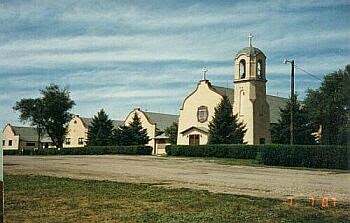
UMary, by contrast, has a total enrollment of just 3,000 — a tiny cluster of stone and concrete buildings hunkered on the edge of a high bluff overlooking the Missouri River. The buildings aren’t beautiful in any conventional sense; built in the middle of the last century for the wear and tear of young people and the wind and weather of the plains, they are low, solid structures with the quiet strength of stones unmoved by the world and its ceaseless spinning.

* * * * *

We started our day in a tiny chapel, well lit and peaceful, with a handful of prospective students and their families, current students, and administrators. We were first to arrive just behind the priest, a gray-haired Benedictine, and prayed in silence until Mass began. It being the feast of St. Mathias, the readings were focused on the selection of Mathias to replace Judas among the Apostles and Jesus’ command to love one another.

In his homily, Fr. Anthony contrasted our current presidential election process with the prayerful selection of St. Mathias, and contrasted the fame and power of our political leaders with the relative anonymity of St. Mathias both before and after his selection: basically the only things we know for sure are that he was with the other apostles in following Jesus from the beginning through the Resurrection and that he died while sharing the faith with an unbelieving world. He does not appear to have been self-seeking, but to have had one desire: to “to go and bear fruit that will remain” and to lay down his life.

I have reflected on his homily numerous times since, and while I don’t fault Frank for working hard to be where he is in his life, I am no longer curious where else I could be.

* * * * *
After Mass I told Brendan and Jodi I had a tremendous sense of peace about UMary. “This is a good place,” I said.
The original school was founded by Benedictine nuns at what was, at the time, the end of the railroad tracks headed West. During the opening session of the day, the current religious sisters who live in the monastery at the edge of the campus came to pray over the incoming students and their families. They ended their prayers with a beautifully harmonized sung blessing, and we were separated into smaller groups from the rest of the day. 
Brendan was assigned an upperclassman to his liking: a triple-major in history, Catholic studies, and secondary education; the drummer in a rock band who was studying Polish in hopes of doing graduate work in Poland. Jodi and I talked with various campus representatives, including an administrator in Admissions who said our parish’s reputation precedes us and asked what we thought it was that makes St. Michael a special place. We also wandered the campus, talking and taking a few photos, and I ended the day with a sense of great joy: I believe Brendan is where he belongs.
It is true, practically speaking, that students should enter college with some sort of plan for what they want to do with a degree — otherwise the time and money are potentially wasted. But I believe it is also true that, for good students, a structured approach to the liberal arts can help create flexible, resilient young men and women who are prepared to lead, to sacrifice, and to preserve our culture in the days to come. I believe, in choosing UMary, Brendan has chosen a higher education (higher even than Yale in the ways that count most), and I’m proud and excited to see where this path leads.

20 Years a Fool: A Resurrection Story

One of the things I gave up for Lent this year was the last word. It might seem an odd thing from which to fast, but on the home front I crave the last word, savor it, seek it with such reckless abandon that I scatter piles of lesser words about the house until at last I have it. In the past I have recognized this fault in myself: that I want to be right, or at very least, heard and understood, in all things. I manage to tamp down this tendency in public, but in private, in flourishes.

Jodi knew of my sacrifice, and just prior to Holy Week, I asked for her honest assessment as to how much progress I had made. She hesitated a long moment, so I said, “It’s alright — I need you to be straight with me.”

She said, “Honestly, I haven’t noticed much of a difference.”

Just as I thought. I knew I hadn’t done well in this regard — and considering the number of times I know I bit my tongue or choked down one last pointed comment, I now knew how gluttonous my appetite for the last word had truly been.

Lent was not a complete loss, however. For one thing, my self-conscious failures led me to look for little things I could do to make up for being a jackass: simple acts of love and kindness like making the bed, which I have rarely if ever done of my own accord. For another, after this sobering conversation with my bride came Holy Week, and the sacrament of Penance, and the Triduum.

Like so many of the faithful, Holy Week crept up on me with alarming quickness and stealth. Once I realized time was short, I redoubled my efforts to hold my tongue, with at least some renewed success. On Tuesday, Jodi and I went to Confession at Mary Queen of Peace, to a young priest who cut us both to the quick, condensing a plethora of sins to a single, focused flaw, then concocting a penance to match.

In my case, he said something like this: “A simple definition of love is giving of yourself to another. A simple definition of pride is claiming for yourself what isn’t yours. All yours sins seem related to this tendency to take things for yourself: wanting to look better than you are to those around you, wanting recognition for what you do, even taking on more responsibility for what’s happening at work or in the world than belongs to you.”

For my penance, he asked me to find three people or causes to which I could give of myself before the end of Holy Week. And it helped.

After work on Holy Thursday, I shut off my computer and phone until after the Easter Vigil. It’s remarkable how peaceful it can be to escape the endless barrage of email and social media “news,” especially in an election year. Nevertheless, in the wee hours of the morning on Good Friday I found myself unable to sleep, and finally rose around 4:30 a.m. to pray and journal.

I sat near the front window with a cup of black coffee in the foreground and choral music in the back; two candles providing a flickering light so as not to deaden the dawn when it arose. My mind wandered across the years of marriage and family life, and I thought of St. Joseph, who is never quoted but ever present in the early life of Jesus in the gospels — the epitome of the “strong, silent type”; the carpenter, whose rough hands and faithful heart made dead wood bloom. Here was a model of a husband and father: quiet, hard-working, life-giving.

Life-giving…

For nearly 20 years of marriage, I have accepted the truth that I married well: a woman of beauty, faith, and virtue who was meant to guide me to Christ. For those same 20 years, I have acknowledged her as life-giver, and myself as a sponge, simply soaking up the love she pours forth.

While all of these things are true, for 20 years I’ve used them as a crutch — something to lean on in my weakness. It sounds so sweet and humble to say, “I’m not worthy,” but when did that become good enough? Should I not strive to become worthy?

For the past several years Jodi and I have helped with engaged couple retreats at our parish. Many times over those years we’ve helped to share this analogy between marriage and the Holy Trinity: God the Father loves God the Son; the Son receives that love and reflects it back to Father; and that love between them is God the Holy Spirit, “the Lord, the Giver of Life.” Similarly, a husband loves his wife; the wife receives that love and reflects it back to her husband; and the love between them becomes so tangible that it gives life — sometimes literally, resulting in a third person.

For years I’ve helped share this message without directly applying it to my role in our marriage. The husband is the life-giver. The husband initiates. His bride receives what he gives, transforms it, and gives it back — but I’m meant to the source. Not a sponge, but a spigot.

I sat, dumbfounded, as dawn arose. All these years of “wearing the pants” in this family, and Jodi has been trying to do both our jobs. When the sun finally rose, I felt like a new man. Or rather, a man rising to new life.

Dust that we are, a day later I was struggling to recall these revelations and was again longing for a sign from God to guide me — like those whom Jesus fed with a few loaves and fishes, who, the very next day, asked Him, “What can you do?

So I resolved to write them down and share them. May they be my own little resurrection story: after 20 years, a fool became more the man he is called to be. Amen.

These Least Brothers of Mine…

My brothers and sisters, show no partiality as you adhere to the faith in our glorious Lord Jesus Christ. For if a man with gold rings and fine clothes comes into your assembly, and a poor person in shabby clothes also comes in, and you pay attention to the one wearing the fine clothes and say, “Sit here, please,” while you say to the poor one, “Stand there,” or “Sit at my feet,” have you not made distinctions among yourselves and become judges with evil designs? — James 2:1-4 

Last night Jodi, Brendan, and I joined a friends of Brendan’s and his parents at Fogo de Chão Brazilian Steakhouse in downtown Minneapolis to celebrate their senior year, their acceptance into the college(s) of their choice, and a backlog of birthdays. Fogo is a carnivore’s paradise, with such an abundance and variety of fire-roasted meats that I kept thinking of Scripture’s forgiving father ordering the slaughter of the fatted calf to celebrate the prodigal son’s return. Server after server stopped by our table with skewer after skewer of beef, pork, chicken, and lamb, carving portions for us until we flipped our green coasters to red to signal, “No mas!” (or “não mais,” I supposed, in Portuguese).

We had a great time with the boys, and ate a delicious meal the likes of which we are unlikely to enjoy again any time soon, given the price. All the way home, however, and all through last night and today, I’ve been haunted by a man I do not know. I saw him only in passing as we looked for a place to park, but the impression he made is indelible.

We drove past the restaurant on Hennepin, and three or four blocks up, turned left to loop around and look for parking garage. As Jodi turned the corner, I saw what I thought was a youth seated on a skateboard, leaning against a building. As we drew nearer and went past, I beheld a man. In those brief seconds as we passed, this is how he appeared to me.

Ecce homo: Click to view full-size sketch.

He was legless, in a grubby t-shirt and dark pants cut short and sewn shut or folded under. His face was of no obvious age, but worn and creased with hard living, and his thin hair stood up in patches from his scalp. I saw that his left hand was on the sidewalk to stabilize and propel himself. His other arm was raised as though gesturing — it ended abruptly in a rounded, red stump several inches short of where his right hand should be.

Brendan saw him, too. We discussed briefly how hard it must be to live in the city, presumably on the streets, in such a condition. Then, determined not to spoil the boys’ celebration, I dropped the subject. We turned left again, backtracked a few blocks, parked, and went in to feast.

As we ate, surrounded by such abundance, I thought of him. As we paid for our decadent meal, I thought of him. As we left Minneapolis in a rush of cars, under the yellow glare of a thousand street lights, I thought of him.

Today it occurred to me that maybe some sense of injustice over the pleasures we enjoyed at dinner exaggerated his state in my memory — but I believe that was the Devil trying to lull me back to complacency. When I showed the sketch above to Brendan, he said it’s what he recalls, too. A few moments on Google turned up this brief newspaper article: apparently he’s been downtown at least since this spring.

Perhaps he is a homeless vet our country has forgotten. Perhaps he is a junkie. Regardless, no man deserves to live with their last good limb pressed to pavement, unable to see above the hoods of the stopped cars as he crosses the busy streets. How will he stand to move about the city in winter, when the salt and road grime stings his fingers and the wind bites his cheeks? Does he take the bus? Who helps him get aboard? How does he keep his skateboard with him, use the restroom, avoid those who would cause him harm? How will he survive?

Had we been walking past, not driving, I’m not sure what I would have done for him. How could I have helped? Given money? To what end? Traded shirts with him? Perhaps, on the feast day of Blessed Teresa of Calcutta, I would have stopped, hunkered down, and acknowledged him, eye to eye, man to man.

Or perhaps I would have avoided eye contact and kept walking, then muttered a guilt-ridden Hail Mary under my breath.

On the way to church this morning, I urged the kids to try offing the Mass for someone in particular, to see if that helped them focus their prayers and remain present the entire time. I committed myself to offering the Mass for this man, whom we drove past and may never see again, but who has cracked my stony heart. I had not previewed the readings for this Sunday; now that I’ve heard them, I am convinced the Lord is working on me. While it is not sinful to enjoy in moderation the pleasures of earthly life — food and drink and friendship — we must not be blind or unkind to those who seem unlovable. If we prefer the company of others to the company of those in need, we fail to follow Christ.

Lord Jesus Christ, you teach us, “Whatever you did for one of these least brothers of mine, you did for me” (Matthew 25:40). Help me, Lord, to hear the cries of the poor and to show kindness and mercy in word and deed. Forgive those times I have failed to love those you love, and strengthen me to do the hard work of charity among these “least brothers” of yours. Help me to step outside my comfort zone and serve and comfort them in prayer, word, and deed. Amen.

Blessed Mother Teresa, pray for us.

LIFT Links: Holy Week and Easter Traditions

Icons of Holy Week: Palm Sunday, Holy Thursday, Good Friday, and Easter

I’ve been a little lax on LIFT Links lately (that’s a lot of Ls) — and now, as we’re headed into Holy Week and the Easter Season, I need to make up for lost time.

First, the basics. Until I met and married Jodi, I was vaguely aware that Palm Sunday was the Sunday before Easter, the Good Friday was the Friday before, and Easter was a pretty big deal–right up there with Christmas. At some point early in our relationship, my bride informed me that her family attended Mass at least three (and sometimes four or more) times during Holy Week, the week between Palm Sunday and Easter Sunday. As I’ve said more than once, they went to church on days I didn’t know church was open!

St. Liborius Catholic Church, Polo, SD

Jodi’s family, and many of the other parishioners at St. Liborius Catholic Church in Polo, SD, went to church at every opportunity during the Holy Triduum: Holy Thursday, Good Friday, the Easter Vigil on Holy Saturday, and morning Mass on Easter Sunday. Today, our family goes on Holy Thursday, Good Friday, and either Holy Saturday or Easter Sunday. It’s a beautiful way to enter into that period of uncertainty and darkness, then light and joy, that Jesus’s disciples experienced between the Last Supper and Christ’s Resurrection.

One more thing before I share some links: attending Mass on every Sunday and all Holy Days of Obligation is one of the five Precepts of the Catholic Church — the minimum requirements to be a practicing Catholic. Receiving Holy Communion is not required every Sunday, however, receiving Holy Communion at least once during the Easter season (which is Easter Sunday through Pentecost Sunday) is required. Receiving the sacrament of Reconciliation once a year is also one of the precepts — and since being cleansed of all serious sins is required to receive Our Lord worthily, Lent is a great time of year to get to Confession so you can receive Holy Communion at Easter.

Now, some links:

Have a blessed Holy Week and Easter, friends!