Motherland of Mercy, Part 1: St. Maximilian Kolbe

Blogger’s Note: I have no set order for these Sacred Heart posts, but am writing as Providence provides and the Spirit moves. Today the readings in 33 Days to Morning Glory shifted to focus on John Paul II, and I was called back to July 2016, World Youth Day in Kraków, Poland

Rome may be the the Eternal City and the seat of Catholic teaching authority, wisdom, and creativity in the world, but it seems to me that Poland is its bleeding, beating heart. Ravaged by wars and neighboring countries, ripped apart and reconstituted, invaded and occupied, the Poles have fought, suffered, and died for centuries, surrendering everything they had except their faith. Today, Poland is the homeland of ten 20th-century canonized Catholic saints and, I would argue, serves as the counter-cultural, Catholic conscience of Europe.

In summer of 2016, however, three specific Polish saints loomed large over World Youth Day in Kraków: the martyr of Auschwitz, St. Maximilian Kolbe; the visionary nun, St. Faustina Kowalska; and the prophetic pope, St. John Paul the Great. Each in his or her own way lived out the love of Christ in the world, pouring themselves out for the salvation of souls. Each embodied His suffering Sacred Heart. Over the next three days I will look at them, one at a time, and explain as best I can what captured my imagination about each of them. Continue reading

Journey to the Heart: A Timeline

One of the obstacles to sharing this roundabout path to the Sacred Heart with you is that in many cases it is only visible in retrospect. The sequence is hazy at this point, even to me. So I’m going to start with a timeline, which will hopefully serve as an outline for the sequence of posts to come. Though I may not write them chronologically, we ought to be able to plug them into the timeline in the end.

Part of the reason for doing this exercise at all is that every so often someone hears me say something like, “God has me here for a reason,”  “God told me such-and such,” or “God is leading me toward X,” and asks me what that means. God doesn’t speak to me audibly, but He opens some doors—in my heart, in others, and in the world—and closes others. This timeline and sequence will hopefully show what I mean.

We begin nearly two years ago… Continue reading

We’ll Always Have Poland

Poland Family

Last Sunday we were blessed to host a party of sorts. What started as my attempt repay the “Poland daughters” who took me out to dinner for my birthday last fall  turned into a mini-World Youth Day reunion, with many of the teens and a couple of the adults from our trip to Krakow a year ago.

We visited, prayed together, and shared a meal: grilled kielbasa and pierogies, pasta and sauce and salad, cookies and root beer floats. We shared our favorite memories and laughed and laughed. We talked about future plans—many of my Poland daughters are starting college this year. And I think we all longed to go back to visit the Motherland.

The next morning I thought I should re-share the post I wrote after the pilgrimage—only to realize I never wrote a recap. I thought about doing a standard Top-10 list, but no matter how I counted or grouped things together, I had too much to share.

So I’ll keep this to three moments that stand out to me above the others. Continue reading

Aesthetic Witnesses: Using Beauty to Build the Kingdom

Art must make perceptible, and as far as possible attractive, the world of the spirit, of the invisible, of God.”

The quote above is taken from Pope John Paul II’s “Letter to Artists,” published on Easter Sunday in 1999. I’ve been reflecting on that letter in terms of the saint’s call, beginning in the late 1970s, for a new evangelization, and also in the context of young Karol Wojtyla’s cultural resistance efforts with the Rhapsodic Theater during the period of Nazi control of Poland. The more I reflect, the more convinced I become that the arts—visual, literary, theatrical, and musical—as well as beauty defined more broadly, are ideal tools both of evangelization and of Catholic resistance and encouragement today.

Beauty in evangelization

Beginning with the artist as an image of God the Creator, St. John Paul II makes a strong case for the special vocation of the artist in service to the true, the good, and the beautiful; their ideal role as revealers of the Incarnation and the Good News; and the necessity of art to the Church and vice versa. Continue reading

God’s Love Is Mercy

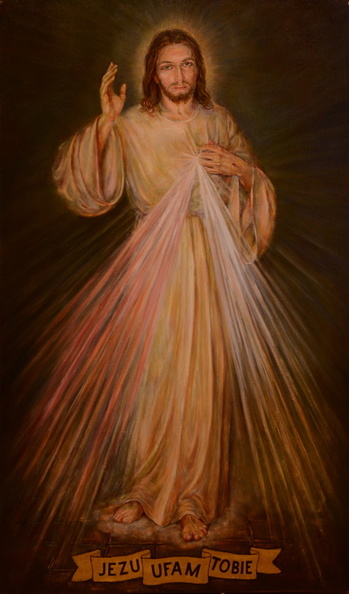
84764-divinemercy“Proclaim that mercy is the greatest attribute of God.” – Jesus to St. Faustina

Devotion to Divine Mercy is not every Catholic’s thing. Some people struggle with the image of Divine Mercy: Jesus, His right hand raised to bless and heal, His left indicating his heart, from which rays of red and white, symbolizing blood and water, pour forth as a fountain of mercy for souls. Every version I’ve seen has been a bit mysterious and unsettling—which seems appropriate, given that it’s a vision of the resurrected Christ.

Some don’t like the chaplet, which is simpler and more repetitious than the rosary. Some consider the visions of a poor Polish nun to be private revelations: fine for her, but not necessary for us (even though she is a saint and was canonized by another saint).

Continue reading