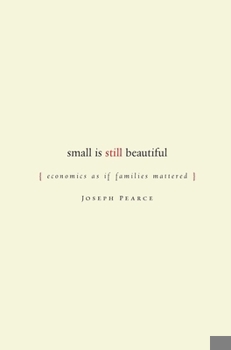
Book Break: Small Is Still Beautiful: Economics as if Families Mattered

Providentially, my reading lately has all been cut from similar cloth: our relentless pursuit of better, newer everything and the dangers it poses to our humanity and health (physical, mental, and spiritual). This latest volume, Small Is Still Beautiful: Economics as if Families Mattered by Catholic scholar, biographer, and author Joseph Pearce was a gift from our Bismarck family, and is a reiteration and expansion on E.F. Schumacher’s 1973 classic Small Is Beautiful: Economics as if People Mattered, with a particular focuses on the environment, food supply, and land use.

In my 2017 review of Schumacher’s book, I described a couple non-academic objections and numerous things I loved about the book. I also said it seemed like the sort of book that had been read, admired, and forgotten in the powerful current of worldly progress.

Continue reading

Wednesday Witness: How Do I Love Me?

How do I love thee? Let me count the ways…

The 19th-century poet Elizabeth Barrett Browning asked the question above in her Sonnet 43. This morning, I ask a different question: How do I love ME?

I am currently reading the book Happy Are You Poor by Father Thomas Dubay, SM. It is a hard, convicting read about taking seriously the Gospel’s words regarding wealth, poverty, possessions, and sharing with those in need. What has struck me hardest thus far is Father Dubay’s insistence on the actual words of Jesus—currently, “You shall love your neighbor as yourself” (Matthew 22:39, cf. Leviticus 19:18).

How do I love myself? Among other ways:

Continue reading

Wednesday Witness: Borders and Boundaries

A few years ago, I worked for the Church of Saint Andrew in Elk River. The parish had a strong charism of service to those in need and a growing Hispanic community. I was able to get to know a few immigrant families through the Faith Formation and sacrament programs, as well as the parish’s Hispanic liaison. The experience gave my valuable perspective on the conditions that might cause someone to uproot their family and cross our southern border (whether legally or illegally) in search of a better life.

Saint Andrew also had an annual mission trip to Mexico. Invariably, the parishioners who traveled and served in the barrios south of the border came back with one overriding impression: Poverty there is often a deeper, darker thing than poverty here at home.

As a result of these encounters, I often found myself asking: What would I be willing to do to protect and provide for my family?

Continue reading

Wednesday Witness: Step Outside Yourself

But God said to him, “You fool, this night your life will be demanded of you; and the things you have prepared, to whom will they belong?” – Luke 12:20

Not long ago I met a woman going through serious medical and financial difficulties. For many weeks, she had been off work and in severe pain due to a spinal injury. She was behind on her bills, immobile most of the time, barely able to care for herself and her child. Friends and family offered what support they could, but even the very best prognosis put her a month away from working again, provided she still had a job.

At the end of a tearful conversation, I offered to pray with her and for her. She gratefully accepted, and I asked the Lord to heal her, to address her challenges, to protect her family, and to guide those around her to know how best to help.

When I stopped to ask if she would like to add anything, she said yes—and then proceeded to pray for a friend who was going through hard times and needed a spiritual boost. She prayed earnestly, by name, for this other person, then thanked God for all the help He has provided to her so far. She never once mentioned her own situation.

Continue reading

Wednesday Witness: Take a Minute

In last week’s Wednesday Witness column, I described one of several homeless men and women who frequented Yale’s campus when I attended in the 1990s. I worked for the graduate School of Music all four years, and one of my first and primary duties was walking the entire campus, distributing or hanging concert flyers and posters at various buildings, businesses, and kiosks. I made the rounds at least once a week; as a result, I saw the local homeless frequently, and they saw me.

During my first year, one man, in particular, kept his eyes open for my brown leather ballcap and black poster portfolio. He was an older fellow, creased and grimy from years on the street, with lank and thinning gray hair, well-worn workman’s clothing, and the unmistakable aroma of body odor and booze. Whenever he saw me, his pale eyes would pull into focus, and his mouth would break into a smile that was equal parts crooked yellow teeth and no teeth at all. He would rise (if seated), reach out to shake my hand, and start the same conversation.

Continue reading