The Still, Small Voice of God

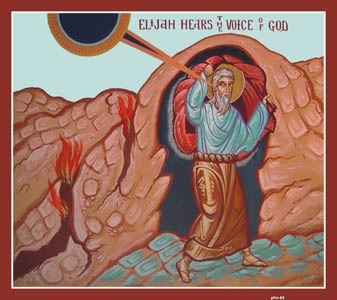
There was a strong and violent wind rending the mountains and crushing rocks before the LORD—but the LORD was not in the wind; after the wind, an earthquake—but the LORD was not in the earthquake; after the earthquake, fire—but the LORD was not in the fire; after the fire, a light silent sound.  When he heard this, Elijah hid his face in his cloak and went out and stood at the entrance of the cave. –1 Kings 19:11-13


It is Tuesday afternoon, and I am writing from home. This column should have been done and in already. It is not, because even a job working for the church is not as important as some things.

Around 9 p.m. last night my youngest son threw up, and my bride informed me she didn’t feel well either.  Between 9 p.m. and 2 a.m. or so, my son was sick probably two dozen times. Jodi did not get as sick, but was as sleepless as Trevor—and I tried to stay clear so that hopefully I could handle little Lily in the morning and keep her from catching whatever this was.

I rose and prayed with Jodi at 5:30. She felt a bit better, and Trevor was sleeping, at last.  At around 6, Emma was sick the first time, and by 8, Lily was complaining that she didn’t feel well either. I was getting ready for work—Day 2 with our new faith formation coordinator, Andrea Zachman—but had the sinking feeling that it was only a matter of time before it hit me, and that my colleagues might rather I stayed home. I was torn—I felt fine, but so had Trevor and Emma before it hit, and I had plenty of work to do. Lily seemed fine, but if she were on the verge, I didn’t want her spreading it to her friends and their families. Jodi was torn, too—she didn’t feel great, but had a mountain of work waiting for her and didn’t feel she could afford to miss a day.

And as fate would have it, we had a blanket of fresh snow on the walk, cars, and roads.

Ultimately we compromised: we both went to work briefly to take care of a few things and bring some additional work home to do around our other duties. We were out of several basic food items in our house, so I fought the blowing snow to stock up on a few things—and now here I sit, writing furiously.

We are all called by God—do you hear Him? I often imagine the God of the prophets speaking to them in a deep, thundering voice, but that’s not what we hear in first Kings, above. Elijah recognizes the Lord in “a light, silent sound”—other translations say “a sound of sheer silence” or “a still, small voice.” God whispers, as it were, drawing us close with his words, into an intimate conversation with Him.

Unfortunately, the noise of the world too often drowns Him out. We hear the voices of our colleagues and bosses ringing in our ears; the ringing of the phone and ping of emails, IMs, and texts…the traffic report…the weather…and nothing of the still, small voice of God.

Excuse me a minute: my other high-schooler, Gabe, just called—he’s sick and can’t drive himself home. Jodi and I need to go get him and the Suburban.

We are all called to a first and universal vocation of holiness. Most of us are called to live out that first vocation in terms of a second vocation to marriage and family life—we sanctify ourselves, our spouses, and our children by imaging God Who is Love. Everything else we do and are come in below that. We are created from Love, and Love is our purpose and end. That’s all. That’s enough.

Because that’s everything.

Be the Bedrock

Everyone who listens to these words of mine and acts on them will be like a wise man who built his house on rock. The rain fell, the floods came, and the winds blew and buffeted the house. But it did not collapse; it had been set solidly on rock. – Matthew 7:24-25

 
A few weeks ago, my daughter Emma shared a beautiful encounter she had during Adoration at Extreme Faith Camp. While praying with her eyes closed, she saw a young girl not unlike our younger daughter Lily, and received the distinct impression that this was Jude, the baby we miscarried before Lily was born. At first she felt sad, reflecting on how she never knew her other sister—until she heard words of consolation from our Lord. After those words, she even invited Jude to sit in her lap, and felt her sister close to her.

Emma used this experience as an opportunity to witness to others: “I guess that what I’m trying to tell you from sharing this story is that the Lord is truly in the Eucharist and he is there to show you amazing things and bring you closer to him. Don’t doubt for a minute that he isn’t truly present because he is. He loves you and wants to have a relationship with you so you can have the amazing life he has planned for you. Also, remember that your loved ones you have lost love you and are praying for you so that you can join them one day in God’s kingdom.”
 
Experiences like these move me deeply, because I didn’t grow up this way. My children are learning at an early age that Jesus is really present in the Blessed Sacrament, that the Holy Spirit moves in their lives, and that God has a plan for their happiness, both here and in eternity. I am an old dog, struggling to learn tricks my pups have already begun to master.
 
I mentioned this to my confessor last week. “We’ve done the best we can for them,” I said, “but activities like Extreme Faith Camp and Core Team have changed their lives. They are experiencing things that I never have!”
 
“You know how this works, right?” he said. “The reason they are able to reach higher than you is because they are standing on your shoulders. You have given them stability—a firm foundation to stand on. So often we hear people say they just want their kids to have what they didn’t have. … But you are actually doing it. You are giving them spiritual gifts.”
 
So many of us want to provide our children with a better life, so we focus on material things, like money, toys, gadgets, or cars; or on opportunities, like extracurricular activities and camps; travel, food, and recreation.  These are not bad things, necessarily, but when we consider all of eternity, we realize we are focused on the wrong kind of better. As St. John reminds us, “the world and its enticement are passing away. But whoever does the will of God remains forever” (1 John 2:17).
 
What is truly good is not of this world at all. By doing as Christ Himself instructed—by loving God, neighbor, and enemy; by leading lives of prayer and striving for holiness; by sharing the Good News that Jesus is Lord and Savior—we can be bedrock for our children: the solid ground upon which they plant their feet and lift their hearts to heaven.

Time Flies: A Thorp Family Update

The most recent photo of us all, with my folks and
sister’s family thrown in for good measure.

I’ve remarked more times than I can count in the past year: “My age doesn’t bother me; it’s the fact that Brendan is heading to college.” It’s my kids’ ages that get to me — not the the additional salt in my pepper, the aches and pains, the fact that I’m often tired and can rarely sleep.

This past year has flown, and with a grad party and a trip to Poland for World Youth Day, the summer promises to be even faster. So I thought I’d offer you all an update on our family before we blink and the leaves fall again.

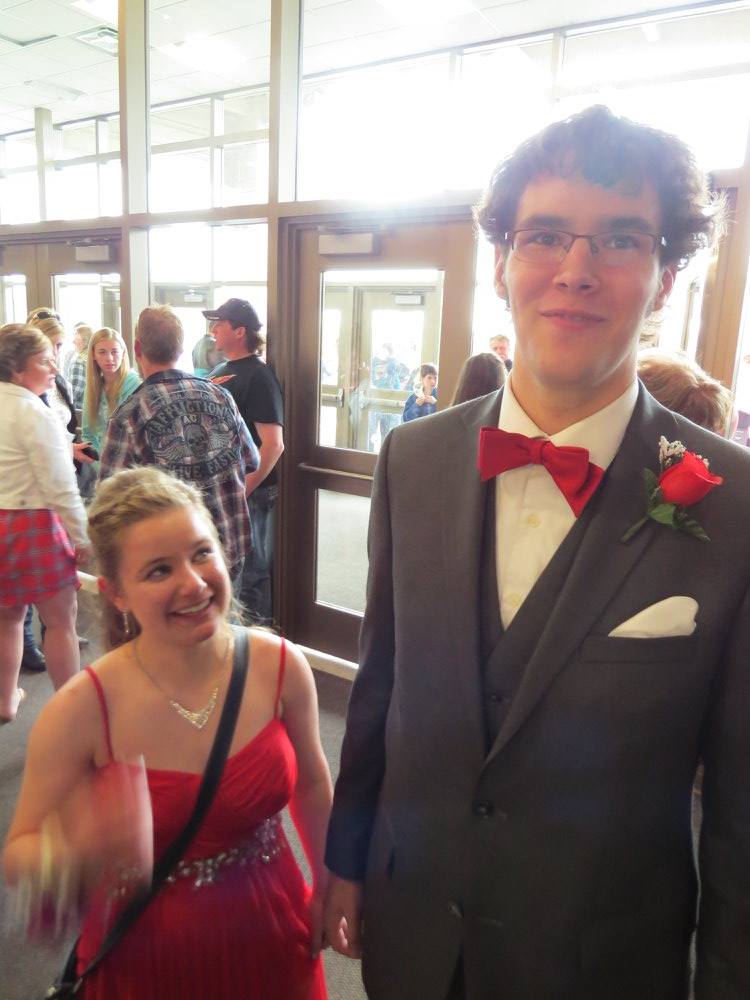
Prom-goers: Brendan and Olivia

Brendan, as you may have heard, is headed to UMary in the fall. He will graduate early in June in the top 10 in his class, with a varsity letter in wrestling and local scholarships from Knights of Columbus Council 4174 (of which he is one of the newest members), the American Legion, and the Hanover Athletic Association. He loves Ultimate Frisbee (actually all four of our teens/tweens do), dabbles in swing-dancing, and is still happily dating Olivia. (Last night’s consisted of Adoration and ice cream.) He is still working at the hardware store, and just starting a second job with a local electrical contractor for the summer. He loves his bass and his music (Foo Fighters is his current favorite band), and yesterday, he bought an acoustic guitar for song writing and kicks. And he has a pipe, which he smokes on occasion.

Swing-dancers: Gabe and Kate

Gabe is now the tallest in our family, by perhaps a quarter inch. He is working on getting his driver’s license this summer, helping our friend’s taxidermy business, and preparing for his junior year of high school. He was confirmed this month, was just inducted into the National Honor Society like his older brother (NHS at our high school does a great deal in service to the school and community), and will be one of the leaders of the high-school pro-life group in the fall. He played soccer but didn’t wrestle this year, and is on the fence about next year — too many other interests, including reading and writing, teaching himself piano, learning Quenya (J.R.R. Tolkien’s Elvish language), and swing-dancing. In this last activity, he works hard and excels — especially when paired with his friend and fellow Lord of the Rings geek Kate. They aren’t dating, just dancing and discerning together.

Emma and two of her flute-playing besties

Emma is easily the tallest female in the house and explored the high-school for the first time yesterday as an incoming freshman. She played volleyball in the fall and is running track this spring — plus playing flute in the band and woodwind ensemble and singing in the middle-school choir. The music, at least, will continue in high school. Emma has followed her brothers to help with the church’s Core Team and is also an avid swing-dancer (which means boys); Gabe’s dance-partner is one of Rosebud’s mentors in becoming a young woman of virtue. Emma dabbles in piano, too; reads voraciously, and bakes like our family is twice the size (and it will be, unless we share her goodies). She is hoping to start baby-sitting soon and wants a new dog almost as much as her dad.

Trevor rocking

Trevor will be our sole middle-schooler next year, and plans to work out this summer in hopes of wrestling on the school team in seventh grade. He is a rhythmically gift version of the boy his father was: a creative thinker and storyteller, easily distracted, heart-on-his-sleeve…but coordinated enough to rock a drum kit (or the kitchen table, a couch cushion, his thighs…), to play basic piano music with relative ease, and to dance to almost any song when the mood strikes him. Also an avid reader and a good student, but with a style all his own: whereas Gabe has a hat collection and wears them on occasion, Trevor wears a brown fedora each day to school. He shows signs of a mechanical knack (another difference from his father) and still loves Legos.

Typical Lily

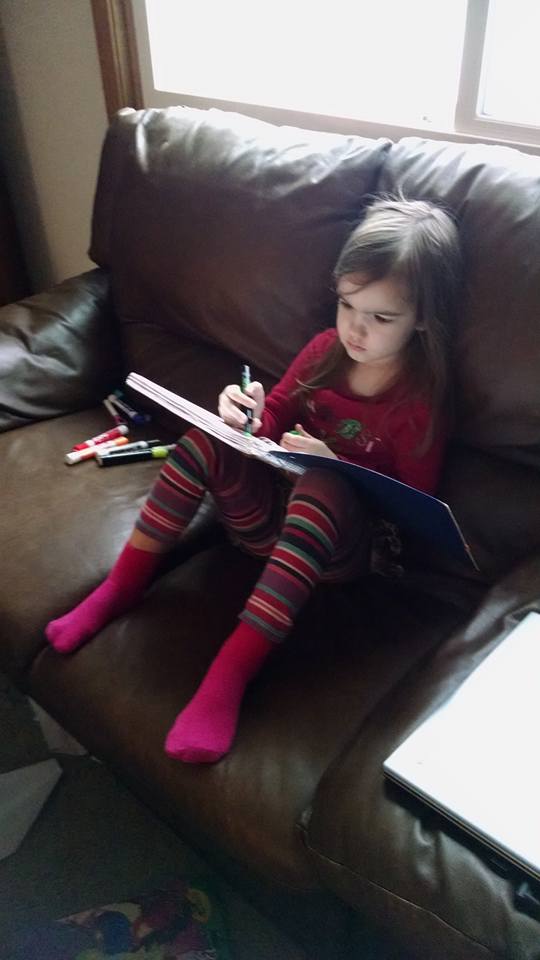
Lily completed her year of Catholic co-op preschool yesterday. She is colorful, funny, opinionated, and creative, with an ever-expanding vocabulary and a precocious sense of humor for a four-year-old, included puns and word-play and physical comedy along with the typical (non-sensical and never-ending) knock-knock jokes. She, too, likes to dance and to watch her swing-dancing elders, and she makes her siblings friends her own whenever she has the chance. She, too, has sprouted in the past year — she is a head taller than her plastic barn playset she so enjoyed last summer — and although she rarely eats a lot at a sitting, she would eat constantly if allowed. And she loves superheroes, especially Batman and the Justice Leaque.

Jodi and I are well — and abundantly blessed, in the midst of such breakneck activity. My bride often says it feels like only a short while ago that Brendan got on the bus for kindergarten the first time, and so it seems to be as well. We will have been married 20 years this August, and for my part, I am as happy as I have ever been.

That said, I had to be reminded of something not long ago, with the help of a priest friend: as Christians, spouses, parents, we have a serious call in this world, which requires a serious, heartfelt response — but none of that means that God doesn’t desire our happiness or enjoyment of this life. He came that His joy may be ours — shame on us if that joy does not pervade all that we do, and all that we are. It can seem terribly romantic to think ourselves unworthy of the blessings in our lives — the soft warmth of the one who lies next to us in the wee hours before waking, or the noise of a full and laughing house — and to strive and sacrifice to show our appreciation and earn our worth. But in truth, we are worthy — intrinsically — as God’s beloved children. So while I must not take my beautiful bride and these five awesome children for granted, I can love them best if I realize that my worth, and each of theirs, comes from our creation in His image and in resting in his embrace.

We are so blessed. As sinners, we don’t deserve it…but what else should we expect from such a God as this?

Last summer…where does the time go?

A Father’s Greatest Fear

This past week, 130 teens from our parish and school received the Sacrament of Confirmation. A few of these young people are already leaders in the community, drawing others to Christ. More will enter into the fullness of the Catholic faith and begin to live as disciples of Jesus, called to follow, and gifted to reach out to their family, friends, and strangers in new and beautiful ways.

But unfortunately, many others will view Confirmation as the last requirement of “growing up Catholic.” They will be happy to be done with religion classes and will begin almost immediately to drift away from the Church.

Last weekend my bride and I spent Sunday afternoon with three other couples trying to raise Catholic families. We talked about cultivating perseverance in our children: strengthening them to look for ways forward when the going gets tough, to have the courage of their convictions, and to fall and rise again. We talked, in particular, about the difficulty of letting our teens make decisions we don’t agree with in order for them to learn on their own those things that our experience could teach but that they won’t hear.

At least two of us agreed that our biggest fear is our children falling away from the faith. My friend said that when he shares this fear, people will seek to reassure him: You are doing everything you can; they have to make their own choices.

“In reality, it’s not about me,” he said. “I worry, because I know how long a road it is to come back.”

I would add to his observation the sobering reality of eternity, heaven, and hell. We don’t like to think about these things—hell, in particular—but Jesus speaks plainly about them. I remember, in my younger years, seeing TV commercials featuring Carol O’Connor of Archie Bunker fame, after he had lost a son to drugs and suicide, saying: “Get between your kids and drugs any way you can.”

If only we took the same approach in the spiritual life.

So how do we keep our kids Catholic? It is not as simple as demanding they show up on Sundays and Wednesdays and go through the motions. All of us have a choice to make, every day, to follow Jesus and make God and our faith the center of our lives. To deny the reality of that choice is to deny the very thing that makes us special in this universe: bodily creations with rational spirits, with intellect and will, so loved by God that He allows us the freedom to choose for or against Him.

Why would anyone choose against God? C.S. Lewis’s short novel The Great Divorce lays out many reasons, rooted primarily in the earthly things—even blessings—that we put ahead of God and cling to at the expense of Him who is all Truth and all Love. God, spouse, children, everything else—is my house in order? Not as often as I’d like.

So what hope is there for our young people? Well, we have a Redeemer who, undeserving though we are, has already suffered on our behalf, and a Father in Heaven who doesn’t want to lose our children, either. He is constantly calling them, and us, to Himself—as singer-songwriter Jon Guerra puts it: “My Father ever chasing/My Chaser ever keeping/My Keeper ever giving/My ever-living God.”

I’ve referenced before an online article called “Keeping Our Kids Catholic: The Indispensable Minimum.” The writer describes our role as parents as forming “a thread of solid formation in morals and Church teaching that will keep even our most errant kids tethered to God—and which God himself can twitch to bring them back someday.”

Ultimately our children belong to the same heavenly Father that we do, and they are His to love, to call home, to save. We are not alone, and we don’t have to do it all. We only have to do all we can.

Eucharist Pep Talk for Parents


[Blogger’s Note: This is roughly the “pep talk”I gave to First Communion parents at the Wednesday, March 16, class — I am posting it here to share it with those who missed.]

The next day, the crowd that remained across the sea saw that there had been only one boat there, and that Jesus had not gone along with his disciples in the boat, but only his disciples had left. Other boats came from Tiberias near the place where they had eaten the bread when the Lord gave thanks. When the crowd saw that neither Jesus nor his disciples were there, they themselves got into boats and came to Capernaum looking for Jesus. And when they found him across the sea they said to him, “Rabbi, when did you get here?” Jesus answered them and said, “Amen, amen, I say to you, you are looking for me not because you saw signs but because you ate the loaves and were filled. Do not work for food that perishes but for the food that endures for eternal life, which the Son of Man will give you. For on him the Father, God, has set his seal.” So they said to him, “What can we do to accomplish the works of God?” Jesus answered and said to them, “This is the work of God, that you believe in the one he sent.” So they said to him, “What sign can you do, that we may see and believe in you? What can you do? Our ancestors ate manna in the desert, as it is written: ‘He gave them bread from heaven to eat.’” So Jesus said to them, “Amen, amen, I say to you, it was not Moses who gave the bread from heaven; my Father gives you the true bread from heaven. For the bread of God is that which comes down from heaven and gives life to the world.” So they said to him, “Sir, give us this bread always.” Jesus said to them, “I am the bread of life; whoever comes to me will never hunger, and whoever believes in me will never thirst. But I told you that although you have seen [me], you do not believe. Everything that the Father gives me will come to me, and I will not reject anyone who comes to me, because I came down from heaven not to do my own will but the will of the one who sent me. And this is the will of the one who sent me, that I should not lose anything of what he gave me, but that I should raise it [on] the last day. For this is the will of my Father, that everyone who sees the Son and believes in him may have eternal life, and I shall raise him [on] the last day.” — John 6:22-40

One of the striking things about this passage is that this conversation happens right after Jesus feeds 5,000 people with five loaves of bread and two fish — and already the people are asking Him for another sign, so that they can believe in Him: “What can you do?” Time and again, Jesus does incredible things, and time and again, the people doubt and ask for another sign.

This passage continues in with the famous Bread of Life discourse, in which Jesus tells the people, “I am the bread of life. Your ancestors ate the manna in the desert, but they died; this is the bread that comes down from heaven so that one may eat it and not die. I am the living bread that came down from heaven; whoever eats this bread will live forever; and the bread that I will give is my flesh for the life of the world” (John 6: 48-51)”

The people, and even his own disciples, struggle with this — it doesn’t makes sense and it offends many of them, so they begin to murmur about it. But Jesus doesn’t back down. He doesn’t say, “Oh, I met this as a metaphor.” He strengthens His language and insists that the people need to eat his flesh and drink his blood. And for many people, this is too much — they stop following Him.

Many Catholics struggle with the mystery of the Real Presence of Jesus in the Holy Eucharist, because it is a mystery. I have struggled with it, too, over the years, and so I pray with the man who asked Jesus to cure his son of a demon: “I do believe, help my unbelief!” (Mark 9:24).

As parents, we have to make a conscious effort of the will to believe this teaching and understand it as best we can. Why? Because as a Church, this is what we believe, and as a parish, this is what we are teaching your children: that Jesus is truly present, body, blood, soul, and divinity, in the Holy Eucharist. We make a big deal out of First Communion, and that’s wonderful. but if we tell our children that Jesus is truly present in the Eucharist, and the next weekend we don’t return to Mass, at some level they will know that we don’t really believe it, because if we did, nothing would keep us away!

As I said, I’ve struggled with this great mystery of our faith, as well — so I want to share a few things that helped me along the way. 
  • The first is something I’ve shared with you all before during First Communion classes. Scripture tells us that, “The word of God is living and effective” (Hebrews 4:12). What God says, is. For example, when God says, “Let there be light,” or let there be plants, animals, or people, it happens. And since Jesus is God, and since God is all good and all Truth, when Jesus says, “This is my body; take and eat,” we can trust that it is, in some mysterious way, truly his Body.
  • The second is something I noticed as I returned to the church and the sacraments: that what appeared to be a bit of bread and a sip of wine affected me in a way that no other bread and wine outside of the Mass ever did. I eat bread and occasionally drink wine outside of Mass, but never do I experience such a sense of peace and love as I do in the Eucharist.
  • The third is something that I began to do self-consciously, as an act of the will: I began to correct my thoughts and words. When I talked or thought about the Eucharist, I began to move myself from referring to the bread and wine, to the consecrated host or the consecrated wine, to the Body and Blood and Jesus. Over time, I began referring to the Eucharist as a person, Jesus, rather than a thing. This made more and more sense to me as I reflected on the fact that we often teach our children not to judge people by their appearances; it’s what’s underneath — what we can’t see — that counts. If the Eucharist is Jesus, it makes sense that the same logic applies: we should not judge the Real Presence by appearance (we see bread and wine) but what is inside and underneath (Jesus’ promise that this is His Body and Blood).
I remember, several years ago, my predecessor Carol asked me if I would lead the closing prayer for our LIFT classes. We had a brief period of Adoration at the end, and I was contemplating what I should say before the closing prayer and wondering how I got in this position. I fell to thinking about who was the most important person in the room. Certainly not me, even though I was leading prayer. Carol was the director of faith formation, but Father was there, too — so he was the most important, the leader…

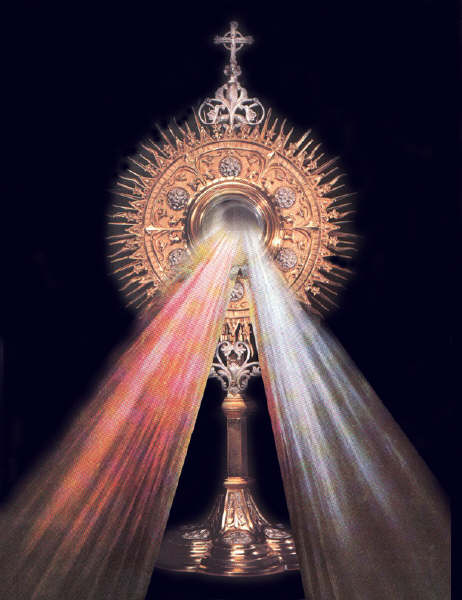
Then I looked at the monstrance and realized the truth that was staring me in the face: the most important person in the room was Jesus Christ, truly present in the Eucharist.

As parents, we must make every effort to believe this and act on it. There is no better witness, no better way to pass on the Catholic faith, than you making the Mass and Holy Eucharist the top priority in your life.