The Power of Family


The family is the community in which, from childhood, one can learn moral values, begin to honor God, and make good use of freedom. Family life is an initiation into life in society. 

– from the Catechism of the Catholic Church, paragraph 2207

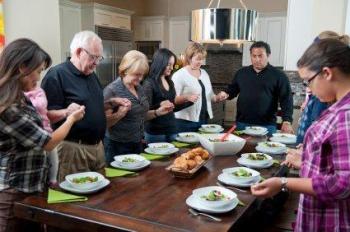
As I type, bishops from around the world are gathered in Rome discussing how best to preserve, strengthen, and encourage Christian families. With so many families suffering or broken, such confusion over the nature and purpose of marriage, and the constant cultural tension between anti-child forces (for reasons of overpopulation, so-called social responsibility, or personal choice and comfort) and  “child worship” (treating each child as the center of the world, deserving of the very best of everything), it’s easy to feel underappreciated and overwhelmed. It’s also easy to get caught up in the everyday hustle of school, work, sports, and recreation and lose sight of the true power of the family as a domestic church: an apprenticeship in love of God and neighbor.


The Catholic Church, in her wisdom, teaches that the family is the fundamental unit of society, with certain rights and responsibilities that no higher level social organization can ever claim. Humans are social creatures, made in the image of God, who is Himself a loving, life-giving communion of Persons—the Holy Trinity. The Catechism insists that government has a duty to protect and foster marriage and family and to help families (and not interfere) with raising and educating their children as they see fit, both in the world and in faith.

The Church, in fact, regards the education of children in the faith as a duty of parents—a point that cannot be overstated.  I sometimes hear parents say, “I want my son to make his own choice about his faith,” or “I don’t want to force it—it will mean more my daughter if she comes to God on her own path.” While it is true that, ultimately, we each make our own choice for or against Jesus Christ and His Church, we cannot entrust that choice to the sole discretion of our children—any more than we would allow them to decide whether to drink something we know to be poison. If we truly believe what the Catholic faith teaches, the choice our children face is much more stark than how they will spend their Sunday mornings—it’s about how they will spend eternity.

Next Wednesday we begin a new year of First Confession/First Communion and Confirmation classes—and as always, it is essential that parents take the lead in sharing the good news of Jesus Christ and the eternal truths of the Catholic Church. Your personal example is the most powerful witness to your children—and male role models, in particular, have extraordinary power in keeping kids Catholic. Even simple things, like reading a Bible story, putting on a tie or a dress for Mass, or taking time to pray with and bless your child before bed, make deep and lasting impressions.

Scripture reminds us, “Train the young in the way they should go; even when old, they will not swerve from it” (Proverbs  22:6 ). We are all practicing Catholics, all sinners who are in training to love as God loves. But as parents we are also powerful, and we must not neglect to use that power to bring our kids to Christ, who said, “Whoever receives one child such as this in my name receives me” (Matthew 18:5).

Blogger’s Note: This article appears in the Sunday, Oct. 18, parish bulletin.

The Flitter-Flutter of Tiny Wings

“Geronimo!”

For the past several days, we’ve had just two kids at home, Trevor and Lily. The elder three were at Extreme Faith Camp, Brendan as a leader, Gabe as a member of the prayer team, and Rose as a camper. Their return, I think, was bittersweet for the younger ones — although bored and (allegedly) overworked at points, they enjoyed having Mom’s and Dad’s full attention. Lily got in trouble for interrupting far less, because there was far less to interrupt. And Trev got to go to Culver’s and Jurassic World with just Jodi and me.

We parents, on the other hand, missed our teens. It took only a day or so for me to stop and calculate that we are just six years from potentially being a permanent four-person household, and eight years from Lily being alone with us, At some point unmarked in the past, the pitter-patter of tiny feet was drowned out by the flitter-flutter of tiny wings as the fledglings prepare to leave the nest.

This, I’m discovering, is going to be harder for me than the fact that I, too, am aging and yet still feel like I have much to learn — in fact, my own feelings of inexperience in this world only magnify my anxiety for my offspring. Have a taught them what they need to know to survive? Will they thrive? Will they avoid the pitfalls and snares in which Jodi and I have become entangled over the years? Have the courage to be faithful in public? To remain Catholic, with all that entails?

We see encouraging signs from each of them. Bren, now 17 and approaching his senior year, has changed his views on a military career, primarily due to moral concerns. He takes his faith very seriously: donates to Catholic causes, joins his friends for weekday Mass on Wednesdays, joins his girlfriend Olivia in the Adoration Chapel in our church. Gabe, nearly 15 and a coming sophomore, still has his eyes on the priesthood, joins his brother and friends at Wednesday Mass, and just last night asked where he could find the Divine Office that priests commit to praying daily — hinting that he’d like to take it up, but that he’d rather not do it alone. Thirteen-year-old Emma came home from having been deeply impacted by Eucharistic Adoration at camp, trembling with emotion before the Blessed Sacrament and alternating between sorrow and joy (ending on joy) as she prayed.

Yesterday I came home from the church for lunch, and popped in a DVD that would not play in my work computer. The video came up immediately, and featured Fr. Robert Barron tackling common Catholic apologetics questions in short video clips. I began cherry-picking a few that might be interesting, and Trev, who will be 11 in few days, sat down to watch. For more than an hour, we watched and discussed the rational foundations for our Catholic faith. It’s amazing to see what he absorbs in such a short time, and I pray the same has been true for the others.

Lily, of course, is only three. She knows Jesus by sight, likes to pray (the Angelus and petitions, in particular, and especially for her friends and for babies) most evenings, and is at home in our church, if not fully engaged by the Mass yet. As I continue in my job as faith formation director, planning the coming year’s program, I realize how much more we could be doing with our parish youth, and by extension, how much more I could have done with my own children. Lily will benefit from that realization — and yet when I look at her four older siblings, I wonder how much I should do differently. But how can I give anything less than my all for my family when the stakes are so high and the implications, eternal?

Confessions of a Fledgling Catholic: Mass Doesn’t Fulfill Me, Either

When he returned to his disciples he found them asleep. He said to Peter, “So you could not keep watch with me for one hour? Watch and pray that you may not undergo the test. The spirit is willing, but the flesh is weak.”    – Matthew 26:40-41

I’ve had a version of the following conversation countless times, including twice in the last week: I don’t get anything out of Mass. I’ve heard it from parishioners and strangers: I’m not learning anything. I’m just going through the motions. I’ve heard it from family and friends: I don’t any feel joy or peace. I don’t feel fulfilled.

These conversations resonate with me because I’ve heard their echo over the years in the hollow around my own heart: I want to love the Mass, but I’m not like those people. I can’t pray like that.

It is a strange sort of pride that insists that our problems are not like anyone else’s—in this case, that we alone struggle with distraction, temptation, and doubt. We often cling to our weaknesses like a badge of honor, insisting, “For me, it’s different…you don’t understand.” I have come to believe that this is from the Enemy—his subtle deception to help us justify ourselves as the exception to the rule and lead us, degree by degree, away from God.  The Devil is cunning and loves distraction as much as we do, so when our minds wander, he seizes the opportunity to tell us we’re not worthy of our call or that we need something more.

Couple the Devil’s taste for stray minds (a fitting appetizer for an entrée of lost souls) with our own misperceptions of what the Mass is, and we are ripe for falling away from our “Sunday obligation.” If we see Mass simply as an obligation, it becomes dry and stale, just another item on the weekend’s long list of To-Dos. If we see Mass as all about us—as weekly affirmation, intellectual nourishment, a spiritual workout, or wholesome entertainment—we will eventually be left cold when it doesn’t leave us fat, flush, and smiling.

But the Mass is not these things—at least not primarily. The Mass is where we come, once a week at least, to give God his due: our love and praise for literally everything we have in this world. We are asked by His Church to do this each Sunday and a handful of special feast days throughout the year. We are asked to spend about an hour a week to thank God for life, family, friends, the beauty of the created world around us, good food and drink, a warm house on a cold night, the breaking dawn, our next breath…

So we come to His house; we sit, kneel, stand, and struggle to stay in the moment, to pray and praise and give thanks. We fight distraction, and occasionally we win. And then, at about the 45 minute mark, instead of simply receiving our praise as His due, God gives us His very substance, our Lord Jesus Christ, in the Eucharist—as if He hadn’t given us enough already!

This is how it occurs to me now: I struggle to spend an hour a week focused on giving thanks and praise to God for everything I have and will have in this world, and before I’m even finished, He pours His whole self out—again—for me.

If I leave this exchange feeling cheated, my heart is not yet in the right place.

The truth is that our hearts aren’t in the right place. They are fallen, fleshy things, slightly off-kilter and left of center, fluttering over temporary pleasure and not yet conformed to Christ. But that’s okay, because the sacraments, particularly, of Confession and Communion, give us the grace we need to continue to reshape ourselves as we were created, in the image of God. All we need is to persist.

I have said before that if people really understood Who was present on the altar and in the Confessional, in the monstrance or the tabernacle, nothing would keep them from coming to the church. I believe this, and yet I struggle to see Jesus in the Holy Eucharist, or in our holy priests, or in my neighbor. I may look like one of those devout souls who are in communion with the heavenly host, praising God during the liturgy each Sunday, but my thoughts turn to my kids and yours, the whispering teens, the appearance of others, Sunday brunch, the budget, the time.

And then I realize that Father has already said, “This is my body,” and my eyes open upon the elevated host. I hear the words of Jesus when He finds his disciples asleep in Gethsemane: “So you could not keep watch with me for one hour?”  And I feel unworthy of being His disciple—an uncomfortable feeling in the moments before Holy Communion. I gaze at the Eucharist in Father’s hands and pray, “Lord, I believe—help my unbelief.”

Alone in ourselves at the Mass, in the midst of so much quiet and so many distractions, it can be difficult to seek and to find God, even when He is so near at hand. As a friend and fellow parishioner puts it: “If you only knew the drama playing out, not only on the altar, but in your very heart and soul!  This is the moment you need God the most, in this insidious serenity of Mass, with your defenses lowered.”

And in this moment, He is closest at hand. St. John of the Cross writes, “If a person is seeking God, so much more is her Beloved seeking her.” Consider that for a moment. When we turn our gaze toward God, He is there, gazing upon us. When we seek Him, He finds us. And when we return our attention to Christ during the Mass, His response is not anger or jealousy, but the response of a bridegroom to His bride: “At last!”

What more could we ask for from the Mass?

And yet we still sometimes feel unfulfilled. One reason may be that we attend Mass, then think: Is that all there is? Of course it’s not. If we feast on the richest foods, then sit idly week after week, we grow comfortable, complacent, and ultimately, fat and unhealthy. The same is true spiritually: we cannot gorge ourselves on the love of God and then sit idly. We are not Christian only on the day of rest. The other six days we are called to work, to be fruitful. The Mass strengthens us to do God’s work in the world—to “go and make disciples of all nations,” as Jesus commissioned us.

But even when we do this work, we may still feel dissatisfied. St. Augustine says, “You have made us for yourself, O Lord, and our hearts are restless until they rest in you.” We are made for God, and we long to be with Him. He gives us so much, but He promises so much more. May we persevere in faith and be made worthy of that promise!

Confessions of a Struggling LIFT Parent

Over the past several weeks, 114 parishioners completed our anonymous LIFT Mid-Year Survey. We received a good balance of responses across all four LIFT nights and all grade levels; we heard strong, positive feedback; very frank and consistent negative feedback; and lots of great ideas about things we could do differently. The results of the survey are available on the church website, stmcatholicchurch.org, by clicking the Faith Formation tab at the top of the page.

I take your feedback seriously, not only because it’s my job, but because I’m a LIFT parent, too. I know firsthand what it’s like to remember the night before LIFT that you haven’t even asked your kids about their homework, let alone helped them with it. I know that it’s harder to motivate myself to attend LIFT as my kids get older. I know that some nights, we’re lucky to remember to say Grace as a family before we scarf a late supper and fall into bed.

I know it’s not easy—but I’m convinced we can make it easier. Below are a few examples of things I agree that we should work to change in the coming year:

  • LIFT stands for Learning In Faith Together, but families are separated and learn completely different things.
  • The goal is to help parents to be the primary teachers of their children, but we don’t really help—we give you tons of content and expect you to figure it out.
  • Another goal is to build community, but our only adult interactions are in small-group settings that are easily the most uncomfortable and least liked aspect of the program.
  • For the price of the program, too much of the teaching falls on the parents—especially in terms of sacramental preparation.
  • At a certain point, it no longer makes sense for parents to be required to attend classes year after year with their children—and if it becomes an obstacle to their children attending, nobody benefits.

On the other hand, I also know that staying involved in LIFT has made a difference in my family. I know that when we finally remember our LIFT homework, the kids know what to expect and buckle down to do it—and since they’ve been involved year after year, the lessons aren’t as hard as they used to be. I know that the more Jodi and I model sacramental living, the more the kids pick it up and reflect it back to us. And I know there is no more powerful motivator for an adult to keep growing in their faith that to have their children pulling them along.

Certain aspects of the LIFT program will not change in the coming year. Family catechesis will remain the core model, and the price of the program is what it is in order to balance the budget. Our goal is to build a LIFT program that delivers on its promise of Learning In Faith Together, that provides better value for the cost, and most importantly, that grounds St. Michael families in a personal relationship with Jesus Christ and His Church.

St. Augustine writes, “You have made us for yourself, O Lord, and our hearts are restless until they rest in you.” Getting LIFT right won’t happen overnight. But when it does, I believe families will come, not because they are required, but because they want to—because their hearts long for God, and they know they can find Him here.

Blogger’s Note: This article appears in the Sunday, Feb. 22, church bulletin .

Go Ahead: Be a Stick In the Mud

I watched the Super Bowl last night with my bride and, at times, my kids. They came and went as it held their interest, and I spent the second half contemplating why we consume this (or why it consumes us) year after year.

The game was exciting to the finish, marred at the end by an odd play call that sealed the victory for the Patriots, followed by a borderline brawl as the Seahawks saw the championship slipping away. But the halftime show and commercials were what really sparked my thinking. Unlike past years, last night there were only a couple of commercials that made me happy the younger kids had already gone downstairs to play — unfortunately, one was a movie promo, which means not only will we be seeing it for months, but there’s a feature-length version somewhere. The halftime show, on the other hand, once again had me talking to my three teens about what’s wrong with the world. It was a short, pointed conversation, since halfway through the performance, my eldest went downstairs to practice his bass and the other two voiced their agreement with my rant and tuned out (from the show, and likely me, as well).


I try to stay somewhat familiar with popular music to know what my kids are exposed to, so I watched the whole thing. Afterward I watched Facebook to see what friends, family, and the general public thought. As expected, opinion was polarized between fans of Katy Perry and Missy “Misdemeanor” Elliot (the female rapper who joined Perry onstage) and people who don’t like their styles of music. But I was struck by the number of comments in the middle — people offering some variation on the theme, “At least this year it was kid-friendly.”

Really?

Call me a prude if you wish, but Perry’s lyrics, antics, and outfits are not kid-friendly. Consider just the songs we heard last night: “This was never the way I planned, not my intention. I got so brave, drink in hand, lost my discretion. It’s not what I’m used to, just wanna try you on. I’m curious for you, caught my attention” (I Kissed a Girl). Or “We drove to Cali and got drunk on the beach. Got a motel and built a fort out of sheets. … Let you put your hands on me in my skin-tight jeans. Be your teenage dream tonight” (Teenage Dream).

Of course, these pale in comparison to Missy Elliot’s Work It lyrics, which I will not post here. Elliot’s verbal dexterity is such that I couldn’t make out most of what she said last night, but I’d like to assume that her halftime rendering of her hit song was substantially edited to even make it on the broadcast.

“Well, it could have been worse…at least she was fully clothed and not dancing suggestively, like in years past.”

Modesty comes in many forms, but crouching like an animal in a minidress, snarling, “I kissed a girl and I liked it!” is not one of them. And as I shared with the teenage boys I spoke to at the church on Wednesday, “It could be worse” is a pretty low bar.

Perry’s performance was only relatively kid-friendly, as compared to shows in years past — and that underscores the problem with relativism. This is how we lose the practice, or even the recognition, of virtue: by allowing ourselves to slip so far down the slope that a half-step back toward the top seems like innocence regained. And the entertainment industry knows their target market well. They don’t care if a 40-year-old dad enjoys the show — they want to hook my offspring, and in that respect, it’s probably better if I don’t like it. The gleaming space lion, the cutesy cartoon beach sequence, and the sandwiching of Perry’s more provocative songs between hits Roar and Firework, which even turn up in grade-school music concerts — the whole production is meant to keep the kids in the room.

Folks, like it or not, they are selling sex to your children — and not the life-giving kind. Last night’s post from the Practical Catholic Junto blog summarizes my concerns in two brief quotes:

It reaches the extremes of its destructive and eradicating power when it builds itself a world according to its own image and likeness: when it surrounds itself with the restlessness of a perpetual moving picture of meaningless shows, and with the literally deafening noise of impressions and sensations breathlessly rushing past the windows of the senses.  …

Only the combination of the intemperateness of lustfulness with the lazy inertia incapable of generating anger is the sign of complete and virtually hopeless degeneration. It appears whenever a caste, a people, or a whole civilization is ripe for its decline and fall.

— from Josef Pieper’s The Four Cardinal Virtues

When we say, “It could have been worse,” we are too comfortable. We have lost the capacity for righteous anger that could set the world straight. We’re giving in.

Late yesterday morning, I was talking to one of our deacons, who was shaking his head at the fact that families might skip religion classes to get an early start on the Super Bowl extravaganza. “I’m an old stick-in-the-mud,” he said, half-apologetically. “I’m not watching any of it. Not the game. Not the commercials. None of it.”

I suppose I’m becoming a stick in the mud, too. But perhaps such sticks will be the only thing people can grab onto to slow our descent.

Next year, I think we’ll watch Groundhog Day instead.