Almost There

Back in my newspaper days, “Almost There” was the name of my weekly column. To me, the title called to mind the joys and challenges of both parenthood and life: the constant wondering and plaintive vocalization (not only from children) of every journey’s most persistent question — are we there yet? — and the fluttergut, giddy anticipation of being always on the verge of something new, terrifying, wonderful…

Tonight we are less than a week from full-term, anxiously awaiting the arrival of our fifth child, and the anticipation is agonizing. Jodi’s discomfort, and her growing anxiety about the discomforts to come, is a burden I would carry for her if it were permitted. I, on the other hand, find myself choking back tears at odd moments, caught up in memories of my love’s labors past, her courage now, and her life-giving beauty.

We’re quite a pair, we two.

Our home is a pre-Christmas jumble. Our kids are wound to their full holiday potential, and occasionally fly off into the wall or ceiling in a buzz of released tension. The baby magnifies all, and the air in the house is thick with suppressed emotion. When this child comes, you’ll know.

On Monday, Jodi said she felt as though something had dropped. We went to the clinic on Tuesday and were told that was not the case; our little one was still high above the birth canal and content to stay there. On Wednesday, returning from Christmas shopping alone, my bride had her first real contraction. “It hurt so bad I thought I was going to die,” she told me when she got home. “I thought, ‘I should pull over,” then thought, ‘I’d rather die at home.'”

We laughed. We’ve done a lot of that. Just one contraction. A doozy, but none since. We wait.

The week before, our doctor, an older man with a wizard’s eyebrows and the experience to wear them without pretense, felt Jodi’s belly — “Feet, rump, head,” he declared as his hands moved and pressed lightly — and told us he felt a great deal of fluid and a not-unusually-large infant. He is not concerned at this point, given our history of large babies and no troubles.

His proclamation, coupled with Jodi’s finicky stomach and appetite and other tiny cues, have led to my official prediction for our baby: we are having our tomboy, an active girl of about 10 pounds (plus or minus two ounces; 9-15 like her daddy would be just fine), 21 inches long or so. She’s gonna sleep alright, but when she starts moving about, she’ll be our first climber. We shall have our hands full. She will have a Thorp head, of course, and Jodi’s hazel eyes that look green in the right light.

You heard it here first…but who knows, really?

If we welcome a boy, our intention is to call him Samuel Firmin Thorp — Sam — middle-named for Jodi’s maternal grandfather (it means “strong”), unless God calls him something else when we see him. If she is a girl, as I predict, she will likely be Lily — Lillian Clara Thorp, middle-named for Jodi’s paternal grandmother.

And so you know: we intend to bring our four older children to the hospital to see the baby and guess the gender before the big “reveal,” so to speak. This means we will tell you much, but not all, when it happens. I will let you know that we’re in labor, and let you know when we have a child, the health and well-being of all involved — but you’ll have to be patient on the specifics. Modern technology is poor at keeping secrets, even from middle- and grade-school kids.

A few weeks back, just before friends held a baby shower for Jodi, someone asked Jodi what we needed for the new arrival.

“I don’t know,” she shrugged. “Nothing really.”

Another friend asked one of the shower organizers the same question.

“Everything, I think!”

Our family, friends, and parish have provided abundantly for us at little cost. I was flipping through old columns and ran across one from 1997, before Brendan arrived, with the headline, “Preparing for baby boggles the mind.” What we worried about then is funny now. So much we didn’t know, and yet we have four children about whom we could not be prouder.

Are we pushing our luck?

No matter. We have what we need, and what we lack will be provided, come what may. We are ready. Little one, are we there yet?
Rosebud on Food

Our daughter is a picky eater. She likes what she likes (toast, buttered noodles, brownies, meat) and little else (most plants). She also has a sense of humor about food and eating.

A few days ago, the boys were talking about our recent train ride to Mall of America and brought up Rainforest Cafe, which no Thorp but Emma has ever entered (for a friend’s birthday party). The boys were speculating about the entrees, and Brendan — recalling Indiana Jones and the Temple of Doom, no doubt — asked if they serve monkey brains.

“I’m not sure,” said Emma, deadpan,  “but not on the kids menu!”

Then this morning, she and I were eating English muffins together. “Emma,” I said sternly, “you’ve got butter on your little finger. You know what you have to do now.” Then I mimed licking my finger and savoring the white fatty goodness.

She smiled. “I’ll do that when I’m finished,” she said. “I’m gonna make sure there’s lots of butter on it!”

How Great Thou Art

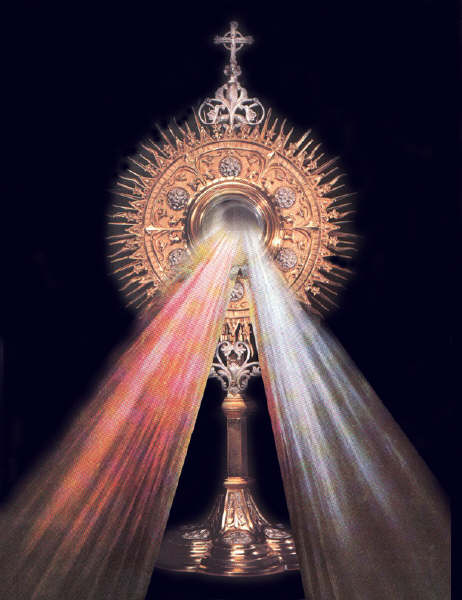
Blogger’s Note: This popped more or less fully formed into my head after I received Communion this morning. Perhaps it’s a new prayer for our children?

Lord, make of me a monstrance,
The Eucharist as my heart,
That all may see your light in me
And know how great Thou art.

Amen.

(Pro) Life, Without Religion, Part 2: A Little … Something

Inspired by recent ultrasounds of our tiny child resting peacefully in utero, last month I shared my response to a common abortion-rights argument: “It’s my body; it’s my choice.” In that post, I argued that, in no way could an embryo or fetus be considered the mother’s body, or even part of the mother’s body.

The question remains, then: what is it? A few possibilities come to mind: it may be a bit of foreign debris or tissue; it may be a tumor (benign or malignant); it may be nonhuman organism (like a parasite or symbiotic microorganism); or, it may be Homo sapiens – a human organism. I’ll address these possibilities one at a time:

  • Foreign debris or foreign tissue. If an embryo were nothing more than a bit of foreign matter that had somehow found its within the woman, it makes sense that her body would respond accordingly, targeting the embryo in the same way it might a sliver or a piece of shrapnel, either to eliminate it from the body or encapsulate and neutralize it. Of course, an embryo consists of living cells, so the body does not react to it as thought it were a simply a foreign object. If an embryo were living, foreign tissue, it makes sense that the woman’s immune system might react negatively to it, in the same way that it might reject a donor organ. In fact, in the vast majority of cases, the woman’s body does the opposite, suppressing it’s own immune system and laboring to provide a protective, nurturing environment and nutrients to encourage growth and development of the embryo. It is true that in certain cases (e.g., an Rh-negative mother carrying an Rh-positive fetus), the woman’s immune system may react to presence of Rh-factor in the fetus’s blood, sometimes leading to death of the fetus – however, most of the population (approximately 85 percent, I believe) is Rh-positive, so such a reaction is certainly not the norm. Nor does it change the fact that the woman’s body continues to try to accomodate the fetus even as antibodies in her blood attack the fetus’s red blood cells.
  • Benign or malignant tumor. I’ve heard it more than once “It’s just a ball of cells.” Actually, I did a little reading for this post to help ensure I’m using the right terminology, and learned that tumors are more commonly defined as a neoplasm that has formed a “lump” – and a neoplasm is a new and abnormal growth or proliferation of cells not coordinated with the body’s healthy tissue. Is an embryo a neoplasm? It is certainly a new proliferation of cells, but typically (left to its own devices), its growth is in clockwork coordination with the healthy tissue around it; in fact, the surrounding, healthy tissues of the woman’s body (left to their own devices) change to become more accommodating to the new growth – again, encouraging growth and development. To quote Arnold Schwarzenegger in Kindergarten Cop: “It’s not a tumah!
  • Parasite or other nonhuman organism. An embryo or fetus certainly derives nutrients and protection, and at some cost the woman in whose body it resides – but is it a parasite (like a tapeworm) or some other symbiotic nonhuman organism (like our gut flora and other bacteria that exist on or in our body and are beneficial or neutral to our health and well-being)? First, consider that non-human organisms (parasitic or otherwise) are not native to us nor do they spontaneously generate within us. Instead, they are acquired. Even our gut flora are acquired at birth and rapidly afterward, from our mothers and the environment. An embryo, on the other hand, is not something caught from another person or acquired from the environment which then colonizes the uterus. And while it takes the introduction of a male gamete to fertilize an egg and ultimately form an embryo, even sperm cells cannot be considered parasites or symbiotic organisms – they have a short-life span and cannot reproduce themselves or “colonize” the woman on their own; those that do not fertilize an egg ultimately die off and are eliminated.
  • Human organism. To review, start where you like: a zygote, an embryo, or a fetus. Clearly these are not non-living things; they are living cells that use nutrients and multiply. If it were merely foreign tissue or an infection, the woman’s body would work to destroy it – no abortion necessary. If it were a parasite or symbiotic organism, it would be acquired externally, not formed internally from two cells whose sole function is reproduction. Now, consider that when a sperm and egg unite and form a zygote, the result is genetically identifiable as human – 23 pairs of chromosomes is the norm, but even some variation in this number (as in the case of Down Syndrome), when permitted to develop, can result in a viable independent organism that we would recognize as human. Some will argue that a skin cell, or an eyelash, or a cancer cell might be alive and genetically human, but we kill those all the time; certainly that isn’t murder, is it?  Of course not. But as we’ve already established, an embryo clearly is not any part of the woman’s body (it’s not even a genetic match) nor is it a tumor (it is developing in coordination with the woman’s body and the result will be a viable, independent human organism). Without a doubt, an embryo is a living, human organism.
Even some abortion supporters make it this far. At this point, the arguments become much more philosophical: abortion supporters claim is that this human organism is not a human being – it is a genetically human living thing, but only a potential human being. This raises a fundamental question: What makes a human organism a human being? I’ll share how my pre-religious mind tackled that question in my next post on this topic.

(Pro) Life, Without Religion, Part 1: It’s My Body!

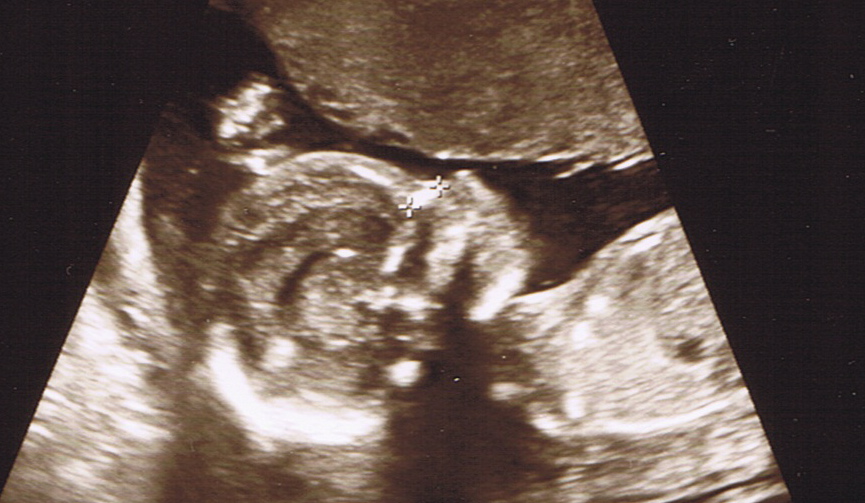
This morning Jodi and I saw the face of an angel — our angel, a tiny new Thorplet, just 11 ounces now at 18 weeks of development. Our baby pulled away from the attempts to examine his or her feet, just like all of our children, but otherwise kept uncooperatively still, making it difficult to get a good look at the tiny, chugging heart. When the sonographer was finally finished her thorough examination, she took the photo above: a tired wee child, hand above head, resting peacefully.

I’ve always loved ultrasounds. In part, it’s the geeky wannabe scientist in me, but mostly, it’s the wonder and sweet jealousy of seeing our tiny baby alive and safe inside the love of my life, and knowing that yeah, I can pee standing up, but I’ll never feel life moving within me. This was a level-2 ultrasound: given my bride’s so-called “advanced maternal age” (I wouldn’t begrudge her a right cross next time someone says that…not this time, but next time…) they offer it as a way of taking a closer look at how both the baby and the mother are progressing. We turned down all the other tests and genetic screening, but taking a closer look at our little one and Jodi, especially given the size of our babies, seemed like a good idea.

The photo above was the highlight of the hour or more we spent in a dimly lit room with the sonographer. It was worth the wait, but to be honest, I was more excited about these two images:

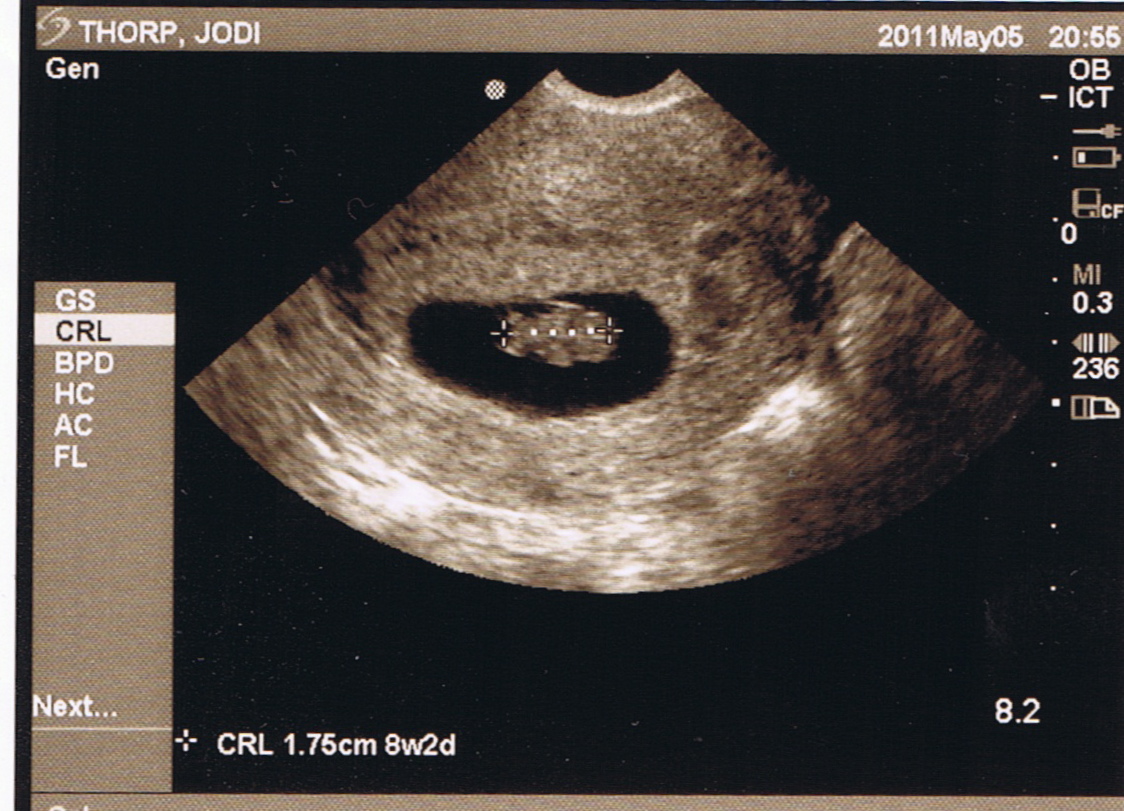
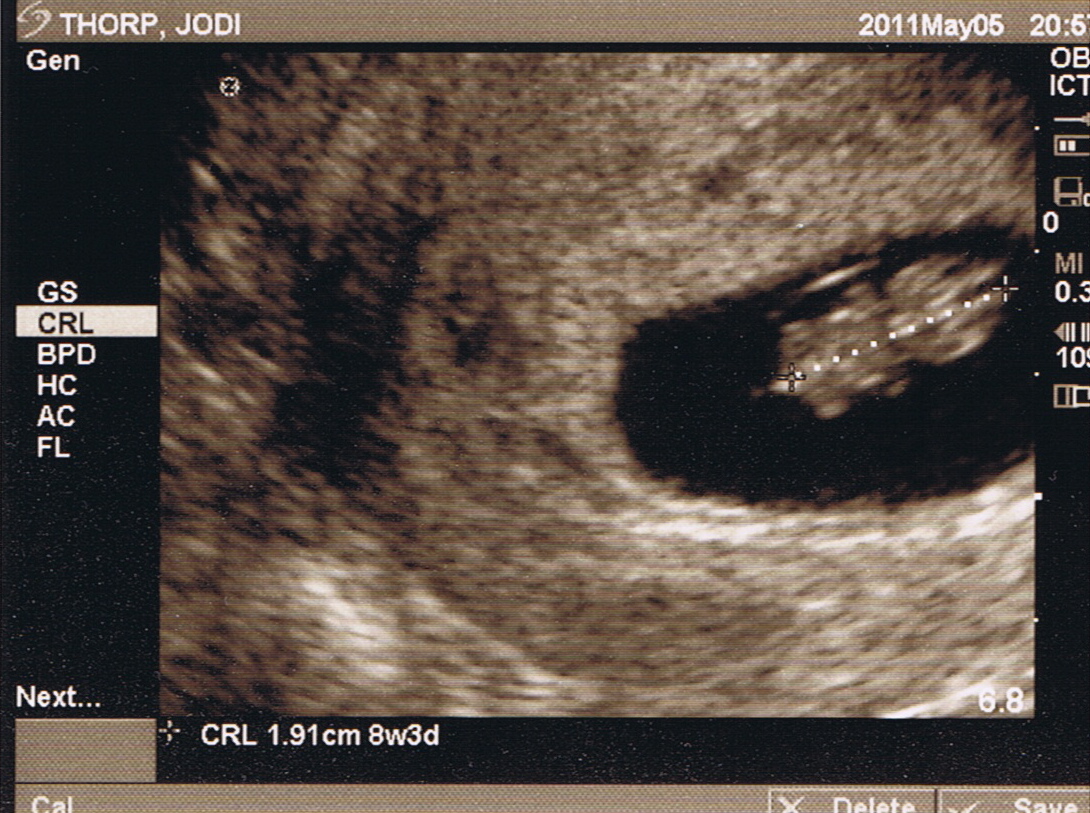
These show our baby at just eight weeks of development. We’re looking down on him or her from above, with an absolutely Thorpian head to the right, and a torso with four tiny limbs extending to the left and down in the lower image. This was a thrill, not only because we lost a little one last fall and were hoping for an “all systems go!” from our doctor, but because there on the screen was a tiny person, less than two centimeters long, with a beating heart and legs and arms that moved independently of any thought or command from Jodi or me. A child the size of my fingertip who, just before Christmas, we will be blessed to welcome and trusted to raise.

Some people say miracles are impossible; others believe they happen, but only rarely. I believe miracles happen daily, all across the world. I’ve got photographic proof.

As we drove home from the earlier ultrasound, I was reminded of an extended argument I had once, on a political blog in South Dakota, with a staunch and pseudonymed liberal who dismissed me and two of my friends as Bible-thumpers for being against abortion. I explained to him that, on the contrary, I studied physical anthropology and human evolution in college and was anti-abortion well before I became a practicing Catholic. I articulated to him a set of arguments against abortion, completely independent of religious belief or church doctrine, and asked, then begged, then dared and taunted, him to engage me on them. He would not.

What came back to me as we drove home was the first argument I offered to him. As I recall, he insisted, on behalf of women everywhere, that “It’s their body; it should be their choice.”

“Which part of their body is it?” I asked.

An abortion removes something from a woman’s body, without a doubt. If what is removed is her, or some part of her, then it should share both her gender and her genes, and she should be somehow physically diminished, something less than the whole and functional woman she was before the procedure. If she had her gallbladder removed, for instance, or a toe, a mortician or coroner might note such a thing upon her death.

A woman who has a “successful” abortion, however, emerges physically intact, but no longer pregnant. What is removed, though taken from within her, and attached to and dependent on her, is not her — not genetically, and not logically. (In my online arguments, I moved from what a fetus isn’t, step by step, to what it is, over several exchanges. In time, I think I’ll do the same here.)

This was made clear again to me when I saw our tiny infant, wriggling in amniotic bliss, at eight weeks of development. Jodi had no say in the flailing of those tiny arms and legs, and that tiny heart beat in part because of, but not for, her. No choice on her part, short of violence, could have stopped it.

And of course, it was made clear yet again today when we saw that beautiful profile at the top of this post. There’s a reason that the Knights of Columbus and other Catholic and pro-life organizations are investing in ultrasound machines for clinics and teaming with expecting mothers to show live ultrasounds of their babies to middle- and high-school students. There’s no better way to recognize the humanity of others than to see them face to face.