Blogger’s Note: This is the third of three posts along my path to the Sacred Heart about the three Polish saints whose loving example pervaded World Youth Day in Kraków, Poland.
Pope St. John Paul II
“We are not the sum of our weaknesses and failures; we are the sum of the Father’s love for us and our real capacity to become the image of his Son.” — Pope St. John Paul II
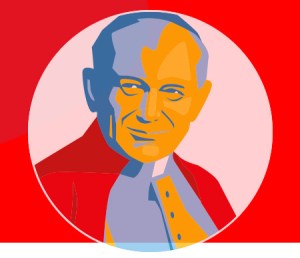 Born Karol Wojtyła in Wadowice, Poland, in 1920. Suffered the loss of his family, freedom, and country by the time he was 21 years old; risked his life under the Nazi regime to promote Polish cultural resistance and study for the priesthood. Recognized as a gifted theologian, pastor, and bishop; elected pope in 1978 and brought the Good News to 129 countries. Instrumental in the fall of dictatorships and Communism; wounded critically in an assassination attempt in 1981; credited Our Lady for preserving his life and met with and forgave the assassin. Served as pope until his death in 2005, despite declining health due to Parkinson’s and old age. One of the most recognized figures of the 20th century. View a more complete biography here.
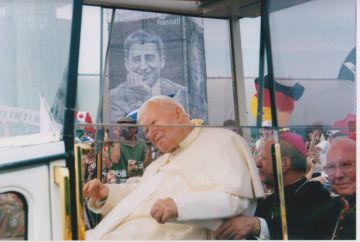
My photo of a saint, taken at World Youth Day in Toronto, 2002.
Unlike yesterday’s saint, Faustina Kowalska, St. John Paul II is the Polish saint I know best. I’ve read countless articles and two biographies: Witness to Hope by George Weigel and Saint John Paul the Great: His Five Loves by Jason Evert. He was the pope during my return to Catholic church and for more than half my life so far. Additionally, he is the one (known) saint I’ve had the privilege of seeing and hearing in person, at World Youth Day 2002 in Toronto, Ontario, Canada. Continue reading
 Born Helena Kowalska in Głogowiec, Poland, in 1905, to a poor, religious peasant family. Felt called to religious life at an early age, but went to work as a housekeeper to help support herself and her family. Accepted to the Sisters of Our Lady of Mercy (OLM) in Warsaw in 1924, and in 1926, received her habit and the name Sister Maria Faustina of the Blessed Sacrament. Began having visions of Jesus as “the King of Divine Mercy” in February 1931, instructing her in His love and mercy, asking her to to paint His likeness with the inscription “Jesus, I Trust in You,” and to establish a feast of mercy in the Church.
 Archangel Stomp