Love Thy Neighborhood

Hello, hello/I don’t know why you say goodbye, I say hello.

— the Beatles, “Hello, Goodbye”

Yesterday Jodi spoke with our neighbors across the street, a friendly couple a bit younger than us, with two small children and a dog, and personalities that draw you in and make you want to smile and visit.

They are moving to Alexandria.

As they talked, the husband and father said something telling: “I’ve talked more to my neighbors since we sold our house than in the previous X years.”

This was not a reflection solely on the rest of us: several homes are for sale or have sold in recent years, and he admitted that he, too, spoke more to the outgoing neighbors than those who appeared to be staying. Continue reading

Dust Bunnies and Mud Bubbles

“A puddle repeats infinity, and is full of light; nevertheless, if analyzed objectively, a puddle is a piece of dirty water spread very thin on mud.” ― G.K. ChestertonManalive

Scripture tells us that God took a bit of dust from the earth, shaped a man, and breathed life into him. The breath of God—spiritus—brings the unliving to life.*

I have seen what this windy world conjures when its breath stirs the dead earth: dust bunnies and mud bubbles. Continue reading

Book Break: Manalive

“Madness does not come by breaking out, but by giving in; by settling down in some dirty, little, self-repeating circle of ideas; by being tamed.” 

– G.K. Chesterton

I’ve quit believing in coincidence. When seemingly random events culminate in a meaningful way, providence is my line now. Such was the case when I was searching the Great River Regional Library website for an audiobook to accompany me to and from Michigan over Divine Mercy weekend. I searched for several titles by name, and several topics by keyword, to little avail. Then I stumbled across an audio version of G.K. Chesterton’s Manalive, narrated by athiest-turned-Catholic and Theater of the Word founder and actor Kevin O’Brien.

I didn’t know what the story was about. That it was Chesterton told me it should be good — but as I’ve said before, Chesterton can be too clever by half at times, and I’d never tried his fiction before. I put in a request for this book and for Mark Twain’s biography of St. Joan of Arc, and Manalive arrived first.

I hesitate to say too much. It is the story of an apparent madman or idiot who invades a British boarding house and turns the humdrum lives of the inhabitants upside down. Ultimately, he is accused of insanity, theft, polygamy, and murder  but how can a man as wicked as that make others feel so alive for the first time in years?

On the other hand, why would such a joyful simpleton  a holy fool  carry a revolver among his holiday luggage and playthings? Our protagonist has a mission, which sounds ominous and, indeed, mad: “I am going to hold a pistol to the head of the Modern Man. But I shall not use it to kill him – only to bring him to life.”

Like Myles Connolly’s Mr. Blue, which I reread over Holy Week, the book portrays a man who had dedicated himself to a worldview that the world has little use for and who pursues it at whatever cost. As a result, he makes us think about our own worldview and priorities. Manalive is chock full of great Chesterton quotes and paradoxes and memorable characters made moreso by O’Brien’s theatrical reading, voicing each of the characters as clearly as if he were several people himself.

By way of criticism: The work does wax poetic at times – particularly the introductory chapter – and at all times Chesterton’s presence is felt in the thoughts, wit, and turn of phrase of the characters. I would also be remiss in not pointing out Chesterton’s use of racial and ethnic stereotypes and language, particularly in drawing the character of  Moses Gould. In the context of this story, it was unsettling, but it struck me more as a product of his time than of strong personal animus. As to his actual views of minorities, I need to read more.

By way of endorsement: I listened to it start to finish on the way to Michigan, again on the way home from Michigan, and yet again on the trip back from Florida with Rose and Trev. It has climbed to the upper heights of my list of favorite stories — and if you want a fictitious explanation for why I’m leaving a good job at the church for a nebulous next step involving writing, this is it. I could not have stumbled across a better novel to bolster and encourage me in this time of transition.

That, friends, is providence.

God’s Love Is Mercy

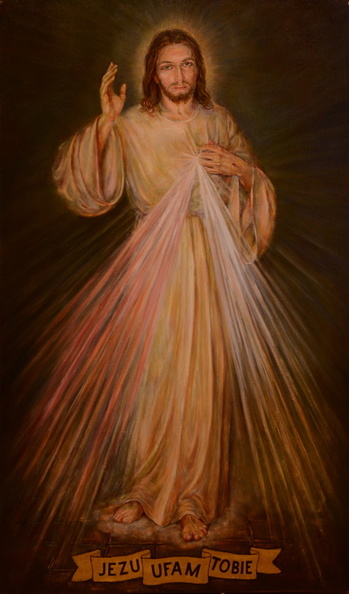
84764-divinemercy“Proclaim that mercy is the greatest attribute of God.” – Jesus to St. Faustina

Devotion to Divine Mercy is not every Catholic’s thing. Some people struggle with the image of Divine Mercy: Jesus, His right hand raised to bless and heal, His left indicating his heart, from which rays of red and white, symbolizing blood and water, pour forth as a fountain of mercy for souls. Every version I’ve seen has been a bit mysterious and unsettling—which seems appropriate, given that it’s a vision of the resurrected Christ.

Some don’t like the chaplet, which is simpler and more repetitious than the rosary. Some consider the visions of a poor Polish nun to be private revelations: fine for her, but not necessary for us (even though she is a saint and was canonized by another saint).

Continue reading

Poured Out In Love

 Each year during Lent, the Church focuses more intentionally on the Passion and Death of Jesus. How strange it seems that, during the very season we are trying to examine our lives and conform ourselves to Christ, we are also focused on Jesus at His lowest: beaten, humiliated, tortured. Jesus tells us in no uncertain terms that, to be His disciples, we must deny ourselves, pick up our cross, and follow Him—but surely we can stop short of whips and spears, thorns and nails, can’t we?

We are each a unique image of God, and each called to follow Christ in a unique way: to pour ourselves out in love for those around us. Most of us won’t be called to martyrdom in the bold and bloody sense—though some of us may. Most of us won’t be called to leave behind family and friends for foreign missions or cloistered religion life— but, God willing, some of us will.

Instead, most of us will be called to holiness in the context of ordinary, everyday lives: working, raising a family, pitching in where we can. This may seem easier than facing blades or beasts in the Coliseum, but I’m convinced it’s not. St. Josemaria Escriva warns us, “Many who would willingly let themselves be nailed to a Cross before the astonished gaze of a thousand onlookers cannot bear with a Christian spirit the pinpricks of each day! Think, then, which is the more heroic.”

To make a once-for-all choice for Christ, in the heat of the moment, facing certain death and eternal glory, seems downright doable compared to 70, 80, 90 years of making a million moment-by-moment choices to love the person in front of us, in every circumstance. Daily discipleship is difficult—and it’s made more difficult when we attempt to carry crosses we were never meant to bear.

Think about it: Each of us is called to be a disciple, and each disciple is called to pick up his or her cross and follow Christ. But since many people choose not to be disciples, we have a lot of crosses lying around, waiting for someone to drag them away. All these crosses can make it difficult to discern which is ours. They can cause us to stumble and fall. They can cause us to neglect our own cross in a misguided effort to clear the path.  But if we take the time to identify our own cross—the one God made precisely for our particular strengths and weaknesses—and if we shoulder it and keep our eyes fixed on Jesus, who walks the path ahead of us, He will show us the way.

This, at last, is discipleship: Not to drive ourselves into the ground trying to do everything for everyone, but to ask God what He wants from us, to listen for the answer, and to resolve to do exactly that—to embrace the cross the Carpenter has crafted with each of us in mind, and leave the others.

Imagine a parish of such disciples, all doing exactly what God has asked of them—no more, no less—and all moving the same direction, pouring themselves out in love on a world that desperately needs it.

Such a parish would change the world, because unlike time and energy, love never runs out.