Wednesday Witness: ‘You Can’t Save the World’

This column is part of a new, weekly series on what the Lord is doing in my heart, specifically encouraging me to simplify my own life in order practice the virtue of charity and the Corporal and Spiritual Works of Mercy. Come back each Wednesday to read the latest!

I’ve always been a big-hearted and emotional fellow. As a grade-schooler, I tried to intervene when those who were littler than me (not many) were being bullied. Invariably, I took a thumping myself. But I couldn’t help it: I hurt to see others hurt.

Whenever I got wound up about some injustice or suffering, real or imaginary, Dad would say, “You can’t save the world.”

What he taught me, instead, was how to stand up for myself, to treat others with respect, and to look out for my own—my family and close friends, those whom I could count on to help take care of me.

Dad was right: I can’t save the world. I can’t even save myself. Jesus is the sole Savior of the world, and—thanks be to God—it is accomplished (John 19:30).

But I don’t think our eternal salvation is what Dad meant.

Continue reading
Wednesday Witness: At My Door

This column is part of a new, weekly series on what the Lord is doing in my heart, specifically encouraging me to simplify my own life in order practice the virtue of charity and the Corporal and Spiritual Works of Mercy. Come back each Wednesday to read the latest!

In last week’s column, I referenced a letter from St. Vincent de Paul, in which he describes our obligation to the poor person at the door. While I was on retreat, the phrase “at the door” stuck with me. We live in a mid-1980s neighborhood in Albertville—a curving, suburban street with split-level homes, mature trees, the barking of dogs, and the laughter of children. We have no beggars, no one camping in the park, no one asking for handouts.

We do, however, have two men with developmental disabilities. Both are about my age (one, a little older; one, a little younger). Both grew up in this neighborhood, and their natural sociability means they know everyone. Both have been friends with us as our family has grown up, until, one by one, my children have aged past them, despite being a generation younger.

Continue reading

So Easy to Love

Jodi, Lily, and I are just back from visiting Gabriel, who is discerning religious life with the Franciscan Friars of the Renewal (CFRs) in New York City. He is currently living at St. Joseph’s Friary in Harlem. The friary and guest house span two well-worn brownstones on 142nd Street, surrounded by other tall rectangular brick homes of the same era, some operating as rundown rentals, some boarded and empty, and some renovated to fetch premium prices from professionals looking for their own little slice of Manhattan.

The friars are well-known among the lonely and the poor in the neighborhood, and not only by their long, gray habits and sandals. They live simply, own next to nothing, and rely on the unfailing love of God and the generosity of friends and strangers to provide them the means to live and minister. It is not an easy life, and yet they are men of great peace, joy, and laughter. They have walked these streets a long while now, sharing whatever they have with everyone they meet—especially the love of God for all His children.

On Thursday morning, we went with Gabe to the café the CFRs operate on the lower level of the guest house. Three days a week they open the shop to anyone for a cup of coffee and a sandwich, or whatever else the friars have in abundance that day, free of charge.

The regulars are an eclectic mix of literal neighbors who share walls with the friary, along with lonely locals, strays, squatters, and the truly homeless. Some have disabilities, mental health issues, or addictions. Most know each other, and they seem to accept each other as the friars receive all of them—as family. They received us in the same way.

Continue reading

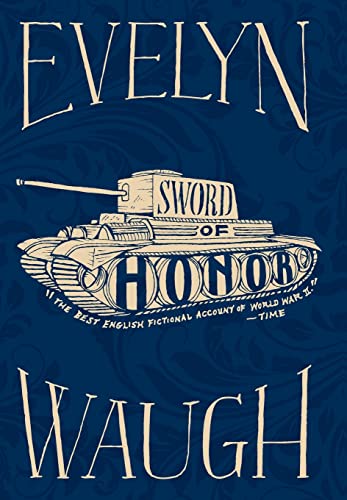
Book Break: Sword of Honor

Last month, I drove to Michigan and back on consecutive weekends. Roadtripping comes easily for me, especially with a good audiobook. During the winter, I saw an article on the Imaginative Conservative website about Evelyn Waugh’s Sword of Honor trilogy, and since I haven’t read anything by Waugh since Brideshead Revisited in 2011, it seemed like a solid choice.

In case you don’t know (I didn’t): Arthur Evelyn St. John Waugh is a British man; an author, journalist, and book reviewer; a World War II veteran; and a twice-married convert to Catholicism. Sword of Honor comprises three separate novels published in chronological order: Men at Arms (1952), Officers and Gentlemen (1955), and Unconditional Surrender (1961).

The books trace the wartime story of Guy Crouchback, the only surviving son of a once well-to-do Catholic family in England, who is floundering after his beautiful but promiscuous wife leaves him for another man (and another, and another) in the early days of World War II. Despite being older than most recruits, he joins the Army to escape his loneliness and reassert himself as a man—God willing, to do something meaningful with his life.

Continue reading

‘He Makes Me Lie Down in Green Pastures’

Last weekend we laid my dad to rest. When it came to death, Dad was a practical man: He wasn’t religious himself, and he didn’t want us to spend a lot of money or effort on a funeral. Sorting through his preferences and our own beliefs wasn’t completely straightforward, but I believe Mom managed admirably.

In Dad’s final months, he had shared with her that Psalm 23 was a favorite passage that his Little Grandma used to read to him when he was little. We all prayed it over him, and for him, many times during the final weeks of his life. During the burial, the line that stuck out most to me was, “He makes me lie down in green pastures.”

I believe the Lord has shepherded Dad, and all of us, well these past months.

+     +     +

Continue reading