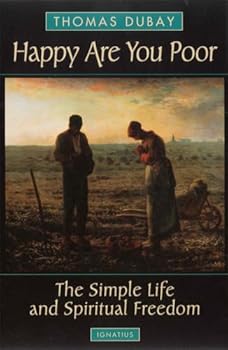
Book Break: Happy Are You Poor

For the past 20+ years, I’ve noticed several strange phenomena nearly every time a conversation turns to what the gospel says about material wealth and spiritual poverty:

  • Friendly conversations turn defensive: “We don’t have that much; so-and-so has X, and vacations every year in Y.”
  • Faithful Catholics attempt to justify themselves: “If you include Catholic school tuition, we give 10 percent like the Bible says—and we serve in other ways too!”
  • Straightforward moralists become subtle and nuanced: “What ‘poor in spirit’ actually means is…’”

And, in some cases, actual spiritual deafness occurs: I was in a conversation once in which I admitted my own struggles in this area and said I felt I needed to do more to actually love my neighbor from my own resources. A friend followed my remarks with, “It’s like Jim says…” and proceeded to relate the exact opposite message.

Father Thomas Dubay’s book Happy Are You Poor was written to combat these phenomena with clear teaching from the Gospels and the rest of sacred Scripture, edification offered by various popes and councils, and the lives of the saints. It was recommended to me by Father Daly in response to the awe I feel as Brother Jude (our second son Gabe) proceeds in his journey as a Franciscan friar and the conviction that I need to live a less self-centered and materialistic life.

Continue reading

Wednesday Witness: Checking the ‘Charity’ Box

Tomorrow is Thanksgiving already, and this Sunday, Advent kicks off. Christmas, it seems, is right around the corner, and the world is already in a rush.

It’s easy this time of year to get caught up in the holiday hustle and forget those around us who don’t have basic necessities, let alone comforts and niceties. It’s easy to mean well—to intend to give to charity, then run out time and money between now and New Year’s Eve and resolve to do better next time. And with so many gift trees, food drives, and red-kettle bell-ringers, it’s easy to give little something in passing and feel good that we “did our part.”

Continue reading

Handled or Healed?

This spring I shared about a homily we heard from Father Columba Jordan, CFR, while visiting Gabe and his fellow postulants in Harlem. Father Columba asked if we were handing our problems over to the Lord or squeezing Him like a stress ball while we tried to handle them ourselves. Surrender is more than admitting we need help or even asking for help—it means relinquishing control and receiving His help, in whatever form it comes.

Fast-forward to this month: After years of talking about it, Jodi and I decided to work on our marriage together by participating in the Healing the Whole Person study at the church this summer. By most measures, our marriage is healthy and strong, but anyone who has spent decades living with the same person can point to areas in need of healing: issues that consistently cause anxiety or anger, conversations that invariably go sideways, little things that drive us crazy in disproportionately big ways. And we don’t want to settle for that.

Continue reading

Everything He Has Is Ours

This post also appeared in the Sunday, March 17, issue of the St. Michael Catholic Church bulletin.

A few weeks ago I was blessed to attend a day-long silent retreat for church staff, led by Father Park. It had been a long while since my last silent retreat, and the time was truly blessed.

One of the scripture passages given to us for reflection was an old standby: the Parable of the Prodigal Son (Luke 15:11-32). Like many of you, I’ve heard this story countless times and sometimes approach it like an old friend I know well, slipping into familiar patterns without a second look or thought.

This time was different. Instead of focusing on the father’s forgiveness, the younger son’s repentance, or the older son’s hardness of heart, what struck me was the father’s unflagging generosity with both his sons.

Or, more specifically, our Heavenly Father’s unfailing generosity with me.

Continue reading

Over the Long Haul

I was blessed last month to be invited by our morning and evening MOM’s Groups to speak about marriage. At the time, I wondered what a man in his late 40s could offer a group of mostly young mothers in their first several years of marriage. Then I recalled a conversation with our oldest son Brendan and his wife Becky when they were discerning marriage. Specifically, I remember telling them, “We promise for better or for worse without really knowing what that means.”

It’s best that we can’t see the future. Maybe an unforeseen struggle will derail all our plans. Maybe it’s a cancer diagnosis or the loss of a child, a broken past or hidden addiction. Or maybe it’s the slow-building weight of sarcasm or unsolicited advice, the accumulated slights of day-to-day living in close quarters, or the endless routine of raising a family. Whatever our cross, when it comes, we can either carry it as a burden or swing it as a bludgeon. For better, or for worse.

After 26 years of marriage, I’ve learned that I’m still the same guy. Certainly I’ve changed a bit: I’ve kicked a few really bad habits, praise God, and gained some gray in my hair and beard. But I still have all the same buttons in all the same places, and Jodi still pushes them—for better or for worse.

Continue reading