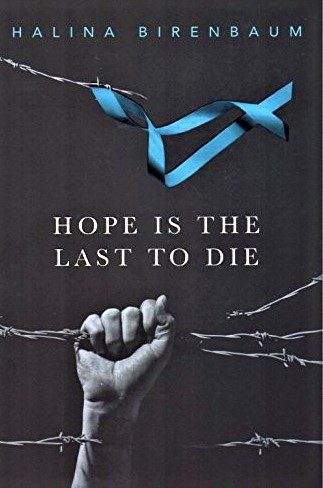
Book Break: Hope Is the Last to Die

In 2016, I was blessed to travel with my son Gabe and STMA Catholic Youth Ministry to World Youth Day in Kraków, Poland. Southern Poland is a wonderful place for a Catholic pilgrimage; so many ancient and modern saints lived and died in so small a region that every day it seemed we visited another sacred site in another blessed city. The big three, of course, were 20th century saints: St. John Paul II, St. Faustina Kowalska, and St. Maximilian Kolbe.

In the case of St. Maximilian Kolbe, we were blessed to visit his religious community at Niepokalanów as well as the concentration camp where he gave his life at Oswiecim (Auschwitz). I say blessed truly, but not in the typical sense of the word. On a sunny summer day, Auschwitz is still and green and peaceful as an cemetery, but still more somber and hushed; the fences, ruins, and the dreadful sign above the gate, “Arbeit Macht Frei” (Work Will Free You), bear silent witness to the cruelty of which humanity is capable.

As we left the camp, we passed a small booth selling items commemorating the place—most prominently, a book entitled Hope Is the Last to Die by Halina Birenbaum. Born Halina Grynsztajn to a Jewish family in Warsaw, she survived the horrors of the Warsaw Ghetto during Nazi occupation, followed by four prison camps in succession:  Majdanek and Auschwitz in Poland, and Ravensbrück, and Neustadt-Glewe in Germany.

I bought the book, as the most appropriate way to recall the place and what happened there. I finally found the courage to read it this Lent.

Continue reading

One-Track Mind

Have no anxiety at all, but in everything, by prayer and petition, with thanksgiving, make your requests known to God. Then the peace of God that surpasses all understanding will guard your hearts and minds in Christ Jesus.

Philippians 4:6-7

I am writing this column from my parents’ log house in rural Michigan. Yesterday our Airedale Bruno and I drove 12 hours to get here. Half the time I listened to the news on Minnesota and Wisconsin Public Radio.  

Public radio is in frustrating entity for me, and this long drive was no exception. On one hand, they interviewed interesting people about compelling topics and told wonderful stories that kept me awake and alert all morning and into the afternoon. On the other hand, nearly every story was presented with a left-leaning worldliness and a persistent godless optimism, as though this past year (and the previous three) were truly unprecedented and hellish, but now the right people with the right ideas, wielding power in the right way, can finally fix everything. Nearly all of the interviews were political, some were explicitly pagan—and none mentioned God in any meaningful way, except to reference the road not taken.

This is the divide that concerns me in our society. This is the fundamental, irreconcilable issue upon which there can be no compromise: Either God is real and created the universe and humanity according to His law and purpose, or He didn’t. Both views have profound implications on how we live together in this world.

Continue reading

Motherland of Mercy, Part 1: St. Maximilian Kolbe

Blogger’s Note: I have no set order for these Sacred Heart posts, but am writing as Providence provides and the Spirit moves. Today the readings in 33 Days to Morning Glory shifted to focus on John Paul II, and I was called back to July 2016, World Youth Day in Kraków, Poland

Rome may be the the Eternal City and the seat of Catholic teaching authority, wisdom, and creativity in the world, but it seems to me that Poland is its bleeding, beating heart. Ravaged by wars and neighboring countries, ripped apart and reconstituted, invaded and occupied, the Poles have fought, suffered, and died for centuries, surrendering everything they had except their faith. Today, Poland is the homeland of ten 20th-century canonized Catholic saints and, I would argue, serves as the counter-cultural, Catholic conscience of Europe.

In summer of 2016, however, three specific Polish saints loomed large over World Youth Day in Kraków: the martyr of Auschwitz, St. Maximilian Kolbe; the visionary nun, St. Faustina Kowalska; and the prophetic pope, St. John Paul the Great. Each in his or her own way lived out the love of Christ in the world, pouring themselves out for the salvation of souls. Each embodied His suffering Sacred Heart. Over the next three days I will look at them, one at a time, and explain as best I can what captured my imagination about each of them. Continue reading