Time Flies: A Thorp Family Update

The most recent photo of us all, with my folks and
sister’s family thrown in for good measure.

I’ve remarked more times than I can count in the past year: “My age doesn’t bother me; it’s the fact that Brendan is heading to college.” It’s my kids’ ages that get to me — not the the additional salt in my pepper, the aches and pains, the fact that I’m often tired and can rarely sleep.

This past year has flown, and with a grad party and a trip to Poland for World Youth Day, the summer promises to be even faster. So I thought I’d offer you all an update on our family before we blink and the leaves fall again.

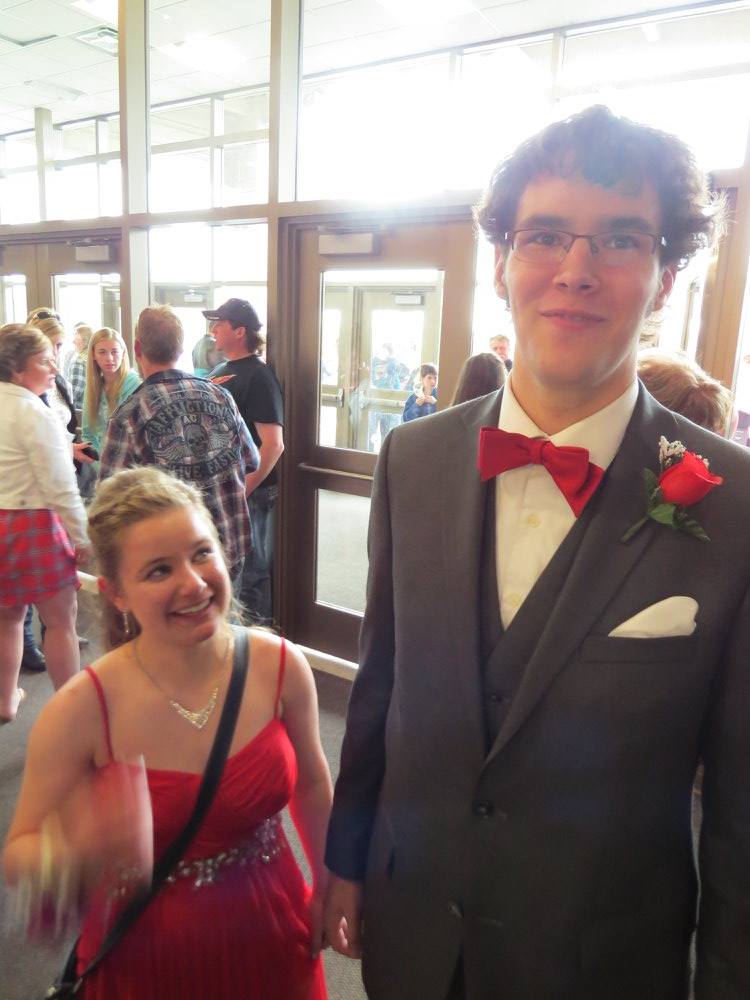
Prom-goers: Brendan and Olivia

Brendan, as you may have heard, is headed to UMary in the fall. He will graduate early in June in the top 10 in his class, with a varsity letter in wrestling and local scholarships from Knights of Columbus Council 4174 (of which he is one of the newest members), the American Legion, and the Hanover Athletic Association. He loves Ultimate Frisbee (actually all four of our teens/tweens do), dabbles in swing-dancing, and is still happily dating Olivia. (Last night’s consisted of Adoration and ice cream.) He is still working at the hardware store, and just starting a second job with a local electrical contractor for the summer. He loves his bass and his music (Foo Fighters is his current favorite band), and yesterday, he bought an acoustic guitar for song writing and kicks. And he has a pipe, which he smokes on occasion.

Swing-dancers: Gabe and Kate

Gabe is now the tallest in our family, by perhaps a quarter inch. He is working on getting his driver’s license this summer, helping our friend’s taxidermy business, and preparing for his junior year of high school. He was confirmed this month, was just inducted into the National Honor Society like his older brother (NHS at our high school does a great deal in service to the school and community), and will be one of the leaders of the high-school pro-life group in the fall. He played soccer but didn’t wrestle this year, and is on the fence about next year — too many other interests, including reading and writing, teaching himself piano, learning Quenya (J.R.R. Tolkien’s Elvish language), and swing-dancing. In this last activity, he works hard and excels — especially when paired with his friend and fellow Lord of the Rings geek Kate. They aren’t dating, just dancing and discerning together.

Emma and two of her flute-playing besties

Emma is easily the tallest female in the house and explored the high-school for the first time yesterday as an incoming freshman. She played volleyball in the fall and is running track this spring — plus playing flute in the band and woodwind ensemble and singing in the middle-school choir. The music, at least, will continue in high school. Emma has followed her brothers to help with the church’s Core Team and is also an avid swing-dancer (which means boys); Gabe’s dance-partner is one of Rosebud’s mentors in becoming a young woman of virtue. Emma dabbles in piano, too; reads voraciously, and bakes like our family is twice the size (and it will be, unless we share her goodies). She is hoping to start baby-sitting soon and wants a new dog almost as much as her dad.

Trevor rocking

Trevor will be our sole middle-schooler next year, and plans to work out this summer in hopes of wrestling on the school team in seventh grade. He is a rhythmically gift version of the boy his father was: a creative thinker and storyteller, easily distracted, heart-on-his-sleeve…but coordinated enough to rock a drum kit (or the kitchen table, a couch cushion, his thighs…), to play basic piano music with relative ease, and to dance to almost any song when the mood strikes him. Also an avid reader and a good student, but with a style all his own: whereas Gabe has a hat collection and wears them on occasion, Trevor wears a brown fedora each day to school. He shows signs of a mechanical knack (another difference from his father) and still loves Legos.

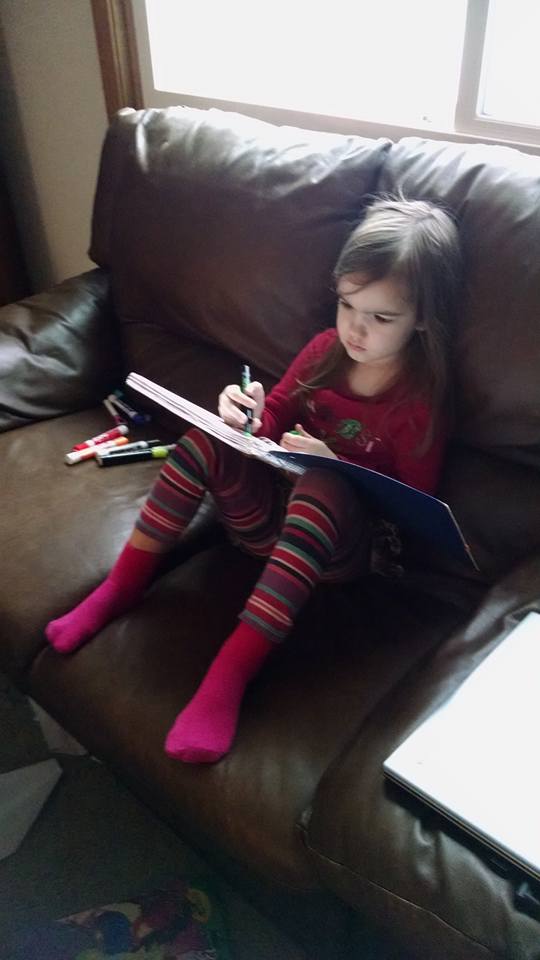
Typical Lily

Lily completed her year of Catholic co-op preschool yesterday. She is colorful, funny, opinionated, and creative, with an ever-expanding vocabulary and a precocious sense of humor for a four-year-old, included puns and word-play and physical comedy along with the typical (non-sensical and never-ending) knock-knock jokes. She, too, likes to dance and to watch her swing-dancing elders, and she makes her siblings friends her own whenever she has the chance. She, too, has sprouted in the past year — she is a head taller than her plastic barn playset she so enjoyed last summer — and although she rarely eats a lot at a sitting, she would eat constantly if allowed. And she loves superheroes, especially Batman and the Justice Leaque.

Jodi and I are well — and abundantly blessed, in the midst of such breakneck activity. My bride often says it feels like only a short while ago that Brendan got on the bus for kindergarten the first time, and so it seems to be as well. We will have been married 20 years this August, and for my part, I am as happy as I have ever been.

That said, I had to be reminded of something not long ago, with the help of a priest friend: as Christians, spouses, parents, we have a serious call in this world, which requires a serious, heartfelt response — but none of that means that God doesn’t desire our happiness or enjoyment of this life. He came that His joy may be ours — shame on us if that joy does not pervade all that we do, and all that we are. It can seem terribly romantic to think ourselves unworthy of the blessings in our lives — the soft warmth of the one who lies next to us in the wee hours before waking, or the noise of a full and laughing house — and to strive and sacrifice to show our appreciation and earn our worth. But in truth, we are worthy — intrinsically — as God’s beloved children. So while I must not take my beautiful bride and these five awesome children for granted, I can love them best if I realize that my worth, and each of theirs, comes from our creation in His image and in resting in his embrace.

We are so blessed. As sinners, we don’t deserve it…but what else should we expect from such a God as this?

Last summer…where does the time go?

Brandings

Blogger’s Note: Another past writing, from 2001. This is one of my favorite pieces of non-fiction I ever wrote, and came back to my mind following this recent post from Prairie Father. In case you are wondering, Fr. Tyler is, in fact, the Tyler mentioned below. Finally, I’m no cowboy. If my terminology is imprecise or inaccurate, forgive me. If it is offensive to cowboys, correct me in the comments!
I

The city girl behind the counter called it a marking. She wore Doc Marten sandals and just last week mistook a bird’s call for approaching cattle. Drugstore cowgirl, with her chopped blonde hair tucked beneath a curled straw hat, more Junior Brown than Tom Mix. She wants a stampede string to keep it in place should she need to chase cattle at the “marking,” and I’m smiling at the thought of her sprinting in her sandals through knee-high grass behind some rangy Angus cow, her hat tied tight beneath her chin.

II

We rose to cinnamon rolls and coffee—six a.m., and Bob’s pulling his tall, red-topped boots over his jeans; a bright silk scarf about his neck; white shirtsleeves shining softly in the morning sunlight. Bob drinks tea, not coffee; sweeps the crumbs from his long moustache, takes from the wall a straw hat with the same crease, crown and brim as his felts, and heads out, spurs jingling, to catch his pony.

The hands arrive in twos and threes, and their rigs line both sides of the driveway—crew-cab pick-ups and long stock trailers with cow-horses saddled and tied short alongside. The men gather around the plank table in the kitchen, exchanging greetings and jabs, sipping coffee and complimenting Cindy on the rolls. All wear boots and hats; many have chinks, and most wear spurs. They range in age from 15 to about 60. Chance, Bob’s youngest, wears his boots outside his pants, same as his dad; a rosy plaid western shirt, battered chinks and a black felt hat set back on his head. He’s rough and ready, a chaw in his cheek and blue eyes sparking, happily cussing the dogs.

Chance has two friends with him today—John’s dark haired and dark skinned, with baggy carpenter’s jeans and Docs on his feet. He’s clearly not cowboy, and his T-shirt reads the same as yesterday: “I’m just one big f—ing ray of sunshine, aren’t I?” (Hyphens mine, not his.) His sister, Rachel, watches Chance with dark eyes and prepares to ride—purple chinks with heart-shaped conchos; a long denim shirt opening on a white tanktop.

Straws are the hats of choice in summer; still, a few felts make an appearance. “Real cowboy hats can be any color, so long as it’s black or silverbelly,” Bob says. Rick Smiley wears a dark gray hat, for what that’s worth, and sky-blue plaid. Frank Timmons wears battered silverbelly, with a sweaty ring at the base of the crown. It sits low on his brow, so that the curled ends of his moustache are often all that escapes its shadow.

Where I come from is not far from the girl at the drugstore. I shake hands with the men around me, conspicuous in a green Filson cap that suggests I’d rather be fishing. I remember selling western boots in that same drugstore, when my own boots and the pearl-white snaps of my uniform shirt branded me a cowboy in the eyes of little boys from New Jersey—this day even my father, in his broad black hat and leather vest with antler buttons, may have dressed too plainly to be called “cowboy.”

III

A couple days later we’re eating chili around that same plank table. Bob took a call a few moments earlier from a Manhattan-based research firm conducting a survey on environmental policy and public opinion. He spends a good ten minutes on the phone with the caller, and by the time he hangs up, he has identified himself as a heterosexual white male, a conservative, a Catholic, and a staunch Republican.

“You realize,” I tell him, “that you are the enemy.”

He’s cutting cheddar with the same pocket knife he cut calves with two days ago. He’s got a saddle shop in his kitchen. He doesn’t care.

IV

The riders mount and spread across a broad expanse of grass to round up the cows and calves. We’re watching from a windy hilltop overlooking the pasture, the pond, an old windmill and a few crooked trees, with the house, pens and buildings beyond.

Bob’s oldest boy, Tyler, is leaning against Sorley, a stripped down Suzuki Samurai with a homemade plywood roof and four-wheel drive—the name comes from the little rig’s sorrel color. He’s only recently back from Winona, where he’s studying for the priesthood; he’s dressed in a plain t-shirt and sweats, untied duck boots and an old fedora. His little brother’s riding with the men below.

Tyler stands in front of the little 4×4, watching the cowboys work. He’s not like these others—he’s a big kid and prone to discussing philosophy, praying aloud in Latin or singing in Spanish—but he looks at home here and I snap a picture of him, God’s country in his eyes.

V

The cows are vaccinated, and the fire’s lit. Bob moves between groups of cowboys enjoying cookies and iced tea and assigns them to work as ropers, wrestlers, branders and cutters. Dad and John man the gate, shooing the bravest calves back into the pen. An odd pairing, to be sure—my father will lock up the brakes on the pickup at the sight of a middle finger, and this kid’s wearing as bad as that across his chest.

The ropers ride into a sea of bawling black and throw their loops. They drag the calves out by their hind feet, and the wrestlers topple them to their right sides and pounce on them, one on the head and topside foreleg, the other on the hind feet. The horses keep the rope tight, looking only slightly interested, and the riders watch. Two needles to the neck; blue smoke, the stink of burning hair and the sizzle of flesh. If it’s a bull calf, a few deft strokes with a pocket knife and a squirt of disinfectant. It’s brutal, quick and effective—strangely, the calves bawl loudest when first roped and dragged, and scarcely limp upon release.

Bob is cutting calves, and in just half an hour, his white sleeves are punctuated in red. He keeps his pocket knife in hand, wiping the blade occasionally on his chinks. It’s coarse surgery, without anesthesia or stitches, and I tell him so.

“You’re right,” he says, looking to the next calf. “It’s pretty rough, what we do to these critters.”

The smoke rolls.

VI

The latest issue of The Atlantic ran an ad for the American Indian College Fund, with the tagline, “Have you ever seen a real Indian?” The picture is of a young woman of no obvious ethnicity, with long dark hair, standing near a wooden cabinet full of microscopes. “Carly Kipp, Blackfeet,” the ad reads. “Biology major, tutor, mom, pursuing a doctorate in veterinary medicine, specializing in large-animal surgery.”

VII

The work’s nearly done, and Chance and Rachel are leaning against a gate, saying little. He dates her cousin, and he, Rachel and John spent last night beneath the stars on a hide-a-bed couch in the back of a pickup.

When the branding’s finished, it’s dinner—roast beef and beans; mashed potatoes and gravy; bread and salad and beer. Some of the men head home—the rest take up spots on the porch or the lawn. After a bit, two guitars come out, and Bob and Paul (a rancher out of Montana who owns the cattle we branded today) take turns picking—old country songs, rock older still—and discussing how music and cowboying has changed over the years.

“My wife tells me,” says Paul, “that if I want to get back to cowboying, the first thing I gotta do is get rid of about 1,500 head.”

I’m riding a sawhorse next to Chance. He takes his dad’s guitar and begins to play—bits and pieces of more recent rock songs. He finally settles into “Mary Jane’s Last Dance”—bending strings to coax all the heartbreak he can out of them, the lyrics audible only in fits and starts above his playing.

Three-year-old Brendan’s on the porch with Rachel—they’ve been splashing each other with water from a five-gallon pail, and Brendan is soaked. Rachel’s hair is dripping, and Brendan’s new “pet” clothespin is clipped to the back of his shirt—he’s been looking for it for the past twenty minutes. She’s swiped a beer from the ice-filled tub in the grass, and Brendan wants what she’s having. They play together for an hour or more, when nobody asked her to—she’ll make a mother someday. Or someone’s favorite aunt, at least.

Bob says her older sister’s a beautiful girl—could’ve been a model.

“She’s got just enough Indian—they’d take her to Elko, to the Artists’ Ride, and dress her in skins …”

Rachel’s a beauty in her own right—her mixed ancestry shows in her complexion, her dark curls and brown eyes. She’s been arguing with Bob about whether her Adidas visor qualifies as a hat.

It takes a special girl, I think, to make a visor and chinks look good.

VIII

I’m driving to work and NPR is talking to songwriter who’s latest recording is called Scar. The title cut, he said, is based loosely on his relationship with his wife—it’s about how our relationships and experiences, for better and worse, mark us for life.

Brutal, quick and effective.

J. Thorp
May 2001

Thomas and Me

Blogger’s Note: What follows is as close as I’ve come to a mystical experience. Because of this, I don’t doubt the charismatic side of our faith as much as some — but also, I recognize more fully that it is extremely hard to know what’s going on in another’s mind, heart, and soul. I wrote this back in 2003, shortly after moving to Minnesota and relatively early in my return to the Church– before my conversion, in many ways. As such, it is a glimpse into an immature prayer life that was blessed with a brief but up-close encounter with God’s love. I’ve made two small edits for clarity’s sake. I would write this differently today, but it is as accurate as it can be. 

Thomas was a lucky man.

Imagine sharing your life with Christ, in the flesh. Experiencing the gospels firsthand. Hearing the people talk of the healer, the prophet, the man who overturned tables in the temple — your friend. Imagine seeing miracles not just happen, but be performed by someone you broke bread with.

Thomas was lucky — not only to have known Jesus personally, but also to have missed His first appearance to the disciples. Imagine — Thomas comes back from wherever he’s been, and his friends are grabbing his robes, spinning him around, each trying to explain over the others that Jesus, three days dead, had come to see them. Had breathed on them. Now, Thomas is no fool — he knows his Lord was flesh and blood, and saw Him crucified. He knows that, despite Christ’s miraculous powers, he didn’t make it off that tree alive, and he can see nine ways to Sunday how somebody pretending to be a risen Christ could really mess things up good for the disciples, for the Jews, for the Romans, everybody.

So he puts up both hands, looks at his brothers and says, “I’ll believe it when I see it. No — as a matter of fact, I’ll believe it when I can examine the holes in His holy hands and feet. When I can stick my hand in His side.”

Imagine the audacity! The disciples are staring at Thomas in open-mouthed disbelief: After all you’ve seen, and all we’ve told you — after all we’ve been through together — you won’t believe until you’ve pierced Him again with your own hands?

Thomas glares resolutely around the room, then stalks out again.

Thomas is lucky, because his Lord wants to give the people every chance to believe and be saved. Christ could have come back the second time and scolded Thomas for his lack of faith in God and his fellow disciples. Instead, he smiles at Thomas and tells him to go ahead and touch the wounds. Put your hand in my side, my friend, and believe!

Thomas immediately falls to his knees and proclaims Jesus his Lord. As a result, we learn two things about our God — He’ll bend over backwards to save us, and being in His presence requires no further explanation.

With 2,000 years of faith, tradition and perspective behind us, it’s easy to fault Thomas for his doubt. But remember, Thomas and the disciples were a newly formed minority, out of favor with the Jewish leadership, and now leaderless. In times like these, it pays to be a skeptic, if only to protect yourself.

Thomas wanted what we all long for — certainty. Faith is fine, but how many times have we all asked for something more?

“Just give me a sign, Lord. Give me something to believe in.”

The signs are all around us, of course — we only need to open up to them. What follows is a true account of what can happen if you do.

*****

Jodi and I were youth leaders for three years before moving to Minnesota. We were volunteers — actually, we had volunteered to help with the high-school youth group, and were quite excited when, the next Sunday, Fr. Bill told the flock he had two new youth leaders.

We couldn’t wait to find out who.

Let me say right off that I’m no saint. Nothing in this world can make you more acutely aware of your own weaknesses than preaching the gospel to young people, or having their parents tell you what a wonderful, positive influence you’ve been in their children’s lives. As youth ministers, were we still sinners? Yes. Did we feel worse than ever about it? Oh, yeah.

Jodi and I did a lot with the group. We made pancake breakfasts for the parish. We sang Christmas carols for the locals. We saw the Pope in Toronto. And often, we just hung out.

The high point of the high-school youth group experience, however, is the yearly trip to Steubenville, Ohio, for Franciscan University’s famous Catholic youth conferences. Thousands of young Catholics, countless deacons, nuns, youth ministers and volunteer chaperones, and the widest assortment of priests you can imagine — biker priests, rapping priests, priests who speak in tongues, wizened old men and young fellows fresh from ordination — all spending the weekend together, singing and praying, laughing and crying. And on Saturday night, calling Christ to earth to walk among the masses.

Saturday night at Steubie is like nothing else. When the Eucharist passes through a gymnasium full of spiritually famished teens, “adoration” doesn’t do justice to the experience. Christ makes His presence known — not at the altar, not on the stage at all, but out among the hungry souls, the Bread of Life, meeting the young people where they are and taking them where they need to be. Their personal God and savior.

I’ve heard from teens who claim to have seen Jesus, talked to Him, held His hand. I’ve heard from people who have been held by Jesus, rocked, soothed. A friend of mine made peace with a relative long dead. Another heard, saw and felt his sins enumerated, forgiven and fall away like so many dry leaves. Kids shriek, laugh uncontrollably, sob, shout. Some stand upright, speaking aloud with God. Some fall flat to the floor, dead to the world around them. Some are prayed over, or escorted out. It quickly becomes apparent that the adults are no longer running the show.

Even so, group leaders are encouraged to devote themselves to staying alert and keeping their young people focused and safe. And the first Saturday night I spent at Steubenville, I wanted nothing more. It was unnerving to close your eyes for too long.

This past July, however, was different. Jodi and I had already relocated to the Twin Cities, and were coming back for one last Steubie trip with “our older kids.” I wanted to soak it up — all the energy, enthusiasm and love that they could give. We arrived at the St. Mike’s church parking lot at 5:30 a.m., and a number of the kids were there already, shivering, sleep still in their eyes. I was bouncing in place. My knees were shaking. It felt electric.

The trip was great — bittersweet, of course, with constant reminders that this was it, the last hurrah. That first night we circled up on the lawn after the evening session, and I told them how wonderful it felt to be there with them. I told them I felt like a live wire, feeding off their energy. I told them I thought the weekend was going to be amazing.

Saturday dawned early and rushed headlong toward adoration. So much going on, but the constant background buzz was tonight, tonight, tonight. The Steubie newbies didn’t know what to expect, and spoke in hushed tones, equal parts excitement and anxiety. The veterans exchanged knowing smiles.

And then we were there – a thousand voices singing softly, countless palms outstretched. The Eucharist appeared, raised high, glowing from within as the spotlight followed it on its slow procession. And the tears came. The laughter, the shouts, and the cries. Our kids were swept with the Holy Spirit, and Christ was there — you could see it in their eyes. I looked from one face to the next, and oh, how I wanted to see what they were seeing.

Gimme a sign, Lord, I thought. Just a touch, a taste.

I could hear the priest’s voice ringing in my head, advising the chaperones: “Remember, this is for the kids.”

But your will, not mine, I added.

*****

That night we sat in a wide circle on the grass. One by one the kids and the adults shared how Christ had manifested Himself, speaking their language, sharing with them exactly what they needed. When my turn came, I told them I’d felt jealous.

“I know I shouldn’t have felt that way, but I so badly wanted to experience what you were,” I said. “Finally I made my peace with the fact that this wasn’t my time — after that, it was just a joy to be with you all.”

And I told them I loved them.

On the bus home Sunday evening, we’re called to the mic at the front of the bus to share our final thoughts on the trip. I don’t know what I’ll say when my turn comes — I want badly to be light and funny, but leaving the youth group is weighing heavily on me.

“Tell us a college story!” someone shouts, and everyone laughs. I have a well-documented tendency to fall back on those stories — and to run long in the telling.

“No college stories,” I say. “What I want to tell you is something you’ve all heard before from me, lots of times. But I want you to really listen this time. I love you guys –”

“We love ya, too, Jim!” the girls in the back shout.

I stop a moment, shake my head: “Thanks, but guys, listen…”

I wait. The chorus of “love yas” slowly quiets.

“Listen to me. We have a tendency to say these things in a casual, off-hand manner like that, but I mean it. I love you. All of you. So much.”

The bus is quiet now.

“We goof around with that phrase all the time — either we don’t say it because it’s sappy or we’re afraid people might think we mean something we don’t, or whatever. Other times we say it offhand, like it doesn’t mean anything. It’s just something we say, right? Let’s not do that. Tonight, let’s take a minute to look at each other, to recognize each other for what we are — flawed human beings, and children of God. Let’s tell each other how we feel and mean it tonight.”

By the time we get back to St. Mike’s, Jodi and I have visited with nearly everyone on the bus, one on one. Even the chaperones have taken my speech to heart, and the bus is warm with affection.

The bus pulls into the church parking lot. A few cars are waiting there already, and a small knot of parents stand in the evening cool, talking quietly. The kids pile out of the bus, a tumble of sweatshirts, pillows and duffle bags, raucous from lack of sleep. Some hug their parents; some, each other. A few hug Jodi and me.

I shout above the din for the group to circle up, and invite the parents and bus driver to join us in a closing prayer. We join hands, and begin in the name of the Father, and of the Son, and of the Holy Spirit.

“Guys,” I say, “I’m shaking again.”

I don’t know where to begin. I tip my head back and stare up into the heavens’ blackness, past countless twinkling stars.

“My God,” I say. “Look up there!”

My legs are trembling.

I begin: “Dear Lord Jesus, thank you. Thank you for the love in this circle tonight. Thank you for the experience of this weekend, for your love, for being there with us. For being here with us. Thank you for joyous laughter and cleansing tears. Fill us with your Spirit, Lord, that we may carry this feeling forward with us, and share it with everyone we meet.”

I ask if anyone has petitions. I’m still looking to the heavens. Ron and Josh, the boys on either side of mean, are squeezing my hands, and my legs continue to shake. There are petitions — for safe travel home, for the youth who couldn’t go to Steubenville, for the church, for sick loved ones, and for all the young people touched by God over the weekend. When the circle is silent, I’m out of breath. “You guys, I can’t stop shaking,” I say. Then I begin the Lord’s Prayer.

“Our Father, who art in heaven…”

The circle picks up the prayer, but my voice falters. The trembling in my legs hits my chest and spreads rapidly toward my fingertips. My head is back; tears are streaming past my ears, and my mouth is open as if to shout, but I can’t speak.

“You okay?” Ron says. He’s squeezing my hand tighter now. So is Josh.

A feeling like strength and power and pure joy arcs through me in waves, and I feel like I’m rising. The Lord’s Prayer complete, kids begin to laugh, shout and sing. The circle remains intact, however, and I manage a groan: “Guys!”

No one hears me. I can’t stop shaking — don’t want to — this feeling — incredible! I don’t know if I’m standing on the pavement or floating above it.

“Guuuys!” I rasp. “Pray! Don’t stop — pray!”

The new youth minister, Mianne, starts a Hail Mary.* I can barely hear them — the feeling is deep and resounding and intense and glorious.

My body is dissolving, except my hands, and I grip Josh and Ron more tightly.

Jesus. Lord Jesus. My God.

Mianne leads a second Hail Mary, and I’m coming down now. I’m laughing and sobbing as they finish the prayer. The circle is intact.

“You know,” I say, gasping for breath. “Remember…I said…I was jealous?…I’m not…anymore…I just…got mine.”

“Praise God!” says Mianne, and the circle cheers. I collapse on Ron and Josh — they are hugging me, and I tell them to hang on to me; I’m not sure I can stand.

Ron whispers in my ear: “What was that?” I look at him and see a knowing smile. “I could feel it,” he says. “Coming out from you. Could you feel it, Josh?”

He could. Ron leans close again, and whispers, “Dude, it felt like you were gonna lift off. We had to hold you down to keep you here.”

*****

I don’t think most of the adults knew what was happening. The kids who were closest to me in the circle knew I’d felt something incredible — some of them had felt it, too — but Jodi, on the far side of the circle, had thought I was just “getting into it” a bit.

I pull her close and try to explain. As the kids begin to leave, we walk to a bench outside the church and pray together.

I pray for understanding. Already my skeptic’s brain is working — I’m exhausted, and have so much emotion invested in the group, etc., etc. Had to be adrenaline, or something.

No. You were touched. And another wave hits me — just one. I look at Jodi with tears in my eyes, smiling.

“Jodi,” I say. “I think I felt God tonight.”

She smiles, and continues to pray with me.

When we arrive at my parents where we’ll spend the night, my mom is waiting up. She asks how the trip was, and we tell her it was great. I’ve a strange look on my face, and when she notices I tell her I had an experience I want to share with her, but I’m not sure how. I tell her I want to sleep on it.

In the morning it’ll be gone, my skeptic’s mind says. Instantly, I begin to tremble, ecstasy and tears rising to the surface.

That night I held my wife until she was sound asleep, for possibly the first time in nearly seven years of marriage. Always before I’d been too warm, too tired, too uncomfortable. Too selfish.

I woke wondering how to explain to my mother, only recently back to the church, and my father, who claims to be atheist, that I’d come heart to heart with Christ. I was afraid they would think I’d finally cracked — I’ve always been an emotional, and sometimes dramatic, child. I lay awake for a while and imagine what they might say to convince me otherwise. In my head their arguments made sense, but each time my heart would rise up and another wave would crash down on me — strength, power and joy. In the shower. Over breakfast. Each time I tried to deny what had happened, or call it something it wasn’t, I would be overcome.

When I finally explained to my parents, I was trembling again, not from fear, but from conviction. When I finished, they didn’t question me or laugh. When I finished, I knew the truth — I had been touched by God. And with the same certainty, I knew I wouldn’t get that feeling again.

*****

So far, I’ve been right. God doesn’t let us replace our faith with Truth, but fosters faith in Truth. My sign was mine alone, to believe or disbelieve, but as soon as I made my choice the sign itself was gone. I don’t tremble. I don’t float. I don’t spark anymore.

Only once in a while, I’ll brush up against it and get gooseflesh and tears — all that remains of that glorious feeling. The earthly things we enjoy — food, drink, sex — don’t come close. The greater joys — love for family and friends, spouse and children; memory; the beauty of life — these too fall short. All strength, all power and pure joy combined as…what?

Love. The love I’d preached to the youth group but never given before that night. A love without boundaries, infinite, founded on our deepest commonalities — we are alive, we are human and we need to love and be loved. A selfless, giving love that never ceases, and never dies.

Christ’s love.

I’d like to say I’m free now. I’d like to say that Christ touched my heart, and I sinned no more. But it hasn’t happened. Touching God didn’t make me perfect, any more than experiencing Truth means I don’t need faith. The good new is it’s harder now — harder to sin, and harder to bear it. The good news is I’m more aware now, and it matters to me. The good news is that love really is all we need.

The Good News is He is real, He is here, and He is love.

J. Thorp

29 Sept 03

*****

*Accounts differ from my own on this point. Mianne told me afterward that we didn’t pray a Hail Mary as a group and suggested that must have been between me and Our Blessed Mother. The teens couldn’t recall for sure.

Farewell to Puck

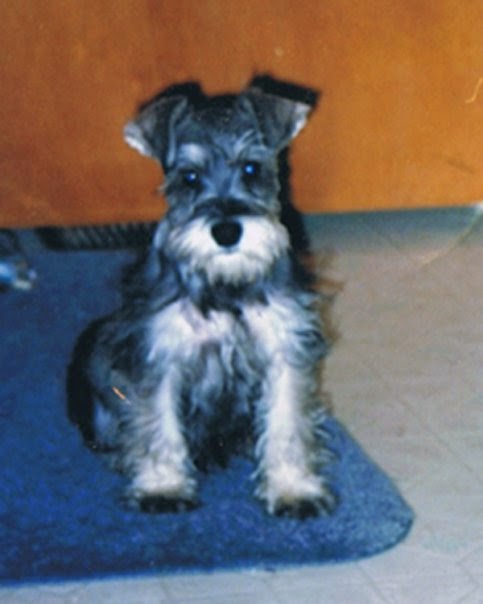
Our new pup, circa 2002

We lost Puck today. At 13 years old, he was certainly not a young for a dog, but definitely not old for a Schnauzer. He had begun, in recent years, to sleep longer and run less, and earlier this fall, he had some teeth removed. At that time, the vet said his blood work was clean and extolled how healthy he seemed for his age, but warned that at this stage in a dog’s life, anything can happen.

And it did. Over a matter of weeks, Puck went from old to frail. He never complained, but slept more, ate less, and stayed closer to the house and us. He was slower on the stairs and slower to respond to our calls and whistles. Then a few days ago, he lost his balance and struggled to stand. Our other dog, Boomer, had done this several times in his old age — he would usually sleep for the better part of a couple of days, then be up and around again. Only Puck didn’t recover.

He was 13, and our kids are age 16 to 2, so he’s been a part of the family for as long as they can remember. We miss him.

Puck, all Christmased out.

We got Puck from a Schnauzer breeder on an old farmstead in rural Michigan. I wanted another dog — a smaller, indoor pet, since Boomer was big, woolly, and hated being inside. Jodi is not a dog person, but gave in to my persistence and the boys’ pestering. (Or was it vice versa?) He was an adorable pup (my Dziadzi — Polish for grandpa — was not overfond of our Airdales, but looked at our Schnauzer and said, “Now that’s a dog!”), and full of curiosity and mischief. I was struggling to come up with a name that reflected both his Germanic roots and his personality, and my choices were getting more and more outlandish. At one point, the name Wolfgang came to mind. I had Mozart on the brain, but was freely associating, and thought of the chef, Wolfgang Puck, then of the Shakespeare character from A Midsummer Night’s Dream.

I looked at our impish pup, and the name fit. (Of course, only later did I discover how a grown man shouting, “Puck!” out the back door sounded to the neighbors, or how many Minnesotans would instantly assume I was a hockey fan.)

Steamy summer roadtrip…

He’s always been an easy keeper and a good traveler. In fact, the only trouble he’s ever been came from a tendency in his younger days to know exactly when we were preoccupied by something else and high-tail it around the neighborhood. During the day, he would turn up in someone’s garage, or walk in through their front door with their kids, and they’d look at his collar and call. At night, he’d run yard to yard, and I’d drive with my head out the window, listening for jingling dog-tags or a neighbor dog in an uproar, trying to catch up to him.

After Boomer passed, Puck no longer wanted us to travel anyplace without him. If he sensed even a hint that we were preparing for something longer than a day trip, he would look for an opening, jump into the van, climb as far back in as he could, and refuse to come out unless I removed him. He would lay in whatever open space he could find in our overstuffed minivan, never bothered the kids when they were eating, and was content to sleep in the vehicle, in garages, in tents, wherever, as long as he could come with us. On cold winter nights, he would curl up under my old Carhartt jacket, head and all, and be there in the morning, ready to greet the frosty dawn.

He loved dog biscuits and pop corn and being scratched above the collar bone, beneath the collar. He used to love chasing tennis balls, but only in the house. He never liked to be picked up or manhandled — I could do what I wanted (he would even roughhouse a bit with me), but he only tolerated Jodi or Brendan lifting him, and nobody else. In recent years, he tended to get out of traffic when little kids were around. He tolerated other known dogs, but strays drove him berserk. Cats made him quiver with nervous energy; he was never quite sure whether he was supposed to chase them or not, and they seemed to relish his uncertainty and rub it in his face.

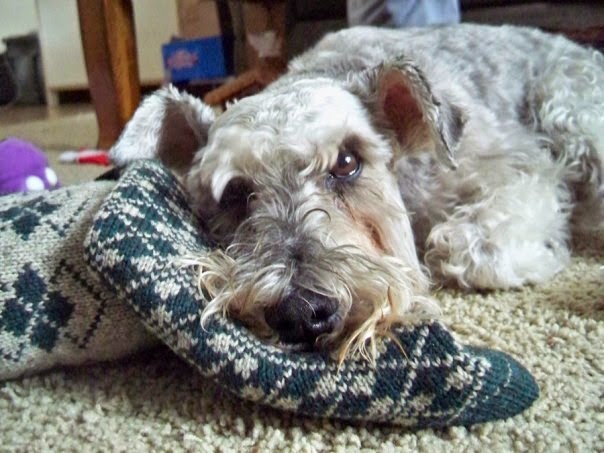
The old man, a couple weeks ago.

When we told the kids last night that it might be his last, we recalled three other special memories. Jodi remembered how our little ones, especially Lily, bonded with Puck by dropping food from their highchairs, and when they realized he was eating it, making a game of it. I remember him shifting from front foot to front foot and softly ruffing at us when he thought we were paying too much attention to baby Lily and not enough to him.

I also remember how perceptive he could be. He had a habit of sidling up to whomever he thought was most likely to pet or snuggle him — he would sit on your toes, even, or thrust his soft gray head up under your hand. But when we lost little Jude, I remember him insisting that I pet him as I lay on the couch or the bed, quiet and sorrowful. He nudged, prodded, cajoled, as if to say, C’mon…better days are ahead!

And he was right.

Goodbye, old man. Good dog.

Rosa Represents

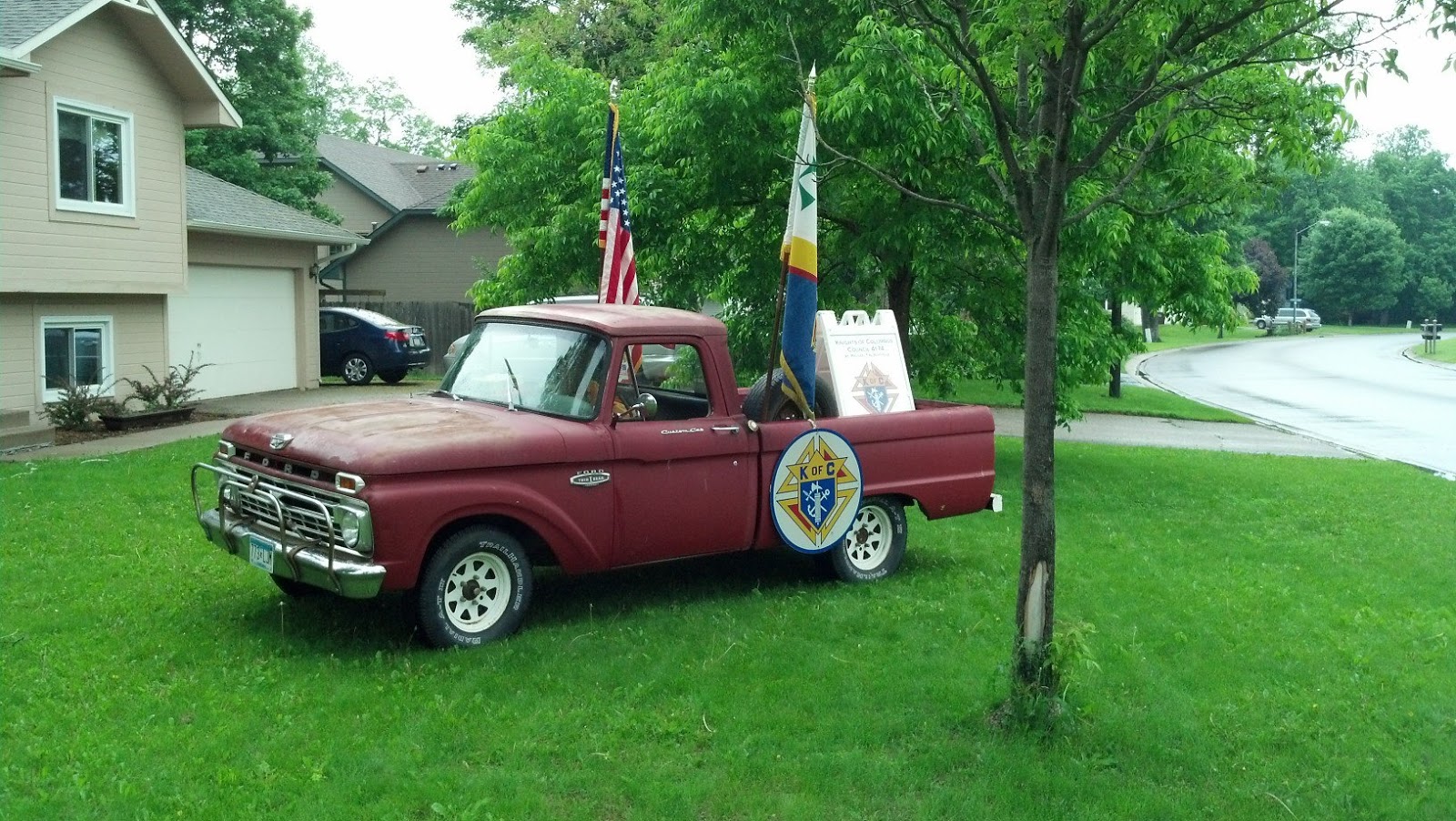
Rosa, ready to go.

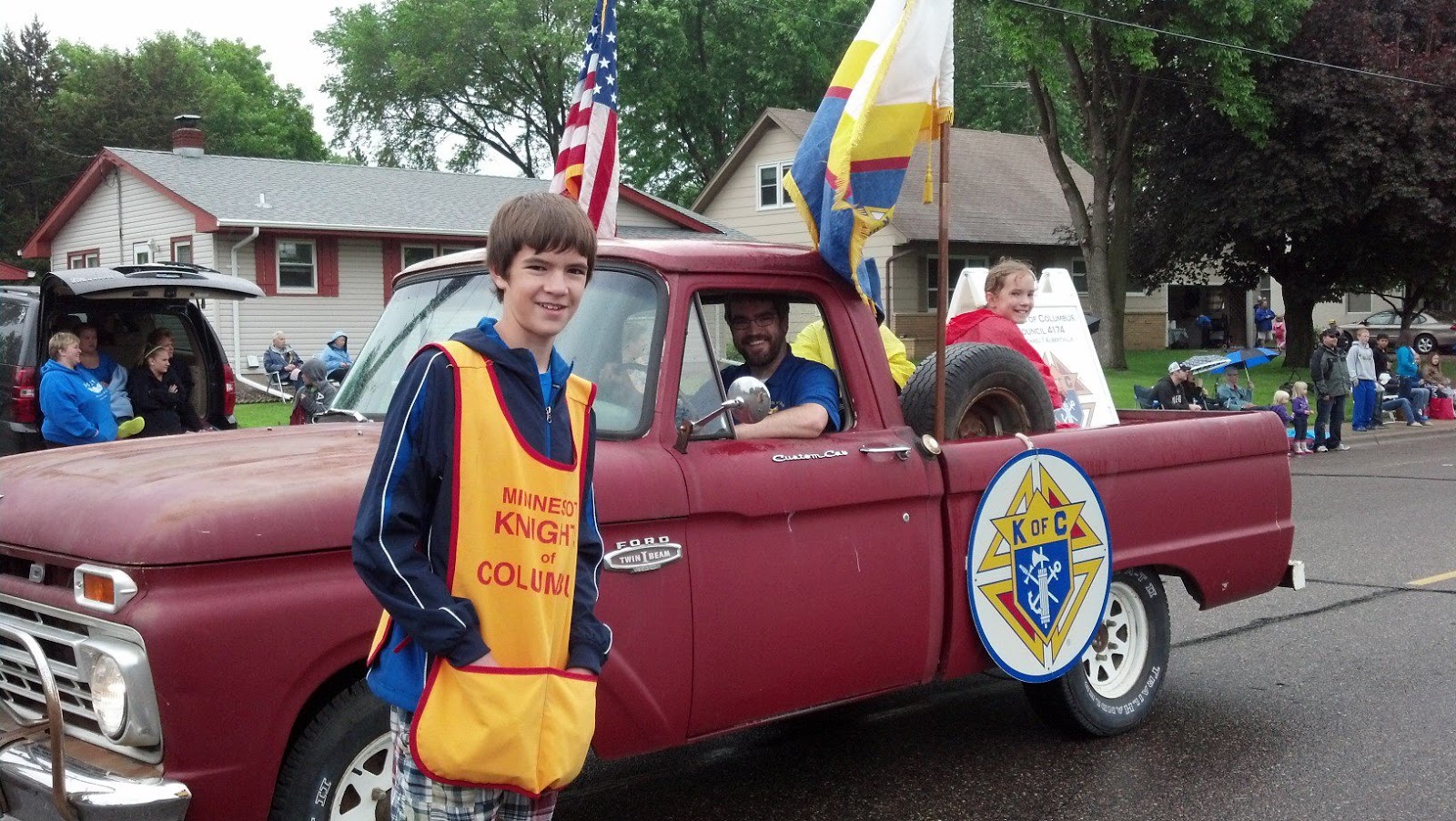
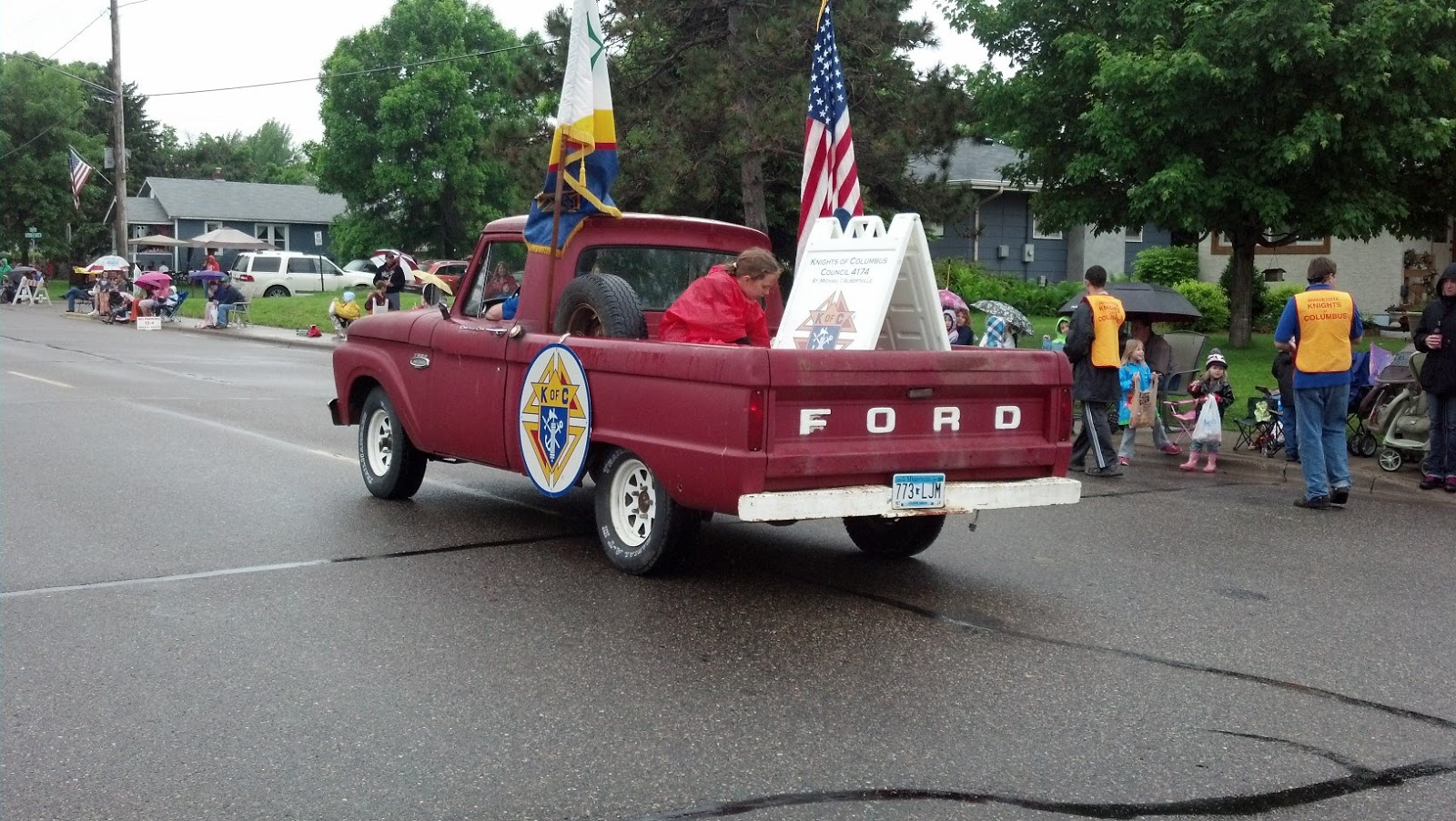
I took Rosa out for an afternoon on the town this past Sunday.  We appeared together in the Albertville Friendly City Days Parade, representing Knights of Columbus Council 4174, with fellow KCs and Catholic youth (including Bren, Gabe, Rose, and Trev) passing out Tootsie Rolls to the crowds.

Parade rest.

She drew a lot of looks and compliments, particularly among gentlemen of a certain age, who might have known someone like her in their younger days. The younger men took notice of both her beauty and her age and were respectful, save one young hoodlum, still red-faced and drowsy from the previous evening’s festivities, who bellowed, “C’mon, light ’em up! Let’s see what kind of power the old Ford’s got.”

Rosa ignored him entirely in favor of a little boy waving enthusiastically from the other side of the street. I leaned out the window, smiling, and said, “She’s got a 240 straight-six. This is about it.”

Show some respect, young man. She’s forgotten more miles than you’ve travelled.

Another young man, clean-cut with Buddy Holly glasses, looked her up and down and said, “’66?”

“Yup,” I said, and he nodded appreciatively.

Were she a woman, guessing her age would be considered uncouth, but for a pickup, it’s a compliment. What might be an adulterous attention to her curves and lines were she human is for Rosa a sign of her authentic, ageless beauty – she is noticed, not because she’s hot, but because she’s classic.

To that end, when we were preparing for the parade, I flew the flags and hung the KC emblems on the side, then grabbed the box of streamers, spangles, and bows left over from last year’s float. I looked from the box to pickup and back, then returned the box to the garage. She’s impressive enough in her own right. Who doesn’t love a modest girl who’s comfortable in her own skin?

Looks just as good going…