You Did It For Me

It is the first full week of Lent, and already I struggle. I must have chosen well which things to uproot from my life—my family and I are enjoying great sport pointing out my unconscious consumption and countless offhand comments, both of which I’m attempting to quit.

Additionally, each Lent we notice how little we focus specifically, consciously, on the Corporal and Spiritual Works of Mercy.  During our morning prayers, Jodi and I shared today’s Gospel reading,  Matthew 25:31-46, which includes these words of warning:

“‘Lord, when did we see you hungry or thirsty or a stranger or naked or ill or in prison, and not minister to your needs?’  …  ‘Amen, I say to you, what you did not do for one of these least ones, you did not do for me.’ And these will go off to eternal punishment, but the righteous to eternal life.”

It’s sobering each time we hear it: another year flown by, and what did we do for the least of His brothers? Our brothers? Continue reading

Chains of Memory

The past couple of days I’ve been plagued by memories: guilty recollections of past sins, glimpses of images I never should have seen, bits of off-color or debauched “humor,” lyrics to songs that should not be sung.

Beginning in college, this was my rebellion. I looked at, listened to, and watched whatever I wanted. And in short order, I proved the adage, “Garbage in, garbage out.” During much of my college years, I swore like a sailor; I told dirty jokes to old friends and new acquaintances, and I made excuses for my behavior—to others and to myself.

“It could be worse,” I said, and I knew I was right. I had a vivid imagination, and worse played out in my mind if I lingered too long on any impure thing.

Thanks be to God, over the first ten year of my marriage to Jodi, I weeded these things out of my life. Little by little I dropped the jokes, kicked my swearing habit, left porn behind, stopped watching racy movies, and cleaned up my taste in music. And beginning with one no-nonsense confession with Fr. Siebenaler, in which he politely but firmly questioned my resolve to actually amend my life and advised me to open myself to Jodi and ask for her help, I left off making excuses, and began instead to apologize.

So here we are, more than a decade later, and the Enemy is at work again: I find myself mindlessly mouthing the music in my head, only to realize it’s some obscene gangster rap fantasy or metal mayhem I laughed at as a younger man. In my mind’s eye I see images I haven’t looked upon in years, like a sin scrapbook I can’t help but leaf through, gazing at memories best forgotten.

That’s the first point of this ramble: you can’t forget. What your brain takes in is filed away for later reference. Every image, every word, is there, tying you to past experience. And those things you subject yourself to again and again, out of desire or habit? Your mind naturally assumes they are important, forging shorter, stronger connections so they can be easily accessed.

I can’t recall yesterday’s discussion with my bride, but I remember every detail of my past sins, with a clarity that repels the spirit and tempts the flesh anew. The Accuser seeks to set me against myself—but I know now I must seek every day, every moment, to purify both body and soul.

That’s the second point: The struggle against sin is noble and never-ending, to be sure, but all struggles are not created equal. The struggle of the rabbit in the snare speeds its demise; it kicks and thrashes against the noose, which only tightens against its efforts.

That was me, in the confessional all those years ago—declaring sorrow for my sins but unwilling to even attempt to remove my head from the strangling wire. The death brought about by sin cannot be escaped by panic, emotionalism, or bodily struggle. It is a spiritual struggle, requiring prayer, persistence, and genuine love of neighbor and of self. At some point, all the plans, safeguards, and accountability measures boil down to a decision: Am I going to stop doing these things or not?

How does one become a saint? Will it.

Finally, the third point: We don’t have to remain bound in these chains of memory, because God’s love is mercy.

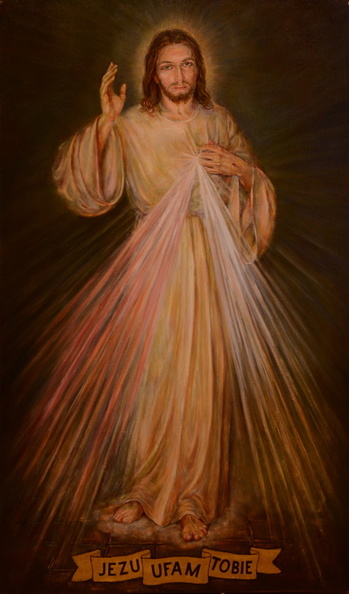
This is not the first time I’ve struggled with recalling past sins and feeling old remorse and new temptation. The last time I remember it as strongly as this, our pastor, Fr. Richards, advised that I repeat the prayer, “Jesus, I trust in you.”
84764-divinemercy

At the time he told me this, it didn’t click with me that these are the words of the inscription at the bottom of St. Faustina’s image of Divine Mercy. (“Jezu ufam tobie” in the original Polish, above.)

Jesus, I trust in you. I trust in your mercy. I trust that you have forgiven these past, confessed sins. I trust that you continue to forgive me. I trust that you love me.

We are washed clean in the blood and water that flow from His Sacred Heart. We need not linger in darkness or doubt. He loves us. He forgives us. He saves.

Healed

But he was pierced for our sins, crushed for our iniquity. He bore the punishment that makes us whole, by his wounds we were healed. — Isaiah 53:5

Almost two weeks ago I shared an image of Jesus I see in my mind, most often in Adoration, in which the scars from His scourging are revealed to me. And as you may have seen, last Thursday I left to make a silent retreat. The weekend was peaceful, profound, and, I believe, fruitful; I will be sharing bits and pieces of it over the next many days, I’m sure.

One particularly impactful reflection began as we prayed the Sorrowful Mysteries of the Rosary, and came to a beautiful conclusion early this morning. As we prayed, I meditated on scourging and crucifixion, and as usual, wondered what must happen to people to harden them enough to inflict such suffering on another human being. I can almost imagine it in the abstract—that people could be cruel enough to flay someone ragged and nail him to a cross to die. But when the scene becomes specific—how could this person put his hand to the whip or the hammer and make that person weep and bleed—I struggle to comprehend the inhumanity.

Could I do it? Never…

And then I thought about those around me, whom I profess to love and then lash with my tongue and pierce with my glance. The suffering I inflict out of comfort and convenience by looking away, tuning out, remaining ignorant and silent and comfortable. Continue reading

God’s Love Is Mercy

84764-divinemercy“Proclaim that mercy is the greatest attribute of God.” – Jesus to St. Faustina

Devotion to Divine Mercy is not every Catholic’s thing. Some people struggle with the image of Divine Mercy: Jesus, His right hand raised to bless and heal, His left indicating his heart, from which rays of red and white, symbolizing blood and water, pour forth as a fountain of mercy for souls. Every version I’ve seen has been a bit mysterious and unsettling—which seems appropriate, given that it’s a vision of the resurrected Christ.

Some don’t like the chaplet, which is simpler and more repetitious than the rosary. Some consider the visions of a poor Polish nun to be private revelations: fine for her, but not necessary for us (even though she is a saint and was canonized by another saint).

Continue reading

Book Break: The Spiritual Combat

Dom Lorenzo Scupoli’s The Spiritual Combat was recommended to me by a friend many years ago, when I was first looking into my patron saint Francis de Sales’s spiritual classic An Introduction to the Devout Life. First published in 1589, Fr. Scupoli’s book was required reading for those whom St. Francis de Sales advised, and he reportedly carried in his pocket a copy given to him by Fr. Scupoli himself.

Over the past several months, I’ve been reading and reflecting on The Spiritual Combatduring adoration. I will warn you up front: It is not an easy read. The language and structure are archaic and complex at times, and Fr. Scupoli takes sin, Satan, and the possibility of Hell uncomfortably seriously (as we should, too). Take your time; read a section and reflect on it. Re-read if necessary. This is a book the rewards patience and prayer.

I believe it will reward repeated reading, as well. Each “chapter” reads like a short reflection building upon the previous. I have read all of these reflections now, but find that, in my own spiritual life, I’m still focused on the first few reflections. Early in the book, Fr. Scupoli insists that in the battle for souls, we must fight or die—but victory can only come from recognizing our own spiritual weakness and putting no trust in ourselves and our own abilities. We must recognize our overwhelming tendency to fall and put all our confidence in a loving and merciful God, without whom we can do no good, but with whom we cannot fail.

I don’t live like that. Most days I still try to get by on my own steam and get frustrated when I stumble or fail. So in terms of spiritual combat, most days I’m still reminding myself of my weakness and striving to distrust me and trust Him instead. When this becomes habitual, it may be time to read this book again!

My edition ends with a shorter work also attributed to Fr. Scupoli, A Treatise on Peace in the Soul. This is another old fashioned, hard-hitting, and practical work, much shorter than The Spiritual Combat, and for me, much easier to apply as a whole to my day-to-day life. The overarching theme is the importance of maintaining peace in the soul and responding immediately to worries, anxieties, and fears that disturb us, recognizing that these are tools the Enemy uses to separate us from God. I read this part in about two sittings and found myself much refreshed and with much to think about and apply, even as a raw recruit to the spiritual combat.

* * * * *

Blogger’s Note: The cover on my edition is the one pictured. As a former wrestler and father of wrestlers, this image of Jacob wrestling the angel alone is worth the price of the book! Also: toward the end of the post at the following link is my brief reflection on Introduction to the Devout Life, another great spiritual book.