Called to the Light Through Confession

Not long after Jodi and I were married, I found myself sitting beside her at Mass with more questions than answers about why I was coming every week, but refusing to resume receiving the sacraments. I had been baptized Catholic as an infant, and had made my First Reconciliation and First Communion as a tween, but had not grown up in the faith. I had a few doubts, a dozen objections, and a hundred excuses — but fatherhood changes a guy, and I was struggling with the fact that what I loved about my wife (her strong and solid faith) I was as yet unwilling to commit to myself.

Our priest at St. Michael Catholic Church in Remus, Michigan, changed all that. I asked Fr. Bill if I could meet with him one evening, and we talked for a couple of hours or more. I dumped my doubts, issues, concerns, and questions in the middle of the floor of the rectory living room, and he helped me pick through them awhile.

Finally he said, “Jim, you’ve got a good head on your shoulders. God gave you that brain, and he wants you to use it. But you aren’t going to find the answers to all your questions if you hold your faith away from you and examine it at a distance. You need to embrace it and look at it up close. You should consider going to confession and resume receiving the Eucharist.”

It sounded reasonable, so I thought I would consider it. “Okay,” I said, “Thank you, Father.”

He smiled. “If you like, I can hear your confession right now.”

“I dunno,” I said. “It’s been a long time…I don’t even remember how.”

“Don’t worry,” Fr. Bill said. “I can help you through it.”

After another half-hour or more, I floated home to my bride, a goofy smile on my face. I have not lived my faith perfectly in the days since that second “First” Confession, but I am always amazed at how wonderful it feels to receive God’s mercy through the sacrament of Reconciliation.

A couple weeks ago, a dear friend in Michigan sent me a copy of Faith magazine from the Diocese of Grand Rapids. On the cover was Fr. Bill, older and balding, but with the same kindly smile. The title of the article? “God is Madly in Love with You: Fr. Bill Zink and the Sacrament of Confession.” It’s a great reminder to practicing and fallen-away Catholics that God loves us — and a reassuring pledge that there is nothing to fear from this blessed sacrament.

Read it and share it, if you feel called — and thank you, Father, for calling me back into the Light!

Farewell to Puck

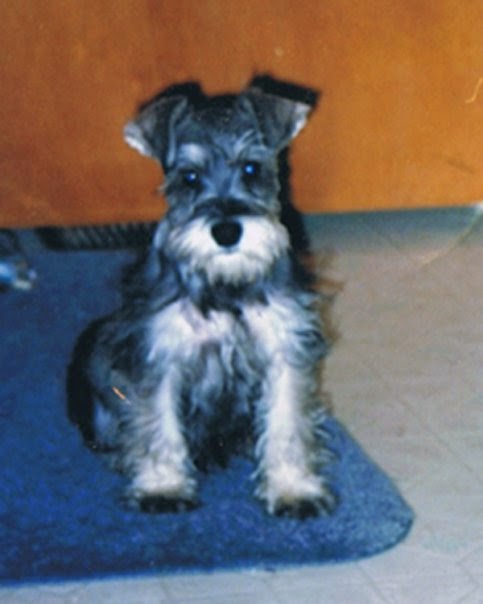
Our new pup, circa 2002

We lost Puck today. At 13 years old, he was certainly not a young for a dog, but definitely not old for a Schnauzer. He had begun, in recent years, to sleep longer and run less, and earlier this fall, he had some teeth removed. At that time, the vet said his blood work was clean and extolled how healthy he seemed for his age, but warned that at this stage in a dog’s life, anything can happen.

And it did. Over a matter of weeks, Puck went from old to frail. He never complained, but slept more, ate less, and stayed closer to the house and us. He was slower on the stairs and slower to respond to our calls and whistles. Then a few days ago, he lost his balance and struggled to stand. Our other dog, Boomer, had done this several times in his old age — he would usually sleep for the better part of a couple of days, then be up and around again. Only Puck didn’t recover.

He was 13, and our kids are age 16 to 2, so he’s been a part of the family for as long as they can remember. We miss him.
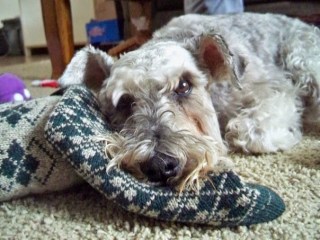
Puck, all Christmased out.

We got Puck from a Schnauzer breeder on an old farmstead in rural Michigan. I wanted another dog — a smaller, indoor pet, since Boomer was big, woolly, and hated being inside. Jodi is not a dog person, but gave in to my persistence and the boys’ pestering. (Or was it vice versa?) He was an adorable pup (my Dziadzi — Polish for grandpa — was not overfond of our Airdales, but looked at our Schnauzer and said, “Now that’s a dog!”), and full of curiosity and mischief. I was struggling to come up with a name that reflected both his Germanic roots and his personality, and my choices were getting more and more outlandish. At one point, the name Wolfgang came to mind. I had Mozart on the brain, but was freely associating, and thought of the chef, Wolfgang Puck, then of the Shakespeare character from A Midsummer Night’s Dream.

I looked at our impish pup, and the name fit. (Of course, only later did I discover how a grown man shouting, “Puck!” out the back door sounded to the neighbors, or how many Minnesotans would instantly assume I was a hockey fan.)
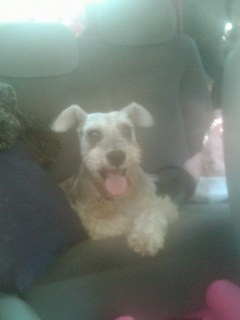
Steamy summer roadtrip…

He’s always been an easy keeper and a good traveler. In fact, the only trouble he’s ever been came from a tendency in his younger days to know exactly when we were preoccupied by something else and high-tail it around the neighborhood. During the day, he would turn up in someone’s garage, or walk in through their front door with their kids, and they’d look at his collar and call. At night, he’d run yard to yard, and I’d drive with my head out the window, listening for jingling dog-tags or a neighbor dog in an uproar, trying to catch up to him.

After Boomer passed, Puck no longer wanted us to travel anyplace without him. If he sensed even a hint that we were preparing for something longer than a day trip, he would look for an opening, jump into the van, climb as far back in as he could, and refuse to come out unless I removed him. He would lay in whatever open space he could find in our overstuffed minivan, never bothered the kids when they were eating, and was content to sleep in the vehicle, in garages, in tents, wherever, as long as he could come with us. On cold winter nights, he would curl up under my old Carhartt jacket, head and all, and be there in the morning, ready to greet the frosty dawn.

He loved dog biscuits and pop corn and being scratched above the collar bone, beneath the collar. He used to love chasing tennis balls, but only in the house. He never liked to be picked up or manhandled — I could do what I wanted (he would even roughhouse a bit with me), but he only tolerated Jodi or Brendan lifting him, and nobody else. In recent years, he tended to get out of traffic when little kids were around. He tolerated other known dogs, but strays drove him berserk. Cats made him quiver with nervous energy; he was never quite sure whether he was supposed to chase them or not, and they seemed to relish his uncertainty and rub it in his face.
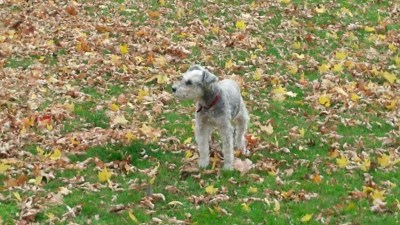
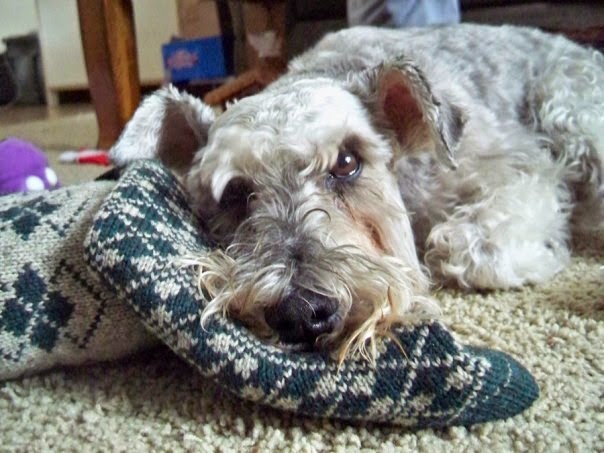
The old man, a couple weeks ago.

When we told the kids last night that it might be his last, we recalled three other special memories. Jodi remembered how our little ones, especially Lily, bonded with Puck by dropping food from their highchairs, and when they realized he was eating it, making a game of it. I remember him shifting from front foot to front foot and softly ruffing at us when he thought we were paying too much attention to baby Lily and not enough to him.

I also remember how perceptive he could be. He had a habit of sidling up to whomever he thought was most likely to pet or snuggle him — he would sit on your toes, even, or thrust his soft gray head up under your hand. But when we lost little Jude, I remember him insisting that I pet him as I lay on the couch or the bed, quiet and sorrowful. He nudged, prodded, cajoled, as if to say, C’mon…better days are ahead!

And he was right.

Goodbye, old man. Good dog.

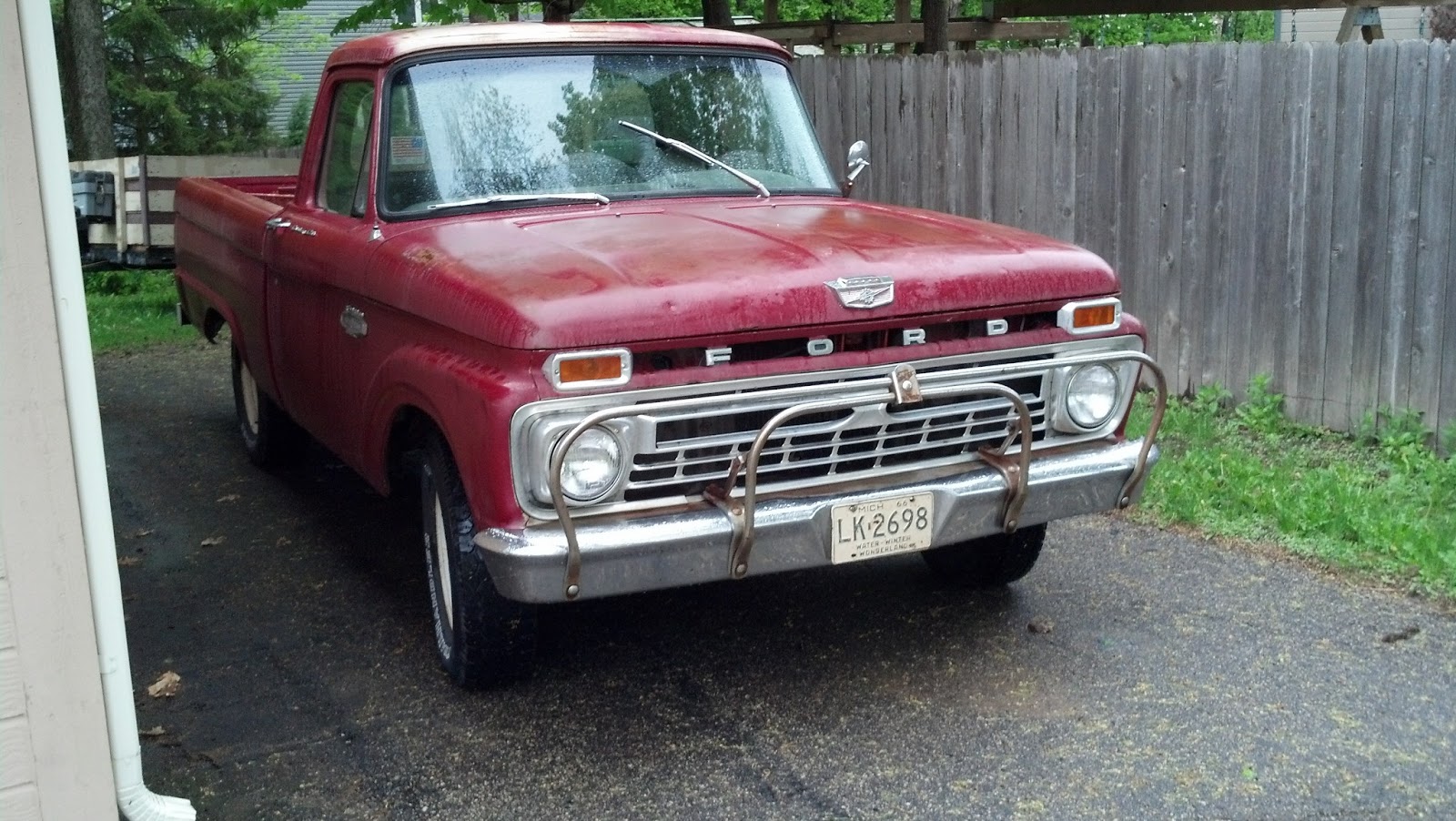
Rosa Comes Home

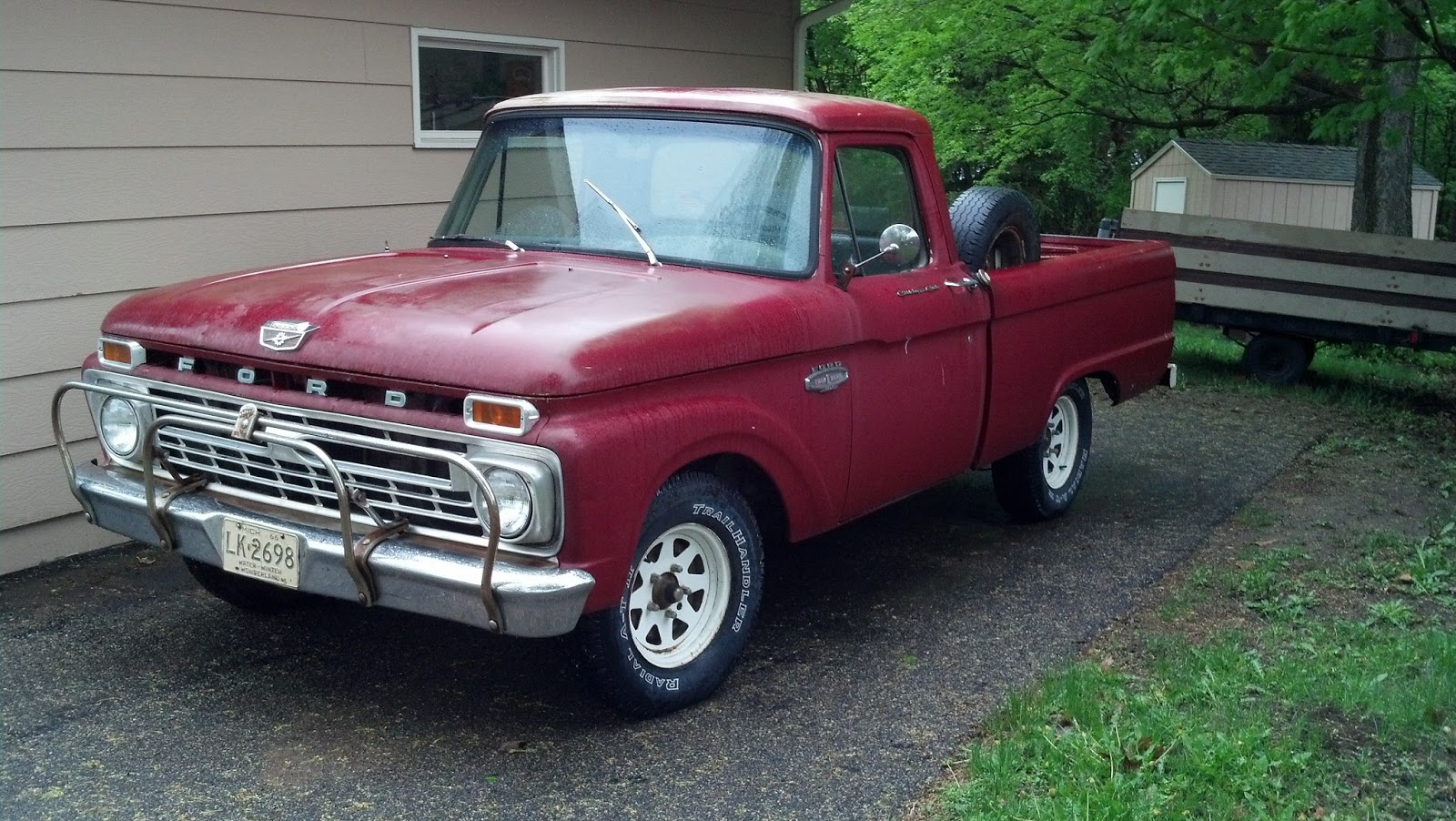
Look who’s back!

When Jodi and I first moved to Minnesota, I wanted a pickup to help with the move. We had a couple thousand dollars to spend, which won’t get you much unless, it turns out, you go “classic” — then it will get you a project truck. I’m not particularly gifted as a mechanic, but with Dad’s help, I figured we could get into something basic and make it roadworthy.

We found a ’66 Ford F-100 with a 240 straight six and three-on-the-tree — a ranch truck, “farm fresh” from Texas. The back bumper is heavy steel stamped with the dealer name: Kozelski Mtrs. West, Texas. The chrome brush guard on the front reads Smash Hit, Waco, Texas (with a lightning bolt between the Hs), and in the back window is a sunbleached sticker for 99.5 KBMA “La Fabulosa” Bryan-College Station. It had originally come to Michigan as a project truck for a father and son who had never quite gotten to it. The body and engine were solid, the electrical system and gauges were marginal, and the shift lever was inserted through a wallowed-out hole in the steering column and “secured” by a filed-down mini screwdriver that served as a pin. As you drove, the makeshift pin would sometime vibrate out, which led to a momentary thrill when the lever came off in your hand mid-shift.

We fixed it up well enough to drive it to Minnesota with a chest freezer full of beef in the back. We hauled whatever needed hauling around here for a year or so, and parked it during the winter so as to avoid getting road salt on a 40-plus-year-old body that had only two tiny rust perforations. It was a three-season vehicle only I would drive; we couldn’t fit it in the garage, and couldn’t afford to store it — so finally, we put it on Craigslist. Dad urged me not to do it. “You’ll never find another one like, and you’ll wish you had it back some day — I know from experience.”

I was only trying to get my money back out of it, but there were no takers. I thought about dropping the price. Then one afternoon, Dad called to make me a deal. He wanted to buy the pickup. He would pay us in beef over the next few years. He would take the pickup back to Michigan, drive it only during the summers, and “someday when I’m gone,” he said, “you can have it back.”

I signed the title over to him, and we were well supplied with meat.

About a year ago, I saw the old pickup again and told Dad I was glad he hadn’t let me sell it. He mentioned that if I wanted it back, I could have it — but he’d only sign back over if I promised not to sell it. This winter we shook on that deal, and today, the old girl came back home to Minnesota.

The journey back was a father-son road trip for Gabe and me — we took two days, traveling north from my folks’ place, over the Mackinac Bridge, then west across the Upper Peninsula and Wisconsin on US 2 and US 8. No more than we got on the highway, fellow motorists started rubbernecking as they passed. The old timers gave us thumbs-up or nods of approval. We stopped at a few antique shops and got a few compliments and one not-so-subtle hint that we should consider selling. We speculated that the big shiny pickups roaring past us on the highways would not still be running in 50 years. Our pickup ran like a champ the entire trip, with only three minor challenges and one momentary thrill:

  • The gauges don’t work. The gas gauge never registers more than half full, and may or may not register empty — that, coupled with an odometer that registers 7/10 to 8/10 of a mile for every actual mile traveled makes judging when to fill up a challenge. Solution? Fill up frequently. The speedometer doesn’t work — but wouldn’t you know, there’s an app for that, using your smartphone’s GPS to tell you exactly how fast your moving and in what direction.
  • The doors don’t lock — which meant I carried a backpack with me wherever we went rather than leave anything of value unattended.
  • The wipers seemed to have a mind of their own. During an Upper Peninsula downpour, they worked great — but a few hours later, when we were thinking of stopping for the night, they quit just as the rain started. Coincidentally, we had just spotted a likely looking motel, so we pulled in. This morning, they worked fine — maybe the old truck was ready to turn in, too?
  • Old-school drum brakes needed polishing? If you have driven an old vehicle, with drum brakes that aren’t somehow power-assisted, they take some getting used to, and you’re wise to give yourself a little more distance to come to a stop. When a line of cars in front of me came to a quick stop behind a vehicle turning left, I had to get on the brakes hard — and the truck pulled sharply toward the shoulder, causing the tires to howl angrily and me, Gabe, and driver in front of me a moment’s panic. Later I tried the same hard stop in a more controlled and traffic-free environment — it pulled hard to the left once, then began stopping more effectively. Little rusty, perhaps?

Dad sent us home with a wooden duck decoy he’s hoping one of the kids will repaint. The duck sat on the dash, and whenever one of us predicted something unfortunate about the truck or the trip, Gabe would knock on the only wood available — earning the decoy the moniker “Lucky Duck.” As for the old truck: she’s never had a name, but given her border town roots and faded red paint, I dubbed her Rosa. Gabe thought immediately of his sister (whom I sometimes call Rosa) and then of her patron saint, Rose of Lima — he began to call the truck “Santa Rosa de Lima” (or more accurately in Gabe-speak, “Santarosadelima!” But for me, she’ll always be La Fabulosa. Bienvenidos, chica.

Rosa La Fabulosa: Thanks for keeping her for me, Dad!

Homebrew III: The Experiment

It’s almost time to bottle my fourth batch of homebrewed beer, a clone of Pete’s Wicked Ale brewed from a Midwest kit, which means I ought to finally report on batch three…The Experiment.

The Experiment came about like this: not long after my successful Irish Stout, some friends were gathering to brew again. I didn’t have the money to purchase another kit — but I did have a “can kit” left over from a misguided venture (retold here) into brewing a decade or so earlier when we still lived in Michigan. The can was a Munton’s Export Stout kit, containing hopped dark malt syrup and abridged instructions. I had a leftover packet of dry brewer’s yeast from my Irish Stout kit (I used a Wyeast packet instead) and, stealing an idea from a molasses stout recipe I’d seen online, I spent a few dollars on raw cane sugar to add to the mix in place of several cups of corn sugar. If all went well, I would have two cases of good dark beer for about five bucks.

I did not follow the instructions to the letter, but combined them with my past two brewing experiences – which means, primarily, that I boiled the ingredients longer. Fermentation was robust the first few days, as expected — the smell from the airlock was sweeter that the Irish stout had been, but with a whiff of hops. Unfortunately I forgot to take a hydrometer reading before sealing the primary fermenter, then dropped and broke my hydrometer during the transfer process. Since I had already drawn a sample during the transfer, I took the opportunity to taste the flat, room-temperature brew. It was sweet—not quite cloying, but sweeter than I had hoped—reminding me at first swallow more of a doppelbock than a stout (or even Samuel Adams Triple Bock, which Dad and I tried once and (like many others) did not enjoy).

I tasted it again at bottling and was again struck by the sweetness. I had read that the raw sugar could lend a “rum” taste to the brew; I hoped the carbonated bottles would not be too sweet to be drinkable.

I opened the first bottle a few weeks ago. It was poorly carbonated, winey, and sweet. I drank about half the bottle and wasn’t crazy about it, but swirled the remained bottles and moved them to a warm place in hopes of further carbonating them. I tried another earlier this month, and while the carbonation was better, the head was still thin, fizzy, and brown, and the beer itself was simply too sweet for my taste. I probably should’ve used corn sugar as recommended, but at least I’ve seen something of the effect of raw sugar in that rummy/winey taste.

In the end, I dumped all but 12 bottles, which I kept for cooking. This weekend I cooked a pot roast in one – seared it first in a cast iron pan with olive oil, then put it in the crock pot with one bottle of The Experiment, two yellow onions (chunked), garlic salt, pepper, and Worchester sauce, and let it cook most of the day. The resulting meat was delicious – so the remaining 11 bottles will be good for something!

Who Is the Public?

I have just finished another book I would not have read if not for my job, Barry Bozeman’s Public Values and Public Interest: Counterbalancing Economic Individualism. First, permit me to confess that, left to my own devices, I would read fiction, poetry, and an occasional history — so I am being forced to broaden my horizons and get educated, which is never a bad thing. Second, let me say that, as a wannabe writer, I have many, many thoughts about this book, mostly concerning its readability. I would not say that I enjoyed it, but it did provoke thought. The primary thought it provoked may be worth sharing. I say “may be” because I am not an economist, a philosopher, a political scientist, or a public interest or public management theorist, so it’s possible that I simply didn’t get it.

My primary thought about the book is that it spends a great deal of time on the topics of whether and how it is possible to identify public values and the public interest, and contrasting those with private or individual economic values and interests (which are often not the same), but it spends remarkably little time on the question of “Who is the Public?” The author is very conscious (almost too conscious) of the limits — the squishiness — of terms like “the public interest” and “public values,” but while his book tackles “interest” and “values” at length, it gives short shrift to “public.”

Especially in the U.S., a vast nation with remarkably diverse cultures, religions, lifestyles, and economies depending on where in the country you reside, it seems to me that the more immediate the “public,” the more practical and realistic it is to identify shared public values and pursue the public interest. At the state level, this becomes less realistic: every state in which I’ve ever lived has had marked, or even deep, social, economic, political, and cultural divisions (“Outstate” or greater Minnesota versus the Twin Cities metro. East River versus West River. Downstate versus the U.P.) and different lifestyles worth protecting. At the national level, then, it seems unlikely that we could identify public values and a cohesive public interest, aside from the broad priorities of securing the nation and preserving our rights to life, liberty, and the pursuit of happiness. The difficulty of pursuing public values and the public interest is not identifying values and interests — these are abundant, diverse, and obvious — but identifying who shares them, which helps to decide at what level of society they should be implemented.

The critique of economic individualism (which, says Bozeman, is increasingly driving our public policy agenda) in the book insists that individuals in this model are concerned primarily with their own economic interests, and perhaps those of a few close others (immediate family and the like). That may be the proper definition of economic individualism, but I don’t know anyone who lives this way. As a friend in Western South Dakota has explained, in his part of the prairie, neighbors take care of each other — and if someone doesn’t contribute to the good of the community, over time they are made unwelcome. They simply don’t last. Those who remain recognize that it is in their personal interest to take public interest: to be engaged in the community and preserve their shared values and lifestyle.

I enjoy a similar experience in “The Bubble” — the devout, small-town Catholic communities in Albertville and St. Michael. My circle of public interest begins at home, with my family; then expands to encompass my parish and the people with whom I share a fundamental belief system and way of life; then to my town(s), which provide the education my children receive and the goods and services we need to live and thrive; then to my state and nation, which should be responsible for ensuring my towns, parish, and family have the opportunity and freedom to thrive. I invest what time, talent, and treasure that I am still free to spend as I wish in the circles closest to me — which makes sense, since the more distant circles I am already obligated by law to support.

It seems to me that Bozeman’s approach to identifying public values, public interest, and ultimately, instances of failure of public policy to deliver in the public interest, is useful in inverse proportion to the size and distance of the “public” considered. At the local level, the public interest is much easier to identify — because although our population is increasingly diverse, we tend to cluster together with likeminded folks who share similar values. But as long as the majority of public resources are allocated at the state and national level, we will struggle with coming up with one-size-fits-all solutions to generic political issues that approximate real-world challenges, but do not reflect the actual problems of real people living in genuine community with each other.