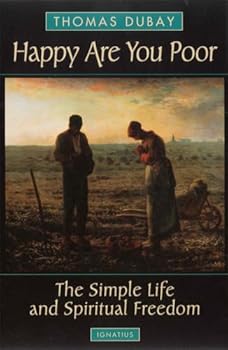
Book Break: Happy Are You Poor

For the past 20+ years, I’ve noticed several strange phenomena nearly every time a conversation turns to what the gospel says about material wealth and spiritual poverty:

  • Friendly conversations turn defensive: “We don’t have that much; so-and-so has X, and vacations every year in Y.”
  • Faithful Catholics attempt to justify themselves: “If you include Catholic school tuition, we give 10 percent like the Bible says—and we serve in other ways too!”
  • Straightforward moralists become subtle and nuanced: “What ‘poor in spirit’ actually means is…’”

And, in some cases, actual spiritual deafness occurs: I was in a conversation once in which I admitted my own struggles in this area and said I felt I needed to do more to actually love my neighbor from my own resources. A friend followed my remarks with, “It’s like Jim says…” and proceeded to relate the exact opposite message.

Father Thomas Dubay’s book Happy Are You Poor was written to combat these phenomena with clear teaching from the Gospels and the rest of sacred Scripture, edification offered by various popes and councils, and the lives of the saints. It was recommended to me by Father Daly in response to the awe I feel as Brother Jude (our second son Gabe) proceeds in his journey as a Franciscan friar and the conviction that I need to live a less self-centered and materialistic life.

Continue reading
Book Break: Small Is Still Beautiful: Economics as if Families Mattered

Providentially, my reading lately has all been cut from similar cloth: our relentless pursuit of better, newer everything and the dangers it poses to our humanity and health (physical, mental, and spiritual). This latest volume, Small Is Still Beautiful: Economics as if Families Mattered by Catholic scholar, biographer, and author Joseph Pearce was a gift from our Bismarck family, and is a reiteration and expansion on E.F. Schumacher’s 1973 classic Small Is Beautiful: Economics as if People Mattered, with a particular focuses on the environment, food supply, and land use.

In my 2017 review of Schumacher’s book, I described a couple non-academic objections and numerous things I loved about the book. I also said it seemed like the sort of book that had been read, admired, and forgotten in the powerful current of worldly progress.

Continue reading

Wednesday Witness: How Do I Love Me?

How do I love thee? Let me count the ways…

The 19th-century poet Elizabeth Barrett Browning asked the question above in her Sonnet 43. This morning, I ask a different question: How do I love ME?

I am currently reading the book Happy Are You Poor by Father Thomas Dubay, SM. It is a hard, convicting read about taking seriously the Gospel’s words regarding wealth, poverty, possessions, and sharing with those in need. What has struck me hardest thus far is Father Dubay’s insistence on the actual words of Jesus—currently, “You shall love your neighbor as yourself” (Matthew 22:39, cf. Leviticus 19:18).

How do I love myself? Among other ways:

Continue reading

Wednesday Witness: Belong, Believe, Behave

Over the past week or so, I’ve found myself reflecting on a homily delivered by Father Richards some years ago. I have written about it before; the gist of the message was this:

  • People in a group or community often insist that those who want to join behave properly and believe correctly in order to belong (Behave, Believe, Belong).
  • People on the margins, however, need a place to belong, where they can come to believe, and learn to behave (Belong, Believe, Behave).

Belong, Believe, Behave is the natural order of things. From the moment we are born into a family, we need secure attachments to our parents to form healthy, ordered relationships and learn to navigate the world. But once we find our place in the world, we often lose sight of the fact that we ever weren’t a part of it.

Continue reading

Wednesday Witness: Wanting, Needing, Having

Between Thanksgiving and this coming Monday, when our new refrigerator arrives, my bride and I will have replaced all four major kitchen appliances. These expenditures were practical: Our dishwasher hadn’t worked in a year or more; the electronic oven controls on our gas range worked only if you held your mouth right while pressing the buttons; our microwave struggled to pop popcorn, and the range lights quit working; and our refrigerator/freezer gets hot to the touch.

At the same time, new appliances were not entirely necessary. We had, after all, survived a year without a dishwasher; the oven still worked with a little coaxing; the microwave was still quicker than most other options for a wide range of tasks; and thus far, the fridge is still cold inside, if not outside. And plenty of people live quite comfortably without one or more of these devices.

Over the past couple weeks, as we prepare to tackle some home projects and work on my old truck, I convinced my bride to allow me to upgrade our garage. My work has gone well the past year—I’ve picked up a few extra projects and used the money from one such project to purchase some new hand and power tools and organize them. Now, when I have time to work on projects, I spend far less time looking for tools, purchasing cheap tools for particular tasks, setting up, and cleaning up. I can just get to work.

Continue reading