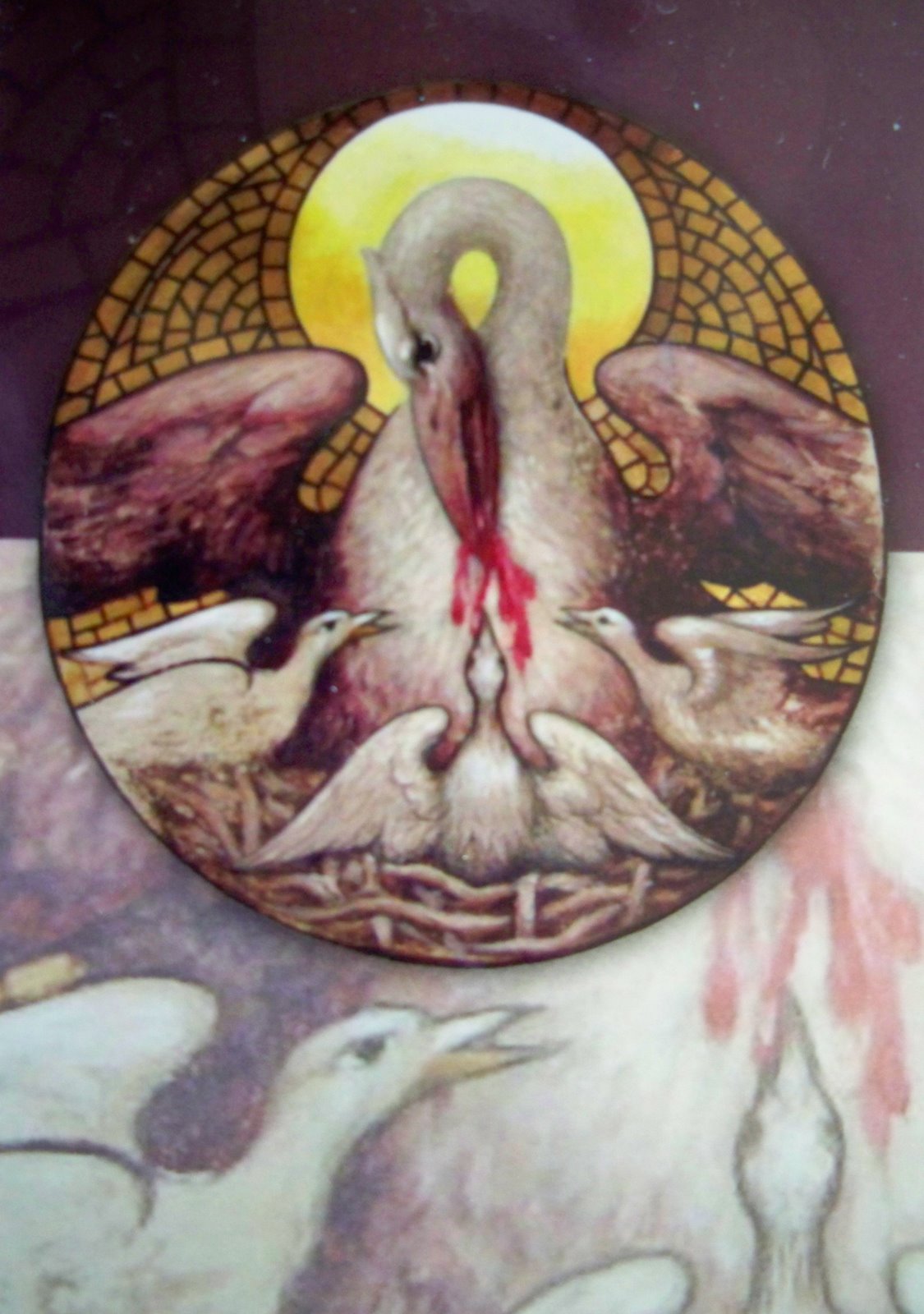
"Feed My Sheep"

When therefore they had dined, Jesus saith to Simon Peter: Simon, son of John, lovest thou me more than these? He saith to him: Yea, Lord, thou knowest that I love thee. He saith to him: Feed my lambs. He saith to him again: Simon, son of John, lovest thou me? He saith to him: yea, Lord, thou knowest that I love thee. He saith to him: Feed my lambs. He said to him the third time: Simon, son of John, lovest thou me? Peter was grieved because he had said to him the third time: Lovest thou me? And he said to him: Lord, thou knowest all things: thou knowest that I love thee. He said to him: Feed my sheep.
— John 21:15-17
* * * * *
The Thorp gang is in western South Dakota this week, where it has been a tremendous honor and blessing to see a dear friend of ours, Tyler Dennis, be ordained a Catholic priest last Friday, June 26, 2009. It is tradition that newly ordained priests give out prayer cards marking their ordination. The front of Father Tyler’s features the image above. The back bears this prayer and explanation:

Take, O Lord, and receive my entire liberty, my memory, my understanding and my whole will. All that I am and all that I possess You have given me: I surrender it all to You to be disposed of according to Your will. Give me only Your love and Your grace; with these I will be rich enough, and will desire nothing more.

— St. Ignatius of Loyola
The pelican is an ancient symbol of Christ. It is said that when no other food is available, the pelican will feed its young with the flesh of its own breast, just as Christ feeds his people with his body and blood in the Eucharist.

The significance of the pelican is not unlike the Gospel reading above, which was the Gospel reading from the Ordination. The theme was repeated numerous times: Feed my lambs. Feed my sheep.

It’s been an incredibly moving last few days. I thought I’d share a little of the experience, from our perspective.

* * * * *
Many of you know that Jodi and I met while working summer jobs at the world-famous Wall Drug Store, she in hats and western wear; I in boots and moccasins. Jodi worked with Cindy Dennis, whose husband, Robert, works his family’s ranch near Red Owl, more than an hour north and west of Wall. Cindy had a little place in town and as I recall, their oldest son, Tyler, was a cerebral and musical teenager working in the dish room at the Wall Drug Cafe. His younger brothers, Tate and Chance, stayed on the ranch with Robert that first summer, I believe (Tate worked at the drug store as a high-schooler) — and somehow they all stayed close.

Robert would come into town now and again, dressed every bit the cowboy of my boyhood visions: colorful boots pulled up over his jeans, western shirts and vests and silk scarves, big mustache and bigger hat. Sometimes he’d come by the house I lived in, guitar in hand, to share cowboy songs and country humor — but the night he played “The Wreck of the Edmund Fitzgerald” and allowed me to help with the lyrics, a friendship was sealed.

* * * * *
We’ve had more than a few adventures with “Cowboy Bob” (as Robert became known in my newspaper columns), Cindy, and the boys. We’ve been snowed in at their place with no power. We discussed all manners of philosophy, swapped jokes, drank beer and tequila and whiskey, traveled together and fished, shared poetry, you name it. It’s been a great friendship over the years, and since Jodi and I sit just about perfectly in age between Robert and Cindy on one hand, and their boys on the other, we’ve enjoyed being friends with the whole gang.

I’ve written about ol’ Jinglebob any number of times over the years, but probably the best picture of the Dennis family I can offer is this essay I wrote after accompanying my dad and our oldest son, Brendan, to the ranch for a branding.

At that time, Father Tyler was completing his undergraduate work at St. Mary’s in Winona, and I offered this assessment:

Bob’s oldest boy, Tyler, is leaning against Sorley, a stripped down Suzuki Samurai with a homemade plywood roof and four-wheel drive—the name comes from the little rig’s sorrel color. He’s only recently back from Winona, where he’s studying for the priesthood; he’s dressed in a plain t-shirt and sweats, untied duck boots and an old fedora. His little brother’s riding with the men below.

Tyler stands in front of the little 4×4, watching the cowboys work. He’s not like these others—he’s a big kid and prone to discussing philosophy, praying aloud in Latin or singing in Spanish—but he looks at home here and I snap a picture of him, God’s country in his eyes.

* * * * *
The little church in Red Owl, St. Anthony Catholic Church, is unlike any other I’ve ever been to. It’s tiny by Twin Cities standards (though not the tiniest West River Catholic church in South Dakota, I’m told): several short pews and a humble sanctuary, with no place to hide or “go through the motions” during the Mass.

During the ordination, Bishop Cupich remarked that a man raised in one of the smallest parishes in the Rapid City Diocese would now being serving in the Cathedral of Our Lady of Perpetual Help, underscoring the unity of the church across all peoples and communities. Small town boy makes good, some may say, but I would suggest Fr. Tyler was good all along, and perhaps better for his rural ranch upbringing. Indeed, Monsignor O’Connell, the homilist during Father Tyler’s First Thanksgiving Mass on Saturday morning, suggested the diocese’s newest priest thank his father for teaching him how to work hard, his mother for showing him how to care about others (a virtue that seems pervasive in ranch country), and his brothers … for teaching him patience.

* * * * *
The weekend before we left for South Dakota, I told a fellow parishioner from our St. Michael Catholic Church that we were attending Fr. Tyler’s ordination, and he insisted there is no more beautiful liturgy in the Church’s traditions. We arrived at Our Lady of Perpetual Help with great anticipation. Deacon Tyler was greeting family, friends and future parishioners at the foot of the front steps to the cathedral, a broad smile on his face. Such joy, I thought. Robert hailed us from the top of the steps, wearing a dark suit, red tie, and his best boots, a grandson on his arm. Cindy descended the steps quickly to greet us, and she seemed joyful and nervous and warm, like a mother at a wedding — and so she was.

We sat midway back on the right. At the opening hymn, the priests processed in pairs, old and young, black and white, tall and short, stout and wiry, dozens of them from across the diocese and from the seminary, with deacons and the bishop, and Tyler, of course, singing with and above the others, the same broad smile in his cheeks as he sang. I grinned the first of several goofy grins that would crease my face all weekend.

The proceedings open with great formality, with Tyler called forth and the bishop asking for verification from his soon-to-be brother priests whether he is known to be worthy. I had been told to expect countless moving moments: the vow of obedience to the bishop and the Church; the laying on of hands upon Tyler’s by each prayerful priest in turn; the kiss of peace, in which each priest in turn greets their new brother with a welcoming embrace. The moment I was most anticipating I was unable to see from the middle of the pew: as those assembled prayer the Litany of the Saints, Tyler lay prostrate on the cold stone floor at the base of the steps before the altar, in the ultimate gesture of humility and submission. Gabe, Emma and Brendan* stretched into the aisle and stared at Tyler’s motionless form; I imagined how he must look lying there, and marveled. (Later I asked the three kids to demonstrate how Tyler was lying, with three very different interpretations. I asked Father Tyler at the Dennis ranch on Sunday, and he explained that he lay flat on his chest with his hands overlapping, palms down, beneath his forehead.)

But the most moving moment in the entire liturgy came at the end, and was entirely unexpected. As the Mass ended, Bishop Cupich announced he would ask Fr. Tyler’s blessing before the bishop himself offered his closing blessing for the congregation. We watched transfixed as the bishop knelt before our friend and humbly bowed his head. My breath caught as Fr. Tyler placed his hands on the bishop’s head and red cap and prayed over him. Incredible.

During the reception that followed, the five of us waited in line to receive our own blessing from Fr. Tyler. We knelt as a family, with Trevor close at heart, and our friend called upon the intercession of the Holy Family and blessing in the Name of the Father, and of the Son, and of the Holy Spirit.

* * * * *
On Saturday morning, all six of us made our way to St. Paul Catholic Church in Belle Fourche for Fr. Tyler’s First Mass of Thanksgiving, a Votive Mass for the Immaculate Heart of Mary. Robert and Cindy invited us to the front pew (“You’re family, y’know …”), and I again spent the hour with a goofy grin and a tear at the ready.

Tyler was no longer the dishwashing teen or the seminarian or the deacon. He had walked nearly a decade on the path to priesthood, from Red Owl to Rome to Rapid City, and he looked at home in the sanctuary. When he spoke the Words of Consecration in particular, our friend and our world changed. We believed, and said “Amen.”

* * * * *
Of course, I’m not the only one blogging about Father Tyler these days:
* * * * *
Finally, this weekend has me thinking about the nature of marriage and other lifelong commitments. Priests undertake years of education, preparation, formation, discernment. The call to the priestly vocation is often compared to the call to marriage as way of understanding the complete, lifelong commitment of the less common vocation.

Two observations come to mind: not for the first time, but with great clarity today. The first is that, while few people would agree to several years of preparation and discernment prior to marriage, perhaps this would drive home the magnitude of the commitment couples undertake when they say, “I do.”

The second is that the “marriage” a priest undertakes is far from loveless. I’ve posted before on my middle son’s own priestly aspirations, and these postings have generated lots of conversation, both online and offline. One friend, in particular, voiced the opinion that a marriage to God would be particularly hard and one-sided work, since your spouse has largely been silent for centuries.

The better metaphor is that a priest (like Jesus, the Bridegroom) doesn’t marry God, but the Church (the Bride) — and as we witnessed all this weekend, the Church consists of real people, is full of love for her priests, and is quite expressive. In addition, Fr. Tyler pointed out the sacramentality of his commitment. I took his comments to mean (in much simplified layman’s terms) the real belief in a real commitment between a real person and a real God doing real good in a real world. From this perspective, his relationship with God is hardly one-sided. (Or if it is, the effort is all on the Other Side …)

God bless you, Father Tyler — and all our priests.

*Trevor stayed with Grandma and Grandpa Venjohn for the ordination; it was scheduled for the evening, and his lungs don’t always agree with incense.

Good Dog

Our 15-year-old Airedale, Boomer, died on Thursday afternoon, June 25, 2009. At his age, it was not unexpected, but still a surprise, if that makes sense. We were slated to leave for South Dakota in a couple of hours, and found him lying in the back yard, in the the shade. He is missed, and so many people commented on my Facebook notice that I thought I should share a little more about him.

* * * * *

My folks started raising Airedales about the time I entered sixth grade. As a teenager, I rode to Tennessee with my folks to pick up a couple of female pups, big-boned hunting-type Airedales called Oorangs, and rode back to Michigan with the two of them chewing on my stocking feet. Seems like maybe I put some money toward them; regardless, my name was on the papers, and I got to name them. The chewing-est one I called Thorp’s Oorang Patchmaker, or Patches, and the curlier of the two, Thorp’s Oorang Ragtop, or Rags.

Boomer came along a few years later. I’ll have to dig out his papers and check, but I’m pretty sure Rags was his mother. His father was a big, matted mess of dog when we got him from some farm in Michigan. Master MacDuff, as he was called, was the biggest Airedale I’d ever seen, and his hair was so long and matted from lack of grooming that he looked like he had dreadlocks. The folks who had him turned him loose, and he tore around the yard like a mad man until Dad told me to step away from the grown men and crouch down. No sooner had I done it, then Duff slowed to a trot and came straight to me. He was a big, gentle, personable dog — a suitable precursor to his son.

Boomer was the biggest pup of the litter, with massive paws he used to swat and stomp his siblings: BOOM! His mother and aunt were tempermental gals, so when we decided to keep him as a stud dog and find new homes for them, we named him Thorp’s BoomOorang, or Boomer.

* * * * *

To my knowledge, the only thing Boomer was ever afraid of was explosive noises — gunshots, fireworks, and thunderstorms would send him to the deepest recesses of his dog house. He was housebroken as a pup, but never took to indoor living, and would get extremely nervous indoors. When Jodi and I first married and took him to South Dakota with us, we spent our first blizzard worried that the 65-degrees-below wind chills would be the death of him. We had rented a pet-friendly duplex — the upstairs of a drafty old two-story. You entered through an enclosed stairway up the back of the house, and a little old lady and her chihuahua lived downstairs.

The first day of the blizzard, we put Boomer in the stairwell to get him out of the weather. When we came home from work, our downstairs neighbor told us he had barked nonstop most of the day. When we went upstairs, we found he had made several messes and shredded a 50-pound bag of dog food.

I called Dad for advice, since it was clear we couldn’t leave him inside again. Dad said Boomer had stayed outside in Michigan on nights as cold as 35 below, and that as long as he had a windproof house and plenty of bedding, he’s be fine outside.

I had my doubts, but put a door flap on his house and filled it half full of cedar shavings. The next morning, I said a prayer and went to work.

When I got home, I found Boomer lying on the yard, the snow drifting over his back, head high, ears up, watching the chickadees flit amongst the leafless hedges. He refused to go into his house until I removed the flap so he could see out. Then he used his great paws to scoop nearly all of the cedar shavings out into the snow. Satisfied, he laid down on the hard floor — and until about three years ago, shunned almost all creature comforts in his kennel or dog house.

* * * * *

As I said, aside from loud and sudden noises, Boomer was fearless and proud, moving around his domain in a loose jog and often parading along the borders of the yard with a bone in his jaws to make the neighbor dogs jealous.

In Michigan, our neighbor dogs were part wolf — the female was about half wolf; the male was 80+ percent wolf, weighed close to 100 pounds and was kept on a heavy chain within a high fenced kennel. And one Thanksgiving Day, he got loose.

I was bent over in Boomer’s kennel, busting ice from his water dish while he made the rounds of the back yard. I heard a low growl behind me and turned to see Boomer, moving in his loose jog, toward a dark wolfish creature nearly twice his size who was staring in my direction. Boomer never broke stride, even when the wolf-dog turned its yellow eyes to him. The wolf hesitated, then turned and loped off.

Blogger’s Addendum: Busia (my mom; Polish for “grandma”) graciously clipped, copied and bound all my columns from my newspaper days in the mid- and late-90s, and Grandma Venjohn wisely kept them where she could find them. As a result, I’ve posted a more accurate account of this episode here. For one thing, it wasn’t Thanksgiving at all …

* * * * *

I’ve written about the Old Man many times over the years, and posted some of those writings. You can find them here:

* * * * *

A bit of shared humor from Boomer’s death date: when Jodi called the veterinarian to find out exactly what to do with a deceased pet when you live in town,* the receptionist kindly informed her, “You can bring him here — a mass burial is $36, or you can have him cremated for $74, or have him cremated and get his remains for $164.”

In the few seconds it took Jodi to process what was said, she thought, Why is a burial mass the cheapest option? And how do they know we’re Catholic? In her defense, when she relayed the options to me, I thought the same thing …

Goodbye, Old Man. Good dog, Boomer. Good dog.

* * * * *

*When you live in the country, pet “funerals” are simpler affairs conducted on your own place.

Top-Heavy

They say a child’s head grows to approximately 80 percent of it’s full size during the first year of life. If this is true, I must’ve cast a shadow like a Tootsie Pop as a child. There was a period as a baby during which I couldn’t hold up my head — try as they might, my folks couldn’t keep it off my shoulder. they would prop it up, and slowly, slowly, it would drop back down.

Developmental problem? Yeah. Too much head for my neck.

When I tried out for the high-school freshman football team in 1988, I weighed 125 pounds soaking wet, and only one helmet was left in the equipment room that would fit my head: an ancient, battered monstrosity with a lineman’s face mask that extended downward to protect a player’s throat, as well. It sat so far back on my head that I looked through the crossbars. The next fall we all got Air Helmets, with inflatable rubber bladders that allowed you to custom-fit them to your head. I received an extra-large helmet — and no air for the bladders.

I have a seriously large head. Not the biggest in the world. But probably the biggest you’ve seen …

It wasn’t until I took a summer job at Wall Drug after my second year of college that I understand the magnitude of the problem above my shoulders. I worked in the boot department, and occasionally would drift into the hat and western wear area to flirt with this gal, Jodi, who worked there. Her colleague, Cindy, tried to fit me for a hat one afternoon, and discovered there was only one hat in the place that fit me: a silver belly derby, size 8 long oval.

Let’s break that down:

  • Silver belly is kind of a pale ghost gray or off-white. My friend Jinglebob says real cowboy hats can be any color, as long as they’re black or silver belly.
  • A derby is, well, something like this. About what you’d expect a greenhorn Yalie to wear out West …
  • Size 8 is big. Darn big. According to The Hat Site, the average adult male human head is about a 7 1/4, which is a circumference of about 22 3/4 inches or 58 cm. My head is a little more that 25 inches, or 64 cm, around. This makes it, in The Hat Site’s estimation, “Probably the largest head size you will ever find …”
  • “Long oval” means I put the “egg” in “egghead.” Look at me from the front (now that I have, um, filled out in my thirties) and my head looks like a relatively normal grown man’s head. Look at me from the side, and it looks like a shaggy watermelon.

Size 8 long oval. This explains, with data, why they called me Warrior Dome during football season (claiming that we could suspend my helmet over the field in inclement weather and play beneath it) and simply Hed in the off season (which actually became my cartoonist alias for awhile in our underground student newspaper, Smoke Signals).

It also explains why, years later, when Bren, Gabe, and I decided to go to a Yankees game, I had to special-order a Yankees cap — and why it fits comfortably on my head, but has since stretched itself shapeless, front to back. It explains why the top item on my Christmas list last year was essentially a $30 stocking cap — the first I’ve found that would fit my head without stretching so thin that the wind whistled through it to chill my ears.

And it explains why, at a St. Paul Saints game a couple weeks back, I bought a cap for a team I had yet to see play ball. See, the Saints carry size 8 ball caps on site, and by some miracle of design, they shape themselves perfectly to my head, unlike the premium-priced New Era caps produced for Major League Baseball teams. For the first time since grade school, I have a cap that holds its shape (and doesn’t look like a yarmulke) on my head. The color’s nice; the logo’s classy; the tickets are cheap; and the games, kid friendly. I’m a Saints fan now. Sometimes a cap earns team loyalty, and not vice versa.

Wish Flowers

We were walking the sidewalk along Selby Avenue toward Dark Raven Studios, where the older kids practice tai chi. Here and there, a tree grew along the walk, skirted in weeds and dust. In the center of the street a crow pecked crumbs from discarded cellophane, hopping first to one side, then to the other, as the occasional car passed.

I snuffed a breath through my stuffy nose and grumbled inarticulately. Only the crow seemed to hear, and flapped to a nearby lamppost.

Then Trevor said, “I know why there are so many wish flowers today.”

Wish flowers? I thought. I looked at our youngest. He was gazing at a clump of ragged dandelions, which had shed their jaunty yellow caps to bare their graying heads to the breeze

“There are lots of wish flower because last week there were lots of dandelions!” he said, pointing to the balding stems.

Today a weed; tomorrow a wish. So much I’ve forgotten about wonder. So much to learn.

True Word Fu

I’m working on a freelance piece right now for a martial arts journal, and its brought me into contact with a remarkable man and book — retired Marine Major Bill Hayes and My Journey With The Grandmaster.

The link above takes you to a reader review of the book that is spot-on (at least with regard to what I’ve read so far). But secondarily, it’s made me rethink my writing. Years of writing to achieve — to earn a grade or a paycheck or praise or what-have-you — have made it more difficult to write authentically. I’ve written as a marketer, fund-raiser, speechifier, you name it — always with an agenda, because that was the job — and it’s now hard to write simply as me.

Hayes’s book oozes authenticity and intimacy. In recent years I’ve learned that my dad wrote quite a bit as younger man. When you read what he wrote back then, you feel as though you’re glimpsing his beating heart. And I see something similar in Hayes’s unadorned words. He says what he means, simply, so that no meaning and no love is lost.

I need to get that level of honesty back, and it struck me that there are parallels between this authenticity in writing and the way he describes his abilities (and his opinion of his abilities as a young Marine and martial artist) before and after he began traditional training with the grandmaster on Okinawa. The old masters, he says, never have an agenda. They are who they are, and they do what they do.

To paraphrase a certain fictitious master: I have much to unlearn.