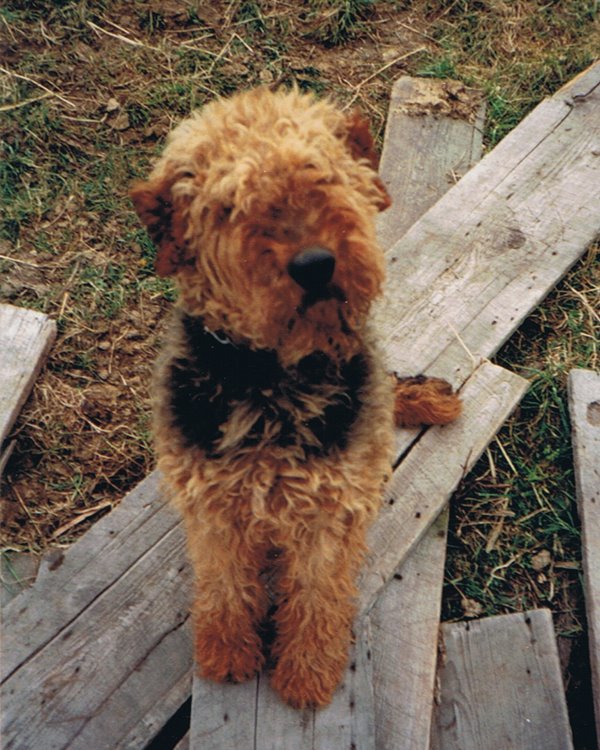
Old Dog, New Trick

Our ancient Airedale, Boomer, is now fifteen or so — old for a dog, very old for a large breed, and truly remarkable for an altogether outdoor dog, who has refused the house (and until last winter, the garage) even in the deepest cold of winter. He’s a tough old man, and he still moves about the yard in a loose trot like it’s all his.

He’s never been much of a watch-dog or a hunter. Gun-shy since puppyhood and easily distracted, he’s simply never had the same sense of duty as Puck, our mini Schnauzer, who patrols the yard and house for any sign of trouble from strangers, squirrels, or even neighbors he suspects. He has never backed down from a fight, to my knowledge and loved to chase cats — but fight, chase, or kill, it was always with a look of joyful gameness, like he was testing his skills, happy to win or lose, bloody or be bloodied. He killed a stray cat once, and left it lay on the driveway; he didn’t worry it with his teeth or parade around with it in his jaws. He used to nab gophers now and again, and would toss them into the air and catch them, or bat them around like hacky-sacks. He was strong and quick, but never mean.

Today you can walk up to him from the back, the side, or even the front, and if he’s not looking at you, he won’t know your there until you touch him, stomp, or clap. He’s slower now, and more frail, but still affable, and I love him.

So last weekend — the Saturday after Thanksgiving — I woke in the wee hours, maybe 2:30, to Boomer’s persistent barking. The last two winters he’s had episodes like mini-strokes or seizures, in which he loses his coordination and sense of equilibrium and begins to stagger around and into obstacles. Last December he woke me this same way, albeit with a more pained and panicked bark. Still, this time I again rose fearing the worst.

I went to the deck door and opened in, letting the winter cold roll in. As soon as the door opened, his barking stopped. I couldn’t see him in the blackness of the kennel — there was no snow on the ground. He whined softly, once toward me and the house; the next toward the narrow patch of woods behind the house and the street beyond. It was not a plaintive cry, but an urgent, pay-attention call.

On the street beyond the trees I heard muffled voices and the shuffle-stomp of drunken footsteps, moving toward the house on the lot whose southeast corner touches our northwest.

Scuff-stomp-shuffle. Whispering. Shuffle-stomp. Soft laughter. Shuffle-shuffle-shuffle.

I heard the workings of the latch, more shuffling, and soft thump of a door sealing out the night. I heard the click of the bolt. And I heard Boomer turn back into his dog house, circle, and lie down with a tired galumph. The night was silent. He never made another sound until morning.

He knew they were there, and he knew when I knew. I had assumed for some time that his hearing and sight were failing, but perhaps it’s his aging brain, so easily distracted as a young dog, is now drawn in tight focus by whatever grabs its attention. During the day I can sneak up on him because so many other things capture his eye or nose.

But at night, in the silence, it seems no one gets by.

Photo: Boomer in his younger days, probably 8 to 10 years ago.

Fear of Death

Blogger’s Note: Have you ever, in the urgency and heat of a conversation, been pushed to consolidate and analyze a pattern of thinking you’ve been victim to for some time and share your findings before you’re certain they are fully baked? Well, I had that experience today. A dear friend was alarmed, in the midst of great blessings, to be suddenly afraid of death. As an emotional, navel-gazing kind of guy, I’ve been down this path more than once, so I worked to put my own cycle into words. And now it seems a part of a larger conversation, involving this post of mine and this post from our friend Deacon Tyler. Forgive the rambling and lofty sentence structures; I’ve been listening to St. Augustine during my commute these past few days. Now, onto the limb — here’s what I replied …

Yes, I do know somewhat of what you speak, I think. And sometimes these feelings are worse in moments of clarity and great joy, when you can see so vividly all you’ve been given (however unworthily!) and all you have to lose. At least, that’s been my case …

For me, the fear oscillates between that of an early death (before I’ve managed to complete what I view in that moment as my earthly duties) and the sudden loss of all that I have (namely, my wife and children) while I yet live. Both fears are more vivid in times of abundant blessing — a dark temptation to take no joy in joy: in one case, out of a natural but short-sighted tendency to cling to what we have without reference to (or reverence for) greater goods to come, and in the other case, to a natural but ill-conceived effort to steel ourselves against possible tragedy (however improbable) which, if taken too far, may lead us to view our blessings as curses (i.e., “Why am I burdened with such wonderful things I can only hope to lose?”).

When fearing an early death, I often want to abandon my livelihood and take my family to a mountaintop (as you’ve heard me say before!) where I can spend all my time eking out an existence, loving my wife, and teaching my children exactly what they need to survive and live uprightly — never mind the fact that Jodi would not regard such a retreat as an act of love, and I scarcely know how to survive and live uprightly myself, let alone how to teach such things. By living we learn — not by retiring.

When fearing the untimely loss of my family, I begin to imagine how I would react. It’s invariably heroic in its first draft — I soldier on, sorrowful and stoic — but with even a second’s worth of consideration, the smallest pinch of realism, I see my emotionally charged self falling utterly apart, at least for a time. How long? Who can tell? — I quickly conclude (true or not) that I’ve never been tested by want or direct and personal tragedy, and may well curl up in a ball and die myself. How unmanly! And I see my wife: so strong in faith, rock-solid, unyielding, and quickly conclude (true or not) that, were the tables turned, she would, in fact, soldier on, sorrowful and stoic. Why, if I were to die suddenly …

… and thus we return to the fear of an early death.

Life and death, that great unknown, is a deep, deep rabbit hole, into which some descend and never emerge. Better, perhaps, to stand at the edge and drop pebbles down, as we did as children, listening to see if and when they struck bottom, than to dig too deeply and collapse the whole thing upon us. A favorite (and to my knowledge, an original) saying on these subjects: We seek to explain the hell out of everything and explain the heaven out of it in the process. Or something like that.

Faith and doubt can both be gifts in moments like these — faith that, independent of what we do (or don’t do), the world and those we love move toward their proper end and all is (or will be) right in the world; and doubt that the proper end can ever be reached without our hand at the till or the oar, which may make us rethink our priorities and love each other more and better.

But the fear never leaves me entirely — and I feel everyday that I can never accomplish what I want, or what I should, or (some days) even what I must. I can only accomplish what I can, and thus far, it’s been just enough.

On Contentment

Even if you sleep in a room
with a thousand mats,
you can only sleep on one.
— Japanese proverb

A little while back, our friend T at Holy Guacamole ended her post with the question, “Will I be content?” I can’t answer for her, but as for me — probably not.

It’s not that I don’t recognize and appreciate how good I’ve got it. A strong marriage, four bright and healthy kids, a great job doing something I’m good at and (often) enjoy … any one of these blessings is remarkable these days. My kids’ grandparents — both sets — are still alive and happily married, and I get along well with my in-laws. Our ancient Airedale, Boomer, continues to happily nap and munch his way through years and seasons, and our mini Schnauzer, Puck, forgives me for writing in the evening while his tennis ball sits motionless at my feet.

And still it’s there, lurking at the outskirts of thought, the creeping dissatisfaction, the nagging doubts, the hollow ache that, if I rest comfortably in these joys, I’ll miss new opportunities and perhaps greater joys. This fear is quickly accompanied by another, and dull but urgent thumping suggesting that if I do not celebrate what I have, I risk losing it.

Contentment is a blessing — but in those rare moments when I feel at peace with my life as it is, the peace is fleeting because I second-guess it. It seems a fine line between contentment and complacency, between being grateful for, and settling for, what you have.

Discontentment is a curse — but is it worse? At least at my age, when I feel I can do more — not just for me, but for my wife and kids and the world, even — I think perhaps this discontentment is what gets me up in the morning and makes me press forward. If I were content, would I be attempting a book right now? Would I have left Hanley-Wood for the U and now, the best job I’ve ever had? We’d probably still be in Michigan. So much would be different — or rather, exactly the same.

So this discontentment might seem to be the result of the idealistic inspirations (relatively) young husband and father who wants the best world he can make for his family — and who wants his children to see that it is possible to live as you wish and do what you love. It’s a blessing in itself, right? Except …

I spent three years or so working for a daily newspaper in Big Rapids, Michigan. The hours and pay, however, weren’t conducive to raising a family, so I went to work for Ferris State University, first as a multi-purpose writer, then as media relations manager. After three years or so, I started feeling fenced in — like I was out of options at Ferris and in Michigan. Jodi and I decided to move to Minnesota, and I took a job with corporate marketing firm.

But after three years or so, I felt like I needed something more — more creativity in my work, maybe a graduate degree. So I went to work for the University of Minnesota.

I’m in my third year at the U now. The skies are grey, and the wind is cold. Now is the winter of my discontent — where will I seek sunlight this time?

The Purple Horseshoe

I once had a purple horseshoe in the center of my chest — right over my sternum, slightly askew, so that the toe pointed to my left shoulder, leaving all the good luck to spill out down and to the right. I was younger then, and the horseshoe stood out from my hairless chest like a grape tattoo. It was no tattoo, however, and when the rest of the freshman football team asked, I told them the truth

* * * * *

We lived in a lake subdivision when I was a kid. My first memory is of sitting on the pickup seat next to the television, riding to our house at the lake, and settling in to sleep on the living room floor, surrounded by knotty pine paneling and the creak of strange oaks outside the window. My folks grew up on farms, but not me.

About the time I started high school, Dad got back into horses. He bought two mares to start with — a well-worn bay named Molly, whose bottom lip always hung limply, like she had a chaw tucked in her gums, and a high-strung Thoroughbred cross named Caitlin, who had one white spot on her chestnut rump to betray her Appaloosa heritage.

We boarded the horses at a place up the road a half-mile or so. I spent a fair amount of time around them, but things didn’t get interesting until Willy came along.

Willy was a short black mule with a wild, spiky mane. We bought him from an old farmer named Wilbur Hunt, but I suggested the name for Willie Olson from “Little House.” Mussed-up dark hair, impish twinkle and a nose for trouble — I’d only just met him, but “Willy” seemed about right.

It only took a few short minutes for Willy to earn his name. We turned him loose in the pasture, and the girls eyed him warily, gossiping softly to each other. Molly gave the nod, and Caitlin took the first run at the little mule. Ears flat, lips back, she thundered toward Willy — who took two quick hops forward and shot two tiny black hooves back to connect audibly with the big mare’s teeth.

Cowed, Caitlin returned to Molly, shaking her head. Molly took a step or two, glared scornfully at Willy, laid back her own ears and charged. Again, two ebony hooves caught her clean in the mouth, and though he never led the herd, Willy earned his place as a full, if somewhat independent, member.

Willy and I fought, as young boys will. We were nearly like brothers — we tolerated each other publicly, loved each other in secret, and showed it by tormenting one another. Willy always found ways to get my goat — bucking me off for commenting on his ears, stepping on my toes, or slipping under the barbed wire to graze in the tall grasses outside the pasture. One afternoon I spotted him there — just beyond the fence, shoulder-deep in green, stemmy grass, munching away and eyeing me as I approached from the barn. He was dragging a long blue-and-white lead rope from his halter — a precaution for just such occasions — and I came armed with a black rubber bucket of sweet feed.

I stuck the bucket through the fence and inched my way under the rusty barbs. Willy’s ears were up and trained on me — he munched cautiously as I approached.

I rustled the oats in the bucket, allowing the breeze to carry the smell of molasses to him. He paused in his chewing, a dozen stems protruding sideways from his mouth — but he did not move forward.

And why should he? I needed to catch him — and I crept closer, rustling the feed, making the bucket the focus of attention and definitely not his halter and rope.

I was two steps away now — the grass was waist-deep, and I couldn’t see the end of the lead rope lying like a snake among the weeds. Willy stretched his neck to sniff at the rim of the bucket. The breeze sent a ripple the length of his mohawk.

I took a step, and Willy lowered his nose into the bucket and began to eat. Slowly, slowly, I eased my free hand toward his halter.

Willy tossed his head and jumped backward, send sweet feed into the air and jerking the hidden rope and my feet from beneath me. I fell flat on my back, and through the grass, saw the little mule turn back toward me. As I gasped for air, Willy came forward, raised one small black hoof and planted it in the center of my chest. Then he turned and walked away.

I lay a long moment, looking up at the blue from my impromptu nest, then stood and unbuttoned my shirt. A small semicircle of blood was forming on my t-shirt, and my chest ached. Willy stood not ten yards away, feeding. I picked up the bucket, now empty, and approached the little mule. He raised his head, I took his halter, and he followed me back to the pasture without protest.

I didn’t look back, but I think maybe he was smiling.

* * * * *

Blogger’s Note: The photo features Dad, Willy and me, circa 1989. I was looking for a better black-and-white shot of just Willy, but I haven’t found it yet. I wrote a while later — in college, I think. Just ran across it again while going through some boxes. I miss that little mule.

Tres Chic(ago)

I head home today from Chicago. While the conference I’m here for is in the Palmer House Hilton, I’m in the “overflow hotel,” the W Chicago. Eurostyle, or so I’m told. I’ve only been to Iceland, which is technically North America. Or so I’m told.

My plane leaves this afternoon, and I’ve got one last conference session this morning, so I’m hoping to pack up later. It’s early, and I haven’t been sleeping well. I open the hotel guide, but it contains nothing as mundane as a checkout time, at least that I can see. The indexing tabs say Yum, Wish, Wired and Show. Where’s Leave?

I want to call the front desk, but there is no such button on the phone. There is a Whatever Whenever button. I hesitate, then press “0” — downstairs (I hope), a phone rings.

A woman’s voice, young, joyful and vaguely French, says, “Thank you for calling Whatever Whenever. What is your wish?”

Do I get three? A waffle-maker. Hot coffee. And the check-out time.

It’s been like this: My room is the last room on the 12th floor, near the fire escape and train tracks. It’s IKEA meets Sinatra inside, grays and dark browns; textiles, wood and stainless, with odd flourishes like a high gray leather headboard, and shadow boxes on the walls displaying a silver hip flask, Zippo lighter, and lipstick case. On a shelf in the bathroom is an insistent message from management: “What can we do for you? (Anything. Just ask.)”

Each elevator ride is a rave or a fashion show, depending on who you’re with. The holographic multicolor gemstone wall coverings, the über-chic clientele from the upper floors, and the pounding house music make the close confines feel like an absurdly short runway; the same music in an elevator full of land-grant college folks like me has the lack of eye contact and close, bouncing discomfort of a club packed with strangers.

You spill out into a lobby lit like perpetual midnight, and the music changes: ’70s cop show. The registration desk is a series of glowing podiums. The walls are lit with giant projections of colorful flowing liquids, a two-story bottomless cocktail. The lobby doubles as a trendy bar, with leather couches that meander and curve so that you face everyone and no one at all and divans unsuitable for anything expect perching bird-like on the edge or passing out.

The cocktail nymph would glow in black light — a pale-skinned, dark haired beauty with icy eyes. Her thin smile says unattainable, but she has thoughtfully chosen to wear a form-fitting black polo shirt as a dress. Very whatever whenever