Are We Scapegoating the Most Vulnerable Among Us?

This past month, the adults in our parish faith formation program discussed Lesson 4 from Fr. Barron’s Catholicism DVD series, “Our Tainted Nature’s Solitary Boast: Mary, the Mother of God.” One of the consistent bits of feedback we heard when we started this video series last year is that sometimes Fr. Barron gets a little academic for the average lay audience — and as a result, the material and discussion questions sometimes miss the mark when it comes to generating discussion. In the case of the lesson on Mary, even the title warranted translation.

I watched most of the Mary video at least six times over the course of the past few weeks, and one part, in particular, stuck out to me as academic and not very applicable to the lives of most Catholics — until I thought about it in a new light.

When Fr. Barron discusses Our Lady of Guadalupe and the impact her appearance to St. Juan Diego made on Mexico, he references a two key facts:

  • The fact is that within 10 years, almost the entire nation converted to Christianity — nine million souls, or roughly 3,000 people a day, every day, for decade turned to Christ.
  • With that conversion, the culture changed fundamentally, and the practice of human sacrifice to appease the gods was eliminated completely.

Then Fr. Barron goes on a brief tangent, discussing philosopher Rene Girard’s cultural theory of the scapegoat mechanism. Briefly, Girard suggests that a dynamic underlies our cultural, social, and personal relationships that serves to restore order during periods of violence or social upheaval by assigning responsibility to a particular victim or victims. The victim is punished, cast out, or killed — and in doing this the society will find itself renewed and unified in common understanding and common purpose.


We see this idea in literature, like the gut-wrenching short story “The Lottery;” in our modern history of wars and genocides; and of course, laid bare in Christ’s crucifixion and in Caiaphas, “who counseled the Jews that it was better that one man should die rather than the people (John 18:14).” Even so, I struggled to relate this theory to our lives today, until I asked myself specifically, “Who do we sacrifice today, and what underlying tension are we trying to resolve?”

It seems to me that we today sacrifice the most vulnerable among us: the unborn, the disabled, the ill, and the dying. If that’s true, to what end do we sacrifice them? 

First, let me say that most people never decide to abort a child or to assist someone in ending their lives — nor would I suggest that those who do aren’t at the end of their ropes and genuinely desperate (though, from a Catholic standpoint, they are sadly misguided). But many of us — even many who consider themselves to be good Catholics — are willing to permit the sacrifice of the vulnerable, at least in some cases. 

Why? I would argue it’s so that we won’t have to suffer with with them.

Let’s face it: most Americans (myself included) have no concept of the way much of the rest of the world lives. Most of us have no stomach for suffering, poverty, or pain. So our society allows human sacrifice and calls it mercy. We do it for the “health of the mother,” or of society, or of the planet. We tell ourselves that we have limited resources, and it’s irresponsible to lavish them on one person, one family, or one nation (never mind that many larger families get by on less, not more, than their small-family peers). Like Caiaphas, we advocate a definite “smaller” evil to avoid an indefinite “bigger” evil. We end their suffering and ours, not by giving of ourselves or sacrificing our present to make a better shared future, but by sacrificing their future — their very lives — so that we may enjoy our present.

This really hit home for me during the recent Life Chain event. Scores of people stood along Hwy 19 between St. Michael and Albertville, holding signs and praying silently for an end to abortion — and for the courage and will to do what is necessary to bring about that peaceful end. It is an uncomfortable experience to stand, exposed and silent, for an hour, confronting one’s neighbors with the evil we permit to occur so that we may live comfortably — but even moreso, perhaps, for the passersby. One young man slowed his car in the lane nearest me, looked hard into my eyes, and pumped his thick middle finger at me — watching me over his shoulder as he passed, for emphasis. I prayed him over the hill and out of sight.

Why so much anger? Because the natural fruit of evil is guilt, suffering, and death. It’s easy to allow death in the abstract, but to be confronted with it, not in anger but in charity, hurts.

Blessed Mother, pray for us, that by your example we will say yes to God, whatever the cost, and that we may suffer well ourselves so that the vulnerable may be spared. Amen.
For Jodi: An Anniversary Poem

The two of us.

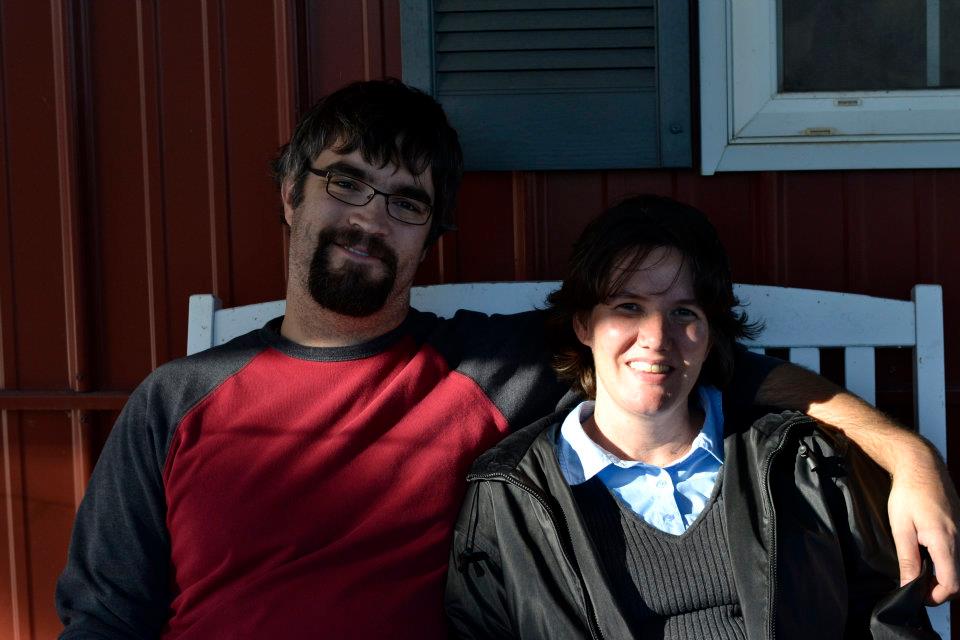
Seventeen years ago today, I promised my life to my bride. I do not say I married my best friend, though I may have thought so at the time and though it is certainly true today. We were young and barely knew ourselves, let alone each other.

In truth, I married my greatest challenge — as I have said before, “the rock, the glue, and the guide.” What we glimpsed during those first three summers in South Dakota was an unseen hand and an unimagined plan for us. Thank you, Jodi, for trusting Him, and teaching me to trust.

genesis

you were the word unspoken, love

the gift yet to bequeath

when light first pierced my darkness and

revealed the void beneath


i was an unformed wastrel then

a breath of dust, alone

you were a shaping vision, love

and carved from solid bone


you were a moving stillness, love

my unknown missing peace

a heartstring tug that drew me near

my bond and my release


i was a crash of water then

and you the softest stone

i broke myself upon you, love

and you returned me home

Rosa Represents

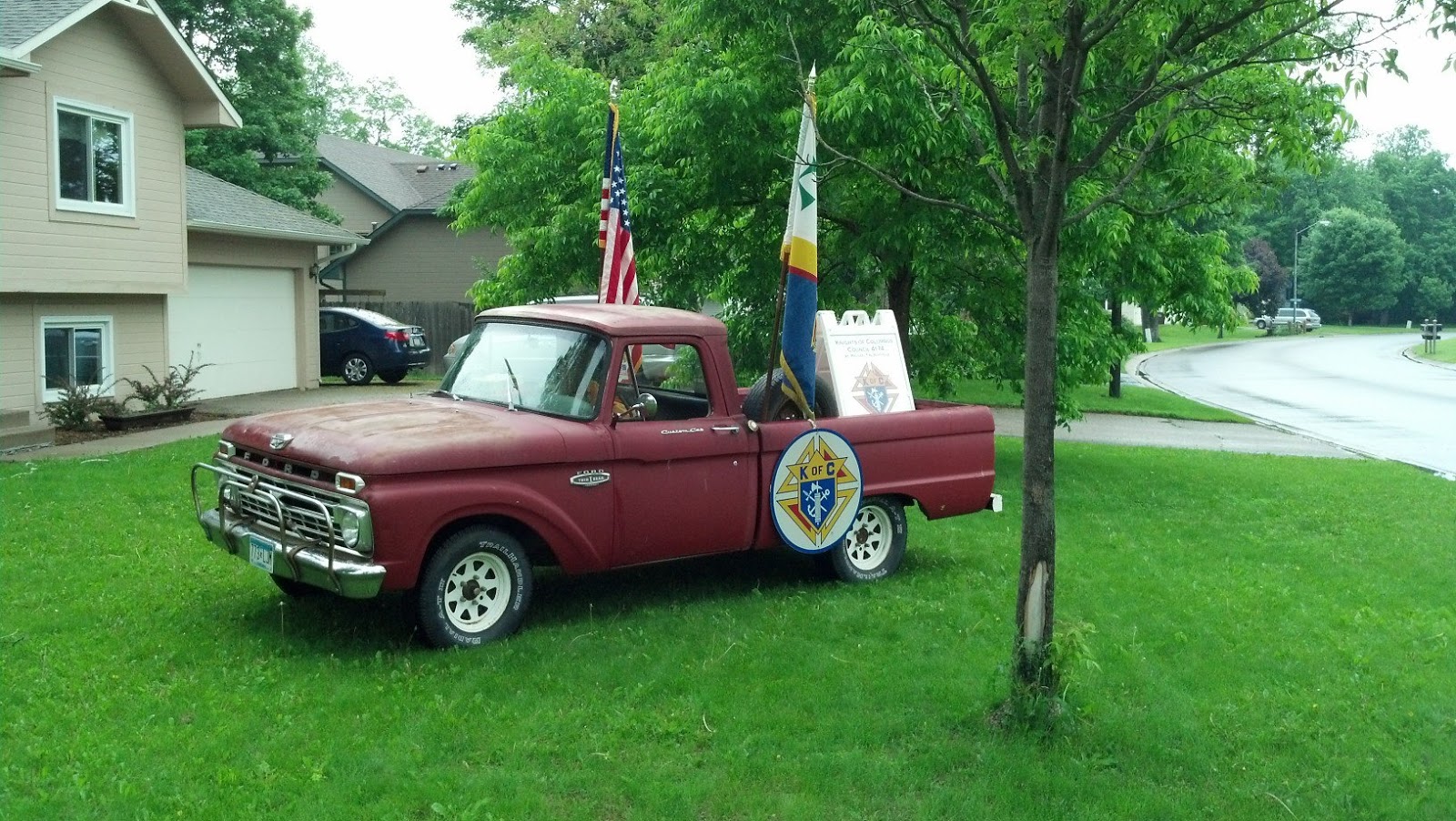
Rosa, ready to go.

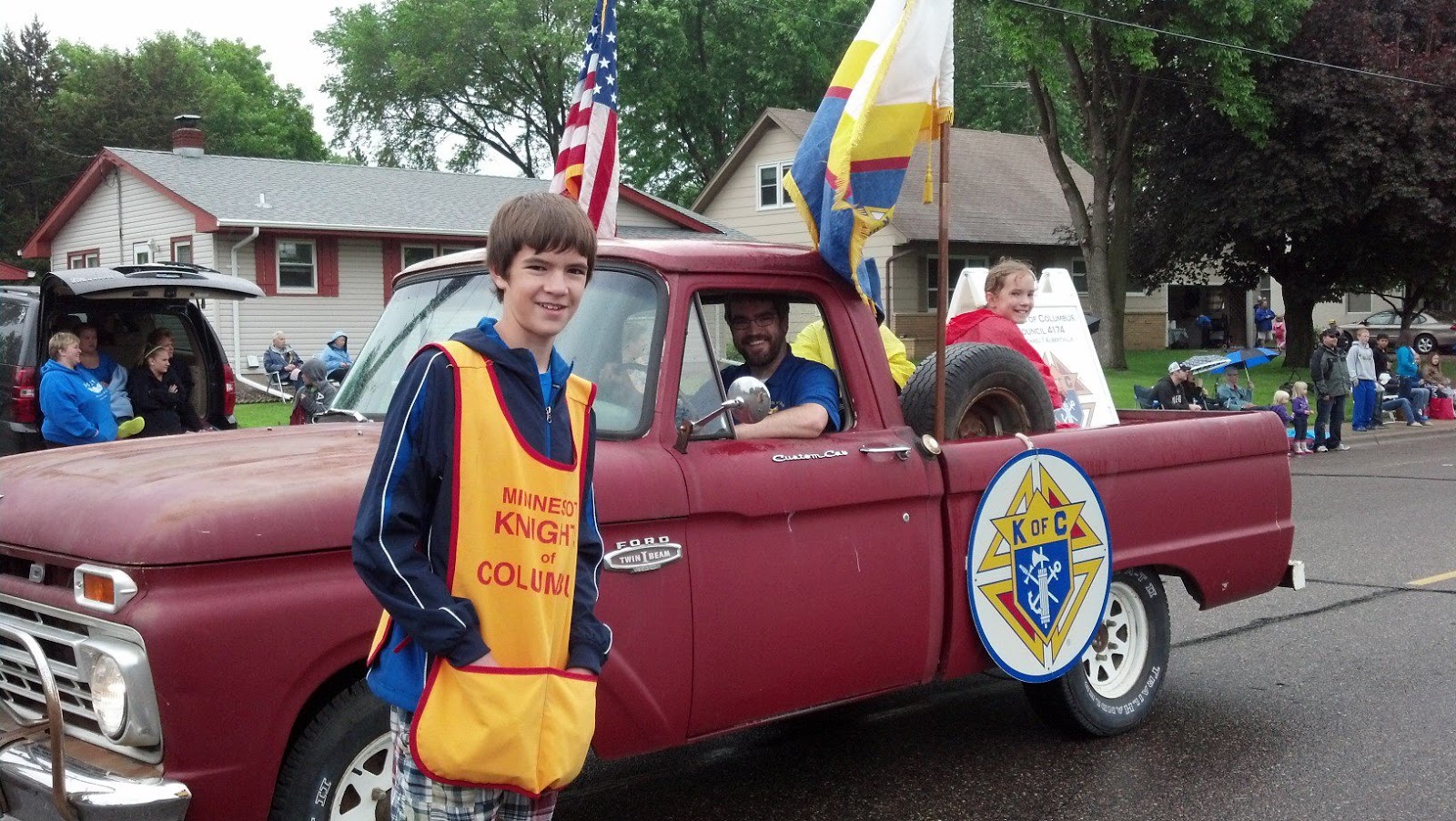
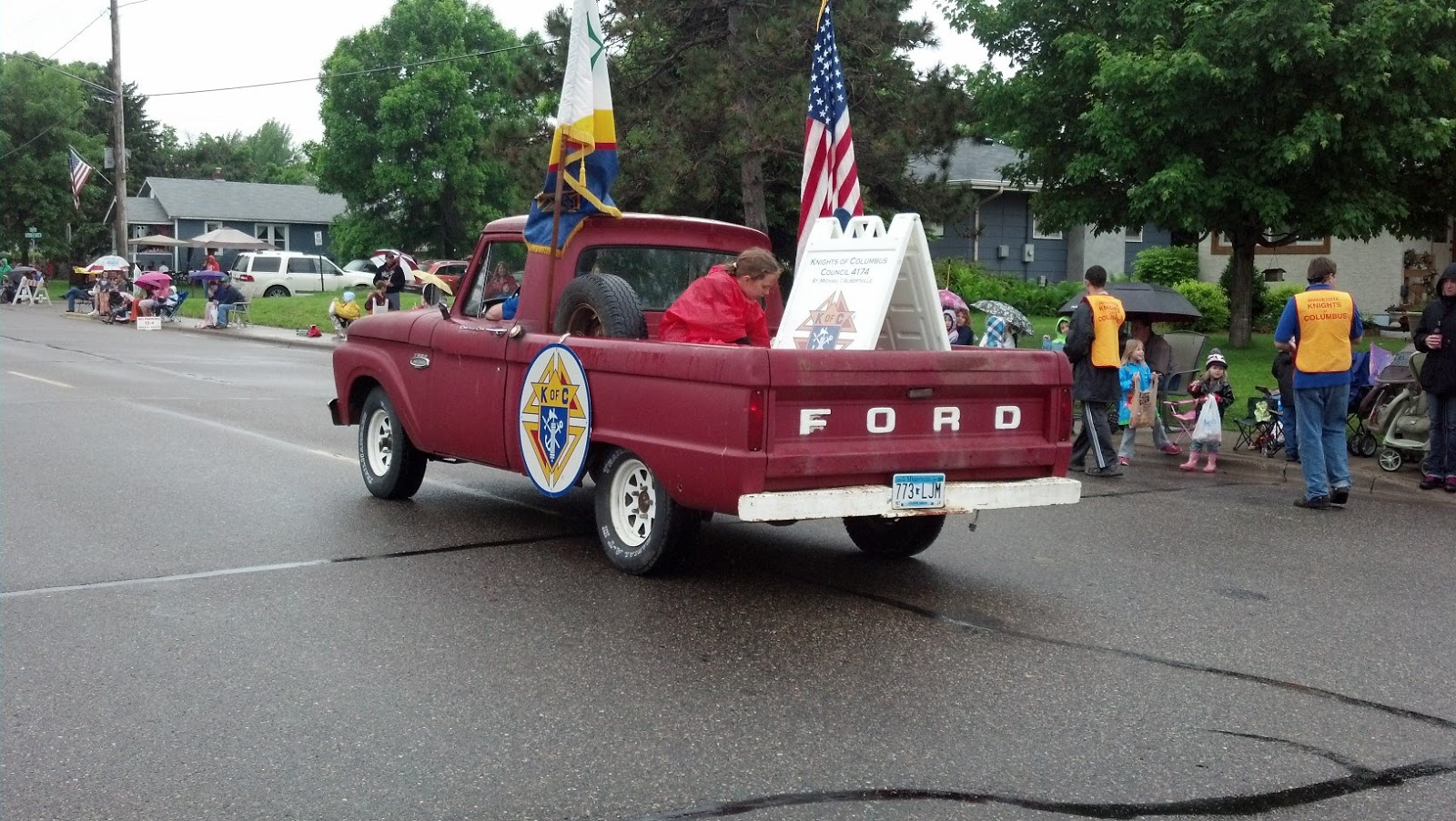
I took Rosa out for an afternoon on the town this past Sunday.  We appeared together in the Albertville Friendly City Days Parade, representing Knights of Columbus Council 4174, with fellow KCs and Catholic youth (including Bren, Gabe, Rose, and Trev) passing out Tootsie Rolls to the crowds.

Parade rest.

She drew a lot of looks and compliments, particularly among gentlemen of a certain age, who might have known someone like her in their younger days. The younger men took notice of both her beauty and her age and were respectful, save one young hoodlum, still red-faced and drowsy from the previous evening’s festivities, who bellowed, “C’mon, light ’em up! Let’s see what kind of power the old Ford’s got.”

Rosa ignored him entirely in favor of a little boy waving enthusiastically from the other side of the street. I leaned out the window, smiling, and said, “She’s got a 240 straight-six. This is about it.”

Show some respect, young man. She’s forgotten more miles than you’ve travelled.

Another young man, clean-cut with Buddy Holly glasses, looked her up and down and said, “’66?”

“Yup,” I said, and he nodded appreciatively.

Were she a woman, guessing her age would be considered uncouth, but for a pickup, it’s a compliment. What might be an adulterous attention to her curves and lines were she human is for Rosa a sign of her authentic, ageless beauty – she is noticed, not because she’s hot, but because she’s classic.

To that end, when we were preparing for the parade, I flew the flags and hung the KC emblems on the side, then grabbed the box of streamers, spangles, and bows left over from last year’s float. I looked from the box to pickup and back, then returned the box to the garage. She’s impressive enough in her own right. Who doesn’t love a modest girl who’s comfortable in her own skin?

Looks just as good going…

Life In The Bubble, Redux

We had some friends over last Friday evening for a fall chili feed. The week was busier than we’d hoped, so up until the moment our guest began to arrive, we were still cleaning, cooking, and prepping…plus managing our kids, our dog, and our jobs. With 30 minutes to go, I was sincerely wondering if this little “get-together” was gonna be worth the effort.

Our friends began to roll in, bearing snacks and sweets, beer and wine, to complement the spread we had started in the kitchen. These were all our friends and all from St. Michael Catholic Church — and most of them knew many of the others, but I’m not sure if anyone but Jodi and me and Fr. Richards knew everyone. We said grace as a party, sampled chilis and home-brewed beers, and talked about kids (had we invited whole families, the dozen or so couples would have had more than 70 children in tow), work, school, politics, hunting, and most importantly in The Bubble, our shared faith. The men ultimately congregated in the basement, and at one point, I walked in to hear a good friend of mine relating how, at a retreat, I once stopped mid-witness, smacked by the Holy Spirit, tearful and trembling and grinning, to tell the men on that retreat, “You guys gotta try this!” Upstairs in the kitchen, three or four life-giving women of our parish were gathered near the sink I was trying to access, talking frankly about how God’s will manifests itself in our lives. I listened a moment, then quietly said, “I love you people.”

From 6:30 to midnight, our house was packed to the rafters with beautiful, prayerful men and women. Father was the first to head home, but he blessed us, upstairs and down, before he left for the night. There were friends missing — some who were going hunting or had other obligations, some we forgot in our own whirlwind of busy-ness, some who live states away in their own little bubbles — but we spent the evening basking in personal warmth and genuine love, and even the ache of their absence helped us to feel complete.

Was it worthwhile? Definitely. Scarcely a waking hour has passed since that I have not paused a moment, thought of one of these dear friends, smiled, and said, “I love you people.” And I do. We hope this will become an annual event, and we will do our best to invite all the others…

I’ve always been a big-headed, geeky, heart-on-my-sleeve kind of guy, with no athletic talent, a poor sense of direction, and few other manly aptitudes upon which to hang my hat. I’m old-fashioned, idealistic, and a hopeless romantic. I write for a living; I don’t follow sports closely; and I don’t drink much or tell off-color jokes (anymore). Often I feel like I don’t fit in. Except here, in The Bubble. Here, Jodi and I have met men and women, our brothers and sisters in Christ, who understand exactly where we’re coming from, and what we hope to be.

What a blessing. What a life.

Book Break: The Abolition of Man

I have said more than once that too often we seek to explain the hell out of everything and explain the heaven out of it in the process. This observation seems tightly intertwined with the arguments set forth in C.S. Lewis’s thin little book, The Abolition of Man. Do not judge this book by its size — the content is dense and provocative, demanding close attention. I’m sure I’ll need to read it again (and again).

The book starts innocently enough, with a critique of an English textbook of the day (the late 1930s) — then expands into a defense of objective reality and value, and the increasingly maligned notion of true right and true wrong. Lewis doesn’t suggest that we won’t continue to debate the finer points of how to live according to this universal Way (he uses The Tao as his term in the book, though he makes it clear that this is for convenience; that the Way transcends world views, creeds, and cultures); his goal is not peacemaking, but to lend credence to the idea that some things are simply worth fighting for and to illustrate the dangers of “debunking” objective values in favor of a more scientific approach to the world — an approach which, ultimately, (he said way back in 1939) would force us to sacrifice our humanity.

This relates to an idea I began to form last week, thinking about the story of the Fall in the book of Genesis: When we seek to become like gods, we become something less. Why? Because the only thing of value we have to trade for godhood is the thing that already makes us as close to God as we can ever be — our humanity. Lewis’s book, to me, was sobering and prescient.

Unfortunately, my head is still spinning, and I know I’m not doing the book justice by a mile. Perhaps a few favorite passages, then…

“As the king governs by his executive, so Reason in man must rule the mere appetites by means of the ‘spirited element’. The head rules the belly through the chest … It may even be said that it is by this middle element that man is man: for by his intellect he is mere spirit and by his appetite mere animal. … The operation of The Green Book and its kind is to produce what may be called Men without Chests. It is an outrage that they should be commonly spoken of as Intellectuals. This gives them the chance to say that he who attacks them attacks Intelligence. It is not so. They are not distinguished from other men by any unusual skill in finding truth nor any virginal ardour to pursue her. … It is not excess of thought but defect of fertile and generous emotion that marks them out. Their heads are no bigger than the ordinary: it is the atrophy of the chest beneath that makes them seem so.”

“The final stage is come when Man by eugenics, by pre-natal conditioning, and by an education and propaganda based on a perfect applied psychology, has obtained full control over himself. Human nature will be the last part of Nature to surrender to Man. … Man’s conquest of Nature turns out, in the moment of its consummation, to be Nature’s conquest of Man. Every victory we seemed to win has led us, step by step, to this conclusion. All Nature’s apparent reverses have been but tactical withdrawals. We thought we were beating her back when she was luring us on. What looked to us like hands held up in surrender was really the opening of arms to enfold us for ever. If the fully planned and conditioned world (with its Tao a mere product of the planning) comes into existence, Nature will be troubled no more by the restive species that rose in revolt against her so many millions of years ago, will be vexed no longer by its chatter of truth and mercy and beauty and happiness. Ferum victorem cepit: and if the eugenics are efficient enough there will be no second revolt, but all snug beneath the Conditioners, and the Conditioners beneath her, till the moon falls or the sun grows cold.”*

“[Y]ou cannot go on ‘explaining away’ for ever: you will find that you have explained explanation itself away. You cannot go on ‘seeing through’ things for ever. The whole point of seeing through something is to see something through it. It is good that the window should be transparent, because the street or garden beyond it is opaque. How if you saw through the garden too? It is no use trying to ‘see through’ first principles. If you see through everything, then everything is transparent. But a wholly transparent world is an invisible world. To ‘see through’ all things is the same as not to see.”

I wholeheartedly recommend this book, although it is essentially philosophy and so will vex some readers. I read the Chronicles of Narnia as a boy, enjoying them somewhat less than the Lord of the Rings trilogy, which appealed to my love of history and myth and language in a different way entirely. But I renewed my love of Lewis as my own children began to read (and watch) Narnia, and even moreso when I finally acquainted myself with Mere Christianity. Abolition came on the recommendation of a good friend and deep thinker, and it is again clear to me that I must read more by C.S. Lewis.

*Ferum victorem cepit essentially means “the conqueror is conquered,” I think.