Lightning on the Stone

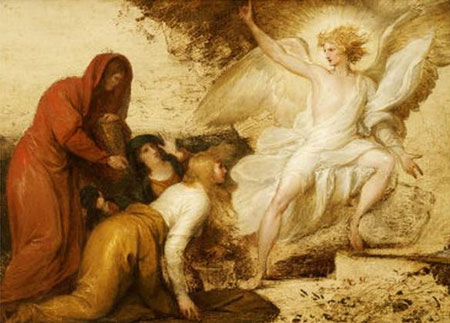
Blogger’s Note: At the Easter Vigil last night, the Resurrection account was from Matthew. The image of the angel appearing like lightning and sitting upon the stone struck meand Lightning on the Stone seemed like a bluesy spiritual someone ought to try to write. So I did this morning. It’s not quite as raw or ragged as it might be if someone sang it over a blues riff…but I’m satisfied.

In dark we walked to that dark tomb

And darkly dreamt of you

Your broken body sealed in stone

And lost in darkness, too, Lord

And lost in darkness too

In gloom we came to Golgotha

As black gave way to gray

I asked our sister Mary who

Would roll the stone away, Lord

Would roll the stone away

The Skull grinned blue—when like a flash

Of lightning from the Throne

An angel, gleaming white, threw back

And sat upon the stone, Lord

And sat upon the stone

As at the rising of the Sun

The Daystar shares its rays

Just so my face with wonder shone

To hear you had been raised, Lord

To hear you had been raised

The sky above was brilliant blue

As blue as any sea

And we rejoiced to tell that you

Were bound for Galilee, Lord

Were bound for Galilee
The Stray: A Christmas Poem


The Stray
Well-groomed for a shepherd, fragrant for a sheep, the sleepless lad lurches, shuffle-stomp, shuffle-stomp, out of town toward the hills. Dawn spills like too much wine, red above the ridges where flock and friends, abandoned, spent the night. Alright, he mutters thickly, steadying himself as for a blow. The sun is up, and now they know.
But what a night!
Ahead a man and donkey walk a slow, steady pace. Full of grace, his wife and infant rock and sway. Clop. Clop. Both stop—and pick their path with care. They see him there. The man measures with a carpenter’s eye. Radiant and shy, the woman offers him a smile as they pass. An ass, an old goat, and a kid—he returns a toothy grin—
But what a woman!
Head pounding, heart pounding, hung-over still. Narrow path, tumbled rock, all uphill. Grumbling and stumbling, the stray finds his way to the herd. Not a word. They are like pilgrims resting at a journey’s end, world-weary and at peace. Eyes bleary, still he sees they also spent the night in light and song. Something’s amiss, he says to one.
What did I miss?

J. Thorp
12/15/16

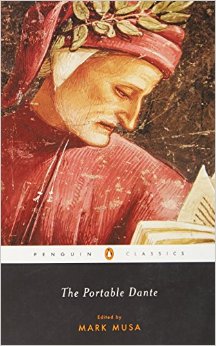
Dante, or Three Things to Love About the Divine Comedy

Blogger’s Note: Several years ago, I agreed to my friend Jacqui’s challenge to read 15 Classics in 15 Weeks. I continue to press forward, this being number 13 of 15, and at this point 15 Classics in 15 Years seems quite doable…

Late last week I finished reading Dante Alighieri’s Divine Comedy in its entirety for the first time. I had read excerpts for different classes over the years, and have read a little about the great work. The book itself was something of a pilgrimage through hell, purgatory, and heaven. This is my least favorite of the thirteen classics I’ve read so far as part of this challenge, and was tough sledding at times. Nevertheless, I do agree that this is a great literary work and worth the effort to complete at least once.

Without further ado, Three Things to Love about Dante’s Divine Comedy:

  • The Ambition. Dante the poet takes us on a journey through the Inferno (Hell), Purgatorio (Purgatory), and Paradisio (Heaven) with Dante the Pilgrim in order that the fictional Dante may change his ways and be saved. Each of these three journeys are told in verse, thirty-three cantos each, with each canto approximately 140 to 150 lines long. Along the way he meets ancient and more recent historical figures, who comment and prophesy on the political and religious turmoil of Dante’s time and place, along with sharing their own experience in the world and in the afterlife. The running commentary on the political machinations and rivalries in Dante’s home was the least interesting aspect of the book for me, but it is nonetheless impressive how much he weaves into this ambitious work.
  • The Creativity. The denizens of Hell and Purgatory, in particular, suffer in hundreds of ways peculiar to their specific sins and attachments. Dante’s Hell is hellish, disgusting and terrifying at times, culminating in an immense figure of Satan, not surrounded by flame, but eternally frozen in ice, suffering for his own sins. The journey through Purgatory is hopeful, but not easy, as imperfect souls labor to let go of those earthly things that weigh them down. Heaven, to me, was actually the least interesting of the three, in part due to the poet’s continued insistence that the beauty of the place was beyond his words and ability — but persevering to the end, to full union with God in the beatific vision, has its rewards. The last few cantos are lovely.
  • The Deep Belief. This, to me, is the greatest aspect of Dante’s masterpiece: the depth of theology, of faith, of true belief. Dante believes in the reality of Hell, and he puts people he loved in this world in that place of torment because of their sins. He peoples his poems with friends, contemporaries, nobles, and popes, explaining how and why each fell or rose, and when Dante the Pilgrim is asked to testify to his own faith, the lines resonate as the poet’s own sincere profession. Who knows how accurate a portrayal of the afterlife these poems are, but Dante gives us much to contemplate as we navigate this world.

I have begun number fourteen of fifteen classics, Tolstoy’s Anna Karenina, with that great opening line: “All happy families are alike; each unhappy family is unhappy in its own way.” It is a long book, but engaging— I hope to be done within the month!

A Christmas Poem: Cave of Wonder

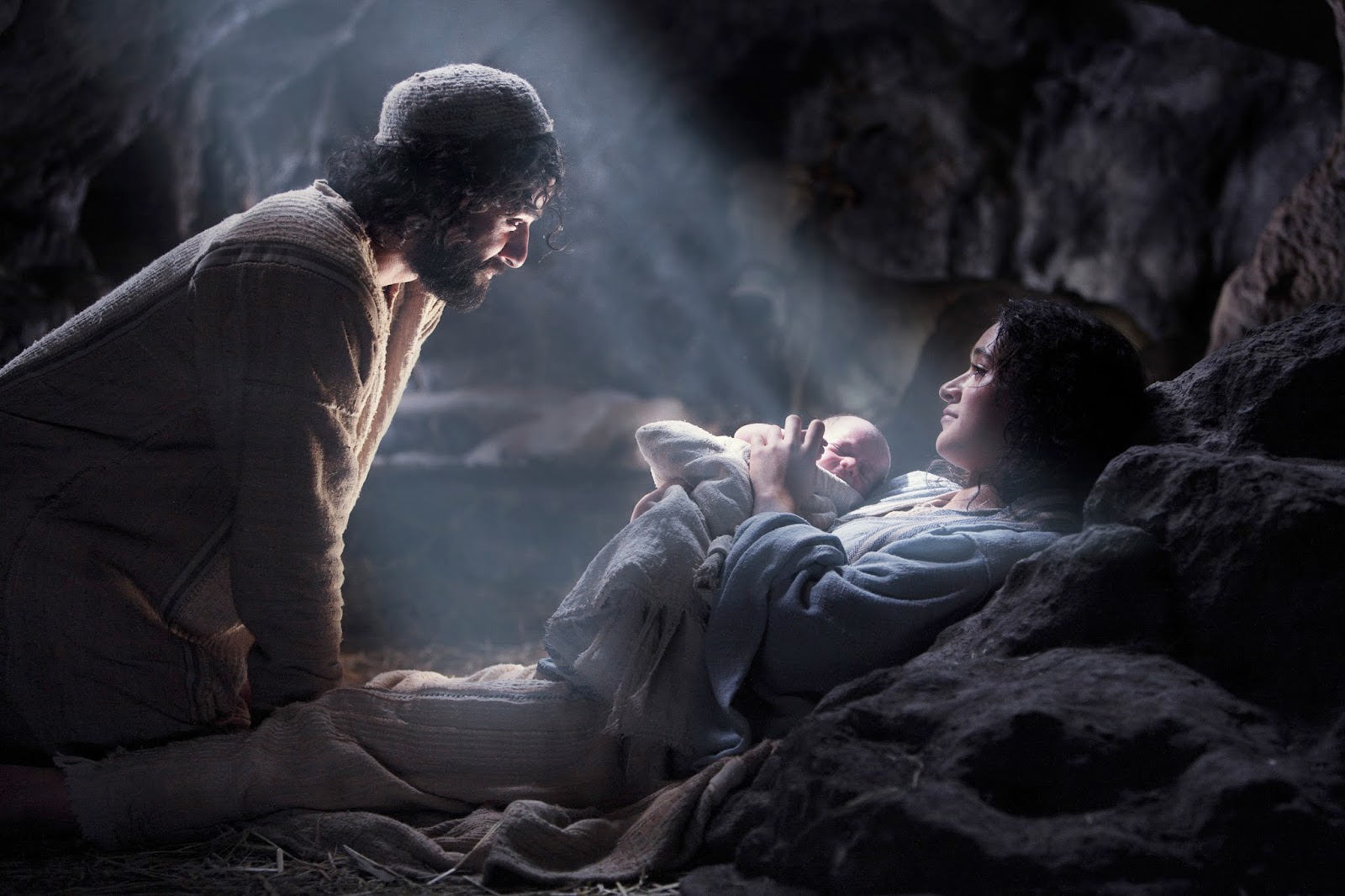
From the film The Nativity Story (2006), rated PG
Wrapped in secret, underground
Sleeping infant makes no sound
Bed of straw and stench of beast
Greatest born to family least
 
Rapt in secret, working man
Virgin mother, shepherd band
Wise men from a country far
Worship Him by light of star
 
Wrapped in secret, hunted one
Earthly might fears Godly son
He has come to seek and save
Born below to rise from grave
 
Rapt in secret, angels sing
Glory to the King of kings
Strength made helpless; selfless love
Here below shows God above
 
Wrapped in secret, greatest gift
By our hands of swaddling stripped
Hung upon a lifeless tree
Sacrifice for you and me
 
Rapt in secret, we the poor
Kneel in before Him evermore:
Blest be home and blest be feast
And blest are we, His servants least
 
J. Thorp
December 2015

Book Break: Impact of God

This spring, Fr. Richards tasked the parish staff with reading Fr. Iain Matthew’s book, The Impact of God: Soundings From St. John of the Cross. This request was a blessing in disguise. It’s a blessing, because the book, ultimately, is a beautiful and thought-provoking exploration of the Spanish mystic’s theology of nada and todo (nothing and all), his approach to prayer, his call to love and union with God. It was in disguise, because by most accounts, St. John of the Cross is not an easy read:

  • first, because he begins with poetry — in particular, achingly breathless love poetry — to God;
  • second, because his unpacking of these poems exposes layer upon layer of latent meaning — like God Himself, hidden within;
  • and third, because his message of detachment and relinquishing control to a God whom we cannot hope to see clearly is a hard teaching.
It’s a difficult book to review, given the challenge of the topic, so instead I will share three key concepts that stuck out to me and to which my thoughts have returned many times in the weeks since I started it. If these entice you, pick up the book and savor it, a bit at a time.
  • St. John writes of a hidden, but active God. Too often we think of God as “out there” — we set out to seek Him, and feel as though the effort is ours. According to St. John of the Cross, this is not the case: God is actively seeking us and inviting us to Himself. The first move is His, and when we respond, the reason He is difficult to perceive is not because He is far away, but because He is infinitely vast and incredibly close. God is not eclipsed by things closer at hand; He is all-eclipsing.
  • God desires union, but needs space to achieve this — and complete union with the infinite God requires lots of space! This is why detachment is important: we must empty ourselves of the things of this world in order to receive the things of the next. When St. John speaks of nada (“nothing” in Spanish), he is talking about creating this space for God, who then makes of Himself a gift in Christ, which by its nature is todo (“all”). Put simply, the only space big enough for todo is nada. While we can work toward this goal of nada ourselves, remember that God is active: He seeks to make room. St. John says that those times of bewildering suffering in life, when God seems so hard to find, quite often are the times in which God is making room for Himself, in you — not forcibly, but by invitation, inviting you to let go and take His hand.
  • Finally, St. John insists that spiritual advisors, teachers, and other guides exercise great care that they not become hindrances to the work of our seeking God. He writes, “God carries each person along a different road, so that you will scarcely find two people following the same route in even half of their journey to God.” This sensitivity to the individual reflects our nature and dignity as unique images of God.

The flexibility is fundamental because it alone does justice to the dignity of each person, a ‘most beautiful and finely wrought image of God’. It does justice too to the laws of growth. … John says that humanity, and each person, was wedded to Christ when he died on the cross, a wedding made ours at our baptism. But all that happens ‘at God’s pace, and so all at once’. It has to become ours at our pace, ‘ and so, little by little’ (Matthews, p. 15).

I will admit that I also found Fr. Matthew’s writing challenging, at first. He weaves quotes from the saint’s poetry, prose, and letters in freely with his interpretations and explanations, creating a poetic account that does not read like literary or theological analysis. Ultimately, this too is a blessing, because a book that could have been an academic exercise turns into a personal invitation to explore the mystic’s works further and to strive for a deeper prayer life. Once you trust that the author knows St. John of the Cross well enough to write with authority, the book reads like a mini-retreat — and I’m sure I will read it again.