Thanksgiving Reflections

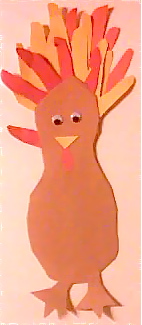
Above: Trevor’s turkey art project…or, “the cursed Indian,” as he calls it.

Stuff For Which I Am Thankful*: my beautiful bride; my astonishing children; two sets of happily married and loving parents (Busia and Dziadzi; Grandma and Grandpa Venjohn); a newly married sister and a new brother-in-law and nephew; my sister’s kids who double as godchildren for us…

* * * * *

A year ago on Thanksgiving, my sister was driving Jodi to the ER while my Mom and I finished dinner and greeted our other guests. I pulled each aside, and explained in a choked voice that we had intended to deliver the good news that we were expecting our fifth child, but that something wasn’t right, and Jodi was headed into the clinic to see a doctor. Was is ordinarily a favorite holiday for feasting and frivolity took a sudden turn: life became very real and close that afternoon, and our blessings, though numerous, seemed worth counting one by one.

It may seem odd to speak of the blessings that flowed from the loss of our little Jude, but there were many, and they began that very day, when the emotional tension reached a point that I called together everyone who was at our home — both sides of the family, adults and children alike — and asked them to pray for Jodi and our baby. We say Grace before every Thanksgiving feast, but this was something different, a deep and heartfelt prayer of petition, and I was moved by our loved ones and touched by God in that moment of profound peace.

In the year since, much has changed. For one, we were forced to take a serious look at our family and discern whether we were called to have another child. With Jude, we had been open to life, but since we had told the kids and had seen the joy in their faces at the prospect of another sibling, we needed to decide if a fifth child were something we would actively pursue — and talk with our doctors about the likelihood that we could lose another. The doctors’ answers were all positive; it didn’t take long to decide, and even less time to again learn we were expecting. On or about Dec. 14 we will welcome a fifth Thorplet — Samuel Firman or Lillian Clara, depending — and our house, our family, and our friends will rejoice. Join us, won’t you?

* * * * *
… all our other nieces, nephews, and godchildren; countless aunts, uncles, and cousins (including in-laws and outlaws; Polish and otherwise); our friends and family in Michigan, Minnesota, South Dakota, Colorado, on both coasts, and everywhere in between…

* * * * *

Today is also Brendan’s 14th birthday, and in his opinion, it doesn’t get better than turkey and ham, mashed potatoes and stuffing, a chocolate cake from his mom, and his own personal apple pie from his godmother, Aunt Brenda. I can’t talk about pregnancy, Thanksgiving, and Bren’s birthday without recalling this day 14 years ago. The following account originally appeared in The Pioneer daily newspaper on Tuesday, Dec. 2:
At long last, we have a son

Few mornings compare to Sundays in October, except perhaps the last Monday in November.
On November 24, 1997, at 9:59 a.m., Jodi and I gave birth [Blogger’s Note: In retrospect, my role was more coaching and cutting the cord] to our son, Brendan James. First he was a tiny patch of hair, dark and slick (“I can see the head,” I cried, and Jodi pushed) — then an immense, misshapen head, and then a baby, wriggling and purple, with blood in his hair. He was tiny and yet strangely huge above Jodi’s shrunken tummy, struggling to make verbal the light, the cold and that infernal bulb syringe moving quickly about his head, from cavity to cavity, removing excess fluids.
Though he did not find the words, he made his case, and gave the face a voice; he cried, and from his cheeks slowly out to each extremity, turned scarlet.
“You have a baby boy,” the doctor said when we forgot to check or ask.
Brendan James Thorp.
We learned a short while late that weighed nine pounds, nine ounces, and measured 21-and-a-half inches long. These measurements seem important, especially to women and more so to those who have given birth to babies nearly as big or bigger. The weight was a source of some pride for me — I weighed in at nine pounds, 15 ounces, so of course he talks after his old man.
As for length…well, it has conjured up old fishing analogies — “He’s a keeper,” I say, and a friend tells me he’d be legal even for a pike.
His head measured 38 centimeters — again, a source of pride, but when I heard this, I wondered who would ask about head circumference.
It was question number four from Jodi’s mom, just behind weight and length. [Blogger’s Note: And the unstated but essential, “Are mom and baby doing well?”]

We never counted fingers and toes — wouldn’t his hands and feet look odd if he had extra or too few? And wouldn’t we still love him with six toes?
I still have counted, and now that twinge of doubt and anxiety that is becoming all too familiar has me wondering if I should…
His feet look like miniature versions of adult feet, which is nothing profound, I know, except that they are not chubby little baby feet at all. They are long, with distinct arches and heels and large big toes. He has wide hands with long, thin fingers like his father (my dad says I was born with a man’s hands). My mother — his Busia (Polish for “grandmother,” and my mom is Polish) calls them Thorp
He is the first male child born to my generation of the Thorp clam that will carry the family name, and my father and I are proud.
The specs — length, weight, etc. — are important, of course, if for no other reason than we are conditioned to ask and to tell. The other things — his hands, his feet, his name — are important because these things have stayed the same.
Our son is changing before our eyes. He has been with us one week now, and each day he is new again. His head has assumed a more regular shape; his color has gone from pale purple to jaundiced yellow to a healthy reddish hue (when not crying — he still turns scarlet when he screams). He is more awake and alert each day, and each day he eats more, sleeps longer, and cries less.
It feels as though the bus will stop at 880 Maple tomorrow, and Christmas Eve I’ll be wrapping Grandpa Thorp’s old Winchester Model 94. After months, weeks, and days of watching, waiting and timing, we’re wishing time would stand still for a moment and let us enjoy our infant son.
Like my white-haired Dziadzi (Polish for “grandfather,” and my mother’s father, like all Galubenskis, is Polish) and my father, I find myself sitting still with Brendan warm on my lap, staring down at him — watching him yawn, cry, sleep and stare back at me. Will he be a wrestler? A scholar? A fireman? He grabs my fingers and squeezes, and I tell him he is strong. I hover over him like other me do, and I’m careful — he is the heaviest nine pounds I’ve ever carried, and no doctor will convince me he’s not delicate and doesn’t need my constant watchfulness and protection. And he shall have it.
If I ramble, it’s because I don’t know what to say — we’ve only just met, and already I’m in love.
We have a son.
* * * * *
…also, a snug house and steady job; our Schnauzer, Puck; our Catholic faith and Life in the Bubble
* * * * *
I never planned to be a father of five (or four, or six), but I am grateful for the call and the opportunity. And today, on this feast, I am grateful to live in a country where Jodi and I are free to make this choice. To be sure, there are many who think we should’ve stopped at two, or one (or even before we started); I have no doubt that I work with several, although thus far they’ve kept their opinion to themselves. I’m grateful for the surprise of gender, knowing that we can welcome whichever wee one emerges with no pressure from society or the State.
I was browsing an online exchange featuring a young soldier speaking out against the Occupy Wall Street protesters and a liberal columnist responding to him. The columnist, as I recall, claimed that liberals dream bigger than conservatives — that they dream of employment and fair wages and health care for everyone, regardless of background or ability. It’s noble sentiment — Christian, even, on some level — but I don’t believe it’s true that this liberal has bigger dreams than me. We have the same dreams, but very different methods of pursuing them. For example, if I could opt in or opt out of the various programs and initiatives designed to save and protect us, fine — I’m free to choose. 
“But,” someone will object, “if people can opt out of these programs , not enough people will participate, and the programs will fail!”
Exactly. If people don’t want help, get out of the way.

I’ve blogged about the pursuit of happiness before. I don’t want anyone to presume to know what’s best for me and my family. I don’t want to be forced into participating in programs or activities that don’t correspond to my values or my faith. And I don’t want to outsource my good life or my responsibilities to love my God, my neighbor, and my enemy. I want to learn to do these things myself. And today I’m thankful to live in a country where this is still possible, and a community full of great examples: people who live each day as both a blessing and a prayer.

The end is the same. But we get there through conversion, not coercion, so that people don’t resent doing right.

* * * * *

…home-brewed beer; books and music; laughter, tears, and prayers…shall I continue?

* * * * *

Finally — although Thanksgiving isn’t really about football — I am grateful that the Lions are a legitimate team playing a meaningful game this afternoon. I am concerned, however: if you watched the pregame for the Monday night showdown between the Vikings and the Packers, you know that if you took the very best attributes of every great quarterback in football history (including Bradshaw’s, not Brady’s, hair) and constructed a Super-Quarterback, you might begin to approach the greatness of Aaron Rogers. With Rogers and the Packers already predestined for the Superbowl, and Ndamukong Suh designated as the “dirtiest player in the league,” I think we’re going to see the NFL enforcing it’s new rule implemented just a couple of weeks ago. Brendan and his friends first noticed this during the Monday night game:

Happy birthday, kid, and happy Thanksgiving, all!

* * * * *

*A partial list in no specific order…
Living with Unbelief

“The new rebel is a Skeptic, and will not entirely trust anything. He has no loyalty; therefore he can never be really a revolutionist. And the fact that he doubts everything really gets in his way when he wants to denounce anything. For all denunciation implies a moral doctrine of some kind; and the modern revolutionist doubts not only the institution he denounces, but the doctrine by which he denounces it. … In short, the modern revolutionist, being an infinite skeptic, is always engaged in undermining his own mines. In his book on politics he attacks men for trampling on morality; in his book on ethics he attacks morality for trampling on men. Therefore the modern man in revolt has become practically useless for all purposes of revolt. By rebelling against everything he has lost his right to rebel against anything.” – G.K. Chesterton

I have a friend from high school – an intelligent and articulate husband and father who reads widely, is well informed on a wide range of issues, and is fearlessly outspoken. I admire these things about him. He is also the closest to a conspiracy theorist of anyone I know. He appears to be skeptical of the government, the media, and the motives of nearly everyone he encounters who is unknown to him or disagrees with his perspective. I can live with that – but I can’t live like that.

In the Ben Stein documentary Expelled—a interesting film with numerous serious flaws, in my opinion—one of the atheist academics says that he rejects the idea of a higher purpose or meaning to the universe, and indeed, rejects free will. He has suffered a brain tumor, and says if it comes back, he will shoot himself in the head.

My first thought was, “Will he?”

How does he know? What if the chemicals and synapses line up differently? What if his neurons compel him to look into the sight organs of those of his species with whom he has chemically bonded, and some subconscious part of his brain gives rise to the unbidden hallucination that these “others” matter to him? Will he override those impulses, knowing that they are false and irrational?

I suppose he won’t. He has no free will, so he can’t override anything. I’m not sure how he professes to believe anything. His choices (er, potential life paths) are two, as far as I can see: either choose nothing, ever, to see whither his impulses lead (they will perhaps compel him to eat, drink, breed, and die, like an animal) or to insist upon his beliefs, but act otherwise – to live as though he had decisions to make, even as he says he doesn’t. He will regard this as perfectly rational. And if he kills himself, those who love him shouldn’t mourn or blame him. It’s nobody’s fault.

I see a similar (not identical) problem with the diehard skeptics and conspiracy theorists. It is reasonable, especially these days, to look around and think the deck is stacked against us. It is prudent, then, to proceed with caution and with our eyes open, doing our best to build a good life, and protect what we have and those we care about. But how much is too much? When you see the government, and those who are wealthy or powerful, and the political structure, and the healthcare system, all as false or corrupt; when you are ready to quit participating in government “of the people,” however flawed it may be; when you are skeptical of transcendental Truth and dismissive of religion – what’s the next step? Secession? Revolution? Or marriage? Can you justify bringing children into such circumstances? I admire my friend’s tenacity in uncovering possible lies and conspiracies, but how, then, does he live his knowledge? On which false information does he act? And what will he teach to his children?

In my college days, I called myself agnostic, thinking this was the most intelligent way to regard God. After all, how could anyone know the unknowable? Only later did I realize that I was hedging – that I didn’t have the courage to believe in God or not. I found, over time, that I could not disbelieve and believe at the same time. I could claim to be an agnostic, but I had to live as a believer or a non-believer.

Devout skepticism, like hard determinism, diminishes the possibility of a credible life without contradiction. The diehard skeptic knows only that he’s skeptical – everything else is uncertain. But I suspect that my friend, like me, has made his choice. He’s a good man, a devoted husband and father, and he genuinely cares about others. He must see something of value in this world, in this country, in his marriage and family, which makes him persist in the face of his doubts. Is it God? Love? Freedom? I don’t know. But he doesn’t behave like an unbeliever. I believe he wants to make the world a better place – and to that extent, his heart is a believer’s heart. It’s a step – forward, in my opinion.

Pinched, or the Descent into Meaninglessness

I have, in the past several months, read more deeply and broadly than I have since college, and perhaps ever. A few weeks back, in my mini-review of Brideshead Revisted, I mentioned that I was reading a new book for work, Pinched: How the Great Recession Has Narrowed Our Futures and What We Can Do About It. I finished it today, and it is a sobering comparison between our current recession, and previous deep downturns at end of the 19th century, in the 1930s, and in the 1970s. The book takes a close look at both the similarities and the differences in order to get a clearer picture of where we are in terms of a recovery (short answer: not very far along) and what we might work to address the short-term, and especially the long-term, effects.

The important issues raised by this book are too numerous to detail, and while I don’t agree with the author on everything, a few insights struck me as particularly compelling, especially on the heels of reading Brideshead and C.S. Lewis’s The Abolition of Man.

First, I have never been one to begrudge the wealthy the fruits of their honest effort; however, Pinched shines a bright and terrible light on the fact that not only are America’s most wealthy and privileged few becoming more so, they are also becoming increasingly detached from the problems and concerns of the rest. Many would rather help the poor on the other side of the world than the struggling here at home, because the visibility and ROI (return on investment) is better.

Second, the book shows clearly that in America, as in the Middle East, men with time on their hands are a major problem. Men are feeling the strain of the recession more keenly than women, and this leads to a wide range of economic, social, and psychological problems that are difficult to remedy. Interestingly, the book even touches on traditional gender roles, indicating that, even in instances in which unemployed men take on more responsibility for household chores and childrearing while their wives work — and indeed, even when their wives say they are satisfied with the level of support their husbands are providing on the home front — nevertheless, satisfaction in the relationship and perception of the male’s worth deteriorates, as I understood it, for both parties.

John W. Gardner once said, “America’s greatness has been the greatness of a free people who shared certain moral commitments. Freedom without moral commitment is aimless and promptly self-destructive.” Don Peck, the journalist who compiled and wrote this book, includes among his recommendations for addressing the fallout of the current recession, a section called “One Culture,” in which he insists that our social fabric is fraying and that cultural solutions are needed, as well as economic ones. He writes:

“The information age — individualistic, experimental, boundary-breaking — has eroded other once-common virtues, ones that we not associate as strongly with a distinctly American character, but that are nonetheless essential to a cohesive, successful society: from family commitment rooted in marriage, to civic responsibility. The Great Recession has merely cast light on the extent of that erosion. The past is not a hallowed place, and we would not want to return to it even if we could. But we do need to sow those virtues again as we move forward — through education and through our own private actions and expectations.”

The book — and this quote in particular — sparked in me an idea for a non-fiction book of my own, exploring the idea that as we debunk age-old beliefs and fail to replace them with new values of equal weight, we devolve into meaninglessness. Relativism, globalism, scientism, the collapse of religion and ritual that help us understand our place in the world (a la Joseph Conrad’s The Power of Myth), and the redefinition of “value” more and more exclusively in economic terms, have actually made the world less understandable — because it no longer jives with what see with our eyes and know with our hearts.

Who Is the Public?

I have just finished another book I would not have read if not for my job, Barry Bozeman’s Public Values and Public Interest: Counterbalancing Economic Individualism. First, permit me to confess that, left to my own devices, I would read fiction, poetry, and an occasional history — so I am being forced to broaden my horizons and get educated, which is never a bad thing. Second, let me say that, as a wannabe writer, I have many, many thoughts about this book, mostly concerning its readability. I would not say that I enjoyed it, but it did provoke thought. The primary thought it provoked may be worth sharing. I say “may be” because I am not an economist, a philosopher, a political scientist, or a public interest or public management theorist, so it’s possible that I simply didn’t get it.

My primary thought about the book is that it spends a great deal of time on the topics of whether and how it is possible to identify public values and the public interest, and contrasting those with private or individual economic values and interests (which are often not the same), but it spends remarkably little time on the question of “Who is the Public?” The author is very conscious (almost too conscious) of the limits — the squishiness — of terms like “the public interest” and “public values,” but while his book tackles “interest” and “values” at length, it gives short shrift to “public.”

Especially in the U.S., a vast nation with remarkably diverse cultures, religions, lifestyles, and economies depending on where in the country you reside, it seems to me that the more immediate the “public,” the more practical and realistic it is to identify shared public values and pursue the public interest. At the state level, this becomes less realistic: every state in which I’ve ever lived has had marked, or even deep, social, economic, political, and cultural divisions (“Outstate” or greater Minnesota versus the Twin Cities metro. East River versus West River. Downstate versus the U.P.) and different lifestyles worth protecting. At the national level, then, it seems unlikely that we could identify public values and a cohesive public interest, aside from the broad priorities of securing the nation and preserving our rights to life, liberty, and the pursuit of happiness. The difficulty of pursuing public values and the public interest is not identifying values and interests — these are abundant, diverse, and obvious — but identifying who shares them, which helps to decide at what level of society they should be implemented.

The critique of economic individualism (which, says Bozeman, is increasingly driving our public policy agenda) in the book insists that individuals in this model are concerned primarily with their own economic interests, and perhaps those of a few close others (immediate family and the like). That may be the proper definition of economic individualism, but I don’t know anyone who lives this way. As a friend in Western South Dakota has explained, in his part of the prairie, neighbors take care of each other — and if someone doesn’t contribute to the good of the community, over time they are made unwelcome. They simply don’t last. Those who remain recognize that it is in their personal interest to take public interest: to be engaged in the community and preserve their shared values and lifestyle.

I enjoy a similar experience in “The Bubble” — the devout, small-town Catholic communities in Albertville and St. Michael. My circle of public interest begins at home, with my family; then expands to encompass my parish and the people with whom I share a fundamental belief system and way of life; then to my town(s), which provide the education my children receive and the goods and services we need to live and thrive; then to my state and nation, which should be responsible for ensuring my towns, parish, and family have the opportunity and freedom to thrive. I invest what time, talent, and treasure that I am still free to spend as I wish in the circles closest to me — which makes sense, since the more distant circles I am already obligated by law to support.

It seems to me that Bozeman’s approach to identifying public values, public interest, and ultimately, instances of failure of public policy to deliver in the public interest, is useful in inverse proportion to the size and distance of the “public” considered. At the local level, the public interest is much easier to identify — because although our population is increasingly diverse, we tend to cluster together with likeminded folks who share similar values. But as long as the majority of public resources are allocated at the state and national level, we will struggle with coming up with one-size-fits-all solutions to generic political issues that approximate real-world challenges, but do not reflect the actual problems of real people living in genuine community with each other.

The Adjustment Bureau

A young, popular New York City politician suffers an unexpected electoral defeat. Suddenly he finds himself face-to-face with the girl of his dreams – a strange woman he’s never met before – in an unlikely place. Their time is short, the attraction is palpable enough for a sudden, passionate kiss, interrupted by campaign staff. She exits quickly. He has only her first name and these few moments. He delivers the speech of a lifetime, and from the jaws of defeat, snatches superstardom and frontrunner status for the next open Senate seat in New York state.

In a city as vast as this, he could never find this beautiful stranger using only her first name – but chance throws them together on a city bus, and it’s clear this is something special. Too special, in fact. He was not supposed to see her again. A group of grim, dark-suited G-men snatch him from his workplace to inform him: they are with the Adjustment Bureau, and this love affair not in The Plan. Whose plan? The Chairman’s – but you know him by many names.

What follows is a fast-paced, but coherent sci-fi romance that turned out to be the perfect mix for my bride and I – with Matt Damon doing a low-key Bourne, trying to outsmart and outpace adversaries who are nearly (but not quite!) omnipotent and omnipresent, and who are bent on keeping him from what he feels sure is true love. More than once he is ripped abruptly from Emily Blunt’s life, re-finds her, and works to regain her trust, unable to tell her what’s really going on.

It’s a solid, entertaining movie, with some language and sexuality (including two instances of a word neither Jodi or I thought was permitted in PG-13 films). And it’s thought-provoking after the fact: at one point, Damon’s character asks a more sympathetic “adjuster” if they are angels. This is not an idle observation, since the underlying problem in the movie is the problem of free will versus predestination. The film proposes a world in which beings who are less limited and more powerful than humans direct the world according to a grand scheme they themselves do not entirely comprehend. From what little I’ve read, this is in close keeping with Catholic traditions and teachings about angels – except that in the film, the adjusters suggest that they function to override human free will, which, unfettered, produced the Dark Ages and the World Wars, but with their guidance (i.e., free will only with regard to small, day-to-day choices), yields peace, happiness, and productivity. (Hmm…that sounds familiar.)

I don’t believe angels, according to Catholic teachings and belief, have the option of taking free will from us. They operate more subtly and keep the world operating according to plan…but we still choose. We make our beds, and we lie in them.

In the film, the very aggressiveness and implacability of the adjusters seem to increase our hero’s resolve and drive him to his climactic decision and the film’s resolution. It’s almost as if the adjusters themselves are off-plan…and as if that, in fact, is part of the plan.