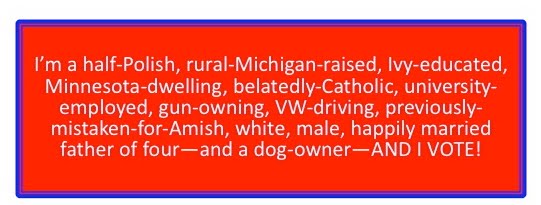
Pre-Election Rant-A-Day 1: Of Course I’m Right! Aren’t You?

Blogger’s Note: I’ve been absent a long time, partly because I’ve been crazy busy this fall, and partly because I’ve had a terribly long and curmudgeonly blog post brewing in my head for months, and no time to write it. So I’ve settled on the “Rant-A-Day” format. My intention is to post a portion of the aforementioned terribly long and curmudgeonly blog post, in rant form, each day until the election, at which point (hopefully) they amount to something.

At Mass on Sunday, Deacon Steele shared the observation that, while saints in heaven are wonderful, saints here on earth can be tough to stomach. You know the type: always polishing their halos and making a point to love the smiles right off their neighbors’ faces.

To a certain extent, in college that was me. Not growing up in the Church, I didn’t consider myself a saint, per se — but my upbringing was quite different from that of most of my college friends and, I thought, clearly superior. Some of this was defensive: I was surrounded by very different expectations and standards of behavior than I was used to, and I watched the beliefs of like-minded classmates crumble around them at the hands of the better-informed and the sharper-tongued. So I bolstered my arguments to support my beliefs — and in the process, polished my halo.

I remember the moment a close friend finally called me on it. We were talking about the death penalty and prison and to what extent a convicted criminal’s environment and upbringing should be taken into account when sentencing. Apparently, I was arguing not very dang much because my friend said, “You think you’re better than them, don’t you?”

I paused for a moment, taken aback by the question (because, let’s be honest, when you hear that question, you’re almost programmed to respond with an indignant, “NO!”). Then I said, “Yeah. Yes, I guess I do. Don’t you?”

“No,” he said. “I think we’re the same. I got lucky to be born into the family I did, and to go to the school I did, and to come here, or I might be in the same situation as they are.”

I didn’t back down at the time, but he gave me food for thought. How much pride could I take in my parents, whom I did not choose, and the solid home and upbringing they provided? How much of me was me, and how much them? I began to listen to myself speak, and I could hear the squeak of the rag on the halo. And I didn’t like it.

Shortly thereafter, I embraced agnosticism — and not just religiously. I started to build a world view on the notion that there was very little we could know for sure about anything, and it’s best to just get along.

Thank God I met Jodi.

See, self-righteousness is ugly. Smugly counting your blessings and crediting yourself for them all won’t win you friends or favor, and clinging blindly to beliefs that keep you safe and comfortable won’t get you to Heaven (or even across the street).

But pretending that nothing is certain — or that you don’t believe in anything for sure — so as not to offend or be caught in error, is as cowardly as it is false. And yet recently — within my 35 years, it seems to me — it has become arrogant to express confidence in or adherence to your personal convictions in public, unless your underlying worldview is neutral. This approach can be summarized by three insidious words: It’s All Good.

“It’s all good.” This is how we summarize freedom and love of neighbor. It’s how we avoid conflict; how we justify ourselves and avoid condemning others; how we let everyone know we’re on their side without taking sides. It is without meaning — and when we live accordingly, so are we.

We cannot and do not live our lives in unbelief. We might keep our beliefs secret, and even act in opposition to them on occasion — but we all have convictions, and we should have the courage of them. We should act, speak, and vote accordingly. We should absolutely vote for like-minded candidates who support our way of life and our values and morals. That’s the only way in which “government of the people, by the people, for the people” can function. If we do anything less — if we decide by our actions, our words, or our ballots that any one candidate, position, or decision is as good as another — we cede our authority to the government, and all priorities and decisions become the state’s.

In this week prior to the elections, the first thing I want to say — the thing I want to shout from the rooftops, really — is this: It is NOT all good. Decidedly not. For God’s sake, and our own, believe in something and make a stand. If it’s all good, as they say, why get out of bed a week from Tuesday? How will you choose, anyway?

It’s all good will be are downfall.

We should come to the polls believing that we’re right — each and every one of us — and if we don’t believe we’re right, we should spend a little time contemplating a new direction before November 2nd. I have a set of beliefs, some of which stem from my upbringing, some of which stem from my experience, and many of which stem from my faith. Not only is it decidedly not arrogant to bring these (faith included, even in America) with me the ballot box, but it is required in order to have a functioning democracy. Our ideas and our ideals must do battle.

So next week, I will vote and do my level best to impose my own belief system on our local, state, and national governments. Why? Because I believe I’m right. Of course I believe I’m right. Don’t you?

Book Break: Starship Troopers

Years ago, I read Robert Heinlein’s Stranger in a Strange Land. I remember only a handful of details about the book — the concept of grokking, the story in broad strokes, the religious aspects — and I remember realizing, at the end, that I had read my first mature science fiction book. Not mature in the Rated M sense (which actually is quite immature, when you think about it) — although the book has its moments and is not for kids — but mature in the sense that it wasn’t a space adventure with rocket-ships, robots, and ray-guns.

Now, some of you know that my middle-school son aspires to the Naval Academy, followed by the Marine Corps. Awhile back I ran across a supposed “required reading” list for our military academies, and nestled among The U.S. Constitution and The Art of War was a surprise title I knew only from a movie preview: Starship Troopers. Thinking it might be a sci-fi book to interest Brendan, I googled it; seeing it was written by Heinlein, I thought I’d better check it out first. We borrowed it from the local library, I skimmed it thoroughly for adult content, then let Brendan have a go.

He devoured it, though he struggled with the rapid fire dialogue and military jargon. I finished it last night, and again discovered that I read a mature science fiction novel.

Heinlein supposedly caught a lot of flack for an overtly pro-military (and some say fascist and species-ist) book. I found it a very compelling read, especially considering it was written in 1959. It’s set in the future, and tells the story about a teenager who volunteers to join the military against his parents’ wishes, mostly because his buddy (and a pretty girl they both know) is doing it. The world has changed since the 20th Century — Earth is part of an interplanetary federation, and ruled as a democracy of sorts…except that only those who have served a full term in the military can vote. Apparently in the late 20th century, things on Earth went downhill: parents ceased disciplining children and were no longer considered responsible for the actions of their children; children, as a result, looked to their peers for security and guidance, joining gangs and engaging in selfish (and ultimately criminal) activities. The criminal justice system ceased holding criminals reasonable beyond a fairly comfortable period of isolation with other criminals, followed by early release and frequent re-incarceration. And citizens young and old became so self-involved that they voted only in their narrow self-interests, for policies that padded their pocketbooks, kept them comfortable, or made them feel good about themselves. Vision, long-term impact, and responsibility to others fell by the wayside…

I’m elaborating a bit. Can you tell the book struck a nerve?

The seductive thing about Starship Troopers is that Heinlein seems to have glimpsed the future, and he paints a picture of the aftermath that is un-American in so many ways and yet makes me shake my graying head in agreement that yes, that’s exactly the problem. Only veterans can be entrusted with vote because only they have shown by their actions — by their service and sacrifice — that they will put the long-term interests of the nation and the public good ahead of their own interests, or even their own lives…un-American, but almost makes sense…parents of juvenile offenders are held partly responsible for the crimes of their progeny and share in the flogging…un-American and brutal, but who hasn’t read a news story and said, “They oughta lock up the parents, instead!”

I recommend the book as a good, quick, and thought-provoking read. I can’t recommend the movie, one, because I haven’t seen it, and two, Denise Richards. (Seriously? She’s the wrong kind of of “cute girl” and Carmen was mostly an emotional presence in the book, not a physical one.) Gonna have to read more Heinlein (and maybe re-read Stranger in a Strange Land). Maybe you should, too.

Colorful Language

Blogger’s Note: My friend, children’s author Jacqui Robbins (yes, the Jacqui Robbins, and don’t act so surprised!) posted this little gem, which got me thinking about when my own kids began to notice differences in people.

Let me say up front: racism is a real problem in the world. As a result, we have complex reactions to race — we notice differences between people quite naturally, and then (especially as adults) we sometimes overcompensate for our reactions. We react so strongly at times that we can confuse our children by overthinking it. This is how I remember one early incident.

Several years ago, Jodi and I took the older boys to a high-school basketball game. Brendan and Gabe were preschoolers, and we were seated in the crowded home bleachers. The visiting team was from a nearby city, and had players “of multiple ethnicities” on the floor. All one of the starters on the home team, the Warriors, were white — and when that one minority player hit a nice jump shot early in the game, the crowd cheered wildly.

“Who made a basket?” asked Brendan.

“Number five,” I said. “Do you see him?”

Brendan went down the steps a ways to get a better look at the scrambling players. “You mean the brown one?” he called back.

The crowd around us matched the makeup of the starting five: Mostly white, except one family seated across the aisle from us. Jodi and I glanced at them in sudden embarrassment. They didn’t seem to have heard.

“There he is,” I said, pointing. “Number five!”

Brendan craned his neck, then looked back at me. “The brown one!” he said. “That’s what I said!”

“I wanna see th’ brown one!” yelled Gabe.

“Listen,” I rasped as Jodi glanced across the aisle. “His name is Charlie. You guys can cheer for him by name. Cheer for Charlie.”

They did, and after a while, the family across the aisle noticed and smiled proudly. And I started to think: The boys didn’t mean anything by it; they’re just kids, pointing out the most obvious distinguishing characteristic. I laughed at myself. To think that I was worried about a color…

The cheer squad chanted, “Here we go, Warriors, here we go!”

“Let’s go, Warriors!” I shouted, and Bren repeated, “Let’s go, Warriors!”

“Who is ‘Warriors’?” asked Gabe.

“That’s the team we want to win,” said Bren. “The ones in white.”

The other team was pressing hard. “Let’s go, Warriors!” yelled Brendan.

“Yeah,” said Gabe. “Let’s go, whites!”

The Man Who Fed the World

Norman who? How is that an American wins the Nobel Peace Prize, the Presidential Medal of Freedom, and the Congressional Gold Medal (a feat only accomplished by four other people in history: Martin Luther King Jr., Mother Teresa, Elie Wiesel, and Nelson Mandela) and throws a National Medal of Science in to boot, and most people don’t know who he is?

How is it that an Iowa farm boy and wrestler comes to the University of Minnesota, almost isn’t admitted, and accomplishes these things? How is it that this man is credited with saving as many as a billion lives and is a household name in certain developing countries, and people here are talking about Brett Favre?

I wouldn’t know him either, except that I work at the University and wrote about him once, so I read his biography. Check out this story, then this great commentary from a few years back, then consider picking up the book, The Man Who Fed the World.

Borlaug not only worked to develop strains of food crops that would grow in areas of the world facing famine, but he taught the people to raise those crops and to continue his scientific work on their own. Not only did he bring new technologies and fertilizers to these areas to boost production, but he advocated for laws and public policies that helped farmers and the hungry.

And when people criticized him for advocating inorganic methods of increasing yields, his response was to invite them to join him in working among the world’s hungry, and then talk. He didn’t oppose organic farming; he simply knew these regions couldn’t grow enough food quickly enough that way to feed those who needed it and was unwilling to choose who would starve.

He didn’t give fish; he taught fishing. He may be the most remarkable man you’ve never heard of.

This Could Be Our Unraveling

“In the end, all of us are paying a price for this home mortgage crisis. And all of us will pay an even steeper price if we allow this crisis to deepen — a crisis which is unraveling homeownership, the middle class, and the American Dream itself. But if we act boldly and swiftly to arrest this downward spiral, every American will benefit.”

— President Barack Obama, in prepared remarks
about his plan to combat the U.S. home mortgage crisis.

I want to be hopeful. I want to be a “glass is half full” kind of guy. But we are already spending a trillion or so dollars, ostensibly to rejuvenate the economy, but perhaps more accurately to preserve a lifestyle, an image of what it means to middle class in America.

Unraveling the American Dream? It used to be that the American Dream was bought with blood, sweat and cash, not credit. It used to be about having a little place to call your own — nothing too fancy, mind you …

My own American Dream started to unravel that moment during my junior year at Yale when I decided to put a stereo and Soundgarden’s Badmotorfinger on my Visa. Up to that point, that card had been an emergency ticket to get home to Michigan. For years after that, the card was a crutch, and the last several years have been spent painstakingly stitching that dream back together.

I don’t see anything in all this spending that changes our collective perspective on living within our means. On the contrary, it appears that government is charging up a storm so we feel confident enough to do the same.

I’m worried, friends. The best-case scenario is that the global economy turns around — which I fear will underscore the idea that we can spend our way to financial freedom. I fear we will emerge more confident than ever that the economic masters of the universe will protect us.

And that could be our unraveling …