Wednesday Witness: ‘You Can’t Save the World’

This column is part of a new, weekly series on what the Lord is doing in my heart, specifically encouraging me to simplify my own life in order practice the virtue of charity and the Corporal and Spiritual Works of Mercy. Come back each Wednesday to read the latest!

I’ve always been a big-hearted and emotional fellow. As a grade-schooler, I tried to intervene when those who were littler than me (not many) were being bullied. Invariably, I took a thumping myself. But I couldn’t help it: I hurt to see others hurt.

Whenever I got wound up about some injustice or suffering, real or imaginary, Dad would say, “You can’t save the world.”

What he taught me, instead, was how to stand up for myself, to treat others with respect, and to look out for my own—my family and close friends, those whom I could count on to help take care of me.

Dad was right: I can’t save the world. I can’t even save myself. Jesus is the sole Savior of the world, and—thanks be to God—it is accomplished (John 19:30).

But I don’t think our eternal salvation is what Dad meant.

Continue reading

Wednesday Witness: All the Time in the World

This column is the first in a new, weekly series on what the Lord is doing in my heart, specifically encouraging me to simplify my own life in order practice the virtue of charity and the Corporal and Spiritual Works of Mercy more and more. Come back each Wednesday to read the latest!

In last Sunday’s gospel, blind Bartimaeus cries out to Jesus, who is passing by with His disciples and a large crowd. The detail that stuck out to me is that, when this beggar calls to the Lord, “Son of David, have pity on me!” many in the crowd rebuke him. These are people like you and me, who have found in Jesus someone we want to follow, maybe even dedicate our lives to. They have heard the Lord preach, seen Him work miracles, and shared in His ministry…and instead of lifting this poor man up and inviting him in, they tell him to pipe down, intending to pass him by.

But not Jesus. He has all the time in the world. He tells His followers to bring the man they have just rejected to Him. Bartimaeus doesn’t need their help, but springs to his feet—a bold move for a blind man—and rushes to the Lord. Jesus asks him what he wants, and he doesn’t ask for food or spare change. He asks BIG: “Master, I want to see.” 

And the Lord delivers even bigger: Not only does Bartimaeus see, but Jesus tells him, “Your faith has saved you.” God’s plan for Bartimaeus is bigger and more generous than even he can dream.

Continue reading

Given Name

To the victor I shall give some of the hidden manna; I shall also give a white amulet upon which is inscribed a new name, which no one knows except the one who receives it.

Revelation 2:17

On Monday evening, something unusual happened—something unique in my experience, though the tradition extends back to the Book of Genesis: My son received a new name.

Our second son, whom we named Gabriel Venjohn Thorp, is discerning religious life with the Community of Franciscan Friars of the Renewal (CFRs). After spending the past year as postulants at St. Joseph’s Friary in Harlem, he and five other young men entered the novitiate Monday at Most Blessed Sacrament Friary in Newark, New Jersey. As novices, they received their habits—the gray hooded robe and cincture of the friars—and their new names. Our son is now Brother Jude Apostoli, of St. Michael.

In my line of work, you might call this a brand refresh: new name, new packaging, same great mission—serving as a living witness and example of the love of Christ.

Continue reading

Seeing Jesus in the Poor

Religion that is pure and undefiled before God and the Father is this: to care for orphans and widows in their affliction and to keep oneself unstained by the world.

James 1:27

A year or two ago, I took my dad to visit an old friend. I heard many stories from their younger days, from middle school through their time in the Army.

I knew my father grew up with a little bit of nothing: He was the youngest of his siblings; his mom died when he was little, and his dad and stepmom had new babies to provide for and little means to do it. That morning I learned that Dad and his friend lived out of Dad’s car for awhile when they were in high school, scraping together what money they could for food or a cheap hotel room by doing odd jobs for their teachers and neighbors.

I learned something else as well: As tough as Dad’s life was at that point, his friend’s was tougher. From his outside perspective, Dad had a wonderful family—a place to get a half loaf of bread if things got really bad. Dad was his friend’s safety net.

Continue reading

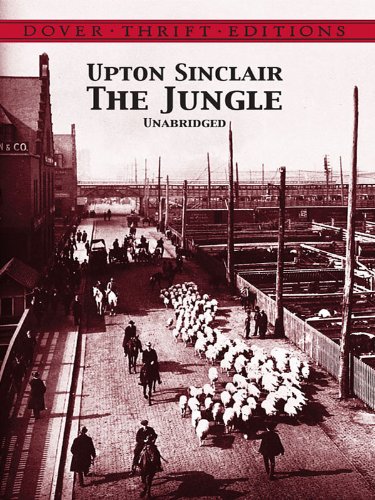
Book Break: The Jungle

A few weeks ago, I attended a day-long training to become a home visitor for our local conference of the Society of St. Vincent de Paul. The most compelling part of the training was the section on what poverty looks like, from the perspective of the person living through it. This segment of the training was led by a man who was born and raised in some of the roughest areas of Chicago and Minneapolis, who was hired by the Society of St. Vincent de Paul as a teen and loved and accompanied for years, through numerous trials and triumphs. Today he is a college-educated husband and father, a successful manager and talented speaker on the state and national level, and a Vincentian for life.

The training was thought-provoking and convicting; it, along with learning more about my own ancestors’ struggles with poverty before I was born, led me to want to dig deeper—which in turn led me to another unread book on my shelf: The Jungle by Upton Sinclair.

Sinclair was an influential muckraking journalist, author, activist, and political candidate at the turn of the 20th century. The Jungle is his fictional but detailed and realistic account of power, corruption, and poverty during this time, particularly in the stockyard district of Chicago. The book follows one immigrant family from Lithuania, who moves to America on the promise of plentiful work for good wages, and finds a corrupt system of capitalists and politicians of every stripe, at every level, keeping prices high and wages low, controlling everything from housing and food supplies in the neighboring slums to law enforcement, inspections, and elections—and driving workers to desperate measures to avoid death by illness, exposure, or starvation.

Continue reading