God’s Love Is Mercy

84764-divinemercy“Proclaim that mercy is the greatest attribute of God.” – Jesus to St. Faustina

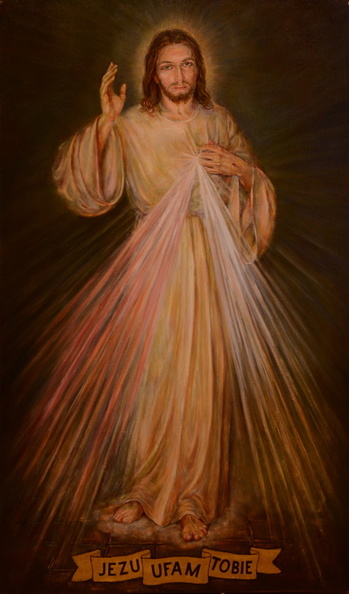
Devotion to Divine Mercy is not every Catholic’s thing. Some people struggle with the image of Divine Mercy: Jesus, His right hand raised to bless and heal, His left indicating his heart, from which rays of red and white, symbolizing blood and water, pour forth as a fountain of mercy for souls. Every version I’ve seen has been a bit mysterious and unsettling—which seems appropriate, given that it’s a vision of the resurrected Christ.

Some don’t like the chaplet, which is simpler and more repetitious than the rosary. Some consider the visions of a poor Polish nun to be private revelations: fine for her, but not necessary for us (even though she is a saint and was canonized by another saint).

Continue reading

Who Is This Mary?

When Brendan came home from college for Easter, one of the first things I noticed was a coarse metal chain around his wrist. It is a sign and reminder of Marian consecration, a total gift of self to God through Mary—a symbol of slavery, but of a good and holy kind—which says he is devoted to doing God’s will in the most perfect way he can, and that he is following his Blessed Mother’s lead in this.

Our local church has undertaken a parish-wide push for Marian consecration this month, using a 33-day self-guided mini-retreat published by Fr. Michael Gaitley as the book 33 Days to Morning Glory. Jodi, Gabe, Emma, Trevor, and I have undertaken this journey together, in hopes that we, too, will be chained to our Lady in mid-May.

The daily readings in this book are short, but thought-provoking, helping us to better understand why Catholics so venerate and so often turn to the Virgin Mary. What struck me this morning is this question: If Mary was sinless, married to a saintly carpenter, and raising a sinless Son, how is it that she was not known better in her day? I know how drawn I am to certain families in our community—families that strive for holiness even as they struggle with all the typical family dysfunction. How is it that Mary and the Holy Family didn’t have a constant throng of people at the door?

Several answers come to mind. First of all, perhaps people did flock to the house in Nazareth, but in the same way we do today. Perhaps they were exactly the sort of family that neighbors were drawn to: mothers confiding with Mary during play dates and nap time, men seeking Joseph’s advice as he worked in his wood shop, parents nudging their children to get to know Jesus because He seemed like a nice boy. Perhaps people realized they were an exceptional family, just not the Holy Family.

But how could they not have seen it?

Well, Mary’s perfect humility comes to mind. I tend to want recognition when I do good work or suffer in some way. Mary, I imagine, would have drawn no attention to herself, and even moreso than our other saints (who were, in fact, sinners), she would have downplayed any recognition she received as due to God and not herself.

And finally, we sinners have a tendency to project our weaknesses onto those around us. No doubt there were those around the Holy Family and Mary who thought they couldn’t possibly be as good as they appeared. The movie The Nativity Story does a great job of illustrating the effect of Mary’s unplanned pregnancy on people’s perception of her, culminating in people scowling from their doorways as Mary and Joseph begin their journey to Bethlehem. (They can feel the eyes upon them, and Joseph jokes to Mary: “They’re going to miss us!”)

Then it occurred to me that these three thoughts might characterize our response to Mary today, as well. We may turn to her as a friend and confidant, or even as a mother, without truly considering her virtue, her proximity to God, her influence as Queen of heaven and earth—without regard for her role as the model and mold of discipleship and humanity. We might not recognize her as powerful, the new Eve and the saint closest to her Son in all respects, because all of this results from a simple, humble yes: complete obedience and submission to God. And we may simply not think she’s “all that”—however good she may be, she’s not God, so why should we let her stand in between us and the Source of life, holiness, and joy?

My answer to this last question is simple: I know how often I’ve lost God, sought Him alone, and failed to find or reach Him. I know I need help. Who better to turn to than the creature like me who loved God best and followed Him perfectly?


Fool for Christ: An Easter Reflection

Such fools, these followers of Jesus. Witless tradesmen, traitors, cowards, and louts, smelling of dust and sweat and fish—with a carpenter to lead them! The honest one, Nathanael, spoke well when he asked, Can anything good come from Nazareth? Yet even he was smitten—by a wandering woodworker!

And then what? This Jesus rides into Jerusalem like God’s gift to humanity, picks a fight with the scribes and scholars, and blasphemes before the high priest. Who could stand for it? They had him flogged and humiliated, beaten within an inch of his life—they gave him every opportunity—and still he would not repent. So they had him crucified.

Great wickedness demands great atonement.

Such disciples! Most of them fled when God’s arm was revealed. Only the young one, John, stuck it out to the end. His mother was there, too, I hear. Poor woman. She raised him right, by all accounts, and this is her thanks: a criminal in an early grave. She must be proud.

They’ve been in hiding since. What would you do, if you left your home and livelihood to follow your heart’s desire, only to see it crushed completely and come to nothing? They say he worked wonders: fed the masses, healed the sick, even raised the dead! But how could that be, unless he came from God Himself? And why would God would allow his servant to be profaned so publicly, so completely—on the Passover, no less! Why could he not save himself?

Unless…

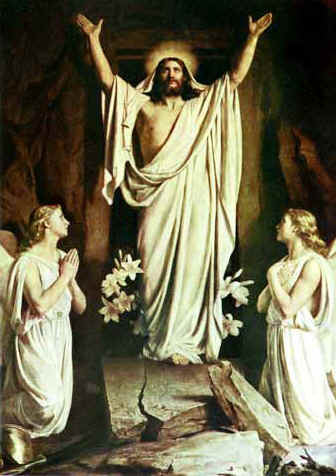
But no. Nothing short of bodily resurrection could make up for so great a loss. For the man Jesus to redeem Himself and his followers, He would have to burst from that tomb of his own accord, bathed in light and breathing God’s own spirit, baptizing in fire as the beheaded Baptist foretold, with angels as His heralds and judgment on His lips. He would have to show Himself victorious over not only worldly powers, but over sin and death itself.

Some say he will. Just imagine: the stone rolled back, an empty tomb, the astonished guards. Imagine the embarrassment of the Romans, the recriminations among the Jewish leaders, the joy and wonder among His followers.

Mercy! Who could stand before so great a Redeemer as that?

On that day, may every knee bend at His holy name. May He find a people worthy to be called His disciples.

And may I be one of them.

Poured Out In Love

 Each year during Lent, the Church focuses more intentionally on the Passion and Death of Jesus. How strange it seems that, during the very season we are trying to examine our lives and conform ourselves to Christ, we are also focused on Jesus at His lowest: beaten, humiliated, tortured. Jesus tells us in no uncertain terms that, to be His disciples, we must deny ourselves, pick up our cross, and follow Him—but surely we can stop short of whips and spears, thorns and nails, can’t we?

We are each a unique image of God, and each called to follow Christ in a unique way: to pour ourselves out in love for those around us. Most of us won’t be called to martyrdom in the bold and bloody sense—though some of us may. Most of us won’t be called to leave behind family and friends for foreign missions or cloistered religion life— but, God willing, some of us will.

Instead, most of us will be called to holiness in the context of ordinary, everyday lives: working, raising a family, pitching in where we can. This may seem easier than facing blades or beasts in the Coliseum, but I’m convinced it’s not. St. Josemaria Escriva warns us, “Many who would willingly let themselves be nailed to a Cross before the astonished gaze of a thousand onlookers cannot bear with a Christian spirit the pinpricks of each day! Think, then, which is the more heroic.”

To make a once-for-all choice for Christ, in the heat of the moment, facing certain death and eternal glory, seems downright doable compared to 70, 80, 90 years of making a million moment-by-moment choices to love the person in front of us, in every circumstance. Daily discipleship is difficult—and it’s made more difficult when we attempt to carry crosses we were never meant to bear.

Think about it: Each of us is called to be a disciple, and each disciple is called to pick up his or her cross and follow Christ. But since many people choose not to be disciples, we have a lot of crosses lying around, waiting for someone to drag them away. All these crosses can make it difficult to discern which is ours. They can cause us to stumble and fall. They can cause us to neglect our own cross in a misguided effort to clear the path.  But if we take the time to identify our own cross—the one God made precisely for our particular strengths and weaknesses—and if we shoulder it and keep our eyes fixed on Jesus, who walks the path ahead of us, He will show us the way.

This, at last, is discipleship: Not to drive ourselves into the ground trying to do everything for everyone, but to ask God what He wants from us, to listen for the answer, and to resolve to do exactly that—to embrace the cross the Carpenter has crafted with each of us in mind, and leave the others.

Imagine a parish of such disciples, all doing exactly what God has asked of them—no more, no less—and all moving the same direction, pouring themselves out in love on a world that desperately needs it.

Such a parish would change the world, because unlike time and energy, love never runs out.

Book Break: The Screwtape Letters by C.S. Lewis

The genius of C.S. Lewis continues to astound me. I read the Narnia series as a child and liked-but-not-loved them (although The Lord of the Rings has taken on new dimensions now that I am a practicing Christian, so perhaps I should revisit the world in the wardrobe, as well). But as an adult, Lewis’s nonfiction — Mere Christianity, The Abolition of Man, and The Weight of Glory — has consistently delivered new spiritual insights and deepened my conversion, and his fictional meditation on the afterlife, The Great Divorce, is one of my favorite books of all time.

Which brings me to The Screwtape Letters. This little book has been on my shelf for quite some time, and my oldest son, Brendan, read it a year or more ago and loved it. The book, ostensibly, is a collection of found letters from the demon Screwtape, an experienced administrator in the bureaucracy of Hell, to his nephew Wormwood, a young tempter striving to lure a budding Christian away from salvation. The letters show the subtlety and patience of the diabolical, the insidious ways in which we are knocked off the straight and narrow path, and the relentlessness with which we are pursued by the “roaring lion looking for someone to devour” (1 Peter 5:8).

I saw myself in nearly every letter, as Screwtape outlines the fledgling Christian’s typical stages of conversion and the best ways in which to turn his progress into regress. The book is darkly funny, which makes the medicine easier to swallow. For example, Screwtape admonishes Wormwood for being naively enthusiastic about the outbreak of war in Europe, saying that while human death and destruction are always to be praised and enjoyed, it is not, in itself, necessarily helpful in the damnation of souls, because A) it affords opportunities for men to exercise saving virtue as well as condemning vice, and B) it can end lives in an instant — snatching souls for the Devil just as easily as from God, and undoing years of patient temptation. He also advises his nephew that tempting humans to great and glorious wickedness can backfire into stunning conversions, and that small temptations that lead them slowly, slowly away from God — all unaware of the danger — is just as good for their Father Below, and besides that, more enjoyable for the skill required.

We never hear directly from Wormwood, but we can hear Screwtape’s displeasure with his dear nephew’s failures and mistakes and begin to sense his affection for the young tempter is only marginally different from his ravenous hunger for condemned souls. My volume (pictured above) included an extra essay, “Screwtape Proposes a Toast,” in which the demon lifts his glass to toast the Tempters Training College and uses the opportunity to explain to the new graduates how Hell is leveraging the public education system on Earth to promote the one thing democracy and virtue cannot survive: forced equality. It is biting and brilliant — and contains one of my favorite passages, about why small, subtle temptations and sins can be better for Hell that bold, passionate wickedness (remember, in this passage from the demon’s perspective, everything is inverted, hence “the Enemy” is God):

I have said that to secure the damnation of these little souls, these creatures that have almost ceased to be individual, is a laborious and tricky work. But if proper pains and skill are expended, you can be fairly confident of the result. The great sinners seem easier to catch. But then they are incalculable. After you have played them for seventy years, the Enemy may snatch them from your claws in the seventy-first. They are capable, you see, of real repentance. They are conscious of real guilt. They are, if things take the wrong turn, as ready to defy the social pressures around them for the Enemy’s sake as they were to defy them for ours. It is in some ways more troublesome to track and swat an evasive wasp than to shoot, at close range, a wild elephant. But the elephant is more troublesome if you miss. — C.S. Lewis, “Screwtape Proposes a Toast”

This is definitely spiritual reading, which you can apply to yourself if you try. A brief example might suffice to illustrate this point: in one letter, Screwtape advises Wormwood on what a huge difference a seemingly small tweak in the language of his “patient” can have on the fate of his soul. He urges his nephew to encourage the man to think of his duty to practice charity as unselfishness. Unselfishness has the advantage, Screwtape says, of turning a positive attribute (charity) into a negative (UN-selfishness), and an external, active habit into something more akin to navel-gazing: inwardly focused, inactive, and a potential source of pride.

He then goes into great detail as to how this commitment to unselfishness can be used to increase resentment and secret pride in marriages and families, as men and women forego the pleasures of this life not out of genuine love and desire of the good for another, but out of a selfish desire to appear unselfish:

“Let’s do what you want to do.”

“No, no, I insist, let’s do what you prefer.”

“Well, I don’t want to anymore.”

“Fine, we’ll do neither.”

She doesn’t even appreciate how unselfish I am!

I don’t need his pity — two can play at this game! 

Like The Great Divorce, The Screwtape Letters led me to think more deeply about the little things that draw me daily away from God, and underscored for me that getting to Heaven is something akin to long-range marksmanship: a tiny deviation at this end can, over the distance of years, result in missing the mark entirely. Yet it never ceases to be hopeful: the demons admit they are at a disadvantage and cannot challenge God directly — and they have no understanding at all of charity, and dismiss it as a lie God has told in service of a secondary goal they have yet to discover. They cannot fathom why He loves us so.