 A little more than a year ago, I wrote a brief review of Oscar Wilde’s play, The Importance of Being Earnest. I was quite disappointed in it, given how much I loved his novel The Picture of Dorian Gray when I read it in 2009, and I said so.
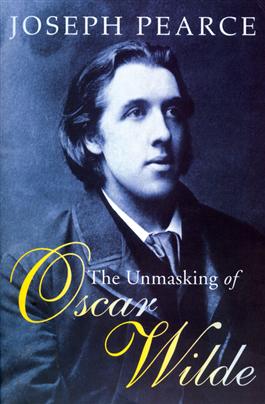
My bride’s soon-to-be sister-in-law — who is as smart and well-read as they come, and who loves Wilde — suggested that there might be more to the play than I thought. A short while later, I ran across Joseph Pearce’s book The Unmasking of Oscar Wilde. I knew only a hint about Wilde’s life and thought perhaps the finding of the this biography was providential. When I saw that it was published by the Catholic publishing house Ignatius Press, I was still more intrigued and vowed to read it. I started it this summer, and finished it last week. It is a thought-provoking, page-turning biography of a fascinating and tragic man.
For someone who knew only a little of Wilde’s purported life, the book was eye-opening on many levels. Pearce cites primary sources such as personal correspondence, several other Wilde biographies, writings from and about Wilde’s contemporaries, and even excerpts from the literature and criticism Wilde wrote and admired. He makes strong attempts to debunk a few longstanding “facts” about Wilde — e.g., that Wilde ever had syphilus — and delves deeply into the thesis that Wilde’s decadent, and ultimately destructive public persona was a mask covering a deeply moral, and tragically conflicted, core. Wilde’s personal descent from artistic genius and admired husband and father into a world of drinking, drugs, homosexuality, and prostitution is reflected in The Picture of Dorian Gray and other works — but almost without exception, those works ultimately conveyed a traditional moral. The legendary decadent was quite often a very Christian writer
Pearce makes his case for the mask analogy well, beginning with Wilde’s mother’s own tendency to cultivate little fictions about herself and to morph with the times, and Wilde’s early and frequent attraction to the romance and arresting beauty of Catholicism, which was viewed unfavorably by his father — and continuing through his apparent long-delayed conversion as he lay dying, broke and lonely.Through each period of Wilde’s life, Pearce draws upon biographical events, historical circumstances, and the often obvious conflict between Wilde’s running criticism of art and society and the deeply moral and religious poetry, fiction, and plays he created alongside it.
Pearce almost makes his case too well for my taste, in fact, building the biography upon Wilde’s love of Dante, as a long descent into Hell, followed by a climb through Purgatory toward an eleventh-hour conversion and (God willing) Paradise. Each chapter fits the construct neatly, and Pearce moves so freely between Wilde’s words and those of his contemporaries, that an inattentive reader can easily lose track of what is actually Wilde in his own words, and what is Pearce positing a reasonable theory about Wilde using the words of others, but that could be mistaken.
Upon reflection, however, I found myself convinced by Pearce’s premise and understanding of Wilde, but wishing that in each chapter he had quit hammering once the nail was driven. I suspect the flourishes that bothered me will delight many other readers.
Learning about Wilde’s life did not make me love The Importance of Being Earnest as a story or play — though it makes the origins and intentions behind the play more interesting to contemplate. Wilde’s own words in the edition I own describe the play as follows: “The play is exquisitely trivial, a delicate bubble of fancy, and it has its philosophy…That we should treat all the trivial things of life seriously, and all the serious things of life with a sincere and studied triviality.” This is the voice of Wilde’s public persona: the irreverent, boundary-breaking, drawing-room wit that made him as legendary and popular as his carnal weaknesses made him infamous. The back cover of my copy claims that Earnest embodies more than any other play, Wilde’s “decency and warmth” by which I think it means it was lighter fare and not in danger of being attacked as indecent, as some of his more explicitly decadent and overtly moral books, like Gray, were.
So why this shift to something lighter — simultaneously less decadent and controversial, and less moral and moving? Pearce isn’t explicit about his views. But it is interesting that Wilde wrote this play during a break in the self-destructive relationship with another man, Alfred Douglas, that brought about his downfall. He hadn’t worked in some time, was deeply in debt, and had few friends upon whom he could rely for help — and he wrote a satire that, unlike his other works, appears purposely to be an exercise in style over substance, mocking conventional morality instead of leveraging immorality to drive home a moral.
It was a triumph at the box office. Perhaps necessity is the mother of invention?
 Archangel Stomp