Rise and Walk: Looking Ahead to Next Year’s Program

This past week we completed our family faith formation sessions for the year, and this weekend our LIFT first communicants will receive the Blessed Sacrament for the first time. The past year has flown by, and I suspect the summer planning season will pass even faster. We have lots of great for next year, but one of more significant changes has to do with the age of Confirmation. After extensive discussion in recent years, including our priests, committee members, catechists, and staff members at St. Michael and St. Albert parishes, we have decided to gradually shift the age of Confirmation to 8th grade for all our students.

This decision was made for several reasons, but for me, the two most compelling are these:
  • Middle-schoolers are more open to evangelization and catechesis. They are more likely to follow the lead of their parents and parish volunteers, more excited about activities and retreats, and significantly less busy. High-schoolers have other priorities, including sports, exams, driver’s ed, jobs, and social lives—and unless their faith is already a top personal priority, it is difficult to make them care.
  • We already have great success in reaching and converting middle-schoolers. We have tremendous youth ministry programs that change kids’ lives (as almost anyone who has sent their kids to Extreme Faith Camp can attest). We don’t capture the heart of every middle-schooler, but of the high-schoolers we have who stay committed to their faith through graduation and beyond, nearly all of them were hooked in middle school. Each year we have a large “bubble” of students who show up for Confirmation classes—why not move the bubble to the age at which we have proven success in reaching kids and helping to keep them Catholic

What does this mean for you? If your children attend the parish school, they will continue to be confirmed in 8th grade. If your children attend LIFT and our parish Confirmation program, the plan looks like this:

  • Next year: Tenth-grade students will see no change; they will complete the second year of the Chosen program and be confirmed in Spring 2017 as planned. Ninth-grade students will complete a more intensive, one-year Chosen program and will also be confirmed in Spring 2017.
  • 2017-18:Ninth-grade students will complete a more intensive, one-year Chosen program and will be confirmed in Spring 2018. Eighth-grade students will complete either a one-year program (either based on Chosen or the YDisciple model) and will also be confirmed in Spring 2018.
  • 2018-19:Eighth-grade students will complete a one-year program using the YDisciple model from this point forward.

The YDisciple model involves forming small groups of around eight students each, beginning in middle school, with a trained adult leader who walks with those students from middle-school until they graduate. In each discipleship group (or D-group), students continue to learn about their Catholic faith, grow in prayer and discipleship, support each other, and hold each other accountable.


This is a volunteer-intensive effort. We will need people who feel called to work with teens and share their faith, who are willing to be trained and to commit to a group of young people, and who are able to share their own lives as examples of faithful discipleship. It is a daunting task to find and train so many volunteers, but we believe this is where God is calling us, and He will make our efforts fruitful.

In fact, our need for dedicated disciples who are ready to work in the vineyard is not limited to Confirmation. We have such great needs in this parish, and so few workers. It is time for those of us who have been asleep to rise and walk, with our spouses and children, our friends and neighbors, and all those in our lives who need Christ—in short, with everyone!
The Power of Family


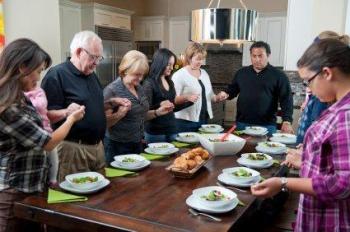
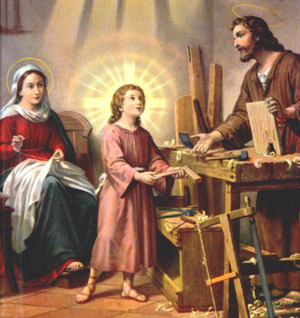
The family is the community in which, from childhood, one can learn moral values, begin to honor God, and make good use of freedom. Family life is an initiation into life in society. 

– from the Catechism of the Catholic Church, paragraph 2207

As I type, bishops from around the world are gathered in Rome discussing how best to preserve, strengthen, and encourage Christian families. With so many families suffering or broken, such confusion over the nature and purpose of marriage, and the constant cultural tension between anti-child forces (for reasons of overpopulation, so-called social responsibility, or personal choice and comfort) and  “child worship” (treating each child as the center of the world, deserving of the very best of everything), it’s easy to feel underappreciated and overwhelmed. It’s also easy to get caught up in the everyday hustle of school, work, sports, and recreation and lose sight of the true power of the family as a domestic church: an apprenticeship in love of God and neighbor.


The Catholic Church, in her wisdom, teaches that the family is the fundamental unit of society, with certain rights and responsibilities that no higher level social organization can ever claim. Humans are social creatures, made in the image of God, who is Himself a loving, life-giving communion of Persons—the Holy Trinity. The Catechism insists that government has a duty to protect and foster marriage and family and to help families (and not interfere) with raising and educating their children as they see fit, both in the world and in faith.

The Church, in fact, regards the education of children in the faith as a duty of parents—a point that cannot be overstated.  I sometimes hear parents say, “I want my son to make his own choice about his faith,” or “I don’t want to force it—it will mean more my daughter if she comes to God on her own path.” While it is true that, ultimately, we each make our own choice for or against Jesus Christ and His Church, we cannot entrust that choice to the sole discretion of our children—any more than we would allow them to decide whether to drink something we know to be poison. If we truly believe what the Catholic faith teaches, the choice our children face is much more stark than how they will spend their Sunday mornings—it’s about how they will spend eternity.

Next Wednesday we begin a new year of First Confession/First Communion and Confirmation classes—and as always, it is essential that parents take the lead in sharing the good news of Jesus Christ and the eternal truths of the Catholic Church. Your personal example is the most powerful witness to your children—and male role models, in particular, have extraordinary power in keeping kids Catholic. Even simple things, like reading a Bible story, putting on a tie or a dress for Mass, or taking time to pray with and bless your child before bed, make deep and lasting impressions.

Scripture reminds us, “Train the young in the way they should go; even when old, they will not swerve from it” (Proverbs  22:6 ). We are all practicing Catholics, all sinners who are in training to love as God loves. But as parents we are also powerful, and we must not neglect to use that power to bring our kids to Christ, who said, “Whoever receives one child such as this in my name receives me” (Matthew 18:5).

Blogger’s Note: This article appears in the Sunday, Oct. 18, parish bulletin.

The Family That Prays Together…

Education in the faith by the parents should begin in the child’s earliest years. This already happens when family members help one another to grow in faith by the witness of a Christian life in keeping with the Gospel. Family catechesis precedes, accompanies, and enriches other forms of instruction in the faith. 

— Catechism of the Catholic Church, paragraph 2226

Seven years ago our parish switched from weekly CCD to a monthly family faith formation model we called LIFT, or Learning In Faith Together. The reason was solid: children whose parents model Catholic living and make faith and the sacraments a priority are more likely to hold onto the faith themselves. Children first experience God’s love through their parents—and the best way to keep kids Catholic is for parents to teach them by their own words and example!

Our program has changed, but our original goal—to gather as a community to help parents share their faith with their children—has not. How will this play out in our LIFT and sacrament classes this year? By emphasizing three ways we can encounter Christ in our day-to-day lives:

  • In Our Family. This year, LIFT families—adults and high-schoolers, middle- and grade-schoolers—will be covering the same monthly topics at an age-appropriate level, so that the faith-building activities for each month can be a family affair.
  • In Our Community. If the Church is the Body of Christ, then we can encounter Jesus in each other. To that end, LIFT will feature shorter lessons and more practical small-group discussions, monthly personal witnesses or speakers from the parish, and a bigger emphasis on service activities and ways of living our Catholic faith outside of the church walls.
  • In the Holy Eucharist and the Sacraments. The teens on our new LIFT Crew offered a profound, yet simple, insight. “Get people in front of the Blessed Sacrament,” they said, “and let Jesus do the work.” So this year, we will be emphasizing the essential importance of Mass and the Holy Eucharist, as well as Confession and the other sacraments, for adults and young people alike.

I often hear parents say that children learn more attending weekly religion classes. While they may learn more of the content of the faith, without the habits of regular prayer, Mass attendance, and confession, and without discussing and living their faith outside of church, that content doesn’t stick. We often speak of planting seeds, but only when good ground is properly prepared can the seeds germinate.

To that end, we are encouraging all parish families, including those in the parish school, to attend LIFT. For families who have children preparing for First Communion and Confirmation, LIFT is required except in three cases: if the children attend the parish school and have regular religion and sacrament instruction; if the children are a part of our parish home-school group and have regular religion and sacrament instruction; or if the family has no children younger than ninth grade.

We are asking for a commitment—but it’s no more than the commitment we’ve already made as baptized Catholics and disciples of Christ.

We know that the cost of LIFT can be an obstacle for families. LIFT and sacrament fees help to cover the costs of staff, materials, speakers, and retreats, but no one is ever turned away from LIFT or the sacraments due to money. Please don’t let the cost stop you from registering and attending!

If it’s a matter of time, consider this: what better investment of two hours a month can you make? Two hours a month to help lead our young people to Christ by personal example—to make disciples, who are “doers of the word, and not hearers only” (James 1:22).

We cannot save time—we only spend it. What greater gift can we spend it on than salvation?

Blogger’s Note: This article appears in the Sunday, Sept. 6, parish bulletin.

The Outcasts Among Us

This parish has a wonderful reputation in the archdiocese. We have good and holy priests, deep roots, a beautiful church filled with Catholic families, and numerous vocations to the priesthood and religious life. When I tell practicing Catholics outside “the Bubble” of St. Michael where I work and worship, they know this place and tell me I am blessed.

Many of you have had the same experience—so a few facts may come as a surprise. For example, did you know that any given fall, only about half of the parish’s school-age youth are enrolled in either the LIFT program or the Catholic school? Or that each year we see a spike in LIFT enrollment among families with children in the sacrament grades—second grade for First Holy Communion; ninth and tenth grade for Confirmation—followed by a drop of about 50 percent after First Holy Communion, and nearly 100 percent after Confirmation? This tells us two things: first, the number of St. Michael youth enrolled in religious education on a regular, year-after-year basis is probably closer to 40 percent, and second, many of the Catholic families in our parish come for the sacraments but form no abiding relationship with Jesus, the Catholic Church, or the Body of Christ—the community of the faithful—present here.

Something is missing, even here in this beautiful, life-giving parish.

I was blessed to make a silent retreat to Demontreville a couple weeks ago. During one of the meals, we listened to Fr. Greg Boyle recount his work among gang members in Los Angeles, and I was struck that these young men were searching for what we all want: a place to belong. That got me thinking: who are the outcasts among us here in St. Michael? Who, in our parish, is just looking for a place to belong?

Perhaps it’s the broken family who struggles to make connections because the kids are only here every other week. Perhaps it’s the single mom who can’t attend MOMs Group because she works long hours—and wouldn’t know what to talk to the other moms about anyway. Perhaps it’s the immigrant family who finds themselves awash in a sea of white, worshiping in a way that is as solemn and foreign to them as they may appear to many of us.

Or perhaps it’s the young family that’s just settling in: Mom’s a cradle Catholic; Dad is coming around—with two young kids and an infant, juggling work and family and faith, swept along in the rush of baseball games and birthday parties. They told the priest five years ago they would raised their children Catholic, but honestly, they don’t know where to start. Mass is a struggle. They’d like to get involved, but maybe they’ll wait until First Communion. Hopefully things will settle down by then.

Those of us who feel at home here are deeply blessed, but we can sometimes forget where we started. At one time—perhaps as children, perhaps as adults—we had basic questions about the faith we were afraid to ask. At one time, someone—a priest, a friend, a stranger—took an interest and nudged us toward God. At one time, we were all on the fringes of faith and could have tipped either way. To our great benefit we fell into the open arms of Jesus.

So let’s benefit others in the same way, recognizing that the best way to deepen our own faith is to follow Christ in spreading the gospel and making disciples. Let us look for the outcasts among us, invite them in, and walk with them up the narrow path to the Cross, and our salvation.

Blogger’s Note: This article appears in the Sunday, August 23, parish bulletin.

Are We There Yet?

Gabe, napping in the minivan…

Back in my newspaper days, I wrote a column each Tuesday called “Almost There.” My bride and I were young parents of two preschool boys at that time, so “Almost there!” was a constant refrain wherever we went. But the name also captured the sense that we were on the verge of putting it all together—of making sense of marriage and family life, and of my newfound faith and fledgling career as a writer.

That was more than 15 years ago, and that sense has never left. The novelty of feeling so close to understanding wore off years ago, however—as a result, I am prone to asking our Lord like the spiritual child that I am: “Are we there yet?”

The answer, invariably, is no.

This world so loves achievement that we have turned even baseline accomplishments like participation and attendance into certificates and celebrations. In what other facet of life besides our faith do we commit ourselves to weekly participation, devotion, and study, year after year, and discover that we have done only what is expected of us?

We long for recognition of our efforts, and this longing even skews our perception of the sacraments. As children and as parents, we are pleased with having made it to Mass or Confession, but sometimes forget that these are not ends in themselves, but means by which we conform ourselves to Christ and reorient ourselves toward Heaven. We treat both Confirmation and Marriage as the culmination of work already done rather than the beginning of something new. The certificates we receive look for all the world like diplomas, when in fact they are birth certificates!

The path to Heaven leads out of this world, and among those born into humanity, only Jesus knows the path in its entirety—so we have no choice but to follow Him and go where He leads. Since we cannot know the path ourselves, the only way we can help others get to Heaven is to teach them to follow Christ who said, “I am the Way.”

Road trip!

How does one follow Christ? St. John of the Cross writes, “God carries each person along a different road, so that you will scarcely find two people following the same route in even half of their journey to God.” As a result, we need to teach others where to find God and how to engage Him—in the Church; through scripture, prayer, and the sacraments. And we need to do this as a community. Why? Since there are as many paths to sanctity as there are unique persons, each of us will resonate with others in ways that no one else can. Somewhere in this parish, someone needs your example!

Fr. Robert Barron shares a story of Jewish academic and Catholic convert Edith Stein, now St. Teresa Benedicta of the Cross, who before her conversion went into a cathedral to admire the architecture and saw a woman still laden from her day’s shopping, kneeling and rapt in silent prayer. This simple act of devotion struck the future saint profoundly, advancing her on the path toward holiness and heaven. Who knows what saints we will help to create simply by showing up each week to bend our knees in prayer and worship?

Blogger’s Note: This article appears in the Sunday, June 14, church bulletin.