Book Break: Story of a Soul

One of the great blessings of surgery has been time to read; as a result, I’ve now finished three books that lay on my nightstand, long overdue. The first was the the autobiography of St. Therese of Lisieux, Story of a Soul. The Little Flower had been much on my mind and had shown up time and again in my prayers and study this past winter, so much so that I decided she must be trying to tell me something. I found her biography in our parish lending library, and finished in late last week.

Autobiographies, especially those that weren’t expressly written for publication, can be challenging to read, and this is no exception. St. Therese is writing out of obedience, fulfilling requests of three different prioresses to record the memories of her life. Her style is emotional, sentimental, somewhat meandering, and acutely self-aware — in fact, she acknowledges throughout the book, with good humor, that she has drifted far from the main point, but that she is writing because she was asked to, and if her work is found lacking and destroyed, it will be of no great loss to her.

It does not take long to realize this is the story of an exceptional soul from an exceptional family. From her earliest days in 19th-century France, the Martin family’s life revolved around their Catholic faith, prayer, and the sacraments. The first thing that struck me (and I believe this was one thing the little saint wished to tell me) was that in her childhood, preparation for receiving Jesus in the Holy Eucharist for the first time was the most important and most exciting thing that could happen. She understood the mystery of the Real Presence early on and longed for the sacrament with her whole being; her entire family — parents, sisters, aunts, uncles, everyone — helped her to prepare, encouraging and instructing her, helping her to make a mature first Confession, even sending this little girl on retreat to prayerfully prepare for her first Communion. We fall far short of this today, and that must change!

From an early age, St. Therese longed for the religious life of a Carmelite sister. The persistence of her vocation also struck me: she prayed long and hard on this beginning in childhood and was so strongly minded that, on a pilgrimage to Rome, she pulled rank on her local priests and bishop and cried to the Pope to let her honor him by entering Carmel at age 15. He told her she would enter if God willed it, and a short time later, the local church authorities relented.

The religious life was not without struggles for St. Therese, and it was there that she perfected her “Little Way,” which has made her so beloved the world over. She wanted to do great things for God, but was confined to a convent, young and of poor health. She could not be a priest, and would not be a missionary or a martyr. She was just a little flower on the forest floor — but the little things she did, she could do with great love. As a result she began to bite her tongue when accused or  provoked, to seek out the sisters who were avoided by others and look for ways to serve them, and to seek the good for others in every situation, regardless of the cost to herself. She began to love as God loves.

St. Therese was extraordinary, but blazed a trail that ordinary Catholics can follow, perhaps, more easily than that of the spiritual powerhouses of the Church. And I think that was another thing she wanted to tell me. This is a beautiful story of a great soul, and while it’s not a traditional page-turner, I highly recommend it.

On a related note: during the same time period as I was reading this book, a colleague gave me a booklet called “40 Days of Preparation for First Communion with St.Therese of the Child Jesus.” It is a booklet of very short daily prayers and exercises for children, based on the prayers and exercises St. Therese undertook as a girl under her family’s guidance. Unbeknownst to me, my colleague Kathy was given the same booklet by one of our priests to consider for use with this year’s First Communicants. It’s a baby step toward what our First Communion preparation ought to be. St. Therese of the Child Jesus and the Holy Face, pray for us!
LIFT Links: The Pro-Santa, Eve-of-Christmas-Eve Edition

Blogger’s Note: I am a big fan of Santa Claus. You do not have to be…but if you’d like to be, and still hope to keep Christ as the focus of your Christmas season, here are some thoughts on how to do so. (Elf on the Shelf is not one of them, because I find him too tangible and a bit too creepy — but to each his or her own!)

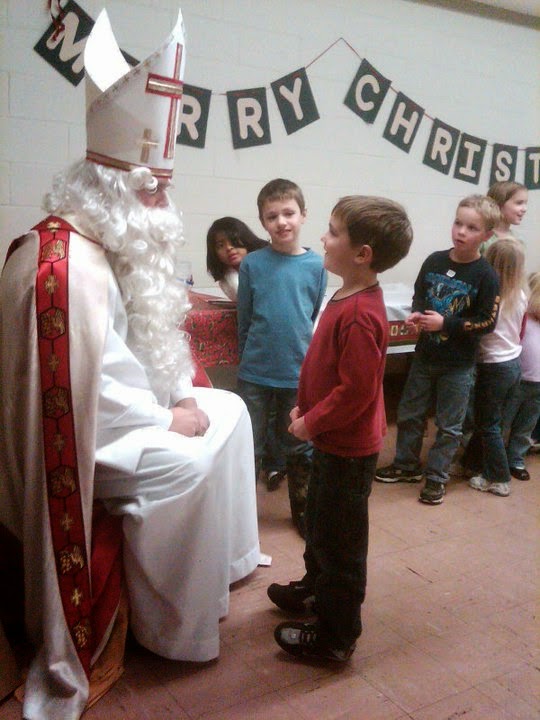
Trevor visiting with St. Nicholas

Book Break: God’s Doorkeepers

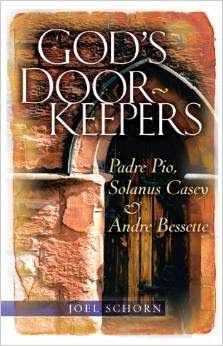
Ordinarily when I do one of these mini-reviews, I try to summarize the book as I offer my reflections on it. In the case of Joel Schorn’s wonderful little book God’s Doorkeepers, which presents the parallel biographies of three 20th century saints (though only two have been canonized to date), I’ll let the summary on the back of the book explain the work for me:
I look on my whole life as giving, and I want to give and give until there is nothing left to give. – Solanus Casey
Padre Pio and Andre Bessette would have readily agreed with Solanus Casey even though, on the surface, none of the three had much to give. All grew up in humble circumstances, each suffered poor health, and none achieved academic distinction or prominent positions in their religious orders. They were, to all appearances, the sort of people others overlook.
Yet in their lifetimes, untold numbers found physical and interior healing through their ministries, and since their deaths their fame has grown enormously. Their secret was the secret of every successful Christian life: In complete humility, they abandoned themselves to the will of God.
Bessette and Casey literally answered the door at their monasteries, and Pio was something of a spiritual doorkeeper in the confessional. God’s Doorkeepers reveals how these miracle-workers, in spite of their lowly circumstances, inspired and continue to inspire those who seek a healing encounter with God.
By way of commentary, I’ll offer this observation: I am sometimes guilty of reading Scripture or accounts of the incredible accomplishments of the ancient saints and silently wondering, “Where is God today? Why does He not show his power and love today as he’s done in the past?” I admit that I sometimes long for a sign (a parted sea, the lame walking, the dead raised) and when I don’t witness these things…I don’t lose faith, per se, but I wonder…

Continue reading

Rosa Comes Home

Look who’s back!

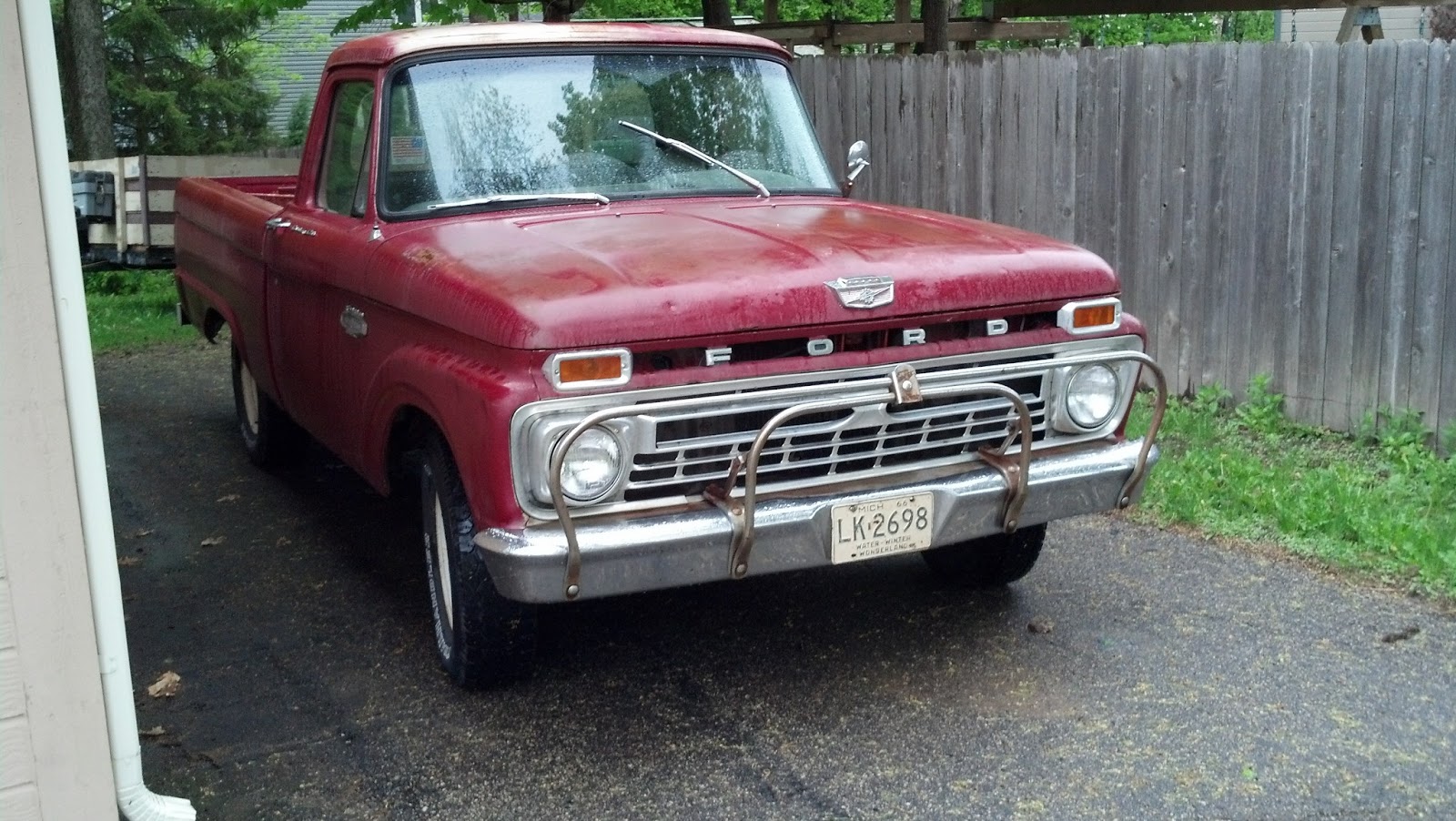
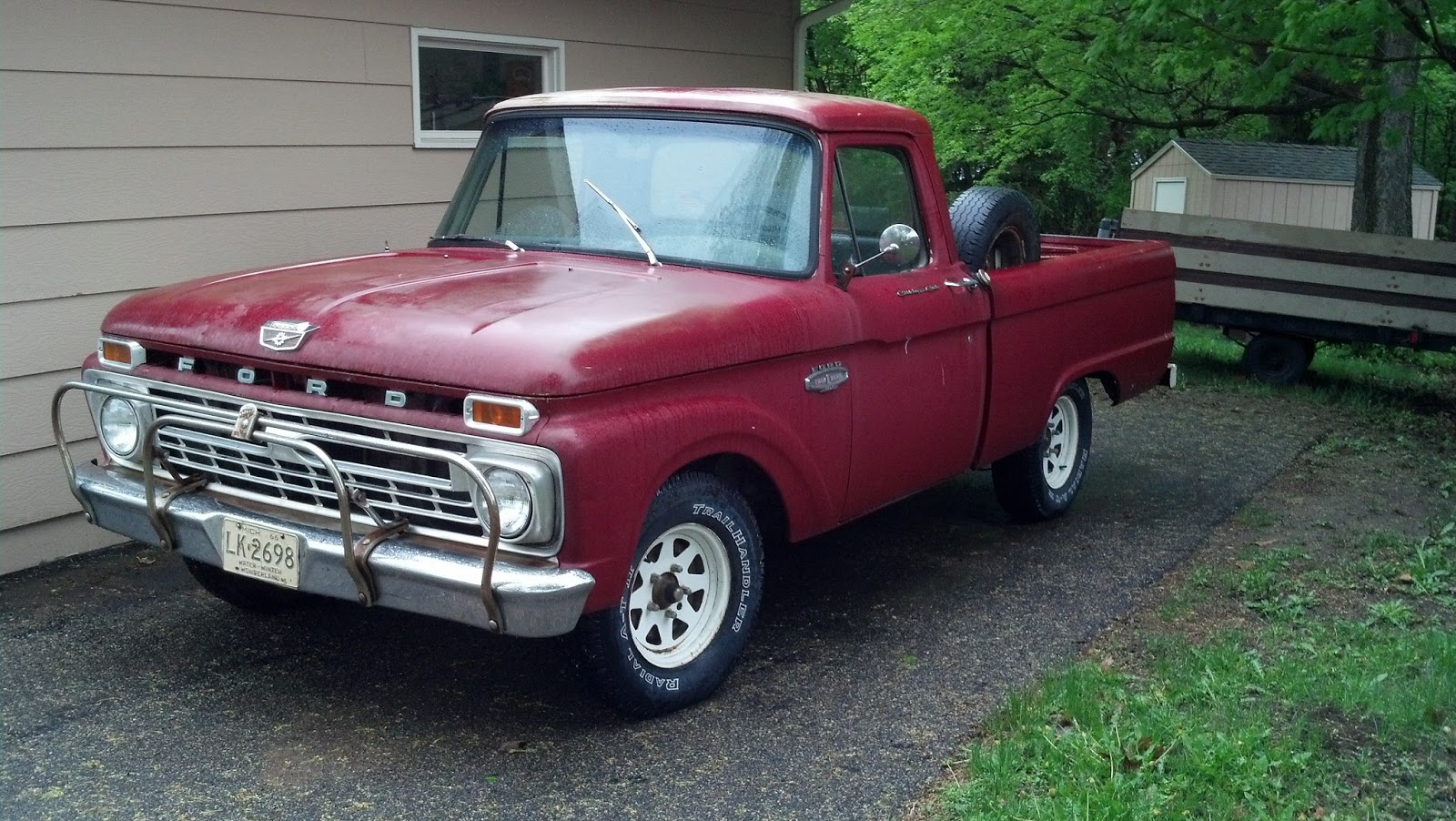
When Jodi and I first moved to Minnesota, I wanted a pickup to help with the move. We had a couple thousand dollars to spend, which won’t get you much unless, it turns out, you go “classic” — then it will get you a project truck. I’m not particularly gifted as a mechanic, but with Dad’s help, I figured we could get into something basic and make it roadworthy.

We found a ’66 Ford F-100 with a 240 straight six and three-on-the-tree — a ranch truck, “farm fresh” from Texas. The back bumper is heavy steel stamped with the dealer name: Kozelski Mtrs. West, Texas. The chrome brush guard on the front reads Smash Hit, Waco, Texas (with a lightning bolt between the Hs), and in the back window is a sunbleached sticker for 99.5 KBMA “La Fabulosa” Bryan-College Station. It had originally come to Michigan as a project truck for a father and son who had never quite gotten to it. The body and engine were solid, the electrical system and gauges were marginal, and the shift lever was inserted through a wallowed-out hole in the steering column and “secured” by a filed-down mini screwdriver that served as a pin. As you drove, the makeshift pin would sometime vibrate out, which led to a momentary thrill when the lever came off in your hand mid-shift.

We fixed it up well enough to drive it to Minnesota with a chest freezer full of beef in the back. We hauled whatever needed hauling around here for a year or so, and parked it during the winter so as to avoid getting road salt on a 40-plus-year-old body that had only two tiny rust perforations. It was a three-season vehicle only I would drive; we couldn’t fit it in the garage, and couldn’t afford to store it — so finally, we put it on Craigslist. Dad urged me not to do it. “You’ll never find another one like, and you’ll wish you had it back some day — I know from experience.”

I was only trying to get my money back out of it, but there were no takers. I thought about dropping the price. Then one afternoon, Dad called to make me a deal. He wanted to buy the pickup. He would pay us in beef over the next few years. He would take the pickup back to Michigan, drive it only during the summers, and “someday when I’m gone,” he said, “you can have it back.”

I signed the title over to him, and we were well supplied with meat.

About a year ago, I saw the old pickup again and told Dad I was glad he hadn’t let me sell it. He mentioned that if I wanted it back, I could have it — but he’d only sign back over if I promised not to sell it. This winter we shook on that deal, and today, the old girl came back home to Minnesota.

The journey back was a father-son road trip for Gabe and me — we took two days, traveling north from my folks’ place, over the Mackinac Bridge, then west across the Upper Peninsula and Wisconsin on US 2 and US 8. No more than we got on the highway, fellow motorists started rubbernecking as they passed. The old timers gave us thumbs-up or nods of approval. We stopped at a few antique shops and got a few compliments and one not-so-subtle hint that we should consider selling. We speculated that the big shiny pickups roaring past us on the highways would not still be running in 50 years. Our pickup ran like a champ the entire trip, with only three minor challenges and one momentary thrill:

  • The gauges don’t work. The gas gauge never registers more than half full, and may or may not register empty — that, coupled with an odometer that registers 7/10 to 8/10 of a mile for every actual mile traveled makes judging when to fill up a challenge. Solution? Fill up frequently. The speedometer doesn’t work — but wouldn’t you know, there’s an app for that, using your smartphone’s GPS to tell you exactly how fast your moving and in what direction.
  • The doors don’t lock — which meant I carried a backpack with me wherever we went rather than leave anything of value unattended.
  • The wipers seemed to have a mind of their own. During an Upper Peninsula downpour, they worked great — but a few hours later, when we were thinking of stopping for the night, they quit just as the rain started. Coincidentally, we had just spotted a likely looking motel, so we pulled in. This morning, they worked fine — maybe the old truck was ready to turn in, too?
  • Old-school drum brakes needed polishing? If you have driven an old vehicle, with drum brakes that aren’t somehow power-assisted, they take some getting used to, and you’re wise to give yourself a little more distance to come to a stop. When a line of cars in front of me came to a quick stop behind a vehicle turning left, I had to get on the brakes hard — and the truck pulled sharply toward the shoulder, causing the tires to howl angrily and me, Gabe, and driver in front of me a moment’s panic. Later I tried the same hard stop in a more controlled and traffic-free environment — it pulled hard to the left once, then began stopping more effectively. Little rusty, perhaps?

Dad sent us home with a wooden duck decoy he’s hoping one of the kids will repaint. The duck sat on the dash, and whenever one of us predicted something unfortunate about the truck or the trip, Gabe would knock on the only wood available — earning the decoy the moniker “Lucky Duck.” As for the old truck: she’s never had a name, but given her border town roots and faded red paint, I dubbed her Rosa. Gabe thought immediately of his sister (whom I sometimes call Rosa) and then of her patron saint, Rose of Lima — he began to call the truck “Santa Rosa de Lima” (or more accurately in Gabe-speak, “Santarosadelima!” But for me, she’ll always be La Fabulosa. Bienvenidos, chica.

Rosa La Fabulosa: Thanks for keeping her for me, Dad!