Book Break: Three Quick Reviews

I am doing something I’ve never done before: I’m sharing three spiritual-book mini-reviews at once, and two are for books I haven’t finished (and may never finish). The books are:

All three are recommended reading, so why not finish them? Read on!

Continue reading

Too Blessed

Blogger’s Note: Most of this post was meant to be the beginning of the annual Thorp family Christmas letter. At this point, we plan to send you all Valentines…

The morning is cold, black, and bitter, like the dregs of yesterday’s coffee left in the car overnight. The thin crescent moon seems a galaxy away; the stars, more ice than fire; the jagged air catches in your throat, and the wind seems to strip life, layer by layer, from your shrunken, shivered form.

It is easy, on mornings like this, to justify staying abed, comfortable and warm beside your lover; to shut off the alarm, burrow into blankets and dreams, and await the sun. On mornings like this it’s hard—and perhaps undesirable—to imagine those who live outdoors in this weather, for whom the blue ache of cold is chiefly a sign they have not died in the night. That which you can feel is not yet frozen.

These are not pleasant thoughts on an early winter morning, when you’d rather be asleep, but they are also nothing a hot shower and coffee won’t cure.

Absolute comfort corrupts absolutely.

Continue reading

Chains of Memory

The past couple of days I’ve been plagued by memories: guilty recollections of past sins, glimpses of images I never should have seen, bits of off-color or debauched “humor,” lyrics to songs that should not be sung.

Beginning in college, this was my rebellion. I looked at, listened to, and watched whatever I wanted. And in short order, I proved the adage, “Garbage in, garbage out.” During much of my college years, I swore like a sailor; I told dirty jokes to old friends and new acquaintances, and I made excuses for my behavior—to others and to myself.

“It could be worse,” I said, and I knew I was right. I had a vivid imagination, and worse played out in my mind if I lingered too long on any impure thing.

Thanks be to God, over the first ten year of my marriage to Jodi, I weeded these things out of my life. Little by little I dropped the jokes, kicked my swearing habit, left porn behind, stopped watching racy movies, and cleaned up my taste in music. And beginning with one no-nonsense confession with Fr. Siebenaler, in which he politely but firmly questioned my resolve to actually amend my life and advised me to open myself to Jodi and ask for her help, I left off making excuses, and began instead to apologize.

So here we are, more than a decade later, and the Enemy is at work again: I find myself mindlessly mouthing the music in my head, only to realize it’s some obscene gangster rap fantasy or metal mayhem I laughed at as a younger man. In my mind’s eye I see images I haven’t looked upon in years, like a sin scrapbook I can’t help but leaf through, gazing at memories best forgotten.

That’s the first point of this ramble: you can’t forget. What your brain takes in is filed away for later reference. Every image, every word, is there, tying you to past experience. And those things you subject yourself to again and again, out of desire or habit? Your mind naturally assumes they are important, forging shorter, stronger connections so they can be easily accessed.

I can’t recall yesterday’s discussion with my bride, but I remember every detail of my past sins, with a clarity that repels the spirit and tempts the flesh anew. The Accuser seeks to set me against myself—but I know now I must seek every day, every moment, to purify both body and soul.

That’s the second point: The struggle against sin is noble and never-ending, to be sure, but all struggles are not created equal. The struggle of the rabbit in the snare speeds its demise; it kicks and thrashes against the noose, which only tightens against its efforts.

That was me, in the confessional all those years ago—declaring sorrow for my sins but unwilling to even attempt to remove my head from the strangling wire. The death brought about by sin cannot be escaped by panic, emotionalism, or bodily struggle. It is a spiritual struggle, requiring prayer, persistence, and genuine love of neighbor and of self. At some point, all the plans, safeguards, and accountability measures boil down to a decision: Am I going to stop doing these things or not?

How does one become a saint? Will it.

Finally, the third point: We don’t have to remain bound in these chains of memory, because God’s love is mercy.

This is not the first time I’ve struggled with recalling past sins and feeling old remorse and new temptation. The last time I remember it as strongly as this, our pastor, Fr. Richards, advised that I repeat the prayer, “Jesus, I trust in you.”
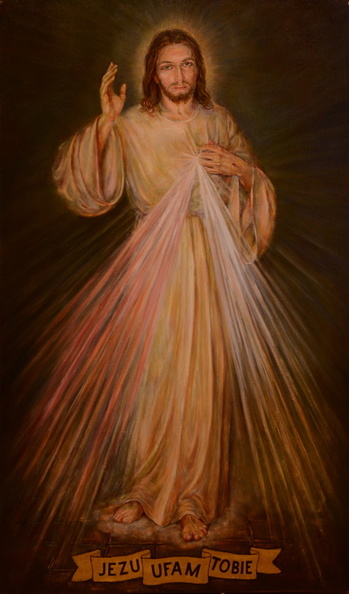
84764-divinemercy

At the time he told me this, it didn’t click with me that these are the words of the inscription at the bottom of St. Faustina’s image of Divine Mercy. (“Jezu ufam tobie” in the original Polish, above.)

Jesus, I trust in you. I trust in your mercy. I trust that you have forgiven these past, confessed sins. I trust that you continue to forgive me. I trust that you love me.

We are washed clean in the blood and water that flow from His Sacred Heart. We need not linger in darkness or doubt. He loves us. He forgives us. He saves.

Will It

I am not much of a sports fan, outside of high-school and intercollegiate wrestling (and even then, I’m not a superfan). I watch professional sports from time to time, not out of a love for any particular sport or loyalty to a particular team, but because I was never much of an athlete myself, so great physical performances are amazing to me.

This also helps to explain why I have so often been a fan of the greatest players and moments in sports. For example, I was a Detroit Pistons fan as a teen, but loved to watch Michael Jordan do his thing, and I still rewatch Gibson’s homer and Jeter’s flip anytime I want to shake my head and grin in disbelief. The ability to anticipate the action, to slow down the speed of the game, to perceive the field clearly, and most importantly, to will your body to respond, is beautiful and incredible to me—especially when I remember my own athletic career. As a young baseball player, I was lucky to make contact with the bat and struggled to stay focused in the field. As a tween basketball player, the pressure to move my body and the ball on offense (or worse yet, shoot) caused the ball to bounced off me and my fumble-fingered hands. As a high-school football player, I finally settled in as a backup noseguard…the one position simple enough for me.  And as a wrestler? I loved the sport, but could rarely make my body respond quickly enough to my opponent’s moves and counters.

So I watch athletes in any sport, willing their bodies to do the beautiful, the amazing, the impossible, and it captures me.

* * * * *

Something changed in me as I approached (and since then, entered fully into) middle age. Whether I’ve grown more accepting of and accustomed to my own strengths and weaknesses, or no longer feel pressured to perform, I can do things I never could before (although I still can’t hit a baseball for any money).  Continue reading

Book Break: The Little Flowers of St. Francis

LittleFlowersStFrancisCoverSometime in the past week or two, I finished The Little Flowers of St. Francis, a collection of stories about St. Francis of Assisi and his earliest brothers, compiled in the 14th century. The book is a delightful mixture of familiar legends (St. Francis and the Wolf, St. Francis Preaching to the Birds), a thorough account of his receiving the stigmata (the wounds of Christ), stories of less well-known miracles, and sage spiritual advice that still applies to souls like mine, several centuries later. It also includes the same sort of stories and wisdom from a few of his contemporaries recognized by the saint and others for their holiness, humility, and simplicity.

My edition is a newer reprint of a 1915 translation by H.E. Cardinal Manning, and includes a handful of beautiful color prints of paintings by F. Cayley-Robinson. The book (pictured) does have a few mistakes in the copy—for the purposes of reading out loud, it might be helpful to pre-read first!

The style is somewhat old-fashioned and poetic, but readable even for youngsters—I can imagine it being a good volume to read out loud to your family. (And a few of the stories, like that of Brother Juniper cutting the foot from a pig that did not belong to him to cook and feed to a sick brother, are hilarious!)

If you are  looking for an enjoyable and edifying introduction to this popular saint and his spirituality, look no further!