Book Break: Praying with Padre Pio

PrayingWith PioYesterday morning I finished Eileen Dunn Bertanzetti’s little book Praying With Padre Pio—a wonderful, simple introduction to the life and spirituality of one of our great 20th-century saints. As I mentioned in the past week, I’m increasingly drawn (or pointed) to St. Pio as an example and intercessor in my own life. A Capuchin monk, priest, mystic, and stigmatist from southern Italy, St. Pio has been the subject of numerous books and biographies; this one breaks his life and spiritual advice into fifteen meditations on topics of particular interest or importance to his practice of the Catholic Christian faith, such as suffering, the Eucharist, Mary, and joy in the Lord.

The book opens with a brief overview of St. Pio’s life before diving into the meditations. Each meditation opens with a one- or two-sentence summary of the topic at hand and an opening prayer. Next follows a brief biographical account of how this particular topic played out in the saint’s life. The book then presents a single question for the reader to reflect on, comparing and contrasting his or her own experience to that of St. Pio’s.

Next, the book shares Padre Pio’s own words on the topic, gleaned from letters, journals, and biographical accounts, followed by three to five reflections, from which the reader is encouraged to choose one. These exercises range from journaling to meditation to resolving to act in a way that underscores the lesson of the day. Finally, the book shares a few relevant scripture passages to reflect on and offers a closing prayer, often in St. Pio’s own words.

I read one meditation a day for the past fifteen days and found the book informative, enjoyable,  challenging, and inspiring. Every day I took something new from St. Pio’s life and spiritual practices that could be adopted to my own—and nearly every day, the topic providentially aligned with the daily scripture readings and other spiritual reading and writing I’m doing these days. This was truly an inspired find; if you are interested, it’s at the parish lending library. (I returned it yesterday, so look in the returns bin!)

More Than Meets the Eye

I believe in one God, the Father almighty, maker of heaven and Earth, of all things visible and invisible. — the Nicene Creed, emphasis mine

Each time we pray the Creed at Mass, we acknowledge—in fact, we profess our sincere belief—that there is more to this world than meets the eye. We believe in saints and angels, heaven and hell, the devil and his minions. We believe in the real presence of Jesus Christ—body, blood, soul, and divinity—in the Holy Eucharist. We believe in the power of prayer and redemptive suffering.

Practicing Catholics proclaim this belief in the invisible world and spiritual realities at least once a week. But do we live daily as if we believe heaven is for real? Continue reading

The Great Improviser, or One Blesséd Thing After Another…

I remember watching an improv comedy group with friends in college. Each member of the troupe was a whirlwind of wit and creativity, responding instantly to audience suggestions, random props, and fellow comics’ off-the-cuff reactions.

After more than an hour of nonstop hilarity and laughter, the group took its bows, then the members spoke briefly to the audience about how they do what they do: How they keep the laughs coming at such a breakneck pace when even they aren’t sure what will happen next?

The basic answer was so simple: Say yes, and

Whatever the situation, the idea, the inane detail added by the last castmate as he passes the scene to you, say yes, and build on it. Anything else — a no, a but, a hesitation, a rejection — derails everything. The joy of improv (for both performers and audience, I’ll wager) is in the way that it embraces the unknown and absurd and builds on them, laugh upon laugh, until the entire humorous edifice is revealed and the leader says, “Aaaaand scene!”

Say yes, and build on it. Embrace the situation and move forward. Such a simple trick — but it requires practice. (If you don’t believe me, get two friends and try Three-Headed Broadway Singer.)

It strikes me today that this is good advice for life, as well. This world is tilted, spinning, ridiculous in so many ways, and at times life appears to be, as an old saying goes, “one damned thing after another.” But it’s not. The sequence of events is not damned, but blessed.

We know that all things work for good for those who love God, who are called according to his purpose. — Romans 8:28

God, in fact, must be the Great Improviser, to work out  His plan among so many free-willing, fallen creatures who are constantly doing the dead-wrong thing. God’s providence, it seems to me, must be a resounding, eternal, “Yes, and…”

Fr. Mike Schmitz shares great perspective on discerning God’s will for us, in which he reminds us that, even in scripture, when God appears to be taking His people by the hands and leading them, still less is known than unknown. In particular, he reminds us that, after being told by the angel Gabriel that she will bear the Son of God, Mary says “Be it done unto me according to your word,” and the very next line in scripture is, “Then the angel departed from her” (Luke 1:28).

Mary is left to improvise: to build upon that yes and each yes after, until the entire astounding edifice is revealed and the Master calls out, “Scene!”

Like Mary, we don’t know what’s coming: what incredible, impossible, unwieldy, absurd situation we may encounter, this moment or the next. But our response matters. In fact — since the universe is beyond our control — our response is all that counts.

It’s so simple, though it takes practice: Step with joy into the unknown. Say yes, and build upon it.

Memento Mori, or Don’t Get Comfortable!

Last week I shared a humorous post about my general lack of physical fitness, in which I declaimed, “I am weary from too much rest—so comfortable it hurts.” At the time, I meant this merely in the physical sense, but this morning the spiritual meaning resonates.

We are creatures of will and intellect, but inertia is mindless. An object at rest tends to stay at rest, and so, too, a man who behaves like an object. When we rest, we often “veg,” which is to say we give up our human and even our animal nature in exchange for potting ourselves, mindlessly, in the sun. Bloom where you’re planted is a mantra today, but we are not flowers or fruit trees. It feels good to soak the golden rays, but, lacking chlorophyll, we are not fed in this way—not for long! We are planted only at the end, and then under a stone.

Also last week, I mentioned that our family is pursuing Marian consecration. Thus far Fr. Gaitley’s book has focused on three saints who, in their separate but similar ways, gave themselves completely​ to Christ through Mary: St. Louis de Montfort, St. Maximilian Kolbe, and Mother Teresa. What struck me this morning was the sense of urgency each of these saints has:

  • St. Louis de Montfort advocated Marian consecration as “the surest, easiest, shortest, and most perfect means” to become a saint.
  • St. Maximilian Kolbe formed his Marian “army,” the Militia Immaculata, with the express goal of bringing the entire world to God through Christ under the generalship of Mary, and to do so as quickly as possible.
  • St. Teresa of Calcutta sought to satisfy the thirst of Jesus for souls and love, and to do this in the best possible way.
Notice that none of these three were satisfied with merely doing a job, or even doing it well.They sought to hear God’s call, to answer it daily, and to act with urgency, in the best way possible to bring about His will. They were not sedentary, physically or spiritually. They did not bloom where they were planted, because they never permitted themselves to be planted. They acted, each moment, as Mary would—as Christ would!—with great love, and with their eyes fixed upon eternity and the fate of the souls they encountered.
Too long have I acted as though good enough is good enough, as though I have time to spend (or not) as I please. If sainthood is the goal, let us pursue it with vigor. God willing, we’ll have eternity to rest!

God’s Love Is Mercy

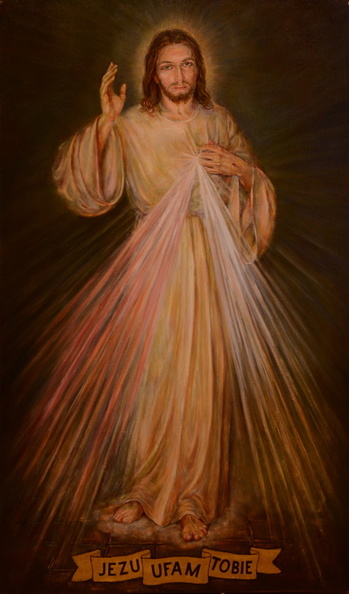
84764-divinemercy“Proclaim that mercy is the greatest attribute of God.” – Jesus to St. Faustina

Devotion to Divine Mercy is not every Catholic’s thing. Some people struggle with the image of Divine Mercy: Jesus, His right hand raised to bless and heal, His left indicating his heart, from which rays of red and white, symbolizing blood and water, pour forth as a fountain of mercy for souls. Every version I’ve seen has been a bit mysterious and unsettling—which seems appropriate, given that it’s a vision of the resurrected Christ.

Some don’t like the chaplet, which is simpler and more repetitious than the rosary. Some consider the visions of a poor Polish nun to be private revelations: fine for her, but not necessary for us (even though she is a saint and was canonized by another saint).

Continue reading