Book Break: The Screwtape Letters by C.S. Lewis

The genius of C.S. Lewis continues to astound me. I read the Narnia series as a child and liked-but-not-loved them (although The Lord of the Rings has taken on new dimensions now that I am a practicing Christian, so perhaps I should revisit the world in the wardrobe, as well). But as an adult, Lewis’s nonfiction — Mere Christianity, The Abolition of Man, and The Weight of Glory — has consistently delivered new spiritual insights and deepened my conversion, and his fictional meditation on the afterlife, The Great Divorce, is one of my favorite books of all time.

Which brings me to The Screwtape Letters. This little book has been on my shelf for quite some time, and my oldest son, Brendan, read it a year or more ago and loved it. The book, ostensibly, is a collection of found letters from the demon Screwtape, an experienced administrator in the bureaucracy of Hell, to his nephew Wormwood, a young tempter striving to lure a budding Christian away from salvation. The letters show the subtlety and patience of the diabolical, the insidious ways in which we are knocked off the straight and narrow path, and the relentlessness with which we are pursued by the “roaring lion looking for someone to devour” (1 Peter 5:8).

I saw myself in nearly every letter, as Screwtape outlines the fledgling Christian’s typical stages of conversion and the best ways in which to turn his progress into regress. The book is darkly funny, which makes the medicine easier to swallow. For example, Screwtape admonishes Wormwood for being naively enthusiastic about the outbreak of war in Europe, saying that while human death and destruction are always to be praised and enjoyed, it is not, in itself, necessarily helpful in the damnation of souls, because A) it affords opportunities for men to exercise saving virtue as well as condemning vice, and B) it can end lives in an instant — snatching souls for the Devil just as easily as from God, and undoing years of patient temptation. He also advises his nephew that tempting humans to great and glorious wickedness can backfire into stunning conversions, and that small temptations that lead them slowly, slowly away from God — all unaware of the danger — is just as good for their Father Below, and besides that, more enjoyable for the skill required.

We never hear directly from Wormwood, but we can hear Screwtape’s displeasure with his dear nephew’s failures and mistakes and begin to sense his affection for the young tempter is only marginally different from his ravenous hunger for condemned souls. My volume (pictured above) included an extra essay, “Screwtape Proposes a Toast,” in which the demon lifts his glass to toast the Tempters Training College and uses the opportunity to explain to the new graduates how Hell is leveraging the public education system on Earth to promote the one thing democracy and virtue cannot survive: forced equality. It is biting and brilliant — and contains one of my favorite passages, about why small, subtle temptations and sins can be better for Hell that bold, passionate wickedness (remember, in this passage from the demon’s perspective, everything is inverted, hence “the Enemy” is God):

I have said that to secure the damnation of these little souls, these creatures that have almost ceased to be individual, is a laborious and tricky work. But if proper pains and skill are expended, you can be fairly confident of the result. The great sinners seem easier to catch. But then they are incalculable. After you have played them for seventy years, the Enemy may snatch them from your claws in the seventy-first. They are capable, you see, of real repentance. They are conscious of real guilt. They are, if things take the wrong turn, as ready to defy the social pressures around them for the Enemy’s sake as they were to defy them for ours. It is in some ways more troublesome to track and swat an evasive wasp than to shoot, at close range, a wild elephant. But the elephant is more troublesome if you miss. — C.S. Lewis, “Screwtape Proposes a Toast”

This is definitely spiritual reading, which you can apply to yourself if you try. A brief example might suffice to illustrate this point: in one letter, Screwtape advises Wormwood on what a huge difference a seemingly small tweak in the language of his “patient” can have on the fate of his soul. He urges his nephew to encourage the man to think of his duty to practice charity as unselfishness. Unselfishness has the advantage, Screwtape says, of turning a positive attribute (charity) into a negative (UN-selfishness), and an external, active habit into something more akin to navel-gazing: inwardly focused, inactive, and a potential source of pride.

He then goes into great detail as to how this commitment to unselfishness can be used to increase resentment and secret pride in marriages and families, as men and women forego the pleasures of this life not out of genuine love and desire of the good for another, but out of a selfish desire to appear unselfish:

“Let’s do what you want to do.”

“No, no, I insist, let’s do what you prefer.”

“Well, I don’t want to anymore.”

“Fine, we’ll do neither.”

She doesn’t even appreciate how unselfish I am!

I don’t need his pity — two can play at this game! 

Like The Great Divorce, The Screwtape Letters led me to think more deeply about the little things that draw me daily away from God, and underscored for me that getting to Heaven is something akin to long-range marksmanship: a tiny deviation at this end can, over the distance of years, result in missing the mark entirely. Yet it never ceases to be hopeful: the demons admit they are at a disadvantage and cannot challenge God directly — and they have no understanding at all of charity, and dismiss it as a lie God has told in service of a secondary goal they have yet to discover. They cannot fathom why He loves us so.

O’Connor, or Three Things to Love About The Violent Bear It Away

Blogger’s Note: Several years ago, I agreed to my friend Jacqui’s challenge to read 15 Classics in 15 Weeks. Though 15 weeks is long past, this, at last, is 15 of 15!

* * * * *
“From the days of John the Baptist until now, the kingdom of heaven suffereth violence, and the violent bear it away.” 
— Matthew 11:12 (Douay-Rheims Bible); epigraph of Flannery O’Connor’s The Violent Bear It Away

I am somewhat embarrassed to say that this was my first venture into Flannery O’Connor’s fiction, and what an introduction. It is a dark, hard, unflinching work, awful and mesmerizing, like a wreck along the highway–and yet strangely hopeful even as it descends. 

The book tells the story of Francis Marion Tarwater, an orphan boy in the mid-20th century deep South, raised with backwoods, biblical faith by his great uncle who believes himself to be a prophet and the boy to be his successor. When the uncle dies (at the very beginning of the story, so not a spoiler), the boy begins a very real spiritual struggle to discover the truth of this calling and the fate of his soul. The book builds a sense of dread even as the reader clings to threads of hopefulness, and erupts in violence both in present tense and in flashbacks–calling to mind a number of interpretations for the title and scripture verse it references.

I hesitate to say much more, for two reasons: first, this is a novel to be experienced, not spoiled or “set up,” and second, I honestly am not entirely sure what to make of it. I decided to wait a day or so before writing Three Things to Love, in order to reflect on the book–and I purposely didn’t read any commentaries. This morning, however, I read a couple of reflections on it by other people, and it appears I am not alone. O’Connor reportedly agonized over it, and readers for years have struggled with its deeper meanings and implications. On the surface, it is about the persistent pull on our hearts of both God and the world, and each person’s struggle to find freedom: will they take up the Lord’s yoke and find that it is light, or cast off the shackles of belief and live this life, for this world? It can be read (and enjoyed, after a fashion) at this level, but I am convinced there is deeper meaning here and will read it again someday.

So with that preamble, Three Things to Love about The Violent Bear It Away:
  • The Descriptions. Unlike several of the other books I read for this challenge (Tolstoy, Dostoevsky, Melville), this is a short book but still ripe with detail and description. O’Connor uses sparse, poetic language; metaphor; and simile to sculpt with words; the results a real, living people unalterably carved in stone.
  • Unflinching Honesty. O’Connor does not shy away from the darkness in humanity, and shares the thoughts and actions of her characters with relentless, sometimes shocking, honesty. At the same time, she does not succumb to the modern tendency to dwell on violence with pornographic detail–her matter-of-fact simplicity makes the book that much more compelling.
  • Eternal Themes. Faith and reason. Freedom and destiny. The nature of love. The spiritual combat. Here they are again: themes that arise in so much of great literature through the ages appearing again in 1960, set in the south of the United States. 
I feel as though I am sharing very little about this book, so maybe some comparisons would help. It reminds me in ways of two other books I enjoyed: Steinbeck’s East of Eden (one of my all-time favorite novels) and a more recent novel, Tobit’s Dog. If you like, check out those reviews to gauge whether The Violent Bear It Away might work for you.

Who Reigns In Your Heart?

Put no trust in princes, in children of Adam powerless to save. 
Who breathing his last, returns to the earth; that day all his planning comes to nothing. – Psalms 146:3-4

This Sunday is the Feast of Christ the King, celebrating the authority and lordship of Jesus over all of creation and marking the end of the liturgical year. Falling just before the all-consuming holiday season and the secular New Year, this feast provides us with an opportunity to reflect on what holds mastery over our hearts before the avalanche of turkey and tinsel. And since it specifically celebrates Chris’s kingship, it takes on special relevance in the aftermath of a contentious election.

Who is this Jesus who rules over all? We are blessed to have an immense icon of Christ the King in the dome of our church. This image, called Pantocrator or “ruler of all,” depicts our glorified Lord looking down from heaven, holding the Book of Life by which we are judged (God’s justice) but with His right hand raised in blessing (God’s mercy). The three-rayed halo behind His head and Greek letters in the image identify Him simultaneously as Jesus Christ (IC XC) and as “I Am Who Am” (WON), or God Himself.

This God-man is the same Jesus who was born in a stable; who grew up a carpenter’s son; who ate with sinners and challenged authorities; who said to His followers, “This is my Body; take and eat;” who suffered humiliation and torture to die on a cross; who rose from the dead and ascended to heaven; and who sent the Holy Spirit to guide the Church in these latter years. This is the same Jesus about whom Nathanael asked, “Can anything good come from Nazareth?” (John 1:46) and Thomas said, “My Lord and My God!” (John 20:28).

We have a second icon of Christ behind the altar and tabernacle, depicted in the womb of the Blessed Virgin. Though within His mother, He does not appear as an infant or as any child we have likely ever seen. His high forehead and discerning eyes convey wisdom and judgment beyond His years. This is the same Jesus that St. Augustine calls, “ever ancient, ever new” and that dwells in the tabernacle, in the Eucharist. He is the very Word of God referenced in John’s Gospel:

In the beginning was the Word, and the Word was with God, and the Word was God. He was in the beginning with God. All things came to be through him, and without him nothing came to be. What came to be through him was life, and this life was the light of the human race; the light shines in the darkness, and the darkness has not overcome it. – John 1:1-5
What joy, what hope, what light we have when He who is the very source of all blessing sits upon the throne of our hearts—and what sorrow, what despair, what darkness we experience when we yield His seat to idols: to fallen persons or passing things that will not—cannot—sustain us.

Advent begins next weekend: four weeks of penance and preparation Christmas. As the Church year ends and we prepare to welcome the newborn King of Kings, let us ask ourselves in whom we have placed our hope and trust. What or whom have we set upon the throne of our hearts? The time is now to elevate Christ to His proper place, that all else may fall into place and peace may prevail.

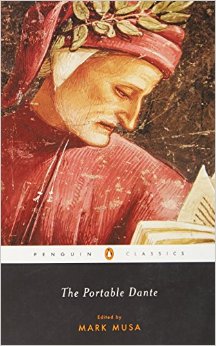
Dante, or Three Things to Love About the Divine Comedy

Blogger’s Note: Several years ago, I agreed to my friend Jacqui’s challenge to read 15 Classics in 15 Weeks. I continue to press forward, this being number 13 of 15, and at this point 15 Classics in 15 Years seems quite doable…

Late last week I finished reading Dante Alighieri’s Divine Comedy in its entirety for the first time. I had read excerpts for different classes over the years, and have read a little about the great work. The book itself was something of a pilgrimage through hell, purgatory, and heaven. This is my least favorite of the thirteen classics I’ve read so far as part of this challenge, and was tough sledding at times. Nevertheless, I do agree that this is a great literary work and worth the effort to complete at least once.

Without further ado, Three Things to Love about Dante’s Divine Comedy:

  • The Ambition. Dante the poet takes us on a journey through the Inferno (Hell), Purgatorio (Purgatory), and Paradisio (Heaven) with Dante the Pilgrim in order that the fictional Dante may change his ways and be saved. Each of these three journeys are told in verse, thirty-three cantos each, with each canto approximately 140 to 150 lines long. Along the way he meets ancient and more recent historical figures, who comment and prophesy on the political and religious turmoil of Dante’s time and place, along with sharing their own experience in the world and in the afterlife. The running commentary on the political machinations and rivalries in Dante’s home was the least interesting aspect of the book for me, but it is nonetheless impressive how much he weaves into this ambitious work.
  • The Creativity. The denizens of Hell and Purgatory, in particular, suffer in hundreds of ways peculiar to their specific sins and attachments. Dante’s Hell is hellish, disgusting and terrifying at times, culminating in an immense figure of Satan, not surrounded by flame, but eternally frozen in ice, suffering for his own sins. The journey through Purgatory is hopeful, but not easy, as imperfect souls labor to let go of those earthly things that weigh them down. Heaven, to me, was actually the least interesting of the three, in part due to the poet’s continued insistence that the beauty of the place was beyond his words and ability — but persevering to the end, to full union with God in the beatific vision, has its rewards. The last few cantos are lovely.
  • The Deep Belief. This, to me, is the greatest aspect of Dante’s masterpiece: the depth of theology, of faith, of true belief. Dante believes in the reality of Hell, and he puts people he loved in this world in that place of torment because of their sins. He peoples his poems with friends, contemporaries, nobles, and popes, explaining how and why each fell or rose, and when Dante the Pilgrim is asked to testify to his own faith, the lines resonate as the poet’s own sincere profession. Who knows how accurate a portrayal of the afterlife these poems are, but Dante gives us much to contemplate as we navigate this world.

I have begun number fourteen of fifteen classics, Tolstoy’s Anna Karenina, with that great opening line: “All happy families are alike; each unhappy family is unhappy in its own way.” It is a long book, but engaging— I hope to be done within the month!

Love Does Not Divide

How long, Lord? Will you utterly forget me? How long will you hide your face from me? How long must I carry sorrow in my soul, grief in my heart day after day?  – Psalm 13:2-3

I ended last night with coverage of the shooting of Philando Castile by a police officer in Falcon Heights, Minnesota. I woke to 12 police officers shot by a sniper in Dallas, Texas.

Can you feel it? The tension in the air? A spark has been struck, I fear, that cannot be contained.

And it’s an election year. Everything is spun, hyper-analyzed, re-calculated, and spun again. Everything is us-versus-them.

Can you hear it? The rattle between my lungs of the small stony lump that passes, these days, for a human heart? I can. It has shrunken and solidified more while I slept.

I can feel my heart hardening, each time my “enemies” advance. I can feel the love draining away and the anger rising. I am tempted to turn away from those I once cared about because we don’t agree. I have no time to spend on the lost sheep with my little flock to attend.

How cavalierly we treat the salvation of souls—including our own.

Here’s what I know for certain about these shootings: Someone took a life. Someone lost a life. Both are terrible and permanent things with serious implications in this world and the next. And the proper response for most of us, who are removed from the situation, is earnest prayer for the souls of those involved and for peace.

The Evil One relishes these divisions in humanity, and fans the flames that rage around us. Instantaneous media coverage and commentary stifles reflection and discernment, prudence and justice. Politispeak and emotionalism obscure the truth, without which there can be no love. We paint our enemies with one brush and hue, and lose sight of them as unique images of God—each one a masterpiece.

Yesterday I ran across a quote from C.S. Lewis’s book Mere Christianity:

[The devil] always sends errors into the world in pairs—pairs of opposites. And he always encourages us to spend a lot of time thinking which is the worse. You see why, of course? He relies on your extra dislike of the one error to draw you gradually into the opposite one. But do not let us be fooled. We have to keep our eyes on the goal and go straight between both errors. We have no other concern than that with either of them.

Our way, as Christians, is narrow, between the errors. Our Way is Christ.

Here’s the truth, as simply as I can express it this gray morning. We have good cops and bad cops; racist, noble, and scared cops…and this morning, living and dead cops. We also have young black men who are good men and bad men; racist, noble, and scared men; and yet again, living and dead men. We have well-intentioned activists on both sides who want justice, and rabble-rousers who just want to fight.

The same applies to Muslims and Christians, to immigrants and natural-born citizens, to men and women. How do I know this? Because all of them are human, and so am I. All of these tendencies live in me, and I must choose which to follow.

It is also true that significant differences exist between the wealthy and the poor, Christianity and Islam, rural and urban America, liberals and conservatives—differences that we must acknowledge plainly and address if we hope to find peace in our communities—but none of these differences are discernible in our DNA or our soul. None are who we are.

I am Catholic, so I am at odds with the culture, with many of my friends, and with much of my family. And it’s complicated. I am a Christian, but I am at odds other Christian creeds, not to mention the non-Christian religions of the world. I’m at odds with scientism, but not science. I am at odds with supporters of abortion, same-sex marriage, and many other ideas. Faith and reason set me at odds with all of these things, but none of these persons—at least, not if I’m practicing my faith well.

So we disagree. Big deal; it happens all the time at my house.  And we each think we’re right? Well of course. If we thought we were wrong and persisted, we have more serious problems.

But one of us must be wrong? True enough—and likely both of us. But truth and love go hand-in-hand, so what are we worried about? Being proven wrong? That’s pride talking, the root of sin.

Is it possible to disagree and get along? We do it all the time with people we love. And Jesus said to love our neighbor and our enemies as we love our own selves. We have our work cut out for us.

I will give you a new heart, and a new spirit I will put within you. I will remove the heart of stone from your flesh and give you a heart of flesh. … You will live in the land I gave to your ancestors; you will be my people, and I will be your God. – Ezekiel 36-26, 28

We can bring God’s good work to fruition, but we must keep foremost in our minds our common humanity and the dignity of each person as made in the image of God. We must focus our attention on the infinite value of each soul to the Creator, and the boundless desire God has for each of us. Salvation of souls is our goal; repentance and love is our means. We cannot allow ourselves to be distracted by the concerns of this world—goods, comforts, guns, money—and lose sight of the only things worth loving: God and neighbor.  These other things are not bad in themselves, but can they get us to Heaven? Not likely, but they could drag us to Hell.

Love ought to be our first and last response. And God willing, as we learn to love as He has loved us and align our love completely with His eternal Truth, it can become our only response.