The Choice Is Still Before Us

 
“Why do you call me, ‘Lord, Lord,’ but not do what I command?” – Luke 6:46
Recently I was paid a great compliment: I was called a disciple. My reaction surprised me. I didn’t feel pride or embarrassment, but alarm. My immediate concern was that if people consider me disciple, they might strive to be like me and fall short of true discipleship. The closer I get to God the more clearly I see how far I have to go. I am a tall man, but a low bar.
 

We all have a choice to make, to leave our former life behind and follow Christ to Calvary. As Deacon Ralph Poyo shared in his recent visit, it is an all-or-nothing choice. We are called to love the Lord with all our heart, mind, soul, and strength. The only way to put God first is to place everything else behind Him.

The bad news is that we cannot work hard enough or love well enough to earn heaven without God’s grace—but neither can we cease to work and presume God’s grace will carry us.

The good news is that the choice is still before us, in every interaction, every moment here on earth.

How do we make the right choice in the moment? Jesus gives us clear instructions. For example:

  • Renounce your possessions, pick up your cross, and follow—otherwise you cannot be a disciple (Matthew 16:24-16, Mark 8:34-38, Luke 9:23-26).
  • Love God, love neighbor, love enemies—it is not enough to love those who love you (Matthew 5:43-48, Luke 6:27-36).
  • Provide for the needs of others as you would for Jesus Himself—anything less is damnable (Matthew 25:31-46).

These words are like a punch to the gut for me. I have no trouble at all crying out to the Lord, but I’m terrible at doing what He commands. I go to Mass, pray pretty regularly, and try not to sin. But I enjoy my life, I dislike suffering, and I am comfortable in this community, in my circle of friends and family, in a job that suits my skills and pays the bills.

Surely I get bonus points working for the church? Didn’t the Pharisees?

We have hope, however. God seeks us constantly, loves us endlessly, wants to forgive us and welcome us home. God proves His love by sending His son to sinners, to live, suffer, and die in order to save us from our sins. We can choose today to accept this love or not. We can choose to love God back or not. We can choose to follow Jesus or not. We can make this choice right now.

But we can’t do it alone. If you are ready to change your life and follow Christ today, talk to someone today. Ask someone you regard as a disciple what to do next. They might be a little flustered at first, because discipleship is a big responsibility. If they are uncomfortable, it may mean they need someone to walk with, too. Ask them to partner with you. And if you don’t know who to talk to or want help from the parish to get started, send an email to smallgroups@stmcatholicchurch.org or call me at the parish office. 

Don’t wait. The way is narrow, but not so narrow that we can’t walk it together!

The Power of Family


The family is the community in which, from childhood, one can learn moral values, begin to honor God, and make good use of freedom. Family life is an initiation into life in society. 

– from the Catechism of the Catholic Church, paragraph 2207

As I type, bishops from around the world are gathered in Rome discussing how best to preserve, strengthen, and encourage Christian families. With so many families suffering or broken, such confusion over the nature and purpose of marriage, and the constant cultural tension between anti-child forces (for reasons of overpopulation, so-called social responsibility, or personal choice and comfort) and  “child worship” (treating each child as the center of the world, deserving of the very best of everything), it’s easy to feel underappreciated and overwhelmed. It’s also easy to get caught up in the everyday hustle of school, work, sports, and recreation and lose sight of the true power of the family as a domestic church: an apprenticeship in love of God and neighbor.


The Catholic Church, in her wisdom, teaches that the family is the fundamental unit of society, with certain rights and responsibilities that no higher level social organization can ever claim. Humans are social creatures, made in the image of God, who is Himself a loving, life-giving communion of Persons—the Holy Trinity. The Catechism insists that government has a duty to protect and foster marriage and family and to help families (and not interfere) with raising and educating their children as they see fit, both in the world and in faith.

The Church, in fact, regards the education of children in the faith as a duty of parents—a point that cannot be overstated.  I sometimes hear parents say, “I want my son to make his own choice about his faith,” or “I don’t want to force it—it will mean more my daughter if she comes to God on her own path.” While it is true that, ultimately, we each make our own choice for or against Jesus Christ and His Church, we cannot entrust that choice to the sole discretion of our children—any more than we would allow them to decide whether to drink something we know to be poison. If we truly believe what the Catholic faith teaches, the choice our children face is much more stark than how they will spend their Sunday mornings—it’s about how they will spend eternity.

Next Wednesday we begin a new year of First Confession/First Communion and Confirmation classes—and as always, it is essential that parents take the lead in sharing the good news of Jesus Christ and the eternal truths of the Catholic Church. Your personal example is the most powerful witness to your children—and male role models, in particular, have extraordinary power in keeping kids Catholic. Even simple things, like reading a Bible story, putting on a tie or a dress for Mass, or taking time to pray with and bless your child before bed, make deep and lasting impressions.

Scripture reminds us, “Train the young in the way they should go; even when old, they will not swerve from it” (Proverbs  22:6 ). We are all practicing Catholics, all sinners who are in training to love as God loves. But as parents we are also powerful, and we must not neglect to use that power to bring our kids to Christ, who said, “Whoever receives one child such as this in my name receives me” (Matthew 18:5).

Blogger’s Note: This article appears in the Sunday, Oct. 18, parish bulletin.

We’re Not Meant to Go It Alone

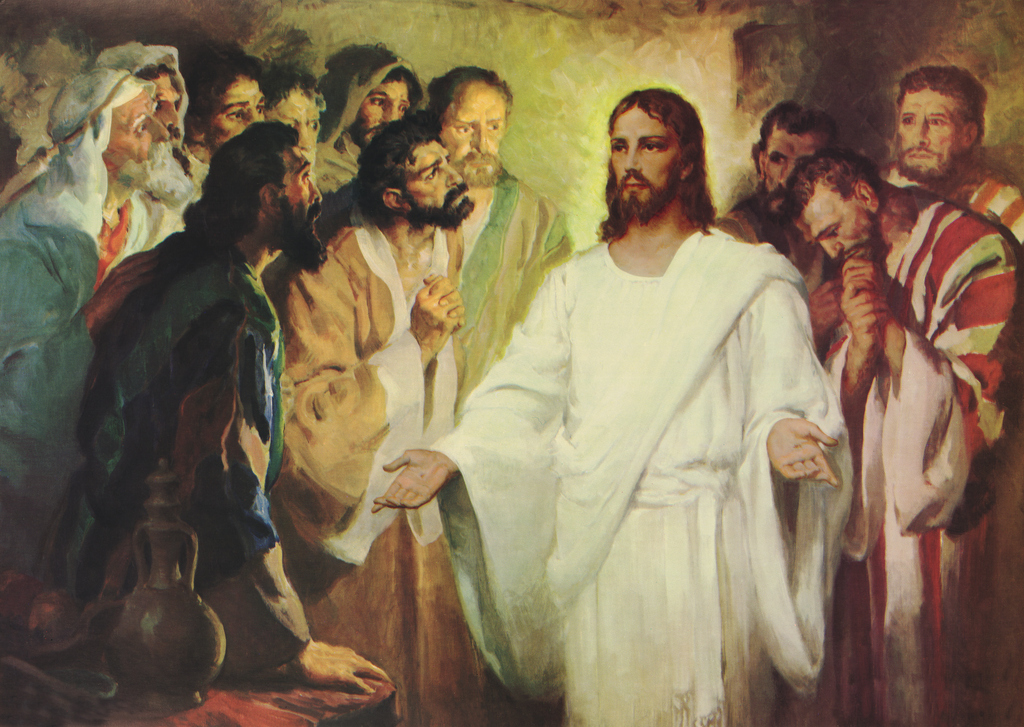
On the evening of that first day of the week, when the doors were locked, where the disciples were, for fear of the Jews, Jesus came and stood in their midst and said to them, “Peace be with you.”
– John 20:19
Imagine yourself as a follower of Jesus before His crucifixion. Imagine the excitement of coming to know the Messiah intimately and waking up each morning in his company, anticipating the day and wondering what profound teaching or miraculous sign awaits.
Now imagine that this man, whom you loved and believed to be the savior of your people, ripped from your midst and publicly tried, punished, tortured, humiliated, and put to death like a common criminal. Imagine the fear: if the Roman authorities and Jewish religious leaders could do this to such a man as Jesus, what could they do to me, a poor sinner?
What would you do?

The disciples chose, as many of us would, to keep a low profile—to remain out of sight behind locked doors. But they remained together. That’s curious.  Certainly a group of Galileans and the executed man’s mother all gathered together in one place did not escape the notice of their neighbors. Wouldn’t it have been sensible to disperse until the scandal blows over – to each return home, if only for a little while?
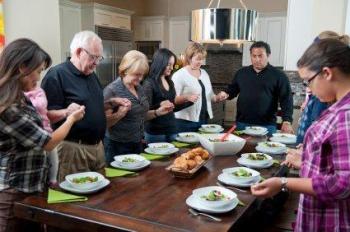
We are not meant to go it alone. We follow Christ to whatever end awaits us in communion with all believers, and we are meant to grow in faith, hope, and love; to face joy and suffering; to live and die; together as members of the Body of Christ here on earth. Only with the support of like-minded Christians can we find the courage and perseverance to pour out our blood, sweat, and tears for those who do not yet know God or His Church. This is yet another reason why our approach to faith formation and the sacraments here at St. Michael is family- and community-based.
In her book Forming Intentional Disciples, Sherry Weddell of the Catherine of Siena Institute identifies five “thresholds” that people pass through on their way to full-fledged Christian discipleship. The first of these thresholds is trust. Put simply, the first step toward conversion is finding a disciple with whom you can relate: a “known Catholic” whom you can talk to, relate to, or admire – or even just a Catholic who seems normal. Believe it or not, you begin to evangelize just by being Catholic and available to the people around you!
And while many people have said that once you leave the church, you’re in mission territory, I would argue that we’re in mission territory even in the pews! So many of your friends, neighbors, and family members – including me – fall short of intentional discipleship and need help. To that end, LIFT this year will include ice-breaker activities and some less-structured small-group time in order to help parish families get to know each other better. 

This social time is just as important as the more structured classroom time, because these are the interactions that shape how we follow Christ, individually and as a community. As we get to know each other, we begin to ask about each other’s families, share each other’s concerns, and pray for each other’s needs—and Christ Himself passes through our midst, filling us with grace and the Holy Spirit, and sharing with us His peace.

Blogger’s Note: This article appears in the Sunday, Sept. 27, parish bulletin.

Book Break: In the Beginning: A Catholic Understanding of the Story of Creation and the Fall

One of the many things I meant to do in the past year was to explore and review several books on the Catholic view of creation and evolution, in order to help parish parents and grandparents answer their questions on the topic and those of their children. My hope was to find a book or two that might be helpful to inquiring minds of all ages.

As usual, I bit off more than I could possibly chew and have completed only one such book. On a positive note, it was excellent.

‘In the Beginning…’ A Catholic Understanding of the Story of Creation and the Fall is an edited compilation of four Lenten homilies given by Pope Benedict XVI in 1981, when he was still Joseph Ratzinger, archbishop of Munich and Freising. His goal was to develop a catechesis of Creation for adults. The four homilies build, one upon the other, to present a clear case for what the Genesis accounts of Creation and the Fall mean and why they continue to matter:

  • The first homily, “God the Creator,” lays out the so-called conflict between the Creation account(s) and science, and discusses how and why we interpret scripture the way we do: in the context of Jesus, to whom the entirety of scripture, written over the course of centuries, points.
  • The second homily, “The Meaning of the Biblical Creation Accounts,” addresses the Creation story specifically, the reasonableness of belief in Creation, the ways in which science points to Creation, the sabbath structure and rhythm of Creation — and the emergence of the view that humanity is at conflict with nature.
  • In the third homily, “The Creation of the Human Being,” Pope Benedict focuses on the heart of the matter for many modern Catholics: where humans come from. He explains that Genesis has more to do with who we are (imago Dei, or image of God) than how we got here, then tackles evolutionary theory directly — what it can explain about our existence, and what it can’t.
  • In the fourth homily, “Sin and Salvation,” Pope Benedict discusses the Fall of Adam and Eve, and the plan for salvation, with Christ as the new Adam. In perhaps the most profound explanation for me personally, he clearly lays out why, because we are creatures created by God, obedience to God’s law is not a restriction of freedom (like we often perceive it) — we are made for this, and thrive under God’s law because it’s in our nature!
The entire book is exactly 100 pages, including the Appendix, entitled “The Consequences of Faith in Creation, which reads like a fifth homily on how we got to the point that, since the Renaissance, understanding of and belief in Creation theology has diminished to the point that it is rarely spoken of in modern Catholicism, and why our fundamental “creatureliness” is essential to our future. Pope Benedict’s style is straightforward and clear; he is obviously well-read and -researched on this topic, but makes it accessible to (though not always easy for) the patient reader. The book is less specifically about evolution that I imagined, but rewarding and worth the time. It’s fun to imagine these as homilies, sitting in the pews, wishing someone was writing all this down.

These Least Brothers of Mine…

My brothers and sisters, show no partiality as you adhere to the faith in our glorious Lord Jesus Christ. For if a man with gold rings and fine clothes comes into your assembly, and a poor person in shabby clothes also comes in, and you pay attention to the one wearing the fine clothes and say, “Sit here, please,” while you say to the poor one, “Stand there,” or “Sit at my feet,” have you not made distinctions among yourselves and become judges with evil designs? — James 2:1-4 

Last night Jodi, Brendan, and I joined a friends of Brendan’s and his parents at Fogo de Chão Brazilian Steakhouse in downtown Minneapolis to celebrate their senior year, their acceptance into the college(s) of their choice, and a backlog of birthdays. Fogo is a carnivore’s paradise, with such an abundance and variety of fire-roasted meats that I kept thinking of Scripture’s forgiving father ordering the slaughter of the fatted calf to celebrate the prodigal son’s return. Server after server stopped by our table with skewer after skewer of beef, pork, chicken, and lamb, carving portions for us until we flipped our green coasters to red to signal, “No mas!” (or “não mais,” I supposed, in Portuguese).

We had a great time with the boys, and ate a delicious meal the likes of which we are unlikely to enjoy again any time soon, given the price. All the way home, however, and all through last night and today, I’ve been haunted by a man I do not know. I saw him only in passing as we looked for a place to park, but the impression he made is indelible.

We drove past the restaurant on Hennepin, and three or four blocks up, turned left to loop around and look for parking garage. As Jodi turned the corner, I saw what I thought was a youth seated on a skateboard, leaning against a building. As we drew nearer and went past, I beheld a man. In those brief seconds as we passed, this is how he appeared to me.

Ecce homo: Click to view full-size sketch.

He was legless, in a grubby t-shirt and dark pants cut short and sewn shut or folded under. His face was of no obvious age, but worn and creased with hard living, and his thin hair stood up in patches from his scalp. I saw that his left hand was on the sidewalk to stabilize and propel himself. His other arm was raised as though gesturing — it ended abruptly in a rounded, red stump several inches short of where his right hand should be.

Brendan saw him, too. We discussed briefly how hard it must be to live in the city, presumably on the streets, in such a condition. Then, determined not to spoil the boys’ celebration, I dropped the subject. We turned left again, backtracked a few blocks, parked, and went in to feast.

As we ate, surrounded by such abundance, I thought of him. As we paid for our decadent meal, I thought of him. As we left Minneapolis in a rush of cars, under the yellow glare of a thousand street lights, I thought of him.

Today it occurred to me that maybe some sense of injustice over the pleasures we enjoyed at dinner exaggerated his state in my memory — but I believe that was the Devil trying to lull me back to complacency. When I showed the sketch above to Brendan, he said it’s what he recalls, too. A few moments on Google turned up this brief newspaper article: apparently he’s been downtown at least since this spring.

Perhaps he is a homeless vet our country has forgotten. Perhaps he is a junkie. Regardless, no man deserves to live with their last good limb pressed to pavement, unable to see above the hoods of the stopped cars as he crosses the busy streets. How will he stand to move about the city in winter, when the salt and road grime stings his fingers and the wind bites his cheeks? Does he take the bus? Who helps him get aboard? How does he keep his skateboard with him, use the restroom, avoid those who would cause him harm? How will he survive?

Had we been walking past, not driving, I’m not sure what I would have done for him. How could I have helped? Given money? To what end? Traded shirts with him? Perhaps, on the feast day of Blessed Teresa of Calcutta, I would have stopped, hunkered down, and acknowledged him, eye to eye, man to man.

Or perhaps I would have avoided eye contact and kept walking, then muttered a guilt-ridden Hail Mary under my breath.

On the way to church this morning, I urged the kids to try offing the Mass for someone in particular, to see if that helped them focus their prayers and remain present the entire time. I committed myself to offering the Mass for this man, whom we drove past and may never see again, but who has cracked my stony heart. I had not previewed the readings for this Sunday; now that I’ve heard them, I am convinced the Lord is working on me. While it is not sinful to enjoy in moderation the pleasures of earthly life — food and drink and friendship — we must not be blind or unkind to those who seem unlovable. If we prefer the company of others to the company of those in need, we fail to follow Christ.

Lord Jesus Christ, you teach us, “Whatever you did for one of these least brothers of mine, you did for me” (Matthew 25:40). Help me, Lord, to hear the cries of the poor and to show kindness and mercy in word and deed. Forgive those times I have failed to love those you love, and strengthen me to do the hard work of charity among these “least brothers” of yours. Help me to step outside my comfort zone and serve and comfort them in prayer, word, and deed. Amen.

Blessed Mother Teresa, pray for us.