Blogger’s Note: This is the latest in a collection of daily posts outlining my journey to the Sacred Heart over the past year or more. See an overview and links to past posts here.
“Enter through the narrow gate; for the gate is wide and the road broad that leads to destruction, and those who enter through it are many. How narrow the gate and constricted the road that leads to life. And those who find it are few.” — Matthew 7:13-14
The narrow way leads ever upward, and you follow as you can. Bare rock and brambles, clefts and washouts so steep and deep you turn sideways to pass or clamber out on all fours. Feet and fingers dirt-caked and bloody; knees rubbed raw, and muscles aching, you begin to imagine the weight of the wood.
The path that left the road was barely a path at all: a crooked parting in the thistles and brush, leading up to scrub oak and pines. Emerging at last above the trees, at intervals you glimpse the road below, broad and easy, winding downward into the cool shadows of the valley; you hear snatches of ribald song, bells, and laughter.
But that was hours ago—the temptation to join the carefree throng is long past. Beyond birdsong and brooksong, the air is thin and sharp as a blade in your lungs. As the sun drops, the urge now is not to turn back, but simply to cease. Continue reading
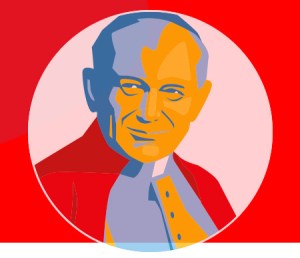 Born Karol Wojtyła in Wadowice, Poland, in 1920. Suffered the loss of his family, freedom, and country by the time he was 21 years old; risked his life under the Nazi regime to promote Polish cultural resistance and study for the priesthood. Recognized as a gifted theologian, pastor, and bishop; elected pope in 1978 and brought the Good News to 129 countries. Instrumental in the fall of dictatorships and Communism; wounded critically in an assassination attempt in 1981; credited Our Lady for preserving his life and met with and forgave the assassin. Served as pope until his death in 2005, despite declining health due to Parkinson’s and old age. One of the most recognized figures of the 20th century.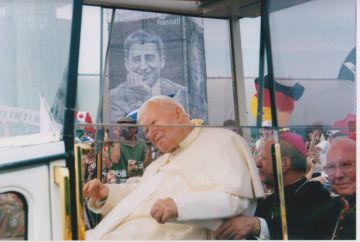
 Born Helena Kowalska in Głogowiec, Poland, in 1905, to a poor, religious peasant family. Felt called to religious life at an early age, but went to work as a housekeeper to help support herself and her family. Accepted to the Sisters of Our Lady of Mercy (OLM) in Warsaw in 1924, and in 1926, received her habit and the name Sister Maria Faustina of the Blessed Sacrament. Began having visions of Jesus as “the King of Divine Mercy” in February 1931, instructing her in His love and mercy, asking her to to paint His likeness with the inscription “Jesus, I Trust in You,” and to establish a feast of mercy in the Church.
  Archangel Stomp