Am I My Brother’s Keeper?

Blogger’s Note: This was meant as a parish bulletin column for next weekend, but it seems appropriate to post it now.

As coronavirus news reached a fever pitch this past week, a friend shared the reality of the threat for his wife, whose immune system is compromised. While he would never suggest that everyone change their behaviors to accommodate the needs of him and his wife, he urged people to understand that just because you might weather the virus with no lasting effect doesn’t mean your neighbor would.

Our world is flush with information; society is rampant with anxiety on the best of days; and we don’t like facing mortality or being blamed if we fail to act. All these things make us ripe for the Enemy’s picking. Who is the deceiver, the accuser, the divider? Who benefits from the disintegration caused by sickness and fear, quarantine and “social distancing”?

On the other hand, who inspired Cain’s infamous question (Genesis 4:9), “Am I my brother’s keeper?” Our thoughts, words and actions either contribute to the spread of this virus and the fear associated with it, or they diminish it. They either divide, or they unite. Continue reading
The Phantom Cross, or ‘It’s Not About You’

I’m Mary and I’m Martha all at the same time
I’m sitting at His feet and yet I’m dying to be recognized.
I am a picture of contentment and I’m dissatisfied.
Why is it easy to work and hard to rest sometimes?

Audrey Assad, “Lament”

My last post, “The Better Part,” was on Mary and Martha, and God continues to hammer my heart with the example of these two holy women. Yesterday was St. Martha’s feast day, so Jodi and I reflected again on the story in Luke chapter 10, and I was struck by how much of my busy-ness—which I pretend is selfless and sacrificial—is in fact all about me. Continue reading

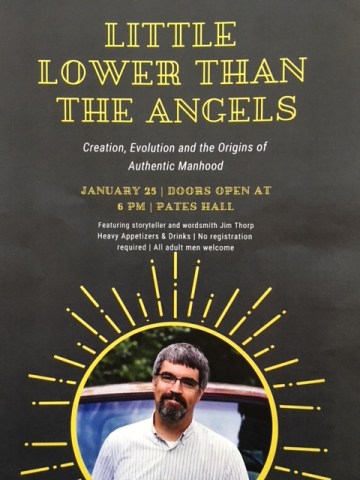
Men’s Club Speaking Gig: ‘Little Lower Than the Angels’

IMG_0716Late last month I was invited to speak to the Men’s Club at Our Lady of Peace Catholic Church in South Minneapolis, where our former associate pastor at St. Michael, Fr. Joah Ellis, is now pastor.

The event was an annual lecture they have called Decuria Schola; the talk was titled “Little Lower Than the Angels: Creation, Evolution, and the Origins of Authentic Manhood.”

If you have time, the video is below—it’s not much to watch, but take a listen and let me know your thoughts.


Book Break: How to Be Holy

How-to-Be-HolyA few weeks ago, my spiritual director did something he’ s never done before: He directed me to read a book. This was not a casual suggestion. He said, “I want you to read it cover-to-cover as soon as possible, so if you are reading something else right now, stop.”

The book was Peter Kreeft’s How to Be Holy: First Steps in Becoming a Saint, which is the popular Catholic writer and philosopher’s take on (“festooning of”) a spiritual classic, Fr. Jean-Pierre de Caussade’s Abandonment to Divine Providence. I have not read the latter, but have read just enough Kreeft to know to expect a relatively quick read, light in tone, punny in humor, and practical in content. Continue reading

Wednesday Witness: Confirmation Pep Talk

Note: Last Saturday evening we had an informational meeting for Confirmation students and parents. Not everyone was able to attend, so I am attempting to recreate the brief Confirmation pep talk I gave, in writing, for those who missed out.

* * * * *

I want to start with a question: Why are we here? Does anyone know? Is it just because I called a meeting?

I’m wearing one of my favorite shirts today: It has a drawing on it of two hands knitting what looks like a DNA strand, and if you look closely at the helix, you’ll see the word HANDMADE. At the bottom is a reference to Psalm 139:

You formed my inmost being; you knit me in my mother’s womb. I praise you, because I am wonderfully made; wonderful are your works! My very self you know. My bones are not hidden from you, when I was being made in secret, fashioned in the depths of the earth. Your eyes saw me unformed; in your book all are written down; my days were shaped, before one came to be. – Psalm 139:13-16

What does this tell us about why we are here? It tells us that God created each of us individually, with a specific purpose in mind, that He knows us intimately and loves us completely. Genesis tells us we are made in God’s image, and the Gospel of John tells us God is Love. We are made by Love, from love, to give and receive love. This is our whole purpose: to learn to love as God loves and ultimately find our way back to Him. The meaning of life is no more complicated than that. Continue reading