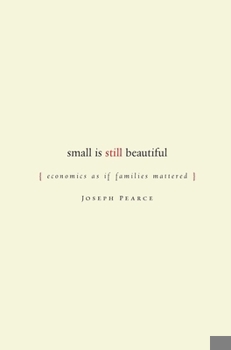
Book Break: Small Is Still Beautiful: Economics as if Families Mattered

Providentially, my reading lately has all been cut from similar cloth: our relentless pursuit of better, newer everything and the dangers it poses to our humanity and health (physical, mental, and spiritual). This latest volume, Small Is Still Beautiful: Economics as if Families Mattered by Catholic scholar, biographer, and author Joseph Pearce was a gift from our Bismarck family, and is a reiteration and expansion on E.F. Schumacher’s 1973 classic Small Is Beautiful: Economics as if People Mattered, with a particular focuses on the environment, food supply, and land use.

In my 2017 review of Schumacher’s book, I described a couple non-academic objections and numerous things I loved about the book. I also said it seemed like the sort of book that had been read, admired, and forgotten in the powerful current of worldly progress.

Continue reading
Book Break: Two Volumes by Matthew B. Crawford

One of the great pleasures of these latter years as a father is receiving books and book recommendations from my grown children. The University of Mary in Bismarck, Saint John Vianney Seminary in Saint Paul, and the Franciscan Friars of the Renewal have led each of them on tremendous intellectual and spiritual journeys. Occasionally, I tag along.

This past Christmas, Brendan and Becky presented me two books I may have never encountered had Brendan not taken a surveying (as in, land measurement) course as an undergrad…a surveying course taught by a history professor with a love for useful arts and practical skills.

Both books are by Matthew B. Crawford, who holds a PhD in political philosophy and a prestigious research fellowship at the Institute for Advanced Studies at the University of Virginia. He also runs a motorcycle repair shop. In these two books, he makes a convincing case that we are ceding more and more of our will, abilities, and control to technologies and systems that make life easier by making it less lively, less human, less worth living.

Continue reading

Book Backlog: Three Recent Reads

I’ve been struggling to find time for more casual, personal writing lately, and I now find myself with a bunch of recent books I intended to share but never got around to. Today’s quick reviews are for:

  • South of Superior, a novel by family friend Ellen Airgood (very enjoyable)
  • The Action of the Holy Spirit by Frank Sheed (clear, concise, and informative)
  • The Shallows: What the Internet is Doing to Our Brains by Nicholas Carr (disturbingly prescient and motivating)

Better brief (and late) than never…here goes!

Continue reading

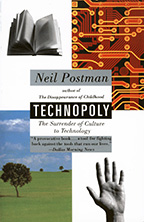
Book Break: Technopoly

Now for something completely different: I haven’t been writing nearly enough and am way behind on books I’ve read and would like to share. Most of the books I share are fiction, spiritual, or both. Technopoly by Neil Postman is neither.

This book came to me as an unexpected Christmas gift from our son Brendan’s friend Nick, who was his roommate at University of Mary and is now a seminarian for the Diocese of Milwaukee. Brendan has always been a curmudgeon and skeptic regarding technology; Nick, not so much, until he started reading more deeply on the subject. Then, he started spreading the word, including by giving our family a lightly used paperback copy of Technopoly.

One of the concepts that intrigued me as a young anthropology major was the idea that, at a certain point, our ancestors began to compete technologically rather than biologically, meaning that, at a certain point, our ancestors crossed a threshhold and were no longer strictly beholden to their biology to survive—the fittest was not necessarily the fastest or strongest hominid, but may be the cleverest one, with the best tools.

I’m certain that, soon afterward, our ancestors saw another defining characteristic of our species: Our solutions to problems often cause other, unforeseen problems. Indeed we can see this in the anthropological record, with evidence of hominids using “tools” to club each other to death beginning nearly half a million years ago.

Continue reading