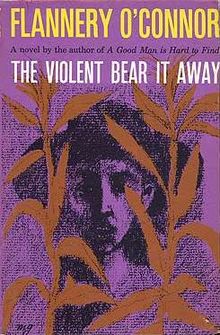
O’Connor, or Three Things to Love About The Violent Bear It Away

Blogger’s Note: Several years ago, I agreed to my friend Jacqui’s challenge to read 15 Classics in 15 Weeks. Though 15 weeks is long past, this, at last, is 15 of 15!

* * * * *
“From the days of John the Baptist until now, the kingdom of heaven suffereth violence, and the violent bear it away.” 
— Matthew 11:12 (Douay-Rheims Bible); epigraph of Flannery O’Connor’s The Violent Bear It Away

I am somewhat embarrassed to say that this was my first venture into Flannery O’Connor’s fiction, and what an introduction. It is a dark, hard, unflinching work, awful and mesmerizing, like a wreck along the highway–and yet strangely hopeful even as it descends. 

The book tells the story of Francis Marion Tarwater, an orphan boy in the mid-20th century deep South, raised with backwoods, biblical faith by his great uncle who believes himself to be a prophet and the boy to be his successor. When the uncle dies (at the very beginning of the story, so not a spoiler), the boy begins a very real spiritual struggle to discover the truth of this calling and the fate of his soul. The book builds a sense of dread even as the reader clings to threads of hopefulness, and erupts in violence both in present tense and in flashbacks–calling to mind a number of interpretations for the title and scripture verse it references.

I hesitate to say much more, for two reasons: first, this is a novel to be experienced, not spoiled or “set up,” and second, I honestly am not entirely sure what to make of it. I decided to wait a day or so before writing Three Things to Love, in order to reflect on the book–and I purposely didn’t read any commentaries. This morning, however, I read a couple of reflections on it by other people, and it appears I am not alone. O’Connor reportedly agonized over it, and readers for years have struggled with its deeper meanings and implications. On the surface, it is about the persistent pull on our hearts of both God and the world, and each person’s struggle to find freedom: will they take up the Lord’s yoke and find that it is light, or cast off the shackles of belief and live this life, for this world? It can be read (and enjoyed, after a fashion) at this level, but I am convinced there is deeper meaning here and will read it again someday.

So with that preamble, Three Things to Love about The Violent Bear It Away:
  • The Descriptions. Unlike several of the other books I read for this challenge (Tolstoy, Dostoevsky, Melville), this is a short book but still ripe with detail and description. O’Connor uses sparse, poetic language; metaphor; and simile to sculpt with words; the results a real, living people unalterably carved in stone.
  • Unflinching Honesty. O’Connor does not shy away from the darkness in humanity, and shares the thoughts and actions of her characters with relentless, sometimes shocking, honesty. At the same time, she does not succumb to the modern tendency to dwell on violence with pornographic detail–her matter-of-fact simplicity makes the book that much more compelling.
  • Eternal Themes. Faith and reason. Freedom and destiny. The nature of love. The spiritual combat. Here they are again: themes that arise in so much of great literature through the ages appearing again in 1960, set in the south of the United States. 
I feel as though I am sharing very little about this book, so maybe some comparisons would help. It reminds me in ways of two other books I enjoyed: Steinbeck’s East of Eden (one of my all-time favorite novels) and a more recent novel, Tobit’s Dog. If you like, check out those reviews to gauge whether The Violent Bear It Away might work for you.

The Outcasts Among Us

This parish has a wonderful reputation in the archdiocese. We have good and holy priests, deep roots, a beautiful church filled with Catholic families, and numerous vocations to the priesthood and religious life. When I tell practicing Catholics outside “the Bubble” of St. Michael where I work and worship, they know this place and tell me I am blessed.

Many of you have had the same experience—so a few facts may come as a surprise. For example, did you know that any given fall, only about half of the parish’s school-age youth are enrolled in either the LIFT program or the Catholic school? Or that each year we see a spike in LIFT enrollment among families with children in the sacrament grades—second grade for First Holy Communion; ninth and tenth grade for Confirmation—followed by a drop of about 50 percent after First Holy Communion, and nearly 100 percent after Confirmation? This tells us two things: first, the number of St. Michael youth enrolled in religious education on a regular, year-after-year basis is probably closer to 40 percent, and second, many of the Catholic families in our parish come for the sacraments but form no abiding relationship with Jesus, the Catholic Church, or the Body of Christ—the community of the faithful—present here.

Something is missing, even here in this beautiful, life-giving parish.

I was blessed to make a silent retreat to Demontreville a couple weeks ago. During one of the meals, we listened to Fr. Greg Boyle recount his work among gang members in Los Angeles, and I was struck that these young men were searching for what we all want: a place to belong. That got me thinking: who are the outcasts among us here in St. Michael? Who, in our parish, is just looking for a place to belong?

Perhaps it’s the broken family who struggles to make connections because the kids are only here every other week. Perhaps it’s the single mom who can’t attend MOMs Group because she works long hours—and wouldn’t know what to talk to the other moms about anyway. Perhaps it’s the immigrant family who finds themselves awash in a sea of white, worshiping in a way that is as solemn and foreign to them as they may appear to many of us.

Or perhaps it’s the young family that’s just settling in: Mom’s a cradle Catholic; Dad is coming around—with two young kids and an infant, juggling work and family and faith, swept along in the rush of baseball games and birthday parties. They told the priest five years ago they would raised their children Catholic, but honestly, they don’t know where to start. Mass is a struggle. They’d like to get involved, but maybe they’ll wait until First Communion. Hopefully things will settle down by then.

Those of us who feel at home here are deeply blessed, but we can sometimes forget where we started. At one time—perhaps as children, perhaps as adults—we had basic questions about the faith we were afraid to ask. At one time, someone—a priest, a friend, a stranger—took an interest and nudged us toward God. At one time, we were all on the fringes of faith and could have tipped either way. To our great benefit we fell into the open arms of Jesus.

So let’s benefit others in the same way, recognizing that the best way to deepen our own faith is to follow Christ in spreading the gospel and making disciples. Let us look for the outcasts among us, invite them in, and walk with them up the narrow path to the Cross, and our salvation.

Blogger’s Note: This article appears in the Sunday, August 23, parish bulletin.

Call—and Response

Given March 11, 2015

I spent two days in St. Paul last week, training to become a VIRTUS facilitator. VIRTUS is the archdiocese-approved program for helping church employees and volunteers keep our children and youth safe from abuse. A number of the presenters spoke of feeling calledto protect kids—and I immediately felt out of place, not because I don’t want to keep kids safe, but because by primary motivation for signing up to become a facilitator was, “Somebody’s gotta do it.”


But over the course of the training the leaders encouraged us to think more deeply about our motives, and I learned something about myself. I told the gentleman next to me, “Our church is like a second home to me and my family—we’re there all the time!—and if there’s anything I can do to make it safer, so that my family and other families can feel at home there, I want to do it.”

Maybe there was a deeper call there after all. 

Two weeks ago I announced that we were putting together a new team of people to help shape our faith formation programs going forward. So far, Kathy and I have received 20 responses about joining the LIFT Crew—15 yes and 5 maybe—from current and past teachers, FFAC members, small-group facilitators, and more. Only one person I’ve spoken to has said no, and even she shared an hour’s worth of great ideas from more than a decade of teaching kids in our parish.

Think about that for a moment: We have people in this community who have been sharing their faith with children for ten, twenty, even thirty years! We have a committee of dedicated parishioners who work behind the scenes to create, promote, and improve LIFT with little public recognition of their time, effort, and results. We have people who are committed to praying specifically for the success of our programs and the conversion of souls. We have teens who, without knowing or asking what it might entail, have said, “Mr. Thorp, I saw that you are looking for people to help with LIFT—sign me up!”

We are surrounded by people who love the Lord and want to live out His call to make disciples. That’s a beautiful thing.

And it works: these people are setting a high bar that others respond to with more prayer, more service, more love. Last Wednesday I went to the archdiocese for training, then hustled back to St. Michael to prepare for LIFT and Confirmation classes. Kathy and both priests were gone, two Confirmation teachers were out, and another was running late. Two out of three videos were malfunctioning, and the mic in the gathering space wouldn’t plug in. I joked that my goal for the evening was to survive.

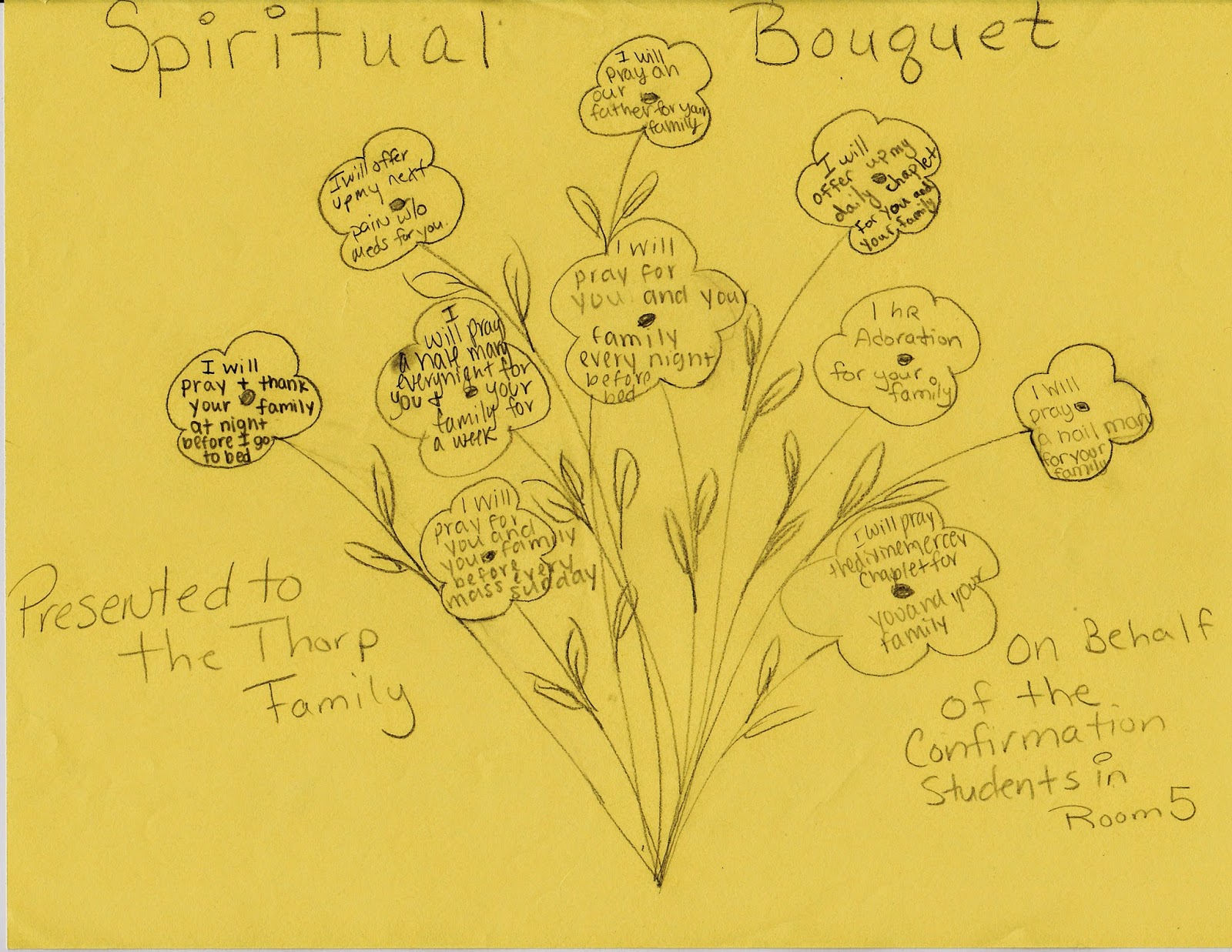
At the end of the night, one of our catechists handed me a picture. It was a pencil drawing of a “spiritual bouquet” from her Confirmation class, with each flower labeled with an act of sacrifice and love her teens had pledged to perform for me and my family in the coming weeks. Prayers, chaplets, and rosaries. Holy Hours in the Adoration chapel. Pain and suffering. Offered up for my family and for me. What else can I do but reciprocate?

Christ calls us to love, and we respond. Love begets love begets love. It’s a beautiful thing.

Blogger’s Note: This article appears in the Sunday, March 22, church bulletin .

On Being Recast…

I think the good Lord is breaking my heart in order to rebuild it today. Nothing bad happening at all — just some rusty scrap between my lungs that is being heated to be molded or hammered into something new, I think. A shield? A sword? A ring? A wrench? Maybe He’ll leave it molten and malleable so it can be reshaped at will…

Why Are We Here?

Blogger’s Note: For those few of you who still follow this blog and don’t attend St. Michael Catholic Church, the article below was published in the Sunday, Sept. 14, church bulletin as part of a regular monthly faith formation column.

This weekend’s Fall Festival is a great opportunity to support our parish and grow in community. Surely it is a sign of life in our local Body of Christ that so many people spend this weekend here, year after year, in fellowship and service. The chairpeople and volunteers, the sponsors and donors, and everyone who works to make this weekend a success deserve our gratitude – so please remember them in your prayers!

It also important, however, that we remember why we do these things. This summer, a friend shared an article with me entitled “Vibrant Isn’t About Busy: Organizing Parish Life for Discipleship.” The article made the case that while an abundance of activities and programs might seem important for attracting people to the faith, quite often these programs are actually distracting from activities like prayer and the sacraments that promote spiritual growth. Parishioners can find themselves so caught up in the busy-ness of it all that they forget that these offerings are not an end in themselves. They only matter if they lead us closer to God and heaven.

With that in mind, you should notice a distinct shift in the emphasis and tone of our faith formation activities this year, beginning with LIFT-Off, our program kickoff event on Wednesday, Sept. 24, at 6:30 p.m. In years past, LIFT-Off has been a combination of entertainment and logistics—something fun for the kids, along with information and scheduling details for the parents. This year, instead, we are opening LIFT-Off with Mass, followed by a brief personal witness or two about the power of a personal relationship with Jesus Christ to transform families. This is a great opportunity to spend a little extra time with Our Lord at the beginning of the academic year, and we’d like to invite everyone in the parish to join us and pray for the success of our faith formation and sacramental programs.

If you haven’t been to a weekday Mass recently, know that both the Mass and the witness should last only about an hour combined. Confirmation families will need to stay a bit longer to meet with Father and me about sacramental preparation; everyone else should be free by about 7:30 p.m. to pick up their LIFT materials and head home. Our goal is to give you an opportunity to spend some time with God giving thanks for His blessings and specifically praying about the needs of your family.

It’s not always easy to commit to family faith formation, weekly or daily Mass, or regular Confession—but we know that parents who make prayer and the sacraments a priority in their lives have children who do the same.  We also know that, with a heart open to God’s graces, what starts as an obligation can become a habit and then a joy. Please consider this year’s LIFT-Off to be a step toward a sacramental life and a renewed relationship with Jesus, and take great hope in His reassuring words to us from the Gospel of Matthew: “Take my yoke upon you and learn from me, for I am meek and humble of heart; and you will find rest for yourselves. For my yoke is easy, and my burden light.”