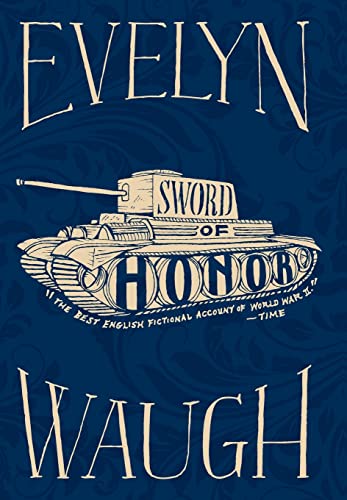
Book Break: Sword of Honor

Last month, I drove to Michigan and back on consecutive weekends. Roadtripping comes easily for me, especially with a good audiobook. During the winter, I saw an article on the Imaginative Conservative website about Evelyn Waugh’s Sword of Honor trilogy, and since I haven’t read anything by Waugh since Brideshead Revisited in 2011, it seemed like a solid choice.

In case you don’t know (I didn’t): Arthur Evelyn St. John Waugh is a British man; an author, journalist, and book reviewer; a World War II veteran; and a twice-married convert to Catholicism. Sword of Honor comprises three separate novels published in chronological order: Men at Arms (1952), Officers and Gentlemen (1955), and Unconditional Surrender (1961).

The books trace the wartime story of Guy Crouchback, the only surviving son of a once well-to-do Catholic family in England, who is floundering after his beautiful but promiscuous wife leaves him for another man (and another, and another) in the early days of World War II. Despite being older than most recruits, he joins the Army to escape his loneliness and reassert himself as a man—God willing, to do something meaningful with his life.

Continue reading

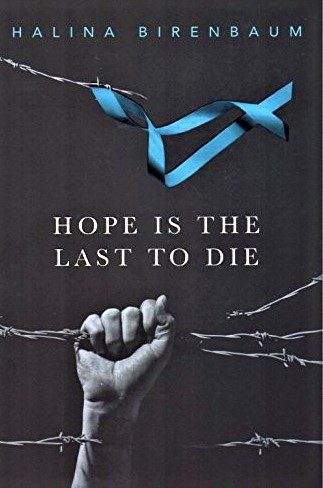
Book Break: Hope Is the Last to Die

In 2016, I was blessed to travel with my son Gabe and STMA Catholic Youth Ministry to World Youth Day in Kraków, Poland. Southern Poland is a wonderful place for a Catholic pilgrimage; so many ancient and modern saints lived and died in so small a region that every day it seemed we visited another sacred site in another blessed city. The big three, of course, were 20th century saints: St. John Paul II, St. Faustina Kowalska, and St. Maximilian Kolbe.

In the case of St. Maximilian Kolbe, we were blessed to visit his religious community at Niepokalanów as well as the concentration camp where he gave his life at Oswiecim (Auschwitz). I say blessed truly, but not in the typical sense of the word. On a sunny summer day, Auschwitz is still and green and peaceful as an cemetery, but still more somber and hushed; the fences, ruins, and the dreadful sign above the gate, “Arbeit Macht Frei” (Work Will Free You), bear silent witness to the cruelty of which humanity is capable.

As we left the camp, we passed a small booth selling items commemorating the place—most prominently, a book entitled Hope Is the Last to Die by Halina Birenbaum. Born Halina Grynsztajn to a Jewish family in Warsaw, she survived the horrors of the Warsaw Ghetto during Nazi occupation, followed by four prison camps in succession:  Majdanek and Auschwitz in Poland, and Ravensbrück, and Neustadt-Glewe in Germany.

I bought the book, as the most appropriate way to recall the place and what happened there. I finally found the courage to read it this Lent.

Continue reading

Book Break: A Canticle for Leibowitz

LeibowitzBeing without work these past few weeks, I’ve had more time than usual to read. Last weekend, I finished Walter M. Miller’s 1959 novel A Canticle for Leibowitz, a book recommended to me by three of the smartest men I know. Set in post-apocalyptic America in the centuries following a nuclear holocaust, it tells the story of the monks of the Albertine Order of Leibowitz, who scratch their livelihood from the rocks and dust of the southwestern deserts and dedicate themselves to their founder’s mission of extracting knowledge from the rubble of the previous civilization and preserving it for the future. Continue reading

Book Break: Valerian Pączek: Priest, Soldier, Quiet Hero

My first visit to the University of Mary Bookstore, a slim little volume caught my eye, perhaps because I was hungry. The book was titled Valerian Pączek: Priest, Soldier, Quiet Hero by William C. Sherman and John Guerrero and is pictured to the right. In proper Polish, the good Father’s name is rendered Walerian Pączek (pronounced va-LAIR-yan POWN-chek, though it appears his Plains parishioners may have said it “paycheck”) and his last name is the singular form of pączki, those stout, fruit- or custard-filled pastries Poles and others enjoy on Fat Tuesday.

I received the book for Christmas and finished it last night. At just 88 pages, it is a quick read, and worth every moment — if for no other reason than to imagine this Polish hero serving as a parish priest in rural North Dakota and recognizing that most of the time, we have no idea what people have been through in their lives.

Fr. Pączek was born in 1909 in East Prussia, a region of Poland which at that time was under German control. He grew up speaking Polish and accentless German, became a Catholic Pallotine priest, joined the Polish Army, served in the British Army after World War II, then moved to the States, ultimately to become a parish priest at historically German and Czech parishes North Dakota. He was quiet about himself and his experiences in the War, so most people had little idea that their Polish pastor:

  • Served in the Polish Home Army (the underground military resistance to the Nazis) under the code-name Germen, providing for the spiritual needs of fighters and refugees with secret Masses and moving intelligence, communications, and large sums of money under the noses of the Germans, even to the Polish government in exile in London.
  • Personally forged documents for Jewish families using the identities of recently deceased Poles gleaned from the growing cemeteries around Warsaw to help them avoid detection by the Nazis. (One of the most compelling scenes in the book is a chance meeting between Fr. Pączek and a Jewish man who escaped to the States from Poland. The Jewish man shows Father his forged documents, and Fr. Pączek rewrites the information on a sheet of paper to show the handwriting is an exact match.)
  • Narrowly escaped death at least six times, was an excellent marksman and carried a handgun during (and after) the war, and was decorated by both the Polish and British armies and recognized by the U.S. Army as well.
  • Was a marked man by the Polish Communist Government after the War — and as a result, spoke little about his service and often destroyed correspondence about it to avoid endangering friends and family still in Eastern Europe (and himself).
  • Spoke several languages and earned multiple degrees, including a doctorate in canon law, which he completed via correspondence to scholars across Europe while serving in parishes in North Dakota.
  • Was known and welcomed by name, rank, and code-name by Pope John Paul II and greeted as Fr. Colonel Pączek by the Swiss Guards when he visited the Vatican.

Juxtapose these facts against this blog post from a former parishioner of Fr. Pączek’s, who recalls going to the Polish priest for Confession because he was more lenient than the other priests in terms of penance, and the words “quiet hero” seem particularly apt. Only at the end of his life did the parishioners who remember him really begin to know him.

The book is clearly a labor of love. Sections of it read like a draft, raising as many questions as they answer — and since so little was known about his life before Fr. Pączek’s death and he was not inclined to make it easy for people to sort out his past, many of those questions and controversies will not be answered this side of heaven. But all told, it is a compelling portrait of a man who shouldered the burdens of war and carried them with quiet dignity all the days of his life.

Unbroken

Blogger’s Note: There are both book and movie spoilers below. You have been warned.

We finally saw Unbroken last week. The book version of the story — Laura Hillenbrand’s 2010 biography of Olympic athlete and WWII veteran Louis Zamperini — is a spell-binding, white-knuckled page-turner. It’s well researched, lovingly crafted, and unflinching in its portrayal of the danger and brutality endured by Zamperini and his comrades during 47 days adrift in a life raft after their plane crashes into the Pacific and two and a half years in Japanese prison camps.

I know many people now, men and women alike, who have read this book, and every single one has loved it. When I finished it, I told Jodi this man had four or five movies worth of material happen to him in his lifetime, and I blogged that “the fact that all of them really happened to one man is almost too much to be believed.

Zamperini died just this past summer at age 97. When I heard the news on the radio, I choked up. What an amazing man.


Perhaps it was too much to expect a single film could carry the weight of Zamperini’s story alone. I liked it well enough, I suppose, primarily because it reminded me of the book — but unlike the book, it had no lasting impact for me. I’ve heard both critics and friends offer two reasons for this (Note: Spoiler alert!):

  • Some have said that it’s overly sanitized — that a PG-13 version of an R-rated book simply can’t convey the horrors experienced by Japan’s POWs. Some have suggested that it’s a “Golden Age of Hollywood” sort of movie, well done but too beautiful, without the real grit we’ve come to expect in newer war movies.
  • Others blame director Angelina Jolie for leaving out the book’s final act, which showed both the dreadful toll Zamperini’s years in captivity took on his mental and emotional health, and the path to forgiveness and healing he found in Jesus Christ.
Although I remain disappointed with the pat ending, which relegates Zamperini’s conversion story and personal forgiveness of his captors to an end note, I’m closer in opinion to the “overly sanitized” argument. Don’t get me wrong: I’m glad that teens may get the chance to see this movie and learn about the man — and the violence is plenty real. What’s missing, from my perspective, is the moment-to-moment tension and suspense of the book: the arbitrary, madness-inducing, constant fear of violence and death that make Zamperini’s survival and redemption so incredible and uplifting. 

For example, in the film, when Louie and his two companions are adrift on the Pacific, they are hungry, thirsty, sunburnt, circled and attacked by sharks, and strafed by Japanese warplanes, just like in the book…except that in the book, these dangers weighed on the men constantly. While the movie plays up a single shark attack for a scare moment, the book portrays the sharks as an ever-present fear, constantly testing the integrity of the raft and the resolve of the men. In the book, the rubber life raft is shot full of holes more than once, and pumping and patching to stay afloat and alive is steady work. In the book, faced with malnutrition, disease, parasites, and torture, the POWs are constantly struggling to stay healthy enough to endure daily hard labor — and the “victories” that Louie wins over his antagonizer, the Bird, are moral victories only, and fleeting. He wakes the next morning with new injuries and new challenges, still malnourished and still under the Bird’s oppressive thumb.
Of course, great books are rarely matched by the films based on them — but if a magical, whimsical book like The Hobbit can be expanded into three dark and swarming action movies of three hours a piece, perhaps we could have given a little more time to Zamperini. The TV miniseries (think Roots or Lonesome Dove) seems to be a fading form — perhaps that would have been a better choice for Unbroken?