Snowy Days Made For Sitting Home

Blogger’s Note: I’ll have more fresh stuff soon. In the meantime, this snowy weekend brought to mind another old column from my newspaper days. This one ran in the Tuesday, October 28, 1997, edition of The Pioneer, Big Rapids, Michigan, just a few days after Jodi and I moved into our first house. Hope you like it.

I’ve always enjoyed snowy mornings. Some I remember in particular like the [morning of] my birthday eleven or twelve years ago.

My best friend Kevin and I stayed outside ’til well after dark [the night before], playing hide-and-seek from the dog in the piles of brown oak leaves around the yard. The next morning Kevin peeked out behind the blind and announced it had snowed.

“Yeah, right,” I said, and rolled over to sleep.

“No, really,” he persisted. I got up to look, and all thoughts of sleep vanished at the sight of the downy white blanket.

That’s how snow comes — soft and silent. Sunday’s light accumulation scarcely made a sound. Saturday my grandfather had brought his lawn tractor and push mower to cut grass a month and more high; Sunday he brought his sweeper and more than a month’s worth of clippings so they wouldn’t suffocate the lawn.

Thence came the snow. Jodi and I were surprised to find our new yard white to a depth of four inches.

Such mornings are made for sitting home and enjoying. My dog Boomer, a great furry Airedale, understands this — on clear, cold South Dakota evenings, while local news anchors warned of deadly wind chills, Boomer could be found curled up on the ground, snow swirling about his head. He’d lie outside until the trail back to his house filled in, enjoying the quiet.

My sister and mother and I spent a good portion of the weekend painting what is to become the master bedroom and baby’s room — achieving whiteness in rooms once blue and yellow. There are few things more maddening than a hint of color beneath new white paint.

Mother Nature, I think, agrees. An upstart maple in our front lawn scattered leaves, first across the newly-mowed and -swept lawn, then across the new-fallen snow. Both Mother Nature and I stopped and frowned.

The truth, with trees as well as people it seems, is that we cannot leave the snow alone for long. For the young, the snow brings with it opportunity. It lies like a blank canvas, and the red leaves of the young maple are as much a part of the day’s enjoyment as are the footprints and angels and snowmen of children.

And as it turned out, I had no right to frown at dry leaves — reveling in the morning’s cold, I cut a path to our cars and stomped rough ovals around both of them, brushing off snow. By the time I’d managed to back out of the driveway, I’d stained the snow brown with grass, gravel and leaves, effectively ravaging the virgin beauty of the morning.

The debates of superintendents and transportation supervisors, of meteorologists and school-children, would be moot could we all grasp this simple truth: snow is best and most beautiful left undisturbed. The first set of tracks across a snowy field and its beauty is diminished; the first perpendicular cut by a shovel or plow spoils it altogether.

The road to town was slush-covered and edged in browning snow. By mid-afternoon, the world outside was road grime and mud — all because we lacked the sense to stay at home and enjoy the day.
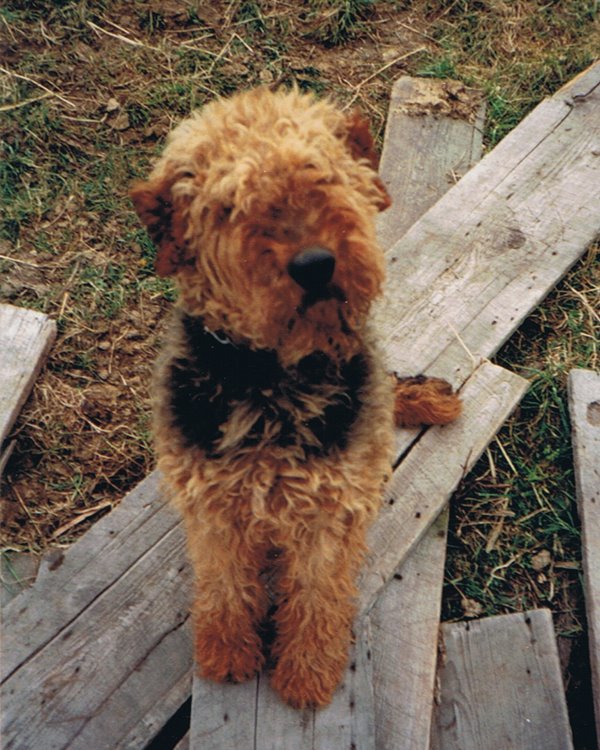
Old Dog, New Trick

Our ancient Airedale, Boomer, is now fifteen or so — old for a dog, very old for a large breed, and truly remarkable for an altogether outdoor dog, who has refused the house (and until last winter, the garage) even in the deepest cold of winter. He’s a tough old man, and he still moves about the yard in a loose trot like it’s all his.

He’s never been much of a watch-dog or a hunter. Gun-shy since puppyhood and easily distracted, he’s simply never had the same sense of duty as Puck, our mini Schnauzer, who patrols the yard and house for any sign of trouble from strangers, squirrels, or even neighbors he suspects. He has never backed down from a fight, to my knowledge and loved to chase cats — but fight, chase, or kill, it was always with a look of joyful gameness, like he was testing his skills, happy to win or lose, bloody or be bloodied. He killed a stray cat once, and left it lay on the driveway; he didn’t worry it with his teeth or parade around with it in his jaws. He used to nab gophers now and again, and would toss them into the air and catch them, or bat them around like hacky-sacks. He was strong and quick, but never mean.

Today you can walk up to him from the back, the side, or even the front, and if he’s not looking at you, he won’t know your there until you touch him, stomp, or clap. He’s slower now, and more frail, but still affable, and I love him.

So last weekend — the Saturday after Thanksgiving — I woke in the wee hours, maybe 2:30, to Boomer’s persistent barking. The last two winters he’s had episodes like mini-strokes or seizures, in which he loses his coordination and sense of equilibrium and begins to stagger around and into obstacles. Last December he woke me this same way, albeit with a more pained and panicked bark. Still, this time I again rose fearing the worst.

I went to the deck door and opened in, letting the winter cold roll in. As soon as the door opened, his barking stopped. I couldn’t see him in the blackness of the kennel — there was no snow on the ground. He whined softly, once toward me and the house; the next toward the narrow patch of woods behind the house and the street beyond. It was not a plaintive cry, but an urgent, pay-attention call.

On the street beyond the trees I heard muffled voices and the shuffle-stomp of drunken footsteps, moving toward the house on the lot whose southeast corner touches our northwest.

Scuff-stomp-shuffle. Whispering. Shuffle-stomp. Soft laughter. Shuffle-shuffle-shuffle.

I heard the workings of the latch, more shuffling, and soft thump of a door sealing out the night. I heard the click of the bolt. And I heard Boomer turn back into his dog house, circle, and lie down with a tired galumph. The night was silent. He never made another sound until morning.

He knew they were there, and he knew when I knew. I had assumed for some time that his hearing and sight were failing, but perhaps it’s his aging brain, so easily distracted as a young dog, is now drawn in tight focus by whatever grabs its attention. During the day I can sneak up on him because so many other things capture his eye or nose.

But at night, in the silence, it seems no one gets by.

Photo: Boomer in his younger days, probably 8 to 10 years ago.

On Contentment

Even if you sleep in a room
with a thousand mats,
you can only sleep on one.
— Japanese proverb

A little while back, our friend T at Holy Guacamole ended her post with the question, “Will I be content?” I can’t answer for her, but as for me — probably not.

It’s not that I don’t recognize and appreciate how good I’ve got it. A strong marriage, four bright and healthy kids, a great job doing something I’m good at and (often) enjoy … any one of these blessings is remarkable these days. My kids’ grandparents — both sets — are still alive and happily married, and I get along well with my in-laws. Our ancient Airedale, Boomer, continues to happily nap and munch his way through years and seasons, and our mini Schnauzer, Puck, forgives me for writing in the evening while his tennis ball sits motionless at my feet.

And still it’s there, lurking at the outskirts of thought, the creeping dissatisfaction, the nagging doubts, the hollow ache that, if I rest comfortably in these joys, I’ll miss new opportunities and perhaps greater joys. This fear is quickly accompanied by another, and dull but urgent thumping suggesting that if I do not celebrate what I have, I risk losing it.

Contentment is a blessing — but in those rare moments when I feel at peace with my life as it is, the peace is fleeting because I second-guess it. It seems a fine line between contentment and complacency, between being grateful for, and settling for, what you have.

Discontentment is a curse — but is it worse? At least at my age, when I feel I can do more — not just for me, but for my wife and kids and the world, even — I think perhaps this discontentment is what gets me up in the morning and makes me press forward. If I were content, would I be attempting a book right now? Would I have left Hanley-Wood for the U and now, the best job I’ve ever had? We’d probably still be in Michigan. So much would be different — or rather, exactly the same.

So this discontentment might seem to be the result of the idealistic inspirations (relatively) young husband and father who wants the best world he can make for his family — and who wants his children to see that it is possible to live as you wish and do what you love. It’s a blessing in itself, right? Except …

I spent three years or so working for a daily newspaper in Big Rapids, Michigan. The hours and pay, however, weren’t conducive to raising a family, so I went to work for Ferris State University, first as a multi-purpose writer, then as media relations manager. After three years or so, I started feeling fenced in — like I was out of options at Ferris and in Michigan. Jodi and I decided to move to Minnesota, and I took a job with corporate marketing firm.

But after three years or so, I felt like I needed something more — more creativity in my work, maybe a graduate degree. So I went to work for the University of Minnesota.

I’m in my third year at the U now. The skies are grey, and the wind is cold. Now is the winter of my discontent — where will I seek sunlight this time?

Last Snow = First Haiku

It snowed last night – heavy wet flakes, the kind common sense dictates you not attempt to move, because A) they weigh a ton per shovelful, and B) they will melt away soon enough. The pines along the back yard look as if the weight of the world had settled on them alone, and the grey clouds hang overhead like a heavy sigh.

But the steady drip from the eaves is the faint patter of hope – a heart beating faintly in the thick silence. So, a haiku:

The last snow, fallen –
draped in white, the trees bow low
at Winter’s passing

Hm. It may help to know that white is the traditional funeral color of Japan, land of the haiku. But while that detail might add a little something, I think it works alright as-is. At least for today.

Sorry it’s been so long …