Don’t Lose Your Sense of Wonder

I sometimes think of life as a high sledding hill with God at the top, giving us a push. It’s left to us to steer, but like any good father, He knows our tendencies to close our eyes or overcorrect better than we do, and so He can see every curve we’ll negotiate, every bump that will bounce us airborne, every tree we’ll hit. He sees the trajectories of other sledders and knows their tendencies, as well—He knows whose paths we’ll cross, for good or for ill, and when we’ll be blindsided. He alone has the long view, the Big Picture. We must persist with less—a glimpse of heaven through the treetops as we slip away, faster, faster…


I remember, as a boy, waiting breathlessly for Christmas. Christmas Eve was sweet agony—tossing and turning, knowing I had to fall asleep so Santa would come and yet straining my ears for the jingle of bells and the chance at a glimpse of that jolly, saintly man. I couldn’t wait for presents, of course, but I knew they would be great because I knew HE was great! And although we were not, for the most part, a church-going family, still we had a beautiful Nativity, and I knew the story of birth of Jesus. I knew, at least, that He too was a great man and a great gift to us. In these two stories, magic, hope, anticipation, and gratitude combined into one overwhelming sensation for my young heart: wonder!

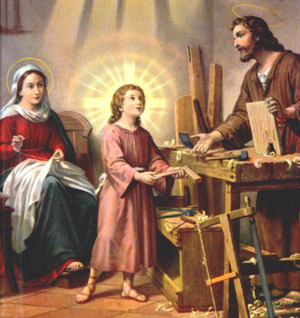
Wonder seems harder to come by these days. Our science and technology have helped us explain the Heaven out of the world around us. And we have so much on our plates. In Mary’s day, she and Joseph were very much concerned with their daily bread, with doing God’s will, and with deliverance from evil. Now we have countless other worries, from careers to car repairs, birthday parties to ballgames. Beneath it all we hear the steady drumbeat to, as one retailer put it this year, “Win the Holidays.”  We seem so short of time, and the pressure on our heart squeezes it empty. Too many of us feel a hollow ache between our lungs as Christmas approaches, instead of joy and wonder.

The good news is that it’s not too late. Christmas is not a day so much as a season, which begins with the Feast of the Nativity on December 25th and continues for a dozen days: a celebration that “God so loved the world that he gave his only Son, so that everyone who believes in him might not perish but might have eternal life (John 3:16).” The good news is that Santa is ephemeral, while Christ is eternal. The good news is the Good News: that Jesus is God made flesh, that He came to live with us and suffer and die for us, that He rose again from dead, and that He saves us from our sins.

It is no wonder we sometimes feel blue at Christmas. We celebrate a joy we will not experience this side of heaven. No matter how blessed we are in this life, the gulf between what we have and what our heart yearns for in Heaven is so deep and so wide we cannot clearly see the other side or hope to cross it on our own. But Jesus came to show us the way; He gives us His Body and Blood to strengthen us, and His own Spirit to lead us.

The road that stretches before the feet of a man is a challenge to his heart long before it tests the strength of his legs. Our destiny is to run to the edge of the world and beyond, off into the darkness: sure for all our blindness, secure for all our helplessness, strong for all our weakness, gaily in love for all the pressure on our hearts.

– My Way of Life, a simplified Summa Theologica

May God bless you and yours with peace and love throughout this season and beyond. Merry Christmas!

Blogger’s Note: This article appears in the Sunday, Dec. 27, parish bulletin.
Our Faith Is Not Genetic

Last month I wrote about the power of family— in particular, parents—in keeping their children Catholic.  It’s sobering, then, to learn that the Catholic Church in the U.S. is losing members faster than it is gaining them, and that, for today’s teens, religious identity is no longer reliably inherited. In other words, Millenials aren’t likely to stay Catholic simply because their parents and grandparents were Catholic.

What does it take to keep our young people in the faith? According to a 2012 Canadian study, young adults who choose to remain Christian have four main characteristics:

  1. They have experienced God’s presence and have witnessed answered prayers.
  2. They can ask and openly discuss their real spiritual questions in their Christian community.
  3. They understand the Gospel at a deep level.
  4. And they have seen communities of faith and older adults living their faith.

Numbers 1 and 4 have to do with experiencing God, both personally and in community. Numbers 2 and 3 involve grappling with spiritual truth. Young people who have the opportunity to know and personally experience God and are encouraged to explore that knowledge and experience are more likely to choose for themselves to remain faithful to Christ and His Church.

Is that the environment we are fostering at St. Michael Catholic Church? In our homes and our schools?

Unfortunately, Catholics have a reputation—earned in many cases—for not spending much time delving into sacred Scripture and for not sharing firsthand experiences of the very real and personal God we hear about in the Bible and the Catechism. And while our Masses may be well attended, a faith that is manifested for an hour on Sunday is not the same faith that made evangelists, world travelers, and martyrs out of a dozen unknown Galileans. Their faith changed lives—their own, first and foremost. If church doesn’t change us, we’re not doing it right!

Eventually everyone makes a choice for or against Christ. So maybe it’s a good thing that we can no longer rely on birth and blood to pass our Catholicism on to the next generation.  If we acknowledge that even cradle Catholics need conversion; if we share our faith not just with those outside the Church, but with each other; if we pray for, and come to expect, God to act in our lives in personal and tangible ways, through answered prayers, spiritual gifts, vocations, and more—we will “become a people living for Christ” in every generation.

Blogger’s Note: This article appears in the Sunday, Nov. 15, parish bulletin.

The Power of Family


The family is the community in which, from childhood, one can learn moral values, begin to honor God, and make good use of freedom. Family life is an initiation into life in society. 

– from the Catechism of the Catholic Church, paragraph 2207

As I type, bishops from around the world are gathered in Rome discussing how best to preserve, strengthen, and encourage Christian families. With so many families suffering or broken, such confusion over the nature and purpose of marriage, and the constant cultural tension between anti-child forces (for reasons of overpopulation, so-called social responsibility, or personal choice and comfort) and  “child worship” (treating each child as the center of the world, deserving of the very best of everything), it’s easy to feel underappreciated and overwhelmed. It’s also easy to get caught up in the everyday hustle of school, work, sports, and recreation and lose sight of the true power of the family as a domestic church: an apprenticeship in love of God and neighbor.


The Catholic Church, in her wisdom, teaches that the family is the fundamental unit of society, with certain rights and responsibilities that no higher level social organization can ever claim. Humans are social creatures, made in the image of God, who is Himself a loving, life-giving communion of Persons—the Holy Trinity. The Catechism insists that government has a duty to protect and foster marriage and family and to help families (and not interfere) with raising and educating their children as they see fit, both in the world and in faith.

The Church, in fact, regards the education of children in the faith as a duty of parents—a point that cannot be overstated.  I sometimes hear parents say, “I want my son to make his own choice about his faith,” or “I don’t want to force it—it will mean more my daughter if she comes to God on her own path.” While it is true that, ultimately, we each make our own choice for or against Jesus Christ and His Church, we cannot entrust that choice to the sole discretion of our children—any more than we would allow them to decide whether to drink something we know to be poison. If we truly believe what the Catholic faith teaches, the choice our children face is much more stark than how they will spend their Sunday mornings—it’s about how they will spend eternity.

Next Wednesday we begin a new year of First Confession/First Communion and Confirmation classes—and as always, it is essential that parents take the lead in sharing the good news of Jesus Christ and the eternal truths of the Catholic Church. Your personal example is the most powerful witness to your children—and male role models, in particular, have extraordinary power in keeping kids Catholic. Even simple things, like reading a Bible story, putting on a tie or a dress for Mass, or taking time to pray with and bless your child before bed, make deep and lasting impressions.

Scripture reminds us, “Train the young in the way they should go; even when old, they will not swerve from it” (Proverbs  22:6 ). We are all practicing Catholics, all sinners who are in training to love as God loves. But as parents we are also powerful, and we must not neglect to use that power to bring our kids to Christ, who said, “Whoever receives one child such as this in my name receives me” (Matthew 18:5).

Blogger’s Note: This article appears in the Sunday, Oct. 18, parish bulletin.

We’re Not Meant to Go It Alone

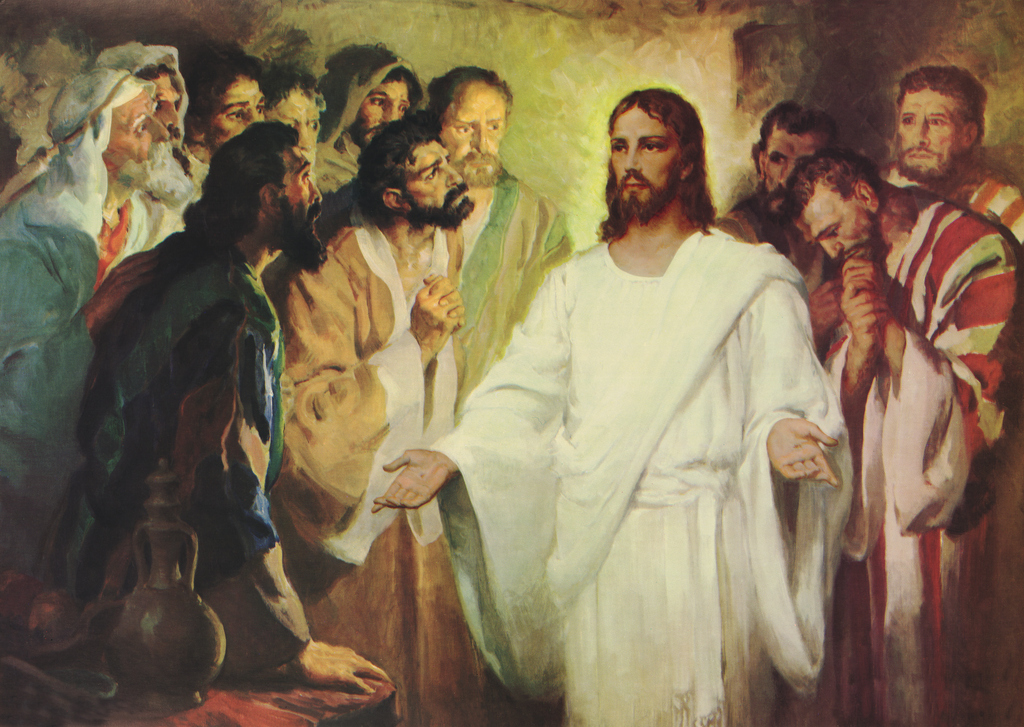
On the evening of that first day of the week, when the doors were locked, where the disciples were, for fear of the Jews, Jesus came and stood in their midst and said to them, “Peace be with you.”
– John 20:19
Imagine yourself as a follower of Jesus before His crucifixion. Imagine the excitement of coming to know the Messiah intimately and waking up each morning in his company, anticipating the day and wondering what profound teaching or miraculous sign awaits.
Now imagine that this man, whom you loved and believed to be the savior of your people, ripped from your midst and publicly tried, punished, tortured, humiliated, and put to death like a common criminal. Imagine the fear: if the Roman authorities and Jewish religious leaders could do this to such a man as Jesus, what could they do to me, a poor sinner?
What would you do?

The disciples chose, as many of us would, to keep a low profile—to remain out of sight behind locked doors. But they remained together. That’s curious.  Certainly a group of Galileans and the executed man’s mother all gathered together in one place did not escape the notice of their neighbors. Wouldn’t it have been sensible to disperse until the scandal blows over – to each return home, if only for a little while?
We are not meant to go it alone. We follow Christ to whatever end awaits us in communion with all believers, and we are meant to grow in faith, hope, and love; to face joy and suffering; to live and die; together as members of the Body of Christ here on earth. Only with the support of like-minded Christians can we find the courage and perseverance to pour out our blood, sweat, and tears for those who do not yet know God or His Church. This is yet another reason why our approach to faith formation and the sacraments here at St. Michael is family- and community-based.
In her book Forming Intentional Disciples, Sherry Weddell of the Catherine of Siena Institute identifies five “thresholds” that people pass through on their way to full-fledged Christian discipleship. The first of these thresholds is trust. Put simply, the first step toward conversion is finding a disciple with whom you can relate: a “known Catholic” whom you can talk to, relate to, or admire – or even just a Catholic who seems normal. Believe it or not, you begin to evangelize just by being Catholic and available to the people around you!
And while many people have said that once you leave the church, you’re in mission territory, I would argue that we’re in mission territory even in the pews! So many of your friends, neighbors, and family members – including me – fall short of intentional discipleship and need help. To that end, LIFT this year will include ice-breaker activities and some less-structured small-group time in order to help parish families get to know each other better. 

This social time is just as important as the more structured classroom time, because these are the interactions that shape how we follow Christ, individually and as a community. As we get to know each other, we begin to ask about each other’s families, share each other’s concerns, and pray for each other’s needs—and Christ Himself passes through our midst, filling us with grace and the Holy Spirit, and sharing with us His peace.

Blogger’s Note: This article appears in the Sunday, Sept. 27, parish bulletin.

The Family That Prays Together…

Education in the faith by the parents should begin in the child’s earliest years. This already happens when family members help one another to grow in faith by the witness of a Christian life in keeping with the Gospel. Family catechesis precedes, accompanies, and enriches other forms of instruction in the faith. 

— Catechism of the Catholic Church, paragraph 2226

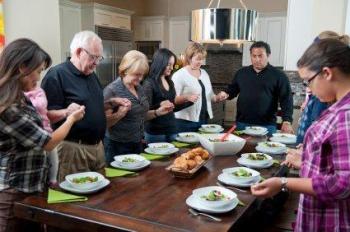
Seven years ago our parish switched from weekly CCD to a monthly family faith formation model we called LIFT, or Learning In Faith Together. The reason was solid: children whose parents model Catholic living and make faith and the sacraments a priority are more likely to hold onto the faith themselves. Children first experience God’s love through their parents—and the best way to keep kids Catholic is for parents to teach them by their own words and example!

Our program has changed, but our original goal—to gather as a community to help parents share their faith with their children—has not. How will this play out in our LIFT and sacrament classes this year? By emphasizing three ways we can encounter Christ in our day-to-day lives:

  • In Our Family. This year, LIFT families—adults and high-schoolers, middle- and grade-schoolers—will be covering the same monthly topics at an age-appropriate level, so that the faith-building activities for each month can be a family affair.
  • In Our Community. If the Church is the Body of Christ, then we can encounter Jesus in each other. To that end, LIFT will feature shorter lessons and more practical small-group discussions, monthly personal witnesses or speakers from the parish, and a bigger emphasis on service activities and ways of living our Catholic faith outside of the church walls.
  • In the Holy Eucharist and the Sacraments. The teens on our new LIFT Crew offered a profound, yet simple, insight. “Get people in front of the Blessed Sacrament,” they said, “and let Jesus do the work.” So this year, we will be emphasizing the essential importance of Mass and the Holy Eucharist, as well as Confession and the other sacraments, for adults and young people alike.

I often hear parents say that children learn more attending weekly religion classes. While they may learn more of the content of the faith, without the habits of regular prayer, Mass attendance, and confession, and without discussing and living their faith outside of church, that content doesn’t stick. We often speak of planting seeds, but only when good ground is properly prepared can the seeds germinate.

To that end, we are encouraging all parish families, including those in the parish school, to attend LIFT. For families who have children preparing for First Communion and Confirmation, LIFT is required except in three cases: if the children attend the parish school and have regular religion and sacrament instruction; if the children are a part of our parish home-school group and have regular religion and sacrament instruction; or if the family has no children younger than ninth grade.

We are asking for a commitment—but it’s no more than the commitment we’ve already made as baptized Catholics and disciples of Christ.

We know that the cost of LIFT can be an obstacle for families. LIFT and sacrament fees help to cover the costs of staff, materials, speakers, and retreats, but no one is ever turned away from LIFT or the sacraments due to money. Please don’t let the cost stop you from registering and attending!

If it’s a matter of time, consider this: what better investment of two hours a month can you make? Two hours a month to help lead our young people to Christ by personal example—to make disciples, who are “doers of the word, and not hearers only” (James 1:22).

We cannot save time—we only spend it. What greater gift can we spend it on than salvation?

Blogger’s Note: This article appears in the Sunday, Sept. 6, parish bulletin.