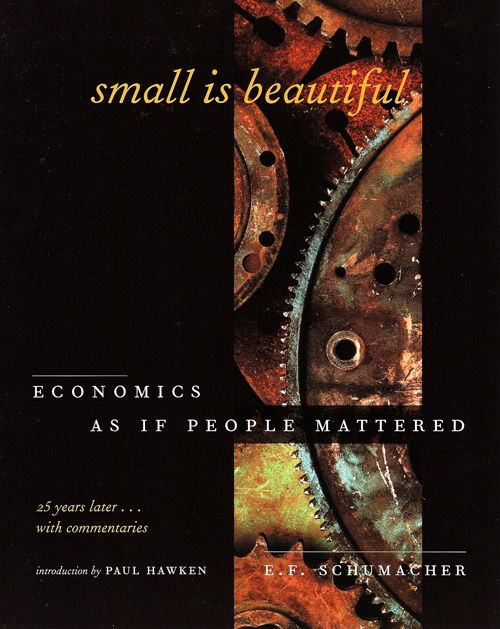
Book Break: Small Is Beautiful: Economic As If People Mattered

One of my regrets from my college days is not taking any courses in economics. I received a relatively unstructured liberal arts education: aside from a few specific prerequisite courses for my undergraduate degree, all class were divided into four groups, and we had to take a certain number from each group. Math and physical sciences were grouped together, so the classes and labs I took in chemistry meant I didn’t have to take math. I heard only complaints from my friends in economics classes, and since I had so many other interesting classes in the social sciences to choose from, I skipped it.

This teenage shortsightedness bothers me still today, since our news and politics revolve around the economy. E. F. Schumacher’s Small Is Beautiful: Economics As If People Mattered recognized this utter domination of economics over all, warned against it, and proposed specific antidotes. Written in 1973—a year before I was born—and recommended to me by a former boss, it strikes me as a book that was likely read, loved, and then neglected by many in the last 40 years as they were swept along by currents too strong to swim against.

With no economic background of my own with which to offer a proper review or critique, I will instead offer a couple of objections and a few ideas I loved from the book.

The most obvious grounds for dismissal of Schumacher’s book for many will be that the alarms he sounded in 1973 were, in retrospect, too shrill—the gloom and doom he predicted, especially in terms of natural resource shortfalls and environmental crises, have not yet come to pass. For some readers, this alone will “prove” that the author obviously didn’t know what he was talking about. Schumacher himself, a Rhodes Scholar and economic advisor with the British Control Commission and the British National Coal Board, warned against trying to predict the future. Common sense told him that finite resources can’t last forever, and exploratory calculations suggested that, at the rates of consumption and growth he was seeing in the 1970s, we were living on borrowed time. He acknowledged it was possible that we would find new sources of fossil fuels and other rapidly consumed resources—his point was, to what end? Unless we change our habits, eventually we will suffer.

The second objection was, for me, the more difficult: at this point in his career, Schumacher had strong opinions about what was wrong in the world and what needed to be done about it, and his blunt negative assessments of markets, economists, and motivations in his day leave little room for compromise or evangelization. I found myself nodding in agreement with three-quarters of his writing, only to run against passages about which I thought, surely not everyone in capitalist society is solely motivated by relentless profit-taking?

On the other hand, Schumacher does an excellent job of drawing our attention to the underlying problems with an economic approach to everything. Early in the book  he quotes his fellow British economist (and an early benefactor of sorts) John Maynard Keynes from 1930: “For at least another hundred years we must pretend to ourselves and to every one that fair is foul and foul is fair; for foul is useful and fair is not. Avarice and usury and precaution must be our gods for a little longer still. For only they can lead us out of the tunnel of economic necessity into daylight.”

Is this not contrary to the Christian ideal and common sense? Can fallen man use sin to achieve virtue? Of course not—but he can use his fellow man to achieve personal prosperity.

Schumacher goes on to write, “This was written forty years ago and since then, of course, things have speeded up considerably. Maybe we do not even have to wait for another sixty years until universal plenty will be attained. In any case, the Keynesian message is clear enough: Beware! Ethical considerations are not merely irrelevant, they are an actual hindrance, ‘for foul is useful and fair is not.’ The time for fairness is not yet. The road to heaven is paved with bad intentions.”

Lest you think of Schumacher as a naïve idealist imagining utopia, consider that two simple, practical ideas he advocated in his writings were the continuation of coal development and reducing energy consumption. He recognized that mankind is notorious for developing new problem-solving technologies that create new problems; that turning one’s back on an entire energy source on the belief that we could replace it entirely with oil or nuclear energy and meet rapidly growing worldwide demand, was foolish, even if it turned out to be true; and that wasting resources we cannot, ourselves, replace never makes sense.

This, to me, is (at least in part) what conservatism ought to be: maintaining the tried and true even as we explore new possibilities and conserving, even when a crisis is not looming, because it’s the sensible and moral thing to do.

Am I good at it? Not very—but getting better.

His biggest idea, however, was the concept of intermediate technologies for developing countries. Schumacher traveled the world and saw that most economic development supported by wealthy nations not only replicated the patterns of economic dysfunction he was in the developed world, but deepened the economic problems in the developing country for all but a fortunate few.

One example he uses (which I will paraphrase and expand on) is that of a large earthwork project that needs to be done in a developing country. You have a range of options you may employ for accomplishing this work, from people using their hands to scrabble and scrape away at the earth to the most modern and powerful earth-moving machinery. The former approach would cost almost nothing and “employ” a lot of people for a long time at menial and nearly impossible work; the latter would employ relatively few people for a relatively short time, unless the expensive equipment broke down and needed repairs—in which case there would be no parts or expertise locally to fix it. In the middle, however, are a range of intermediate technologies, however, that could put people to work, providing income for their families, value for their time, and dignity for themselves. For example, equipping a hundred men with well-built shovels and wheelbarrows would put those men to work—plus many more making and repairing shovels and wheelbarrows using local materials. The money earned by all those people (instead of just a few heavy-equipment operators) could be used to support other local industries—because what good is producing food or consumer goods if no one has any money to buy them?

There is much to love in this book, including Schumacher’s very Catholic views on the dignity of work and the human person. He speaks against an all-pervasive economic approach to efficiency, which quantifies and assigns value to the incalculable and invaluable. When everything is assigned a value, the sacred (such as human life) is diminished and no longer sacred. He speaks against an approach to labor and productivity that reduces work to individually pointless tasks without freedom or creativity and fails to employ large segments of society that, because they see no value in their time and effort, quickly devalue themselves. And he speaks against the underlying assumption that one who works less and consumes more is better off than one who works more and consumes less.
It is a thought-provoking read, and I highly recommend it. 
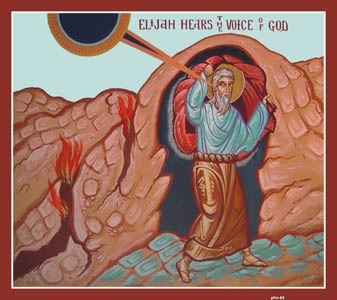


The Still, Small Voice of God

There was a strong and violent wind rending the mountains and crushing rocks before the LORD—but the LORD was not in the wind; after the wind, an earthquake—but the LORD was not in the earthquake; after the earthquake, fire—but the LORD was not in the fire; after the fire, a light silent sound.  When he heard this, Elijah hid his face in his cloak and went out and stood at the entrance of the cave. –1 Kings 19:11-13


It is Tuesday afternoon, and I am writing from home. This column should have been done and in already. It is not, because even a job working for the church is not as important as some things.

Around 9 p.m. last night my youngest son threw up, and my bride informed me she didn’t feel well either.  Between 9 p.m. and 2 a.m. or so, my son was sick probably two dozen times. Jodi did not get as sick, but was as sleepless as Trevor—and I tried to stay clear so that hopefully I could handle little Lily in the morning and keep her from catching whatever this was.

I rose and prayed with Jodi at 5:30. She felt a bit better, and Trevor was sleeping, at last.  At around 6, Emma was sick the first time, and by 8, Lily was complaining that she didn’t feel well either. I was getting ready for work—Day 2 with our new faith formation coordinator, Andrea Zachman—but had the sinking feeling that it was only a matter of time before it hit me, and that my colleagues might rather I stayed home. I was torn—I felt fine, but so had Trevor and Emma before it hit, and I had plenty of work to do. Lily seemed fine, but if she were on the verge, I didn’t want her spreading it to her friends and their families. Jodi was torn, too—she didn’t feel great, but had a mountain of work waiting for her and didn’t feel she could afford to miss a day.

And as fate would have it, we had a blanket of fresh snow on the walk, cars, and roads.

Ultimately we compromised: we both went to work briefly to take care of a few things and bring some additional work home to do around our other duties. We were out of several basic food items in our house, so I fought the blowing snow to stock up on a few things—and now here I sit, writing furiously.

We are all called by God—do you hear Him? I often imagine the God of the prophets speaking to them in a deep, thundering voice, but that’s not what we hear in first Kings, above. Elijah recognizes the Lord in “a light, silent sound”—other translations say “a sound of sheer silence” or “a still, small voice.” God whispers, as it were, drawing us close with his words, into an intimate conversation with Him.

Unfortunately, the noise of the world too often drowns Him out. We hear the voices of our colleagues and bosses ringing in our ears; the ringing of the phone and ping of emails, IMs, and texts…the traffic report…the weather…and nothing of the still, small voice of God.

Excuse me a minute: my other high-schooler, Gabe, just called—he’s sick and can’t drive himself home. Jodi and I need to go get him and the Suburban.

We are all called to a first and universal vocation of holiness. Most of us are called to live out that first vocation in terms of a second vocation to marriage and family life—we sanctify ourselves, our spouses, and our children by imaging God Who is Love. Everything else we do and are come in below that. We are created from Love, and Love is our purpose and end. That’s all. That’s enough.

Because that’s everything.

We Are a Pilgrim People

“I’ll be home for Christmas, if only in my dreams.”
 
We are on the home stretch: a week out from the blessed Feast of the Nativity, Christmas, when we celebrate the birth of our Savior, Jesus Christ. Many of us, however, feel as though Christmas has been upon us for weeks now, an immense burden of gifts, lights, music, and cheer under which we labor to breathe—like a lone elf struggling to load the loot of the world into a glossy red sleigh.
 
The first Christmas was uncomfortable for a different set of reasons. In the days prior, a newly-married couple traveled from Nazareth to Bethlehem with a few essentials and a donkey. They traveled not by choice, but by order of the emperor in Rome. They arrived not to familiar faces, food, and comfort, but to a town crowded with distant kin and strangers, and the crudest of accommodations: a dugout-stable-turned-makeshift-nursery where the woman would give birth to a son.

It turned into celebration of sorts, I suppose, as angels summoned shepherds from the hills to the town to greet the newborn as they were, dirt-poor and smelling of sheep. A star, too, beckoned Magi from the East, strange and majestic, in rich robes and bearing gifts too generous for the circumstances. (I wonder if Joseph might have gripped his staff a little tighter, wondering how he, his wife, and son would make it back across the dangerous country alive while carrying gold, frankincense, and myrrh.)
 
Imagine a Christmas celebration in which only your third and fourth cousins showed up, along with the local indigent population and three fabulously wealthy foreigners—and then you had a baby the basement. Perhaps the stresses of this Christmas are more manageable from this perspective.

Mary and Joseph were displaced—from Nazareth to Bethlehem for the census; from Bethlehem to Jerusalem for the presentation of Jesus at the Temple; and in exile to Egypt, to protect their son from the murderous intent of Herod. Even as a baby, “the Son of Man has nowhere to rest his head” (Matthew 8:20).
 
In LIFT this month, we are completing our study of the Mass. As an introduction to the adult and teen lesson, we are watching a short video from elementsofthecatholicmass.com on the role of parishioners in the Mass. As the video explains, the word parishioner comes from the Greek work paraoikos, meaning pilgrim—it’s the same Greek word that gives us the English word pariah, which means outcast.
 
We don’t belong here. We, like the Holy Family, are a pilgrim people, en route to our true home with God in heaven. The Church is the ship that carries us: the ark which preserves God’s people from the storms and waves that batter and drown the rest of the world.* Let us take refuge here from the maelstrom—the dizzying spin the world has put on Christmas—and draw near, instead, to Mary, Joseph, and the newborn king of kings.
 
* * * * *
*In fact, the area of the church worship space where we sit, which we commonly call the sanctuary, is technically called the nave—which comes from the Latin word for ship.

Who Reigns In Your Heart?

Put no trust in princes, in children of Adam powerless to save. 
Who breathing his last, returns to the earth; that day all his planning comes to nothing. – Psalms 146:3-4

This Sunday is the Feast of Christ the King, celebrating the authority and lordship of Jesus over all of creation and marking the end of the liturgical year. Falling just before the all-consuming holiday season and the secular New Year, this feast provides us with an opportunity to reflect on what holds mastery over our hearts before the avalanche of turkey and tinsel. And since it specifically celebrates Chris’s kingship, it takes on special relevance in the aftermath of a contentious election.

Who is this Jesus who rules over all? We are blessed to have an immense icon of Christ the King in the dome of our church. This image, called Pantocrator or “ruler of all,” depicts our glorified Lord looking down from heaven, holding the Book of Life by which we are judged (God’s justice) but with His right hand raised in blessing (God’s mercy). The three-rayed halo behind His head and Greek letters in the image identify Him simultaneously as Jesus Christ (IC XC) and as “I Am Who Am” (WON), or God Himself.

This God-man is the same Jesus who was born in a stable; who grew up a carpenter’s son; who ate with sinners and challenged authorities; who said to His followers, “This is my Body; take and eat;” who suffered humiliation and torture to die on a cross; who rose from the dead and ascended to heaven; and who sent the Holy Spirit to guide the Church in these latter years. This is the same Jesus about whom Nathanael asked, “Can anything good come from Nazareth?” (John 1:46) and Thomas said, “My Lord and My God!” (John 20:28).

We have a second icon of Christ behind the altar and tabernacle, depicted in the womb of the Blessed Virgin. Though within His mother, He does not appear as an infant or as any child we have likely ever seen. His high forehead and discerning eyes convey wisdom and judgment beyond His years. This is the same Jesus that St. Augustine calls, “ever ancient, ever new” and that dwells in the tabernacle, in the Eucharist. He is the very Word of God referenced in John’s Gospel:

In the beginning was the Word, and the Word was with God, and the Word was God. He was in the beginning with God. All things came to be through him, and without him nothing came to be. What came to be through him was life, and this life was the light of the human race; the light shines in the darkness, and the darkness has not overcome it. – John 1:1-5
What joy, what hope, what light we have when He who is the very source of all blessing sits upon the throne of our hearts—and what sorrow, what despair, what darkness we experience when we yield His seat to idols: to fallen persons or passing things that will not—cannot—sustain us.

Advent begins next weekend: four weeks of penance and preparation Christmas. As the Church year ends and we prepare to welcome the newborn King of Kings, let us ask ourselves in whom we have placed our hope and trust. What or whom have we set upon the throne of our hearts? The time is now to elevate Christ to His proper place, that all else may fall into place and peace may prevail.

Your Eternity Begins Now


For the past few years, our family has joined numerous others from our parish and surrounding churches for Life Chain, an hour of silent public prayer for an end to the evil of abortion in our country. We spread out along Highway 19 between the parish school and Middle School West and stand facing the road, holding signs and praying.

On the back of the signs are suggested hymns, prayers, and petitions to guide our personal reflection during that hour. Every year, I am taken aback by the petition that asks me to pray for God’s mercy for all I have failed to do to protect life and work for an end to abortion—because every year, I am convinced I could have done more.

Now we are two weeks out from electing a new president. Most of us have likely made up our minds how we will vote—guided, I hope, by reason and a well-formed conscience.  God willing, no Catholic will cast a vote in support of abortion or its proponents. Beyond that, faithful Catholics can and do disagree on how best to combat the evils in our society by our actions at the ballot box. With that in mind, I would like to share three thoughts about the aftermath of Election Day.

First, remember the words of St. Therese of Lisieux: “The world is thy ship and not thy home.” We are a pilgrim people, and although our country is great and worth fighting for, the kingdom to which we truly belong is not here. We are called to evangelize and make disciples; to deny ourselves, take up our cross, and follow Jesus. The outcome of this election will not change our mission.

Second, we are all called by God—and not one of us is worth less in His eyes because of the votes we’ve cast, the mistakes we’ve made, or the sins we’ve committed. Whatever happens on November 8th, we will continue to suffer for our faith, as Christ foretold, and our nation and world will continue to need our light, our service, our faithful example. Cast your vote on Tuesday and move on, because we must pull together as one body, one spirit, in Christ.

Finally, we have no time to waste. Too often our efforts on behalf of the unborn, marriage, freedom of conscience, or religious liberty hinge on the headlines and reach a fever pitch every four years with the election of a new president. We support particular candidates or policies; we act as though everything is riding on the results of the next election, then shake our heads when nothing changes and go back to minding our own business.

What about the roughly 1,460 days between presidential elections?

As Catholics, our opposition to abortion and the other great evils of our time is not primarily about saving lives, but about saving souls—including our own. Obedience to Christ and His Church is a daily choice. Disobedience is also a choice. So is complacency and non-action.

Every moment, God calls; every moment we respond. Our eternity begins now.
Lord, have mercy on me for all have failed to do here in my own community to draw people to you and build your kingdom. Amen.