Scuttle It and Swim

Shortly before I left my job at the church, a long-time parishioner and “straight shooter” stopped by the parish office. Seeing me there and knowing I was leaving soon, she inquired what I would be doing next. I told her I hoped to be writing full-time for the Church. She gazed a moment at me, a slight smile creasing her face, then asked, “Are you seeking a life of poverty?”

Her practical candor caught me off guard, compared to the wonder and well-wishes I had received up to that point—as did my off-the-cuff reply: “Well, there are worse things!”

I have now been a month without work. Our bills are paid thus far; I’ve done one small freelance job for a former colleague, and I have a couple more freelance proposals out for review, but no response to date. I’ve applied to a handful of full-time communications jobs at Catholic organizations and several non-Catholic (and even non-writing) positions. The budget will be tight in the coming weeks.

There are worse things. Continue reading

A Walk on the Waves

At once Jesus spoke to them, “Take courage, it is I; do not be afraid.” Peter said to him in reply, “Lord, if it is you, command me to come to you on the water.” He said, “Come.” Peter got out of the boat and began to walk on the water toward Jesus.

– Matthew 14:27-29

Today is my last day as a parish employee. I have been profoundly blessed to work for the Church I love, in the church I love, with people I love, for a community I love, for the past three years. My father always preached, Leave it better than you found it. I pray I’ve done so. I know I’m better than you found me.

Today I leave the boat for a walk upon the waves.

Over the past several weeks, as my departure became known, I’ve heard a number of variations on the following: It’s brave of you to step out in faith like this. It’s such a powerful witness of trust: going where the Lord leads you. I’m sure you are on the right path and I can’t wait to see where it leads! Continue reading

A New Mission

By now it’s pretty well gotten around that I’ll be leaving the role of faith formation director at the end of June. A number of you have said, “I can’t wait to hear what you’ll be doing next,” to which I reply, “Me, too!”  On the other hand, we have taken great leaps forward in the past three years, and I have never felt unappreciated or under-compensated working for the parish. It’s good work—it’s just not my work.

 I’ve made a discovery this past year: I have an evangelist’s heart.

I am competent at many things, and even skilled at some of them. I can be an administrator, a catechist, a communicator, an administrative assistant, and a laborer. I can do all sorts of things when needed. But I have an evangelist’s heart.

And, thanks be to God, I can write. I’ve known this for some time, and every staff or personal retreat I’ve been on for the past decade or more has resulted in me saying to my bride, “Whatever happens from here forward, I need to write.” I’ve been told the same thing countless times, by family and friends, acquaintances and total strangers. I’ve never made a successful go of writing on my own, however—I think primarily because, until now, I’ve tried to do it on my own. I’ve never really asked what God wanted me to write and waited for an answer.

I have always been the least rational and most emotional of all my male friends. I blunder through the world heart-first, find beauty in strange places, share too much, talk too much, and cry more than my bride. It’s embarrassing. I’m not good at casual friendships: most of the time I either go deep, or I can’t link a name to a face.  Any given week I love humanity and hate it, sometimes at the same time.

But when I share from the heart, when I speak or write about things I care about—faith, marriage, family—it moves people. When I talk about my own journey from part-time Catholic kid to an Ivy-educated agnostic with a porn problem to a faithful husband and father, it touches people. And I want to do that.

What’s more: God wants me to do that. (I finally asked.) No more pretending these gifts are weaknesses or wishing He made me differently. I am what He made me, and I’m only as free as I am obedient to His will.

It’s exciting: I feel like an apostle being called by Jesus to follow. And it’s terrifying: I don’t like reaching out to new people, because loving those people involves time, effort, and usually pain. Plus I can’t see my way forward. Peter and Andrew, James, and John dropped their nets and left their boats behind. Matthew left his post, his money, his whole former life. I have a primary vocation as husband and father. I can see no way to do what God is asking of me in my free time, and no simple way to make a living. I can’t see a logical next step.

So for the first time in my life, I find no solution other than utter abandon, to give everything to the Lord and let Him sort it out.

Dive in. Heart-first.
Hammer and Tongs

It feels to me as though God is hammering me into something harder and more useful than I have been thus far in life. And that can only be a good thing. But in this moment, I can feel the tongs, the fire, the hammer, and cannot see the pattern.* I don’t know what He hopes to forge or even the shape He desires. I can only stay malleable and submit, trusting the Craftsman’s vision is keener than my own.

That is not easy for me. Which is likely why it must be done this way.

—–

*Please regard this as a metaphor and a sentiment I wanted to capture; nothing more. My current anxieties are minor in the big scheme of things. I just wish sometimes I could see what He sees…

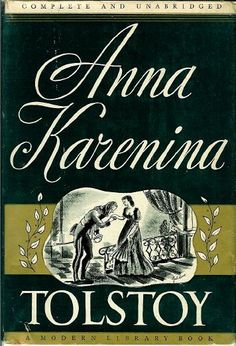
Tolstoy, or Three Things to Love About Anna Karenina

Blogger’s Note: Several years ago, I agreed to my friend Jacqui’s challenge to read 15 Classics in 15 Weeks. Though 15 weeks is long past, the end is near, this being number 14 of 15.

I am not like other men (or at least, not like many that I know). I have just past my forty-second birthday, and just read Leo Tolstoy’s immense novel Anna Karenina, by personal choice—and I loved it. 

My friend Fr. Tyler (from the Prairie Father blog) recommended it to me as “the greatest love story ever born in the mind of man and put to paper.” He has never led me astray in terms of fiction, but other men might not see that as a recommendation. I mentioned to a friend a week or so ago that I was reading it, and asked if he had ever. He laughed and said, “Ah…no.”

“It’s a great book,” I said, and again he smiled: “I don’t doubt it.” And that was that.

It is a big book (736 pages in my edition, with narrow margins and smallish type), full of Russian names and nicknames—Anna Arkadyevna Karenina, Konstantin “Kostya” Dmitrievich Lëvin, Prince Stepan “Stiva” Arkadyevich Oblonsky, Russian place names and politics, and Russian aristocrats who flavor their conversations with French and occasionally German. (Thank goodness for Google Translate!)

Despite these difficulties, I struggled to put it down. It manages to be an amazingly detailed portrait of time, place, and people, and yet remarkably universal and relevant to this time and place: 21st century America and even the 2016 election. It is heartbreakingly tragic, and incredible hopeful and uplifting. It is newly ranked among my favorite books of all time.

Without further ado, Three Things to Love About Anna Karenina:

  • Complexity of Characterization: Tolstoy sees his characters clearly and portrays them in all their complexity. Think of this: Anna is written as captivatingly beautiful; men and women alike can’t help but respond to her appearance and charm—and neither can you. This beauty could seem stereotypical or convenient for the sake of the story. It could be hammered away at like a one-note tune. But Anna is never simply beautiful.* She is captivating and tragic: people are drawn to her and repelled; her passions are apparent; her motives unknown even to herself. Tolstoy makes you love her and despair, much like her husband. And all of the characters are this way. Tolstoy is a keen observer of people: his descriptions are not of men, but of  intellectual men, simple men, dashing and pasty men, dandies and duds (sometimes within the same character).The worst have their qualities; the best have their faults. None are flawless, and so we believe in them.
  • The Art of Pacing: Tolstoy’s novel is peopled by people, and they live as we do, in time, lost in thought and out in the world. He details the lives, habits, thoughts and appearances of his characters and weaves together different story lines in a way that is simultaneous clear and keeps the reader wanting more. I had to fight the urge to flip forward when he jumped from one thread to another. As a writer, I realized in reading this that I rush everything: descriptions, details, day-to-day life. I leap from scene to scene, dialogue to dialogue, crisis to crisis—and only sketch the people involved. Tolstoy takes the time it takes. I could learn something here.
  • Religion and Culture. In March of 2011, I wrote of The Brother Karamazov, “Dostoevsky does not shy away from religion and philosophy, permitting his characters to speak at length (and in character, so not always clearly) about the existence of God, morality, humanity, science, psychology, justice, the state, and more. I was struck by how a book written circa 1880 could have so much to say about our world in 2011.” Replace Dostoevsky with Tolstoy and 2011 with 2016, and it applies here. I have been struck throughout this challenge by the fact that the true classics of literature capture the universal condition of humanity. They are not old, but timeless. It’s a pity that increasingly these books appear not to be read.
One final note: What I loved most about the book (but didn’t share as one of the Three Things, because it’s so personal to me) is that I saw myself in it. Anna’s story is obviously the focus, but the protagonist of the main parallel story, Konstantin Levin, is an idealistic, emotional man who wants to understand how the world works, but when he engages in society, in politics, it makes no sense. He drives himself to the brink by contemplating what it all means; he wants marriage and family and life in the country—and yet he struggles to enjoy these things with all the pressures he puts on his heart. 
The description of Levin before and during the birth of his first son brought me to tears. (I am not like most other men.) And finally, this:

I’ll get angry in the same way with the coachman Ivan, argue in the same way, speak my mind inappropriately, there will be the same wall between my soul’s holy of holies and other people, even my wife, I’ll accuse her in the same way of my own fear and then regret it, I’ll fail in the same way to understand with my reason why I pray, and yet I will pray—but my life now, my whole life, regardless of all that may happen to me, every minute of it, is not only not meaningless, as it was before, but has the unquestionable meaning of the good which it is in my power to put into it!

My list of 15 classics has changed somewhat over time; my next and final book will be much shorter: The Violent Bear It Away by Flannery O’Connor. Back soon!
—–
* I’m free-associating now: we recently watched an old Western on Netflix, The River of No Return, with Robert Mitchum and Marilyn Monroe. God bless Monroe, but she is a kind cinematic shorthand. She does what’s required: sing, seduce, weep, laugh, but her role in the story is, as our elder daughter once characterized her job as a toddler, to sit here and look beautiful. Anna is not that. At all.